Showing posts with label technology. Show all posts

Tuesday, July 22, 2025

It's "Wheels Up" At AirVenture Oshkosh 2025


The Experimental Aircraft Association's (EAA) annual week-long AirVenture gathering in Oshkosh, Wisconsin, is underway. It's better known as "Oshkosh" to aviation enthusiasts and you can be assured that every one of them has the event on their bucket list. There's good reason. Imagine a fly-in attracting around 7500 airplanes. Imagine 2500 aircraft exhibits, 800 commercial exhibitors, daily world-class airshows, and a total of around 700,000 guests.


AirVenture at Oshkosh is far from your average fly-in


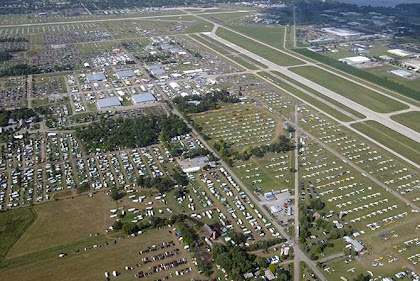
Organizers call the event "the world's greatest aviation celebration" and this year marks its seventy-second edition. The map below gives readers an idea of the scope and scale of Oshkosh and indicates why the event turns a rather sleepy Wittman Regional Airport into the busiest airport in the world for one week each year.


AirVenture grounds - for scale, that's an 8000 foot runway at the top 

AirVenture grounds looking east to Lake Winnebago


I had the privilege of attending the event several times in the last decade of my career. Energizing, informative, and significant, the show was a great vehicle for delivering an organizational message to a large, captured, and enthusiastic audience. You may ask why the National Park Service (NPS) would send a dozen or so employees and volunteers to work an air show. First, the agency has almost fifty out of its more than 400 units with a significant link to an aviation theme. In addition, the Service maintains a fleet of fixed and rotary wing aircraft contributing over 20,000 hours of flight time annually in support of park operations, maintenance, and resource and fire management. Add to that interagency cooperation across departments as well as airspace regulation over the parks and the justification become clearer. In recent years the NPS's presence at the event has been reduced significantly and folded into a more cooperative effort with other federal agencies. In summation, it's a grand and demanding opportunity to reach out face-to- face with thousands of guests who enjoy and impact resources and services in and ver the parks.


Nothing like fly-in camping with thousands of your best - in this case closest - friends


If you can't attend AirVenture, the EAA maintains a comprehensive up-to-the-second website where you can spend hours reading, watching and listening to events. I've been looking up at the sound of an aircraft engine ever since I could lift my head. If you are blessed with the same response make your plans to attend an Experimental Aircraft Association AirVenture. You will not be disappointed. Until then "wheels up" every chance you get!


Tuesday, December 17, 2024

A Dream Beyond Time Comes True


On this day in 1903 at Kitty Hawk on the outer banks of North Carolina, the 27-mph wind was harder than they would have liked since their predicted cruising speed was only 30-35 mph. The headwind would slow their ground speed to a crawl but they proceeded anyway. With a sheet they signaled the volunteers from the nearby lifesaving station that they were about to try again.

Now it was Orville's turn. Remembering Wilbur's experience, he positioned himself and tested the controls. The stick that moved the horizontal elevator controlled climb and descent. The cradle that he swung with his hips warped the wings and swung the vertical tails, which in combination turned the machine. A lever controlled the gas flow and airspeed recorder. The controls were simple and few, but Orville knew it would take all his finesse to handle the new and heavier aircraft. At 10:35, he released the restraining wire. The flyer moved down the rail as Wilbur steadied the wings. Just as Orville left the ground, John Daniels from the lifesaving station snapped the shutter on a preset camera, capturing the historic image of the airborne aircraft with Wilbur running alongside.


The Wright Flyer begins its first successful flight, December 17, 1903


Again, the flyer was unruly, pitching up and down as Orville overcompensated with the controls. But he kept it aloft until it hit the sand about 120 feet from the rail. Into the 27-mph wind, the ground speed had been 6.8 mph, for a total airspeed of 34 mph. The brothers took turns flying three more times that day, getting a feel for the controls and increasing their distance with each flight. Wilbur's second flight - the fourth and last of the day – was an impressive 852 feet in 59 seconds.

This was the real thing, transcending the powered hops and glides others had achieved. After four years of research and development the Wright machine had flown.


Monuments spanning the 120 feet of the first flight


On completing the flight the brothers walked four miles to Kitty Hawk and sent their father a telegram:


Success four flights Thursday morning all against twenty one mile wind started from level with engine power alone average speed through air thirty one miles longest 57 seconds inform Press home Christmas

Their pilot-controlled, sustained and powered flight by a heavier-than-air machine would soon change the world.

For comprehensive information on this historic event visit the National Park Service's Wright Brothers National Memorial web page.


Credits:

1903 photograph, unrestored version: Library of Congress
Monuments photo; text: National Park Service, Wright Brothers National Memorial


Tuesday, November 26, 2024

Willis Carrier: His Invention Touches Almost Every Aspect Of Our Lives


One of the most significant books in the historiography of the South, Ulrich Bonnell Phillips's Life and Labor in the Old South, begins with these words:

Let us begin by discussing the weather for that has been the chief agency in making the South distinctive. . . . The summers are not merely long but bakingly hot, with temperatures ranging rather steadily in the eighties and nineties of the Fahrenheit scale.

The early 20th century one-story Southern home, with its high-roof, wrap-around porch, and traditional "dog trot" breezeway, is a vernacular response to that bakingly hot summer. Homes of this type can still be found throughout the South. In fact contemporary construction in the region often incorporates its features in vestigial form. But what has made the South so popular these days? I believe in particular the subtropical climate remains the most powerful draw. The New South's social and political climates also contribute to the demographic shift. Still, Southerners must deal with the heat and humidity as do others impacted by urbanization, commercialism, and industrialization. Today that means most the United States and its inhabitants.  And that brings us to the significance of this week in the history of American invention and its application and impact in our lives.


On November 26, 1876, a son, Willis H. Carrier, was born into an old New England family. In 1902, Carrier developed an electrical system of conditioning air in a stiflingly hot and humid Brooklyn printing plant. The new environment ensured stability in the paper and the perfect alignment of four-color printing. It was soon a huge success in several industries that demanded such requirements. By the 1920s, air conditioning became popular in retail trade and entertainment, especially the movie theater. It was a small jump from commercial systems to home systems, and by the 1930s, air conditioning began a slow but steady increase in usage until the post World War II era when it boomed. In two generations, Carrier's application had impacted almost every facet of American life and spread quickly throughout the world in the second half of the century

From an environmental perspective, air conditioning made the South livable year round. One could work hard outside on a mid-summer Georgia day and find comfort in an air conditioned break at work and a cool, comfortable supper and evening at home. Today, we take this comfort for granted across the nation giving it attention only when it's time to change the filter or the compressor dies.


Carrier posing with a 1920 model chiller


Especially if you call the South "home," work in a highrise office or on your family farm, take a moment today to thank Willis for his contribution. It's an invention you're going to appreciate so very much in 2025 when that heat begins its sure progress to "bakingly" unbearable levels in the summer. 

For more information on the impact of air conditioning on the American experience check out this site:

http://www.theatlantic.com/technology/archive/2011/07/keepin-it-cool-how-the-air-conditioner-made-modern-america/241892/


Tuesday, July 23, 2024

EAA AirVenture 2024 At Oshkosh


Today is Day 2 of the Experimental Aircraft Association's (EAA) annual week-long AirVenture gathering in Oshkosh, Wisconsin. It's better known as "Oshkosh" to aviation enthusiasts and you can be assured that every one of them has the event on their bucket list. There's good reason. Imagine a fly-in attracting around 7500 airplanes. Imagine 2500 aircraft exhibits, 800 commercial exhibitors, daily world-class airshows, and a total of over 600,000 guests.


It's far from your average fly-in


Organizers call the event "the world's greatest aviation celebration" and this year marks its 71st edition. The map below gives readers an idea of the scope and scale of Oshkosh and indicates why the event turns a rather sleepy Wittman Regional Airport into the busiest airport in the world for one week each year.


AirVenture grounds - for scale, that's an 8000 foot runway at the top


I had the privilege of attending the event several times in the last decade of my career. Energizing, informative, and significant, the show was a great vehicle for delivering an organizational message to a large, captured, and enthusiastic audience. You may ask why the National Park Service (NPS) would send a dozen or so employees and volunteers to work an air show. First, the agency has almost fifty out of its more than 400 units with a significant link to an aviation theme. In addition, the Service maintains a fleet of fixed and rotary wing aircraft contributing over 20,000 hours of flight time annually in support of park operations, maintenance, and resource and fire management. Add to that interagency cooperation across departments as well as airspace regulation over the parks and the justification become clearer. In recent years the NPS's presence at the event has been reduced significantly and folded into a more cooperative effort with other federal agencies. In summation, it's a grand and demanding opportunity to reach out face-to- face with thousands of guests who enjoy and impact agency resources and services.


Nothing like fly-in camping with thousands of your best - in this case closest - friends


If you can't attend AirVenture, the EAA maintains a comprehensive up-to-the-second website where you can spend hours reading, watching and listening to events. I've been looking up at the sound of an aircraft engine ever since I could lift my head. If you are blessed with the same response make your plans to attend an Experimental Aircraft Association AirVenture. You will not be disappointed. Until then "wheels up" every chance you get!


Saturday, April 27, 2024

A Birthday For The Airbus A380: The World's Biggest Passenger Aircraft


In 1970 Airbus was formed as a multinational corporation to compete with the highly successful commercial aviation industry in the United States led primarily by Boeing and McDonnell Douglas. By the late 1980s Airbus began studying the potential for a wide-bodied aircraft to compete with Boeing's highly successful 747 which entered service in 1970. Airbus research led the company's management to proceed with development based on significant market interest in the Middle East and Asia. After a decade of design based on efficiency, passenger comfort and innovative aeronautical engineering, the aircraft went into production in 2000. It would go on to makes its maiden flight as the A380 on this day in 2005.The A380 took to the air as - and remains - the world's largest passenger plane. It has a wingspan of almost 262 feet, a length of just over 238 feet, and almost 6000 square feet of floor space on two full length levels that can accommodate up to 853 people. Since production began the aircraft has flown more than 7.5 million flight hours without an aircraft loss or fatality.


Airbus A380 during a landing Paris Air Show 2007


Singapore Airlines was the first to introduce the aircraft to commercial service in late 2007. When production ended in 2021, 251 A380s had been delivered to about two dozen customers with Emirates Airline being the largest at 128 aircraft. By the end of production the cost of each aircraft was $445 million. In addition, the development cost of the 380 program, estimated at $34 billion, had not been recovered.

Most of the aircraft have been configured with typical seating for 525 people, generally divided into the standard three classes. The high option accomodation on some planes is a 130 square foot, three room “Residence” located forward on the upper deck. Other configurations can include bars, beauty salons, shops, cafes and extra features for premium cabins, including showers. The following video will attest that not all the comfort is reserved for the high end traveler.


Despite having 50% less cabin noise, 50% more cabin area and volume, larger windows, bigger overhead bins, and two feet more headroom than the 747-400, the A380 was not a commercial success. Unfortunately, it was developed just as the industry was shifting away from the need for larger aircraft serving hubs and toward a to point to point operation that could be served with smaller planes.


As more and more A380s are being removed from service, sixteen airlines continue to fly it on long range international routes. Emirates operates the largest fleet with 121 aircraft. Only four are based in the United Kingdom and the Middle East, the remainder in Asia and Australia. Every month in 2023 will bring a decline in A380 use despite growing international travel.

There will come a time when the A380 is a museum piece but it will always be remembered as an extraordinary technological achievement that provided in flight luxury unseen since the 1930s.


Singapore Airlines First Class Suite


Sources

Text and Illustrations:
Airbus A380, wikipedia,com
production costs, forbes.com

Tuesday, February 20, 2024

John Glenn Makes History Aboard The Spacecraft, Freedom 7


Sixty-two years ago today, John Glenn rocketed into space history to become the first American to orbit Earth. In 1962, Glenn made three orbits then returned to a splashdown about 500 miles northeast of Puerto Rico. Over the years more 350 Americans have joined him in space travel.


John Glenn in orbit, February 20, 1962


The NASA website has a fine multimedia presentation on Mercury-Atlas 6, the mission that put Glenn and his spacecraft, Friendship 7, into orbit. Wikipedia has a page on the mission and some excellent recommendations for further reading online. To commemorate the event, The Ohio State University has a comprehensive look at Glenn's life and that of his wife, Annie. I also recommend The Right Stuff, Tom Wolfe's outstanding 1979 book on the formative days of the American space program and the seven astronauts - including Glenn - selected for the Mercury program.

When we look back at the American space program, this achievement was one of the nation's proudest moments. It's heartening to see a renewed interest in space exploration let alone definitive commitments to future astronauts, a return to the moon or a mission to Mars on the part of our national government. I imagine this is in part due to commercial competition. You can learn more about our reach into space by the private sector at this this Wired link.


Glenn in training, January 20, 1962


Sunday, December 17, 2023

The Wright Brothers: The Dividend Of Perseverance


On this day in 1903 at Kitty Hawk on the outer banks of North Carolina, the 27-mph wind was harder than they would have liked since their predicted cruising speed was only 30-35 mph. The headwind would slow their ground speed to a crawl but they proceeded anyway. With a sheet they signaled the volunteers from the nearby lifesaving station that they were about to try again.

Now it was Orville's turn. Remembering Wilbur's experience, he positioned himself and tested the controls. The stick that moved the horizontal elevator controlled climb and descent. The cradle that he swung with his hips warped the wings and swung the vertical tails, which in combination turned the machine. A lever controlled the gas flow and airspeed recorder. The controls were simple and few, but Orville knew it would take all his finesse to handle the new and heavier aircraft. At 10:35, he released the restraining wire. The flyer moved down the rail as Wilbur steadied the wings. Just as Orville left the ground, John Daniels from the lifesaving station snapped the shutter on a preset camera, capturing the historic image of the airborne aircraft with Wilbur running alongside.


The Wright Flyer begins its first successful flight, December 17, 1903


Again, the flyer was unruly, pitching up and down as Orville overcompensated with the controls. But he kept it aloft until it hit the sand about 120 feet from the rail. Into the 27-mph wind, the ground speed had been 6.8 mph, for a total airspeed of 34 mph. The brothers took turns flying three more times that day, getting a feel for the controls and increasing their distance with each flight. Wilbur's second flight - the fourth and last of the day – was an impressive 852 feet in 59 seconds.

This was the real thing, transcending the powered hops and glides others had achieved. After four years of research and development the Wright machine had flown.


Monuments spanning the 120 feet of the first flight


On completing the flight the brothers walked four miles to Kitty Hawk and sent their father a telegram:


Success four flights Thursday morning all against twenty one mile wind started from level with engine power alone average speed through air thirty one miles longest 57 seconds inform Press home Christmas


Their pilot-controlled, sustained and powered flight by a heavier-than-air machine would soon change the world.

For comprehensive information on this historic event visit the National Park Service's Wright Brothers National Memorial web page.


Credits:

1903 photograph, unrestored version: Library of Congress
Monuments photo; text: National Park Service, Wright Brothers National Memorial


Sunday, November 26, 2023

Thank You, Mr. Carrier


One of the most significant books in the historiography of the South, Ulrich Bonnell Phillips's Life and Labor in the Old South, begins with these words:

Let us begin by discussing the weather for that has been the chief agency in making the South distinctive. . . . The summers are not merely long but bakingly hot, with temperatures ranging rather steadily in the eighties and nineties of the Fahrenheit scale.

The early 20th century one-story Southern home, with its high-roof, wrap-around porch, and traditional "dog trot" breezeway, is a vernacular response to that bakingly hot summer. Homes of this type can still be found throughout the South. In fact contemporary construction in the region often incorporates its features in vestigial form. But what has made the South so popular these days? I believe in particular the subtropical climate remains the most powerful draw. The New South's social and political climates also contribute to the demographic shift. Still, Southerners must deal with the heat. And that brings us to the significance of this week in the history of American invention and its application and impact in our lives.


On November 26, 1876, a son, Willis H. Carrier, was born into an old New England family. In 1902, Carrier developed an electrical system of conditioning air in a stiflingly hot and humid Brooklyn printing plant. The new environment ensured stability in the paper and the perfect alignment of four-color printing. It was soon a huge success in several industries that demanded such requirements. By the 1920s, air conditioning became popular in retail trade and entertainment, especially the movie theater. It was a small jump from commercial systems to home systems, and by the 1930s, air conditioning began a slow but steady increase in usage until the post World War II era when it boomed. In two generations, Carrier's application had impacted almost every facet of American life and spread quickly throughout the world in the second half of the century

From an environmental perspective, air conditioning made the South livable year round. One could work hard outside on a mid-summer Georgia day and find comfort in an air conditioned break at work and a cool, comfortable supper and evening at home. Today, we take this comfort for granted across the nation giving it attention only when it's time to change the filter or the compressor dies.


Carrier posing with a 1920 model chiller


If you call the South "home," take a moment today to thank Willis for his contribution, an invention you're going to appreciate so very much in 2024 when that heat begins its sure progress to "bakingly" unbearable levels in the Southern summer.

For more information on the impact of air conditioning on the American experience check out these sites:

http://www.theatlantic.com/technology/archive/2011/07/keepin-it-cool-how-the-air-conditioner-made-modern-america/241892/

http://www.oldhouseweb.com/how-to-advice/how-air-conditioning-changed-america.shtml


Saturday, September 2, 2023

Why Climate Change Is Way Beyond Fossil Fuel And Potentially Our Ability To Manage It


For the past two months or so some serious solar flares have washed our planet. The series of solar storms emitting these strong flares from the surface of the sun has rotated from view and no longer pose a threat to Earth. On the other hand as we approach 2025 and the peak of the current sunspot cycle we could soon be washed in an abundance of electromagnetic energy. Although a very, very minimal threat to life thanks to our ozone layer these storms could be a serious threat to a society that relies on electricity.


Solar flares are a frequent occurrence and scientists have measured their strength for a century. The last flare to seriously impact the world's electrical systems and components was in 1972. That event degraded satellite performance, blocked radio frequencies, disrupted electrical grids, produced high current surges in telephone lines, detonated magnetic sea mines, and produced auroras so bright they cast shadows. To say the least it was a dramatic happening.

In February 2022 Elon Musk's SpaceX program launched another series of Starlink telecommunications satellites. Before they could be moved to their final orbit the headwinds of a strong solar flare doomed them to a degrading orbit and an eventual fiery end in our atmosphere. It's only the latest consequence of our experience with solar winds.

On September 1-2, 1859, the high technology of the day had a similar experience that heliophyisicists call the Carrington Event. It was named after British astronomer Richard Carrington who with fellow astronomer Richard Hodgson first documented a solar flare in detail. We can only imagine the impact of that event given our reliance on electricity today. 

The Carrington Event literally "turned on the lights." Our friends at spaceweather.com wrote this about the event:

...a billion-ton coronal mass ejection (CME) slammed into Earth's magnetic field. Campers in the Rocky Mountains woke up in the middle of the night, thinking that the glow they saw was sunrise. No, it was the Northern Lights. People in Cuba read their morning paper by the red illumination of aurora borealis. Earth was peppered by particles so energetic, they altered the chemistry of polar ice.


Orange dots mark sighting of auroras on the morning of September 2, 1859


The geomagnetic storm that day was so powerful that telegraph keys sparked and caught fire. Even with power lost in the lines, the storm electrified them to the point that messages could still be sent. Given our dependence on technology today, such storms pose a significant threat. Here's more from NASA's Science News page:

...a huge solar flare on August 4, 1972, knocked out long-distance telephone communication across Illinois. That event, in fact, caused AT&T to redesign its power system for transatlantic cables. A similar flare on March 13, 1989, provoked geomagnetic storms that disrupted electric power transmission from the Hydro Québec generating station in Canada, blacking out most of the province and plunging 6 million people into darkness for 9 hours; aurora-induced power surges even melted power transformers in New Jersey. In December 2005, X-rays from another solar storm disrupted satellite-to-ground communications and Global Positioning System (GPS) navigation signals for about 10 minutes.

Read more about past CME events in this link on the spaceweather.com page.

There is one certainty and that is the more our knowledge expands the more we understand how little we really know. Perhaps it is time to pay as much attention to coronal mass ejections and solar flares as we do to climate change. Both could pose significant world-wide threats. Both deserve more study. 

And for the philosophers among us there's always the challenge of pondering what we don't know about what we don't know. 

Enough for now. I'll let you explore the very new issue of near earth objects (NEO) on you own for now and leave my comments for another day.


Sunday, August 6, 2023

Special Bombing Mission Number 13, August 6, 1945


On August 6, 1945 at 8:15 a.m. Japan Local Time the world changed.

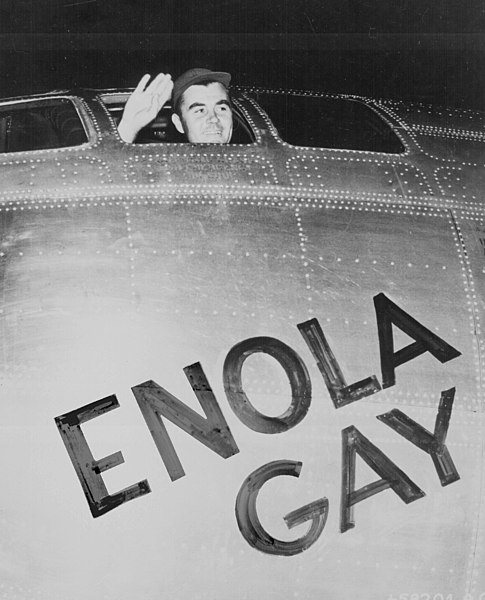
Forty-three seconds after releasing the bomb nicknamed "Little Boy," pilot Col. Paul Tibbets was alerted to the blast by radioactivity tingling in his teeth and the metallic taste from electrolysis on his tongue. Ten and a half miles away, tens of thousands of people had already vanished in a brilliant flash. A massive firestorm would grip the city within minutes and kills thousands more. This photo taken minutes after the blast at a distance of six miles was found in a suburban Hiroshima grade school in 2013:


The photo below was taken after the removal of street and lot debris and revealed the full extent of the destruction.


As the first use of an atomic weapon against an enemy, the decision to drop the bomb on Hiroshima - and Nagasaki three days later - was controversial. The decision assuredly brought a very quick end to the war with Japan and in the eyes of most historians and military experts saved the lives of millions of combatants and civilians. For more on this historic event and its aftermath readers should visit the Harry S. Truman Library & Museum's outstanding archive of primary sources relating to the story.


Tibbets, pilot and commander, in the cockpit prior to takeoff for Hiroshima


For a three minute assessment of the event by Tibbets visit this history.com link.


The last surviving Enola Gay crew member - Theodore "Dutch" Van Kirk - died at his home in Stone Mountain, Georgia, in 2014. It's one more indication that our greatest generation as an eyewitness to history is itself rapidly moving into history.


Sources

Photos and Illustrations:
Ground photo, gizmodo.com.au
Hiroshima aftermath, U.S. Navy Public Affairs Website, chinfo.navy.milEnola Gay photo, National Archives and Records Service


Monday, July 24, 2023

AirVenture Over Oshkosh 2023


The Experimental Aircraft Association's (EAA) annual week-long AirVenture gathering in Oshkosh, Wisconsin, kicks off today. It's better known as "Oshkosh" to aviation enthusiasts and you can be assured that every one of them has the event on their bucket list. There's good reason. Imagine a fly-in attracting around 7500 airplanes. Imagine 2500 aircraft exhibits, 800 commercial exhibitors, daily world-class airshows, and a total of over 600,000 guests.


AirVenture at Oshkosh is far from your average fly-in


Organizers call the event "the world's greatest aviation celebration" and this year marks its seventieth edition. The map below gives readers an idea of the scope and scale of Oshkosh and indicates why the event turns a rather sleepy Wittman Regional Airport into the busiest airport in the world for one week each year.


AirVenture grounds - for scale, that's an 8000 foot runway at the top 


I had the privilege of attending the event several times in the last decade of my career. Energizing, informative, and significant, the show was a great vehicle for delivering an organizational message to a large, captured, and enthusiastic audience. You may ask why the National Park Service (NPS) would send a dozen or so employees and volunteers to work an air show. First, the agency has almost fifty out of its more than 400 units with a significant link to an aviation theme. In addition, the Service maintains a fleet of fixed and rotary wing aircraft contributing over 20,000 hours of flight time annually in support of park operations, maintenance, and resource and fire management. Add to that interagency cooperation across departments as well as airspace regulation over the parks and the justification become clearer. In recent years the NPS's presence at the event has been reduced significantly and folded into a more cooperative effort with other federal agencies. In summation, it's a grand and demanding opportunity to reach out face-to- face with thousands of guests who enjoy and impact resources and services they provide.


Nothing like fly-in camping with thousands of your best - in this case closest - friends


If you can't attend AirVenture, the EAA maintains a comprehensive up-to-the-second website where you can spend hours reading, watching and listening to events. I've been looking up at the sound of an aircraft engine ever since I could lift my head. If you are blessed with the same response make your plans to attend an Experimental Aircraft Association AirVenture. You will not be disappointed. Until then "wheels up" every chance you get!


Thursday, April 27, 2023

For Now, It's Still The King Of The Skies


In 1970 Airbus was formed as a multinational corporation to compete with the highly successful commercial aviation industry in the United States led primarily by Boeing and McDonnell Douglas. By the late 1980s Airbus began studying the potential for a wide-bodied aircraft to compete with Boeing's highly successful 747 which entered service in 1970. Airbus research led the company's management to proceed with development based on significant market interest in the Middle East and Asia. After a decade of design based on efficiency, passenger comfort and innovative aeronautical engineering, the aircraft went into production in 2000. It would go on to makes its maiden flight as the A380 on this day in 2005.
The A380 took to the air as - and remains - the world's largest passenger plane. It has a wingspan of almost 262 feet, a length of just over 238 feet, and almost 6000 square feet of floor space on two full length levels that can accommodate up to 853 people. Since production began the aircraft has flown more than 7.5 million flight hours without an aircraft loss or fatality.


Airbus A380 during a landing Paris Air Show 2007


Singapore Airlines was the first to introduce the aircraft to commercial service in late 2007. When production ended in 2021, 251 A380s had been delivered to about two dozen customers with Emirates Airline being the largest at 128 aircraft. By the end of production the cost of each aircraft was $445 million.

Most of the aircraft have been configured with typical seating for 525 people, generally divided into the standard three classes. The high option accomodation on some planes is a 130 square foot, three room “Residence” located forward on the upper deck. Other configurations can include bars, beauty salons, shops, cafes and extra features for premium cabins, including showers. The following video will attest that not all the comfort is reserved for the high end traveler.


Despite having 50% less cabin noise, 50% more cabin area and volume, larger windows, bigger overhead bins, and two feet more headroom than the 747-400, the A380 was not a commercial success. Unfortunately, it was developed just as the industry was shifting away from the need for larger aircraft serving hubs and toward a to point to point operation that could be served with smaller planes.

As more and more A380s are being removed from service, sixteen airlines continue to fly it on long range international routes. Emirates operates the largest fleet with 121 aircraft. Only four are based in the United Kingdom and the Middle East, the remainder in Asia and Australia. Every month in 2023 will bring a decline in A380 use despite growing international travel.  

There will come a time when the A380 is a museum piece but it will always be remembered as an extraordinary technological achievement that provided in flight luxury unseen since the 1930s.


Sources


Text:

aerospace-technology.com

wikipedia.org


Photos and Illustrations:

commons.wikimedia.org

Monday, February 20, 2023

John Glenn: First American To Orbit Earth


Sixty-one years ago today, John Glenn rocketed into history to become the first American to orbit Earth. In 1962, Glenn made three orbits then returned to a splashdown about 500 miles northeast of Puerto Rico. Over the years over 350 Americans have joined him in space travel.


John Glenn in orbit, February 20, 1962


The NASA website has a fine multimedia presentation on Mercury-Atlas 6, the mission that put Glenn and his spacecraft, Friendship 7, into orbit. Wikipedia has a page on the mission and some excellent recommendations for further reading online. To commemorate tomorrow's event, The Ohio State University has a comprehensive look at Glenn's life and that of his wife, Annie. I also recommend The Right Stuff, Tom Wolfe's outstanding 1979 book on the formative days of the American space program and the seven astronauts - including Glenn - selected for the Mercury program.

When we look back at the American space program, this achievement was one of the nation's proudest moments. It's heartening to see a renewed interest interest in space exploration let alone definitive commitments to future astronauts, a return to the moon or a mission to Mars on the part of our national government. I imagine this is in part due to commercial competition. You can learn more about our reach into space by the private sector at this this Wired link.


Glenn in training, January 20, 1962


Saturday, December 17, 2022

WIlbur And Orville Wright, December 17, 1903: "Success Four Flights Thursday Morning...."


On this day in 1903 at Kitty Hawk on the outer banks of North Carolina, the 27-mph wind was harder than they would have liked since their predicted cruising speed was only 30-35 mph. The headwind would slow their ground speed to a crawl but they proceeded anyway. With a sheet they signaled the volunteers from the nearby lifesaving station that they were about to try again.

Now it was Orville's turn. Remembering Wilbur's experience, he positioned himself and tested the controls. The stick that moved the horizontal elevator controlled climb and descent. The cradle that he swung with his hips warped the wings and swung the vertical tails, which in combination turned the machine. A lever controlled the gas flow and airspeed recorder. The controls were simple and few, but Orville knew it would take all his finesse to handle the new and heavier aircraft. At 10:35, he released the restraining wire. The flyer moved down the rail as Wilbur steadied the wings. Just as Orville left the ground, John Daniels from the lifesaving station snapped the shutter on a preset camera, capturing the historic image of the airborne aircraft with Wilbur running alongside.


The Wright Flyer begins its first successful flight, December 17, 1903


Again, the flyer was unruly, pitching up and down as Orville overcompensated with the controls. But he kept it aloft until it hit the sand about 120 feet from the rail. Into the 27-mph wind, the ground speed had been 6.8 mph, for a total airspeed of 34 mph. The brothers took turns flying three more times that day, getting a feel for the controls and increasing their distance with each flight. Wilbur's second flight - the fourth and last of the day – was an impressive 852 feet in 59 seconds.

This was the real thing, transcending the powered hops and glides others had achieved. The Wright machine had flown.


Monuments spanning the 120 feet of the first flight


On completing the flight the brothers walked four miles to Kitty Hawk and sent their father a telegram:

Success four flights Thursday morning all against twenty one mile wind started from level with engine power alone average speed through air thirty one miles longest 57 seconds inform Press home Christmas


Their pilot-controlled, sustained and powered flight by a heavier-than-air machine would soon chnage the world.

For comprehensive information on this historic event visit the National Park Services Wright Brothers National Memorial web page.


Credits:

1903 photograph, unrestored version: Library of Congress
Monuments photo; text: National Park Service, Wright Brothers National Memorial


Saturday, November 26, 2022

Cool Man Willis


One of the most significant books in the historiography of the South, Ulrich Bonnell Phillips's Life and Labor in the Old South, begins with these words:

Let us begin by discussing the weather for that has been the chief agency in making the South distinctive. . . . The summers are not merely long but bakingly hot, with temperatures ranging rather steadily in the eighties and nineties of the Fahrenheit scale.

The early 20th century one-story Southern home, with its high-roof, wrap-around porch, and traditional "dog trot" breezeway, is a vernacular response to that bakingly hot summer. Homes of this type can still be found throughout the South. In fact, contemporary construction in the region often incorporates its features in vestigial form. But what has made the South so popular these days? I believe in particular the subtropical climate remains the most powerful draw. The New South's social and political climates also contribute to the demographic shift. Still, Southerners must deal with the heat. And that brings us to the significance of this week in the history of American invention and its application and impact in our lives.


On November 26, 1876, a son, Willis H. Carrier, was born into an old New England family. In 1902, Carrier developed an electrical system of conditioning air in a stiflingly hot and humid Brooklyn printing plant. The new environment ensured stability in the paper and the perfect alignment of four-color printing. It was soon a huge success in several industries that demanded such requirements. By the 1920s, air conditioning became popular in retail trade and entertainment, especially the movie theater. It was a small jump from commercial systems to home systems, and by the 1930s, air conditioning began a slow but steady increase in usage until the post World War II era when it boomed. In two generations, Carrier's application had impacted almost every facet of American life and spread quickly throughout the world in the second half of the century

From an environmental perspective, air conditioning made the South livable year round. One could work hard outside on a mid-summer Georgia day and find comfort in an air conditioned break at work and a cool, comfortable supper and evening at home. Today, we take this comfort for granted across the nation giving it attention only when it's time to change the filter or the compressor dies.


Carrier posing with a 1920 model chiller


If you call the South "home," take a moment today to thank Willis for his contribution, an invention you're going to appreciate perhaps as early as March of 2023 when that heat begins its sure progress to "bakingly" unbearable levels in the Southern summer.

For more information on the impact of air conditioning on the American experience check out these sites:

http://www.theatlantic.com/technology/archive/2011/07/keepin-it-cool-how-the-air-conditioner-made-modern-america/241892/

http://www.oldhouseweb.com/how-to-advice/how-air-conditioning-changed-america.shtml


Friday, September 2, 2022

The Carrington Event: How Space Weather Electrified The World


For the past two months or so some serious solar flares have washed our planet. The series of solar storms emitting these strong flares from the surface of the sun has rotated from view and no longer pose a threat to Earth. On the other hand as we approach 2025 and the peak of the current sunspot cycle we could soon be washed in an abundance of electromagnetic energy.  Although a very, very minimal threat to life thanks to our ozone layer these storms could be a serious threat to a society that relies on electricity.


Solar flares are a frequent occurrence and scientists have measured their strength for a century. The last flare to seriously impact the world's electrical systems and components was in 1972. That event degraded satellite performance, blocked radio frequencies, disrupted electrical grids, produced high current surges in telephone lines, detonated magnetic sea mines, and produced auroras so bright they cast shadows. To say the least it was a dramatic happening.

In February of this year Elon Musk's SpaceX program launched another series of Starlink telecommunications satellites. Before they could be moved to their final orbit the headwinds of a strong solar flare doomed them to a degrading orbit and an eventual fiery end in our atmosphere. It's only the latest consequence of our experience with solar winds. 

On September 1-2, 1859, the high technology of the day had a similar experience that heliophyisicists call the Carrington Event. It was named after British astronomer Richard Carrington who with fellow astronomer Richard Hodgson first documented a solar flare in detail.  We can only imagine the impact of that event given our reliance on electricity today. Here is more about the geomagnetic storms of the last 150 years.

The Carrington Event literally "turned on the lights." Our friends at spaceweather.com wrote this about the event:


...a billion-ton coronal mass ejection (CME) slammed into Earth's magnetic field. Campers in the Rocky Mountains woke up in the middle of the night, thinking that the glow they saw was sunrise. No, it was the Northern Lights. People in Cuba read their morning paper by the red illumination of aurora borealis. Earth was peppered by particles so energetic, they altered the chemistry of polar ice.


Orange dots mark sighting of auroras on the morning of September 2, 1859


The geomagnetic storm that day was so powerful that telegraph keys sparked and caught fire. Even with power lost in the lines, the storm electrified them to the point that messages could still be sent. Given our dependence on technology today, such storms pose a significant threat. Here's more on the story from NASA's Science News page:


...a huge solar flare on August 4, 1972, knocked out long-distance telephone communication across Illinois. That event, in fact, caused AT&T to redesign its power system for transatlantic cables. A similar flare on March 13, 1989, provoked geomagnetic storms that disrupted electric power transmission from the Hydro Québec generating station in Canada, blacking out most of the province and plunging 6 million people into darkness for 9 hours; aurora-induced power surges even melted power transformers in New Jersey. In December 2005, X-rays from another solar storm disrupted satellite-to-ground communications and Global Positioning System (GPS) navigation signals for about 10 minutes.


Read more about past CME events in this link on the spaceweather.com page.

There is one certainty and that is the more our knowledge expands the more we understand how little we really know. Perhaps it is time to pay as much attention to coronal mass ejections and solar flares as we do to climate change. Both could pose significant world-wide threats. Both deserve more study. Enough for now. I'll let you explore the very new issue of near earth objects (NEO) on you own for now and leave my comments for another day.


Monday, August 8, 2022

Hiroshima: A New Weapon Ends A War


There's been almost no mention of this event in newscasts this week but I believe it's worth remembering.

On August 6, 1945 at 8:15 a.m. Japan Local Time the world changed.

Forty-three seconds after releasing the bomb nicknamed "Little Boy," pilot Col. Paul Tibbets was alerted to the blast by radioactivity tingling in his teeth and the metallic taste from electrolysis on his tongue. Ten and a half miles away, tens of thousands of people had already vanished in a brilliant flash. A massive firestorm would grip the city within minutes and kills thousands more. This photo taken minutes after the blast at a distance of six miles was found in a suburban Hiroshima grade school in 2013:


This photo taken after the removal of street and lot debris revealed the full extent of the destruction.


As the first use of an atomic weapon against an enemy, the decision to drop the bomb on Hiroshima - and Nagasaki three days later - was controversial. The decision assuredly brought a very quick end to the war with Japan and in the eyes of most historians and military experts saved the lives of millions of combatants and civilians. For more on this historic event and its aftermath readers should visit the Harry S. Truman Library & Museum's outstanding archive of primary sources relating to the story.


Tibbets, pilot and commander, in the cockpit prior to takeoff for Hiroshima


For a three minute assessment of the event by Tibbets visit this history.com link.


The last surviving Enola Gay crew member - Theodore "Dutch" Van Kirk - died at his home in Stone Mountain, Georgia, in 2014. It's one more indication that our greatest generation as an eyewitness to history is itself rapidly moving into history.


Sources


Photos and Illustrations:
Ground photo, gizmodo.com.au
Hiroshima aftermath, U.S. Navy Public Affairs Website, chinfo.navy.milEnola Gay photo, National Archives and Records Service


Friday, July 22, 2022

Wiley Post: American Pilot, Inventor, And Trailblazer Solos Around The World


July is an important month in the history of flight. On July 14, 1914, the US Signal Corps organized an Aviation Section that would eventually grow into the US Air Force. And on July 19, 1969, the Apollo 11 mission first landed humans on the moon. So far in July 2022 NASA  released the first images from its spectaculat Webb telescope and both NASA and SpaceX continued their ambitious rocket development and launch programs aimed at the moon and Mars. All of these endeavors were preceded by the work of a number of aviation pioneers whose own achievements often get lost in history. Today we remember another July event and the famous American aviator who achieved it. His name was Wiley Post. After a journey of eight days he returned to his starting point at Floyd Bennett Field in Brooklyn, New York, to complete the first solo flight around the world. Here is a map of the journey:


And here is what This Day In History (history.com) says about the flight:


Two years earlier, Post had won fame when he successfully flew around the northern part of the earth with aviator Harold Gatty. For his solo around-the-world flight in 1933, he flew a slightly greater distance–15,596 miles–in less time. For both flights, he used the Winnie Mae, a Lockheed Vega monoplane that was equipped with a Sperry automatic pilot and a direction radio for Post’s solo journey.
His aircraft, Winnie Mae, was as well known as its pilot. The Smithsonian National Air and Space Museum's summary description of the plane say this:


Flying this specially modified Lockheed 5C Vega, famed aviator Wiley Post set many records and pioneered several aviation technologies. In 1931 Post and navigator Harold Gatty flew it around the world in eight days, and in 1933 Post became the first to fly around the world solo, taking only seven days. In 1935, while wearing the world's first pressure suit, which he helped design, Post flew the Vega into the stratosphere, reaching 547 kilometers (340 miles) per hour while cruising in the jet stream. The Winnie Mae was named for the daughter of F. C. Hall, the original owner and a close friend of Post.

Designed by John K. "Jack" Northrop, the Lockheed Vega first flew in 1927. It was the first aircraft with a NACA [National Advisory Committee for Aeronautics] cowl that
 decreased drag and increased power plant cooling by streamlining airflow around and through the engine.


Winnie Mae at her place of honor in the Time and Navigation exhibit at the Smithsonian National Air and Space Museum, Washington, DC


Over the next two years Post explored the development of a suit for high altitude flight. During his experimental flights he became the first man to encounter the high speed air currents we know as jet streams. On August 15, 1935, he and the American cowboy humorist, Will Rogers, died in the crash of Post's hybrid Lockheed home-built aircraft while exploring the possibilities of an air mail route across Alaska. Below is a photograph of the pair taken shortly before their fatal accident:


Will Rogers (on wing) and Wiley Post (by prop) as they prepare to depart Point Barrow, AK, August 15, 1935


In many ways Post's interest in science, experimentation and controlled, powered flight mirrors that of Wilbur and Orville Wright. The brothers enabled Post to make his contribution to aviation history. And Post's work in turn continues to inspire and enable new pioneers to go higher, faster, and farther.


Sources

Photos and Illustrations:

Map, fiddlersgreen.net
Winnie Mae, Smithsonian National Air and Space Museum
Post and Rogers, Library of Congress, Prints and Photographs Division

Text:

wikipedia.com
history.com
airandspace.si.edu
gendisasters.com
acepilots.com


Wednesday, April 27, 2022

In 2005 A Massive FlyIng Machine Took To The Air


In 1970 Airbus was formed as a multinational corporation to compete with the highly successful commercial aviation industry in the United States led primarily by Boeing and McDonnell Douglas. By the late 1980s Airbus began studying the potential for a wide-bodied aircraft to compete with Boeing's highly successful 747 which entered service in 1970. Airbus research led the company's management to proceed with development based on significant market interest in the Middle East and Asia. After a decade of design based on efficiency, passenger comfort and innovative aeronautical engineering, the aircraft went into production in 2000. It would go on to makes its maiden flight as the A380 on this day in 2005.

The A380 took to the air as - and remains - the world's largest passenger plane. It has a wingspan of almost 262 feet, a length of just over 238 feet, and almost 6000 square feet of floor space on two full length levels that can accommodate up to 853 people. Since production began the aircraft has flown more than 7.5 million flight hours without an aircraft loss or fatality.


Airbus A380 during a landing Paris Air Show 2007


Singapore Airlines was the first to introduce the aircraft to commercial service in late 2007. When production ended in 2021, 251 A380s had been delivered to about two dozen customers with Emirates Airline being the largest at 128 aircraft. By the end of production the cost of each aircraft was $445 million. 

Most of the aircraft have been configured with typical seating for 525 people, generally divided into the standard three classes. The high option accomodation on some planes is a 130 square foot, three room “Residence” located forward on the upper deck. Other configurations can include bars, beauty salons, shops, cafes and extra features for premium cabins, including showers. The following video will attest that not all the comfort is reserved for the high end traveler.


Despite having 50% less cabin noise, 50% more cabin area and volume, larger windows, bigger overhead bins, and two feet more headroom than the 747-400, the A380 was not a commercial success. Unfortunately, it was developed just as the industry was shifting away from the need for larger aircraft serving hubs and toward a to point to point operation that could be served with smaller planes.

As more and more A380s are being removed from service, sixteen airlines continue to fly it on long range international routes. Emirates operates the largest fleet with 121 aircraft. Only four are based in the United Kingdom and the Middle East, the remainder in Asia and Australia.
There will come a time when the A380 is a museum piece but it will always be remembered as an extraordinary technological achievement that provided in flight luxury unseen since the 1930s.


Sources


Text:

aerospace-technology.com

wikipedia.org


Photos and Illustrations:

commons.wikimedia.org


ShareThis