Showing posts with label music history. Show all posts

Wednesday, July 9, 2025

He Penned A Masterpiece At 21


Bob Dylan turned 84 earlier this year. That means he's been writing songs for over 60 years. He was only 21 on July 9, 1962 when he walked into the Columbia Recording Studios in New York to record a song to be included on his second album. The song, Blowin' in the Wind, brought him fame and recognition as one of the nation's leading folk poets of the twentieth century. The lyrics and Dylan's comments on the song were published in June 1962 in the folk journal, Sing Out. He said this:


Too many of these hip people are telling me where the answer is but oh I won’t believe that. I still say it’s in the wind and just like a restless piece of paper it’s got to come down some . . . But the only trouble is that no one picks up the answer when it comes down so not too many people get to see and know . . . and then it flies away.


Dylan and Joan Baez, March on Washington, August 8. 1963


The music critic, Andy Gill, said this about the song in his book, Classic Bob Dylan, 1962-1969: My Back Pages:

Blowin' in the Wind marked a huge jump in Dylan's songwriting. Prior to this, efforts like The Ballad of Donald White and The Death of Emmett Till had been fairly simplistic bouts of reportage songwriting. Blowin' in the Wind was different: for the first time, Dylan discovered the effectiveness of moving from the particular to the general. Whereas The Ballad of Donald White would become completely redundant as soon as the eponymous criminal was executed, a song as vague as Blowin' in the Wind could be applied to just about any freedom issue. It remains the song with which Dylan's name is most inextricably linked, and safeguarded his reputation as a civil libertarian through any number of changes in style and attitude.


Blowin' In the Wind is a poem for our time, perhaps all time.


Sources

Photos and Illustrations:
U.S. Archives and Records Service, Rowland Scherman Collection

Text:
wikipedia.com, Bob Dylan entry
history.com

Tuesday, June 17, 2025

Igor Stravinsky: Bringing New Sounds To A New Century


Igor Stravinsky, popularly recognized as a leading founder of Modern music in the 20th century, was born in Russia on this day in 1882. He lived in Switzerland and France before immigrating to the United States after World War II. Over his lifetime he composed in a variety of styles but is best remembered for his dazzling, rhythmic music in the early years - 1910 to 1914 - of the Ballets Russes produced by Sergei Diaghilev in Paris.


Portrait of Stravinsky                     Robert Delaunay, 1917


His work during that brief period included The Firebird (1910), Petrushka (1911), and The Rite of Spring (1913). One could say they are all signature pieces - experimental and revolutionary - that dazzled and in some cases infuriated their audiences. Regardless, the three compositions as well as other sounds from Stravinsky's imagination had a huge impact on music and the arts. He was 27 when audiences first heard The Firebird. Keep in mind that Henry Ford sold 10,000 cars that year, the U.S. had 1000 miles of paved road, half the American population lived on farms or towns with fewer than 2500 people, and the flying machine was a very rare and thrilling sight.

In the century since the premiere of The Firebird, its innovative sounds have been re-patterned by the likes of Aaron Copeland, Leonard Bernstein, John Williams and others including Philip Glass who has perhaps carried rhythm as art to its farthest horizon to date. In the view of Tom Service writing in The Guardian in 2011,

Stravinsky is the only common influence that composers from Steve Reich to Thomas Adès, from Judith Weir to John Adams, from Elliott Carter to Louis Andriessen, can all agree on. Without Stravinsky, there would be no minimalism, not much neo-classicism, not enough rhythmic energy, and not nearly enough compositional freedom in the 20th and 21st centuries. Four decades on, the Stravinsky that's proved most popular with audiences, orchestras and concert halls is the colouristic brilliance of the three early ballets, Firebird, Petrushka, and the Rite.

Indeed, Stravinsky broke rules. In doing so he made new music. A century later it remains as fresh as the year it was composed. And although Stravinsky left this world almost a half century ago he indeed remains as the title of Service's article describes him, "Stravinsky Our Contemporary." Here's more proof with excerpts from a November 2019 concert by the Los Angeles Philharmonic under the baton of the brilliant conductor, Gustavo Dudamel. The Rite of Spring is one of the orchestra's signature pieces.


Some say the most productive experiments often make the biggest messes until they are better understood. The genius and madman in Stravinsky would very much agree.

For more on the place of dissonance in Stravinsky's music here is an entertaining seventeen minute journey on the subject by the British composer, Davis Bruce. This video can be as technical as you want to make it. By no means am I a musical technician so I enjoyed it by simply listening to how Stavinsky's used dissonance to create some of the most popular music of the last century.


Sources

Photos and Illustrations:
portrait, public domain, Robert Delaunay, New Art Gallery Walsall, West Midlands, England

Text:
Igor Stravinsky entry, Wikipedia.org
quotation, Tom Service, "Stravinsky Our Contemporary", theguardian.com, April 6, 2011

Friday, May 30, 2025

He Was The King Of Swing From Coast To Coast


In 1935 Benny Goodman and his band had a regular late-night gig on Saturdays on NBC's radio program, Let's Dance. Broadcast from New York, most of the local teens and twenty-somethings who enjoyed his music were fast asleep. On the other hand, it was perfect timing for young audiences on the West Coast. A labor strike brought the program to a sudden and unexpected end and put Goodman and his band out of work. Together they decided on a coast to coast tour. In the interior states, the tour was a disaster because people didn't care for "upbeat" jazz arranged for orchestra. The band was looking forward to the Palomar Ballroom in Los Angeles as the last stop and an end to the pain. When they arrived, thousands of young fans who had heard them on the radio were waiting to hear them in person. What was to be a welcome end to a disastrous tour turned into the beginning of the swing era.


In the shadow of Bebop: Benny Goodman, 1946


Eighteen months later , the now famous Goodman Orchestra was invited to present a jazz review on January 16, 1938 in Carnegie Hall, a venue historically reserved for "high brow" music. Several members of the Duke Ellington and Count Basie orchestras and others joined on stage to perform a concert ranging from traditional to unconventional. No jazz bandleader had ever performed there. The concert was a sensation, reaffirming Goodman as the "King of Swing," and jazz as serious American music. In the eyes of many music critics and historians, this concert remains the single most important event in popular music history in the United States. Superlatives aside, the concert was a study in swing music history and jazz improvisation.

After several curtain calls at the end of the concert, Goodman announced to the screaming fans that an encore would follow. Sing, Sing, Sing was the last song in that set. It already was a popular piece for the band but this performance lifted it to holy status in the swing jazz genre. Featured players: Gene Kruppa on drums, Babe Russin on saxophone, Harry James on trumpet, Goodman on clarinet, and Jess Stacy in a masterpiece of improvisation on piano.


Today we celebrate the birthday of the clarinetist and bandleader, Benny Goodman (1909 - 1986). You can read more about him at his Wikipedia entry here. Mention "Palomar Ballroom" and "Carnegie Hall" in the same breath and any popular music historian will follow with "Benny Goodman." His performances at the two venues took place more than 80 years ago. Today we remember both concerts as course changing landmarks in the history of swing and jazz.


Publicity style photo of Benny Goodman around 1960


Sources

Photos and Illustrations:
1946 photo, Library of Congress, William Gottlieb Collection
1960 photo,public domain, publicity style candid photo of Benny Goodman

Text:
bennygoodman.com
Benny Goodman entry, wikipedia.org

Thursday, May 29, 2025

Igor Stravinsky's THE RITE OF SPRING, A Premiere Wrapped In Praise And Riot


There was an important anniversary in the world of music this weekend. Most of my musical posts usually concern people. This one is about a composition in the forefront of a revolution in sound at the end of the Edwardian era. On May 29, 1913 the 30 year-old composer, Igor Stravinsky, made music history in Paris. The event was the premiere of the ballet, The Rite of Spring. Like his earlier work for Sergei Diaghilev's Ballets Russes, it was experimental and revolutionary. When combined with primitive choreography and a human sacrifice theme some in the audience were dazzled while others were infuriated to the point of riot. 

The violence subsided rather quickly, the anger simmered a bit longer and Stravinsky's imaginative compositions went on to have a huge impact on music and the arts. At the forefront stands The Rite of Spring - Stravinsky produced several arrangement throughout his life - as one of the most widely recorded and performed  works in the world. It remains as fresh in 2025 as it was in 1913. In that century its innovative energy in sound and rhythm has been re-patterned by the likes of Aaron Copeland, Leonard Bernstein, John Williams, Philip Glass and many others.


Photo from 1913 showing original costumes

In the early 1980's the original choreography was meticulously reconstructed after being lost for almost six decades. A few years after its completion it was presented by the Joffre Ballet. Several adaptations based on the original costuming and set design have appeared over rhe last forty years. In my opinion the Jofre production remains the better representation of what that 1913 audience both heard and saw. Here is Part 1 - all three available on YouTube - of their performance.


Some say the most productive experiments often make the biggest messes until they are better understood. The genius and madman in Stravinsky would very much agree. 


Sources

Photos and Illustrations:
public domain photo from First Nights: Five Musical Premieres by Thomas F. Kelly. Yale University Press, New Haven, 2000.

Text:
Igor Stravinsky entry, wikipedia.org


Friday, May 23, 2025

Artie Shaw: He Searched For The Perfect Sound


The music world has several significant birthdays to remember this week. One of them (May 23, 1910) belongs to  Arthur Arshawsky, the clarinetist, composer, band leader, and author better known as Artie Shaw. To say that Shaw was complex and difficult would be an understatement. He was married eight times, greatly disliked fame, and resented the conflict between creativity and the music industry so much that he virtually abandoned music in the early 1950s. Perhaps his life illustrated a never ending search for perfection by a man who could have approached it in any number of fields. When he died in December 2004 at the age of 94, he was recognized as one of the century's finest jazz clarinetists and a principal force in the development of the fusion of jazz and classical music that would become known as "Third Stream Music." Technically, I think he was at the top. This 1936 recording of him performing his composition, Interlude in B Flat, provides the evidence:


And here is Shaw with strings and woodwinds performing Alberto Dominguez's composition, Frenesi. It charted at #1 in 1940 and would remain one of Shaw's greatest hits.


He completed an autobiography in 1952 and two years later gave up a full-time commitment to the industry and turned to a vast range of interests from advanced mathematics to literature. He went on two write several novels and short stories as well as an unfinished historical fiction trilogy on the jazz era. For a more thorough examination of even more facets in the life of this restless musical genius, visit this link at Swing Music Net for his obituary and this entry for his Wikipedia biography.

Saturday, May 3, 2025

Crosby And Seeger: Two Very Different Voices In American Music History


Two iconic American entertainers share May 3 as a birthday. 


Bing Crosby 1930s.jpg
Crosby publicity photo from the 1930's

Born in 1903, Bing Crosby used his baritone voice and recording technology to develop a personal singing style that made him the nation's top entertainer for a generation beginning in the mid-1930s. Young people probably know little if anything about Crosby. He died in 1977 but I think he sits at the pinnacle of the American entertainment industry in that era - along with Bob Hope - and is well worth exploring if you enjoy popular culture. The Crosby family has authorized a comprehensive site about The Crooner if readers want more information. For a small taste of his talent, here is Crosby singing to Grace Kelly in the 1956 film, High Society:


Our second birthday celebrant is Pete Seeger, an entertainer who has been described as the most successful communist in the United States. I'll let readers discover the politics for themselves and focus instead on Seeger as singer and songwriter. 

File:PeteSeeger2.jpg
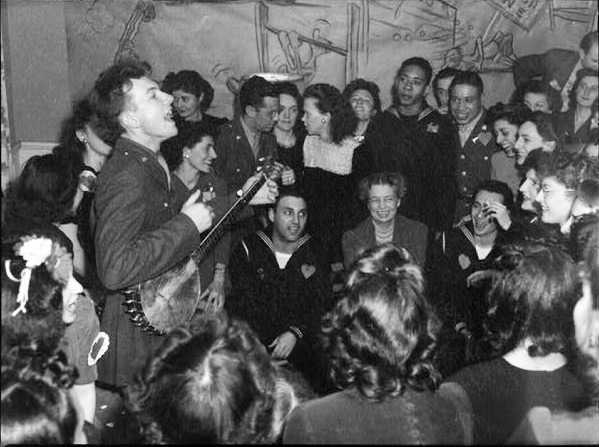
Entertaining at labor canteen opening, Washington, DC, February 1944

Seeger was born in 1919 into a musical family, took up the family's leftist politics, and made a name for himself as a "protest singer" in the 1940s. In 1950, he was a member of the folk group, The Weavers, and in the bow wave of a folk music revival in the U.S. It was short-lived, however, as the group was blacklisted in 1953 for suspected political reasons. A decade later Seeger found himself at the forefront of the 1960's folk revival embedded in antiwar activities and the Youth Revolution.  He continued singing and pursuing his social, political, and environmental activism around the world almost to the day he died at 94 in 2014. For more information and a host of links, here is his Wikipedia entry.

For a taste of Pete Seeger the performer, here he is singing lead and playing his banjo on the first recording (1949) of If I Had A Hammer, co-written with Lee Hays, also with The Weavers:


Although this video highlights Seeger, it does not do justice to the beautiful harmony The Weavers produced. Readers may want to explore the Internet for more of their recordings. Their 1981 reunion concert at Carnegie Hall is a particularly moving statement on the American music experience.


Sources

Photos and Illustrations:
commons.wikimedia.org/wiki/File:Bing_Crosby_1930s.jpg
loc.gov/pictures/resource/fsa.8d41983/

Friday, April 25, 2025

She's Still The First Lady Of Song


The incomparable jazz singer, Ella Fitzgerald, was born on this day in Newport News, Virginia, 108 years ago. When she was 17, Ella Jane Fitzgerald wanted to dance at an amateur night at the Apollo in Harlem, but was intimidated by other dancers and decided to sing instead. It was the beginning of a career that took her magnificent voice through the big bands, to jazz, bop, and the Great American Songbook. With a voice ranging from smoky to bright she put her signature on every note and sharp diction on every word. For people who like to immerse themselves in lyrics, Ella was unbeatable. And when she forgot those lyrics or let the spontaneity flow, the scat singing was priceless.


The First Lady of Song in 1960     Erling Mandelmann


Only once did I see her perform and that was in an overcrowded and hot venue in Washington. After a few songs, the crowd didn't mind the environment. She had us wrapped in music for over two hours and left us wanting more after several encores. Everyone had a great time that evening, especially Ella. Looking back on that concert, I realize how significant it was. She had turned 50 and completed recording her famous Songbook series a few years earlier. And though her peak years were coming to an end, what she had left exceeded the best of what most 20th century singers ever offered. She went on to perform another quarter of a century dazzling audiences everywhere. Ella passed away twenty-eight years ago, but she's still entertaining fans through a huge discography and video record. In all, it is an immense if not iconic legacy.


Fitzgerald and President Reagan at the White House in October 1981


Throughout her very public life, Ella Fitzgerald remained a private if not shy person. Were she receiving a birthday cake today, I can envision a broad, approving smile and nervous glances from squinting eyes behind those big bottle bottom glasses. She'd respond with a heart-felt "Thank you, thank you," and move into the comfort and safety of song.

Here she is in 1964 performing two Johnny Mercer jazz standards for the last of her now legendary Songbook albums - eight in all - produced by Norman Grantz and released over an eight year period. The series has never been out of print and remains a hot seller over fifty years after its release.


In almost sixty years, few jazz vocalists - there are many fine ones performing today - can approach the significance and near-perfection of Fitzgerald's interpretation of the Great American Songbook. To me, nothing since has quite matched it and I doubt anything in the future will without some extraordinary changes within the music industry and jazz itself.

Though she left us in 1996, Ella simply "is." I can only imagine the look on the faces of the heavenly hosts when she waltzed through those pearly gates scat singing all the way. So here's a happy birthday wish going up to the First Lady of Song. Simply incomparable and yes, sometimes too marvelous for words.


Sources

Photos and Illustrations:
Mandelmann photo, commons.wikimedia.org
White House, Item C4495-9A, President Reagan with Ella Fitzgerald after her performance for King Juan Carlos I of Spain in the east room, 10/13/81; Ronald Reagan Presidential Library and Museum, Simi Valley, California.

Wednesday, April 2, 2025

Happy 78th Birthday, Emmylou Harris


In fifty years singer-songwriter Emmylou Harris has won fourteen Grammy Awards including a Lifetime Achievement Award in 2018. Along the way she's gained many honors including membership in the Grand Ole Opry, the Country Music Hall of Fame, the American Academy of Arts and Sciences, and a star on the Hollywood Walk of Fame. Her career first gained traction in small clubs and coffee houses in Washington and its suburbs. I was only a few miles from most of the venues but sadly never saw her perform. Still, it was impossible not to see and hear the advertising in and around Georgetown in DC and the Maryland suburbs of Bethesda, Chevy Chase and Silver Spring. By the early '70's she moved to Los Angeles to work with Gram Parsons and his band, The Grievous Angels. When Parsons died in 1973 the devastating event led her to focus on Parsons's search for the fusion sound he called "cosmic American music." The sound Harris and Parsons produced in their short time together, in addition to her life-long dance with experimental sounds in folk, blues and country music, would have a significant impact on decades of American music.

Harris continues to produce innovative and award-winning sound. In 2016 a selection of duets with Rodney Crowell - The Traveling Kind - won a Grammy for Best Americana Album. Here is a track from the album:


Today, Emmylou Harris turned 78. Fame has been kind to her given such a long and successful touring and recording career. She's brought quality entertainment to millions of people since the beginning in those early days with Graham Parsons. We'll never know where the two of them would have gone together in the world of music but it's safe to say it would have been far. Here is a song she and Bill Danoff wrote as a tribute to Parsons:


Boulder to Birmingham

I don't want to hear a love song
I got on this airplane just to fly
And I know there's life below
But all that it can show me
Is the prairie and the sky

And I don't want to hear a sad story
Full of heartbreak and desire
The last time I felt like this
It was in the wilderness and the canyon was on fire
And I stood on the mountain in the night and I watched it burn
I watched it burn, I watched it burn.

I would rock my soul in the bosom of Abraham
I would hold my life in his saving grace.
I would walk all the way from Boulder to Birmingham
If I thought I could see, I could see your face.

Well you really got me this time
And the hardest part is knowing I'll survive.
I have come to listen for the sound
Of the trucks as they move down
Out on ninety five
And pretend that it's the ocean
coming down to wash me clean, to wash me clean
Baby do you know what I mean

I would rock my soul in the bosom of Abraham
I would hold my life in his saving grace.
I would walk all the way from Boulder to Birmingham
If I thought I could see, I could see your face.


Thank you, Emmylou, and a happy birthday (April 2), too. It's been quite a journey from those gigs at the Red Fox Inn.


Sources:
Photo, emmylouharris.com
Lyrics: play.google.com

Friday, March 21, 2025

J. S. Bach: Sounds From Heaven


J.S. Bach statue in Leipzig, Germany


Today marks the birthday (in 1685, and for Old Style calendar sticklers, it's March 21) of one of the great three "B's" in classical music, Johann Sebastian Bach, He gave us some of the most sublime music in western culture and it would be an oversight, especially as a Lutheran, not to honor this master of the Baroque and pillar of Lutheranism. 

Here, in seventeen minutes, I think you will understand the compelling effect Bach music has on listeners. In this interpretation by Glenn Gould you'll also be able to hear the performer's notorious verbal accompaniment.


His music was largely forgotten for almost a century following his death, but had been restored by the first quarter of the 19th century. The new-found popularity of Bach was due largely to the composer-performers, Felix Mendelssohn and Ludwig van Beethoven, and the publication of many of Bach's works. 

I was introduced to the music of J.S. Bach as an infant at Mount Calvary Lutheran Church in my little hometown in the mountains of Maryland. The church already had been baptizing members of my father's family for over seventy years. In the summer of my ninth year our family moved leaving behind not only familiar places but also a church family. When I left town I took Bach's faith and music with me. 

So what makes his music so appealing? I could give you my opinion but I'm going to defer to Rick Beato, a performer, composer, producer, teacher, and music historian who has produced an outstanding fifteen minute assessmenyt of Bach and his legacy. Beato's You Tube channel has many videos on the subject. Prepare to be surprized watching your favorite musicians of the past sixty years - jazz, blues, rock, country, c;lassical, or whatever - discuss the place of Bach in the lives and careers. 


Bach's music has remained very much alive in me since leaving "home" seventy years ago. His preludes. fugues, harmonies, the shear wonder of his work, it's all in my blood, and I can't play a single note of it. Wouldn't have it any other way. I simply listen and let it flow.

It's my hope that you can take time today to listen to the videos in this post. Normally I try to avoid posting music longer than ten minutes but today will be an exception. Also, I trust if interested you'll watch the other Bach videos available on Beato's YouTube channel. You will not be disappointed.

As an aside, I highly recommend Rick Beato's YouTube channel as an outstanding source for news and general info on all kinds of music and music history. He knows the industry from all sides in addition to being an entertaining host and interviewer.


Music's ultimate end or final goal…should be for the honor of God and the recreation of the soul.

                                                        J. S. Bach - Leipzig, 1738


Sources

Photo: stlpublicradio.org, flickr/seabamirum


Thursday, February 27, 2025

Marian Anderson: Powerful Voice, Powerful Message


Today is the birthday of the American singer, Marian AndersonWhen she passed away in 1993 at the age of 96 the world lost one of its finest voices of the 20th century. She swept to international fame in 1939 with a public performance at the Lincoln Memorial in Washington. 


The Daughters of the American Revolution (DAR) had denied her the opportunity to perform in their venue, Constitution Hall, because she was black. The decision didn't sit well with First Lady Eleanor Roosevelt who sat on the national board of directors of the DAR. Mrs.Roosevelt intervened and helped arrange one of the iconic events of our time.


Portrait of Marian Anderson, 1940

Here is a documentary, Portrait of Marian Anderson, produced for the Greater Washington Telecommunications Association and first aired on public television on May 8, 1991. I normally don't post lengthy audiovisuals but this one affords viewers a flexible opportunity to learn about her life, listen to her singing, and hear her personal observations on an extraordinary life that included seven decades on the stage.


Sources

Photos and Illustrations:
1939 concert, public domain photo by U.S. Information Agency, National Archives and Records Administration, Washington, D.C.
Anderson portrait, Carl Van Vechten Collection, Library of Congress

Text:
Title quote, Marian Anderson 

Friday, January 31, 2025

Celebrating The American Composer, Philip Glass, On His Birthday


Philip Glass                           Luis Alvarez Roure, U.S., 2016


Philip Glass is the most well-known minimalist composer and master of what he calls music of repetitive structure in our time. He was born into a musical family in  Baltimore and lived in an apartment above his father's record store. In that environment he developed a love of music, particularly modern classical music, by listening to promotional recordings and records that had been returned to the store. At eight he was studying music at the Peabody Conservatory of Music. At fifteen he continued his musical training and studied mathematics and philosophy at the University of Chicago. 

Listeners cannot help but "count" in one way or another throughout all of his compositions. And his work is surely a Calculus in our own time, retaining its minimalist core wrapped in a stylistic evolution. He has composed operas, symphonies, concertos, string quartets, chamber pieces, and film scores. Three of his scores received Academy Award nominations.

He wrote his first score for the film, Koyaaniqatsi (1982), a mesmerizing audiovisual feast by Godfrey Reggio and Ron Fricke examining the interface of people, technology, and nature. Glass's score for this film has become a signature piece, one that he and his ensemble have performed around the world for almost four decades. Glass has also composed for many popular films including Candyman (1992), The Hours (2002), and the memorable satire, The Truman Show (1998).


Listening to Glass is often more an experience where one can get be the music as a participant rather than merely listen. Even at its simplest, his work has complexities in tone, harmony, tempo and orchestration. For one thing, Glass counts. He plays by the numbers, practicing his musical arithmetic adding, subtracting, multiplying, dividing, and even solving some algebraic formulas here and there. In the end music to Glass seems like the mathematics he studied. Fortunately for our culture, popular as well as haute, he became an extraordinary, prolific, and popular composer whose significant international influences in the music world continue to this very day which happens to be his 87th birthday.


Sources

Photos and Illustrations:
Collection of the Smithsonian National Portrait Gallery, Washington, D.C.

Text:
philipglass.com
wikipendia.org

Wednesday, January 29, 2025

Frederick Delius: Saturation In Sound


Delius in 1907


The English composer, Frederick Delius, was born on this day in Yorkshire in 1862. At 24, he lived the classic story of breaking away from the family business - wool, no less - to pursue a love for the arts, in this case, music. The break was interesting for it took him first to Solano Grove and an orange plantation on the banks of the St. Johns River south of Jacksonville, Florida. Later, he would teach music in Danville, Virginia, before returning to Europe for formal education in Germany. He took the sounds of American culture with him. In 1888, he settled in Paris, later married the painter, Jelka Rosen - she painted the portrait below - and devoted his life to composition. In his last sixteen years he was tortured by the pain of a slow death from syphilis contracted during his early years in Paris. In the four years before his death in 1934, he was blind and essentially paralyzed from the neck down. He composed and completed some of his most significant work during this period, all of it reaching paper through the notations of his loyal amanuensis, Eric Fenby.

Delius patterned much of his music after that of his friend and fellow composer, Edvard Grieg, but tempered it with English impressionism, a love of naturalism, and his American experience, particularly his immersion in African American cultural themes while working on his father's grapefruit plantation. The result was a unique and demanding music for performer and listener alike and one that almost demands an acquired appreciation. From his death until the 1970's many in the classical music industry thought his compositions were "too sweet" and trapped in immature cliches. Today, his popularity continues to grow but I believe he remains an underappreciated figure in 20th century music.


Portrait of Delius by his wife, Jelka Rosen, Grez-sur-Loing, France, 1912


I first encountered Delius's music in a BBC program in 1968. The unique lyric quality of his compositions was like a magnet and there was no escape from the compelling soundscapes with such rich, complex imagery and depth. It was easy to fall under the Delius spell as a student of physical and historical geography. The appreciation increased when I began a life-long career focused on the nation's most significant and often most beautiful places.


Years ago, I had the opportunity to sit alone on a dock watching the evening move over the St. Johns River landscape not far from Solano Grove. Delius's music was in my head and all the beauty of "Old Florida" was in my heart. A century earlier he had likely walked the river's edge at that very place, watched the same sun glistening on the water, heard the worker's songs blending with those of insects and the wind rustling the reeds and nearby palmettos.

Over his lifetime he would be identified with the English school of music, but would put much of that Florida experience into his work. In fact, he has a significant place in American music history having been the first classical composer to use musical themes of black Americans in the South. Those themes appear in several of his composition more than forty years before George Gershwin and Porgy and Bess

This post opened with Song of Summer, written in 1930 when Delius was blind and paralyzed. To conclude, here are two earlier compositions. The first is from the Florida Suite, written in 1888 when he was twenty years old. Music historians agree that this piece represents the first use of black American folk idioms in classical form by a European composer. He also composed the first black opera, Koanga. (George Gershwin is most often erroneously credited with this accomplishment, but his opera, Porgy and Bess, premiered fifty years later.
 
The second work,  In A Summer Garden, was composed in 1908. This and many other Delius works would go on to influence a number of popular music composers well into the 20th century. Perhaps the most significant of them was the iconic composer, pianist, and bandleader, Duke Ellington, whose composed - most likely with his arranger, Billy Strayhorn - In a Blue Summer Garden as a tribute. 


Over forty years have passed since I watched that sunset near Solano Grove. That's a long time to explore and mature in one man's music. It remains a most satisfactory experience filled with complex brushstrokes of sound so different, immersive, and timeless.


Music is a cry of the soul. It is addressed and should appeal instantly to the soul of the listener. It is a revelation, a thing to be reverenced.
                                                                          Frederick Delius


Sources

Photos and Illustrations:
Delius photograph, Monographein Moderner Musiker, Leipzig, Germany: C.F. Kahnt Nachfolger, 1907. Public domain in the United States
Portrait of Frederick Delius by his wife, Jelka Rosen.

Text:
title, from comments by Delius biographer, Christopher Palmer, 1976
The Delius Society
Before the Champions: Frederick Delius' Florida Suite for Orchestra, Mary E. Greene., M.A. Thesis, University of Miami, 2011
Radio Swiss Classic, Frederick Delius
Wikipedia, the free encyclopedia, Frederick Delius

Thursday, January 16, 2025

The Night Jazz Arrived


In 1935 Benny Goodman and his band had a regular late-night gig on Saturdays on NBC's radio program, Let's Dance. Broadcast from New York, most of the local teens and twenty-somethings who enjoyed his music were fast asleep. On the other hand, it was perfect timing for young audiences on the West Coast. A labor strike brought the program to an unexpected end and put Goodman and his band out of work. Together they decided on a coast to coast tour. In the interior states, the tour was a disaster because people didn't care for "upbeat" jazz arranged for orchestra. The band was looking forward to the Palomar Ballroom in Los Angeles as the last stop and an end to the pain. When they arrived thousands of young fans who had heard them on the radio were waiting to hear them in person. What was to be a welcome end to a disastrous tour turned into the beginning of the Swing era.


In the shadow of Bebop, Benny Goodman, 1946

Eighteen months later, the now famous Goodman Orchestra was invited to present a jazz review on January 16, 1938 in New York in Carnegie Hall, a venue historically reserved for "high brow" music. Several members of the Duke Ellington and Count Basie orchestras and others joined on stage to perform a concert ranging from traditional to unconventional. No jazz bandleader had ever performed there. The concert was a sensation, reaffirming Goodman as the "King of Swing," and jazz as serious American music. In the eyes of many music critics and historians, this concert remains the single most important event in popular music history in the United States. Superlatives aside, the concert was a study in swing music history and jazz improvisation.


Publicity style photo of Benny Goodman, ca. 1960

After several curtain calls at the end of the concert, Goodman announced to the screaming fans that an encore would follow. Sing, Sing, Sing was the last song in that set. It already was a popular piece for the band, but this performance lifted it to holy status in the swing jazz genre. Featured players: Gene Kruppa on drums, Babe Russin on saxophone, Harry James on trumpet, Goodman on clarinet, and Jess Stacy in a masterpiece of improvisation on piano.


After January 16, 1938, jazz soon became mainstream American music. Recordings of the concert have remained in print as best sellers since 1950 when Goodman found long-forgotten acetate tape masters given to him the night of the concert. In 1998 aluminum studio masters were discovered and released as a set of compact discs that became one of the best selling live jazz recordings ever.


Sources


Photos and Illustrations:
1946, Library of Congress, William Gottlieb Collection
ca. 1970, public domain, publicity style candid photo of Benny Goodman

Text:
bennygoodman.com
Benny Goodman entry, wikipedia.org

Monday, November 18, 2024

Remembering Johnny Mercer, The Sentimental Gentleman From Savannah, Georgia


Mercer statue, Ellis Square, Savannah, Georgia


November 18, marks the 115th anniversary of the birth of John Herndon Mercer (1909-1976). For fans of the Great American Songbook, this is a significant event. Mercer won four Academy Awards for Best Original Song and had another twelve nominations. Indeed he was quite a music master.

Born into wealth in Savannah, Mercer often recounted how his Aunt Hattie hummed to him in his crib and "he hummed right back at her." It was the beginning of a musical career that would produce more than 1500 published songs, a few thousand more unpublished songs and song fragments, scores of poems and prose pieces, an unfinished autobiography, and a major chapter in the history of American music in the twentieth century.

In Mercer's Savannah a rich Southern culture blended with that of a diverse and exciting port city. He spent his childhood fascinated by train and ship whistles, and the sounds and rhythms drifting from the black churches around town. He was thrilled by the chance to slip away from his mother's watchful eye and visit the black business district on West Broad Street - now MLK Boulevard - where he listened to race records. The family's summer home on the Vernon River, about ten miles south of town, immersed him in the natural world of Georgia's tidal creeks and salt marshes. By his teen years, he loved hearing the dance and jazz bands every summer at the famous Tybrisa Pavilion on nearby Tybee Island. He also began writing songs and skits for his student productions at Woodberry Forest School in Virginia.

When the family business failed in the late '20s, any hope of returning to Woodberry or attending college dimmed. He grew bored at home and shipped off to New York to become a Broadway performer. The demand for singers was weak but he began tinkering with lyric writing when he wasn't singing or working odd jobs. Here is his first published song lyric:


Lyrics are meant to be heard but it's not always easy to appreciate them without the poetry on the page, especially when written by such a word genius:


Out of Breath (1930)

lyrics by Johnny Mercer
music by Everette Miller


Mine's a hopeless case,
But there's one saving grace,
Anyone would feel as I do;
Out of breath and scared to death of you.
Love was first divined,
Then explored and defined,
Still the old sensation is new;
Out of breath and scared to death of you.
It takes all the strength that I can call to my command,
To hold your hand.
I would speak at length
About the love that should be made,
But I'm afraid.
Hercules and such
Never bothered me much,
All you have to do is say "Boo!"
Out of breath and scared to death of you.


Yes, it's pretty simple, comic stuff but it had flashes of wordplay and bouncy rhythm. It was perfect for the Garrick Gaieties revue of 1930.

One of the chorus girls left Johnny out of breath as well. Her name was Ginger Meehan and she was Bing Crosby's squeeze at the time. Eventually, Mercer won her over and they married in 1931 after Johnny secured a staff job writing lyrics. The following year, his persistent work paid off when he partnered with Hoagy Carmichael, already well-known for his sensational song, Stardust. After several months, the collaboration produced Lazybones, Mercer's first hit song. It was full of black dialect and all the stereotypical perceptions of the day.

By the time Lazybones became popular, the New York music industry was in full transition thanks, in part, to the rapidly growing film industry in California. Films needed songs and with his prospects cooling in New York, Mercer traveled to Hollywood where he met his old friend, Bing Crosby, who had already made the transition to the West. The early years were a challenge for Mercer, but things changed in 1936. That year, Crosby offered to sing one of Mercer's songs in the film, Rhythm on the Range. The film wasn't much. The song was a runaway hit:


I'm An Old Cowhand

words and music by Johnny Mercer


I'm and old cowhand
From the Rio Grande,
But my legs ain't bowed
And my cheeks ain't tanned.
I'm a cowboy who never saw a cow,
Never roped a steer 'cause I don't know how,
And I sure ain't fixin' to start in now.
Yippy I O Ki Ay,
Yippy I O Ki Ay.

. . .

And I learned to ride
'Fore I learned to stand,
I'm a ridin' fool who is up to date,
I know ev'ry trail in the Lone Star State,
'Cause I ride the range in a Ford V-Eight

. . .

And I come to town
Just to hear the band,
I know all the songs that the cowboys know,
'Bout the big corral where the doagies go,
'Cause I learned them all on the radio.

. . .

Where the West is wild
'Round the borderland,
Where the buffalo roam around the Zoo,
And the Indians make you a rug or two,
And the old Bar X is a Bar B Q.
Yippy I O Ki Ay,
Yippy I O Ki Ay.


I think Mercer came into perfect form with this one. With a little help from his pal, Crosby, his name became associated with songwriting among Hollywood's shakers and makers. In these early years, he struggled through a few flop movies, but he learned the ins and outs of Hollywood, and continued writing poetry to music. Mercer went on to great fame after I'm An Old Cowhand. Movies, records, and radio brought his folksy, common sense, "free and easy, that's my style" personality into homes across America and made him a beloved next door neighbor. 

Mercer could be serious with a lyric, but he was equally capable of making us laugh at ourselves and our circumstances. Hooray for Hollywood is an outstanding example. I'd say almost every American can hum the title line but it's the rest of the lyric that really sparkles. Here's the song as it appeared in Busby Berkeley's 1937 blockbuster film hit, Hollywood Hotel. If you don't want to miss any words, the original lyric is below.


Hooray For Hollywood

words by Johnny Mercer
music by Richard A. Whiting


Hooray for Hollywood!
That screwy bally hooey Hollywood,
Where any office boy or young mechanic
Can be a panic,
With just a good looking pan,
And any bar maid
Can be a star maid,
If she dances with or without a fan,

Hooray for Hollywood!
Where you're terrific if you are even good,
Where anyone at all from Shirley Temple
To Aimee Semple
Is equally understood,
Go out and try your luck,
You might be Donald Duck!
Hooray for Hollywood!

Hooray for Hollywood!
That phoney super Coney Hollywood,
They come from Chilicothes and Paducahs
With their bazookas
To get their names up in lights,
All armed with photos from local rotos,
With their hair in ribbons and legs in tights,

Hooray for Hollywood!
You may be homely in your neighborhood,
But if you think that you can be an actor,
See Mister Factor,
He'd make a monkey look good.
Within a half an hour,
You'll look like Tyrone Power!
Hooray for Hollywood!


Over three decades Mercer wrote the lyrics to hundreds of songs, collaborating with the country's top music writers, including Harold Arlen, Bernie Hannigan, Hoagy Carmichael, Harry Warren, Gene DePaul, Henry Mancini, Jerome Kern, Rube Bloom, and Matty Malneck.

In 1971, Mercer appeared in what he called a "parlor evening" performance as part of the 92nd Street Y's Lyrics and Lyricists Series. At the end of the program, Mercer delivered an unforgettable medley of his "bread and butter" songs. I'd say most songwriters and performers would be pleased to have five songs in such a list. Mercer had twenty-nine. Regardless of your age and interest in popular music, you may be surprised at how many of these songs you recognize today:


Lazybones (1933), music by Hoagy Carmichael

Goody, Goody (1936), music by Marty Malneck

Too Marvelous For Words (1937), music by Richard A. Whiting

Jeepers Creepers (1938), music by Harry Warren

Satin Doll (1958), written with Duke Ellington and Billy Strayhorn

You Must Have Been A Beautiful Baby (1938), music by Harry Warren

That Old Black Magic (1943), music by Harold Arlen

Accentuate the Positive (1944) music by Harold Arlen

Fools Rush In (1940), music by Rube Bloom

I Remember You (1942), music by Victor Schertzinger

Day In - Day Out (1939), music by Rube Bloom

Dearly Beloved (1942), music by Jerome Kern

Come Rain or Come Shine (1946), music by Harold Arlen

Tangerine (1942), music by Victor Schertzinger

Hooray For Hollywood (1938), music by Richard A. Whiting

Laura (1945), music by David Raksin

Dream (1944), words and music by Johnny Mercer

On the Atcheson, Topeka and the Santa Fe (1946, Academy Award for Best Music, Original Song, music by Harry Warren

Something's Gotta Give (1954), words and music by Johnny Mercer

One For My Baby (1943), music by Harold Arlen

In the Cool, Cool, Cool of the Evening (1951), Academy Award for Best Music, Original Song, music by Hoagy Carmichael

Skylark (1941), music by Hoagy Carmichael

Autumn Leaves (1950), music by Joseph Kosma

I Wanna Be Around (1962), words and music by Johnny Mercer and Sadie Vimmerstedt

Blues in the Night (1941), music by Harold Arlen

Charade (1963), music by Henry Mancini

Summer Wind (1965), music by Henry Mayer

Moon River (1961), Academy Award for Best Music, Original Song, music by Henry Mancini

Days of Wine and Roses (1962), Academy Award for Best Music, Original Song, music by Henry Mancini


That's plenty of "bread and butter" on one man's plate, but we need to keep in mind that he had seven more songs nominated for an Academy Award that never made it into the medley. What a talent.

If you're curious to learn even more about Mercer, your minimal immersion requires three books, one website, and one audio disk.


THE BOOKS:


A good starting point is, Johnny Mercer: The Life, Times and Song Lyrics of Our Huckleberry Friend. It was collected and edited by television producer Bob Bach and Ginger Mercer, Johnny's widow. There's nothing scholarly about it. It is simply a nostalgic look at Mercer's career through photos, letters, notes, sheet music covers, lyrics, and tributes. Photos are always worth their thousand words, and the book gives readers the chance to study the lyrics to almost 100 Mercer songs. One highlight is the publication of the texts of four Christmas greeting cards. In two of them, Johnny worked his lyrical magic using all the surnames on his card list. The book concludes with incomplete lists of his published songs and motion picture contributions.


Philip Furia takes a more scholarly approach to Mercer in his book, Skylark: The Life and Times of Johnny Mercer. This book is a well-balanced treatment of a life characterized by great success as well as trouble and torment. It is well known that Mercer could be not only a gentleman and generous friend when sober, but also a vicious drunk who frequently sent roses to his victims the day after his verbal assaults. But Furia is at his best analyzing the process of songwriting, devoting many pages to a single song, and detailing the origin and evolution of the lyric. If you want to skip the nostalgia and go straight to reading a very good biography, Furia has written your book.


Gene Lees was a music biographer, lyricist and jazz historian who was a personal friend of Mercer's beginning around 1950. He brings more of a Hollywood insider perspective to the Mercer story, and does so with an entertaining, informal style. If this is what you look for in a biography, then Portrait of Johnny: The Life and Times of John Herndon Mercer is your book. The book doesn't have Furia's tight organization, but it is full of personal recollections and opinions from scores of close friends and associates. The high point for me is the author's extensive use of direct quotes from Mercer's unpublished autobiography. On the other hand, Lees gives his readers almost too much detail on Ginger Mercer as the terror in her family's life. Some readers may say the book is more of a layman's psychological analysis than a true biography. Regardless, it provides a nice balance to Furia's book in spite of the duplication.


This exhaustively researched 2013 biography by Georgia State University professor, Glenn Askew adds much to the Mercer story, builds upon the previous popular biographies, and places Mercer firmly in the context of American music and its impact throughout the world. Askew's thesis that Mercer brought blues, jazz, and Southern-themed music, first, to the attention of American audiences and, second, throughout the world with his founding of Capitol Records, is soundly defended. His ninety pages of notes provide even more information in addition to valuable documentation and context.


THE WEBSITE:

If you want to use the Internet as a source of information on Johnny Mercer, there is no better site than the Johnny Mercer Foundation. The home page may look a bit complex, but don't let that fool you. The links open windows to hundreds of pages of information and media.


THE AUDIO CD:

You can find scores of audio CDs featuring the songwriting and singing talent of Johnny Mercer. For me there is one essential CD and an "honorable mention." The essential is An Evening With Johnny Mercer, the 92nd Street Y Lyrics and Lyricists program Mercer did in 1971. I think it's a great hour to spend with the man and his music.

The "honorable mention" is Ella Fitzgerald Sings the Johnny Mercer Songbook. Fitzgerald's brilliant eight-album Songbook Series was recorded between 1956 and 1964, at the height of her vocal quality. The Mercer tribute is included here because of her near-perfect diction - you do want to hear the words - the fact that Mercer was the only lyricist honored in the Songbook Series.

I have provided you with some details about Mercer's life, his contribution to American popular music, and best of all, several examples of his words and music. In addition, for those interested in learning more about him, I listed several sources in a variety of formats. There's plenty more to know. For example, you'll find that Mercer was both the source of the idea and a founding member of Capitol Records. You'll also read that he was extraordinarily generous. And you'll also find out that almost throughout his life, the fame and fortune came at great personal cost. That seems to be the rule. Still, Mercer's gap-toothed smile and performance talent brought a wealth of entertainment to millions of Americans during his active years beginning in the mid 1930s.

Almost two generations have passed since Mercer's death in 1976. He may be gone, but that mountain of music and the ideas he left behind are very much alive and well. Mercer stays with Great American Songbook and jazz enthusiasts through the singers and organizations that keep his music and legacy alive. Here is a list of past and present singers


THE SINGERS:

Margaret Whiting (Long associated with Mercer as a performer and family friend, she was a most significant individual promoter of Mercer's music late in her life.)

Frank Sinatra

Mel Torme (extensive recordings from the Mercer catalog, but no single album)

Sylvia Syms

Nancy LaMott (outstanding interpretation; her untimely death was a great loss to the music world))

Susannah McCorkle

Diana Krall (extensive recordings from the catalog, but - very sadly - no single album)

Bobby Darin (a landmark album recorded with Mercer; it's a classic)

Maxine Sullivan (simply swinging jazz from a great vocalist)

Shari Lynn

Jenny Ferris

Blossom Dearie (close associate of Mercer in his last years who kept his memory and music very much alive until her death in 2009)


That just about covers my Mercer birthday tribute this year. I want to end with three favorite Mercer lyrics that have become embedded in our culture as great American songs and jazz standards over their sixty years. They are:


Midnight Sun


Lionel Hampton and Sonny Burke wrote Midnight Sun in 1954 as an instrumental and had a big hit with it. The story goes that Mercer heard the tune on the freeway heading to his office. By the time he got there, he had the lyric. Ella Fitzgerald has "owned" this song for fifty years.


Your lips were like a red and ruby chalice warmer than the summer night
The clouds were like an alabaster palace rising to a snowy height
Each star its own aurora borealis suddenly you held me tight
I could see the midnight sun....


Early Autumn

Early Autumn was composed in 1949 by Ralph Burns and Woody Herman.


When an early autumn walks the land and chills the breeze
And touches with her hand the summer trees,
Perhaps you'll understand what memories I own.
There's a dance pavilion in the rain all shuttered down,
A winding lane all russet brown
A frosty window pane shows me a town grown lonely....


Laura


In 1944, the film, Laura, appeared with a theme song composed by David Raskin. The next year Mercer added the haunting lyrics.


Laura is the face in the misty lights,
Footsteps that you hear down the hall.
The laugh that floats on a summer night
That you can never quite recall.

And you see Laura on the train that is passing through,
Those eyes how familiar they seem.
She gave your very first kiss to you
That was Laura but she's only a dream....


If you do pick up a book or check out a website, you'll find that Mercer was quite a diverse personality. As a lyricist, composer, performer, businessman, and philanthropist, he shaped much of the American popular music industry for forty years, beginning in the mid 1930s. You'll also find that, almost throughout his life, the fame and fortune came at great personal cost. That seems to be the rule. Still, Mercer's gap-toothed smile and performance talent brought pleasure to millions of Americans during the mid-century. He's still with us in so many ways.

So happy birthday, Johnny. You're just about too marvelous for words.


References: Books by Bach and Mercer, Furia, and Lees; Johnny Mercer Foundation; Georgia State University Archives, and The Complete Lyrics of Johnny Mercer, by Kimball, Day. Kreuger and Davis.

ShareThis