I was born in Maryland and spent my first thirty years living there, first in the Appalachian Mountains, then on the Eastern Shore, and later in suburban Washington. After a year in South Carolina, I moved to Georgia in 1977. I soon met another park ranger who worked in Florida. She was a wonderful woman who became my best friend. then my wife, and soon the mother of our three children. I spent over eleven years working in the historic city of Savannah, Georgia, and on the moss-draped sea islands nearby before moving to Atlanta.. In 2007, I retired from the National Park Service and a career dedicated to preserving and interpreting resources and themes in the cultural and natural history of the United States. It was a most rewarding experience. Today, I enjoy living in the rolling hills and woods of the Appalachian Piedmont east of Atlanta.
For almost two months Muslim forces laid siege to the city of Vienna. Their objective was far larger than a city. It was in fact the defeat of Europe and an end to the Christian world. Fortunately it was not to be. The army of the Holy Roman Empire and the commonwealth of Poland-Lithuania defeated the much larger Army of the Ottoman Empire at the Battle of Vienna, September 11-12. The year was 1683. You can read more about this complex battle at the link. With their defeat the 300 year-long Muslim effort to conquer Europe ended. That effort
Battle of Vienna Franz Geffels (fl, 1635-1671)
inclued a first siege by Suleiman the Magnificent in 1529. Wikipedia's Siege of Vienna entry has more on this event as well as others involving the history of this pivotal city over the past thousand years.
By coincidence or intention the date of September 11 witnessed two significant events in the thousand year long history of religious conflict between Christians and Muslims. I doubt we have seen the last conflict as such history demands remenbrance and vigilance.
For fantasy fiction fans this day in 1954 has great significance. It is the day that J.R.R. Tolkien'sThe Fellowship of the Ring first appeared on store shelves in the United Kingdom. The book was the first of three volumes in the high fantasy novel we know today as The Lord of the Rings. A used copy of that first edition with its original dust jacket would fetch an owner at least $6500. An autographed copy would easily be in six figures as Tolkien was a bit of an introvert and disliked autographing his books. I doubt that sum would matter much to true fans. To them the words within are priceless.
Who was the man behind this beloved three volume narrative we know as The Lord of the Rings? The 1968 BBC video below contains some footage of an interview and explores Tolkien's real and imaginary worlds. The audio is not the best so viewers may want to use earbuds or headphones.
Below is a probing, fast-paced, and well-known Tolkien interview from BBC Radio in 1964. It was first broadcast in 1971. All of Tolkien's brilliance and eccentricity is on full display in this wide-ranging look at one of the most beloved writers of the last century.
It would take a generation after his death (1973) before a cinematic version of his great work would, perhaps could, appear. The Lord of the Rings film series produced between 2001 and 2003 not only created a new generation of readers but also energized existing Tolkien fans to reexamine his work. All of this new energy and imagination has had a significant effect on the world of fiction and fiction writing. Tolkien's creative genius and the publication of Fellowship of the Ring - and The Hobbit - started the surge. We can't say with precision where that surge takes us but we can be certain that Tolkien's legacy will be enjoyed and expanded long into the years ahead.
Sources
Photo: tolkienlibrary.com
Text: wikipedia.com, J.R.R.Tolkien tolkienestate.com "Why Did Tolkien Write The Lord of the Rings," Michael Martinez, middle-earth.xenite.org
For a prescient and enigmatic 20th century personality it is hard to surpass that of the British social critic and writer, George Orwell. In 1949 he published his most significant work, the novel1984. Can't speak about today but 60 years ago at the height of the Cold War with the Soviet Union virtually every high school graduate knew of the book and many of them read it or parts of it as required reading.
Orwell experienced the rise of collectivist thinking in Great Britain and other parts of the world including the United States. He was also well aware of the totalitarian collectivism in the Soviet Union. The totalitarianism he rejected outright but not all the elements of collectivist thought At the same time he raised issues with republican and democratic forms of government and the capitalism that sustained them. In other words Orwell was a critic at large whose observation and analysis would have broad appeal and give rise to thought-provoking quotes, including this one from 1949:
The new aristocracy was made up for the most part of bureaucrats, scientists, technicians, trade-union organizers, publicity experts, sociologists, teachers, journalists, and professional politicians.
Our volatile nation-wide experience over the last five years - our dance with the Covid-19 coronavirus, laptop coverups, the Russian disinformation hoax, and Soviet-style political trials - has brought us face to face with many members of this new aristocracy. The American democratic republic embraced many of these players in the 20th century first with Progressivism, then with Roosevelt's New Deal, but it was Lyndon Johnson who would embedded significant elements of the "new aristocracy" in his Great Society program. It was after all a national government initiative designed to end in a progressive utopia for the American people. I leave an evaluation of the program's success over the last two generations to my readers. Instead I choose to focus on Orwell who as time passes seems to be more and more a visitor from the future who spoke not in terms of political parties but in an exploration of the human condition, universal rights, classical liberalism, and the power of the individual.
George Orwell - Eric Arthur Blair - was born on this day in India in 1903 and educated at Eton College and through self-study and his experiences in Asia and Europe. Wikipedia defines him aptly as "an English novelist, essayist, journalist and critic. His work is marked by lucid prose, awareness of social injustice, opposition to totalitarianism, and commitment to democratic socialism."
George Orwell Press Photo, 1933
Most of us know him only as the author of 1984 but there is much more to read and appreciate from this man who is consistently described as one of the most influential writers of the last century. If you only know him as a novelist, I suggest you read some of his early essays, especially Down and Out in Paris and London (1933), The Road to Wigan Pier (1937), and Homage to Catalonia (1938). These works explore social justice themes in some of the finest, most vivid, objective, and descriptive writing to be found in modern English. More aspects of Orwell's insight appear in his literary criticisms which are available in several compilations.
For a man who passed away at 46, George Orwell left us an enormous and rich body of work that I am sure will influence social and political thought for a very long time.
Sources:
Photos and Illustrations: public domain, old accreditation for National Branch of Union Journalists, www.netcharles.com
Today marks the birthday (in 1685, and for Old Style calendar sticklers, it's March 21) of one of the great three "B's" in classical music, Johann Sebastian Bach, He gave us some of the most sublime music in western culture and it would be an oversight, especially as a Lutheran, not to honor this master of the Baroque and pillar of Lutheranism.
Here, in seventeen minutes, I think you will understand the compelling effect Bach music has on listeners. In this interpretation by Glenn Gould you'll also be able to hear the performer's notorious verbal accompaniment.
His music was largely forgotten for almost a century following his death, but had been restored by the first quarter of the 19th century. The new-found popularity of Bach was due largely to the composer-performers, Felix Mendelssohn and Ludwig van Beethoven, and the publication of many of Bach's works.
I was introduced to the music of J.S. Bach as an infant at Mount Calvary Lutheran Church in my little hometown in the mountains of Maryland. The church already had been baptizing members of my father's family for over seventy years. In the summer of my ninth year our family moved leaving behind not only familiar places but also a church family. When I left town I took Bach's faith and music with me.
So what makes his music so appealing? I could give you my opinion but I'm going to defer to Rick Beato, a performer, composer, producer, teacher, and music historian who has produced an outstanding fifteen minute assessmenyt of Bach and his legacy. Beato's You Tube channel has many videos on the subject. Prepare to be surprized watching your favorite musicians of the past sixty years - jazz, blues, rock, country, c;lassical, or whatever - discuss the place of Bach in the lives and careers.
Bach's music has remained very much alive in me since leaving "home" seventy years ago. His preludes. fugues, harmonies, the shear wonder of his work, it's all in my blood, and I can't play a single note of it. Wouldn't have it any other way. I simply listen and let it flow.
It's my hope that you can take time today to listen to the videos in this post. Normally I try to avoid posting music longer than ten minutes but today will be an exception. Also, I trust if interested you'll watch the other Bach videos available on Beato's YouTube channel. You will not be disappointed.
As an aside, I highly recommend Rick Beato's YouTube channel as an outstanding source for news and general info on all kinds of music and music history. He knows the industry from all sides in addition to being an entertaining host and interviewer.
Music's ultimate end or final goal…should be for the honor of God and the recreation of the soul.
Some kids - few I'd guess - still hear about receiving a lump of coal in their Christmas stocking as reward for a year of bad behavior. So much for gifts as a sign of grace at Christmastide. On the other hand given the state of behavior of too many children indictrinated with the Marxist concept of class struggle and its extension of diversity, equity, and inclusion could mean we are a bit overdue acknowledging the idea that "everyone gets a trophy" really means "no one gets a trophy." Perhaps it's time to restore some form of reward - punishment if you will - for the erosion of good conduct.
We don't have to create something new for this plan. Some years ago I stumbled on an Old World solution that's been around for centuries in many central and eastern European cultures. To boot, the solution to bad behavior has been associated with the most benevolent and generous of figures, Sinterklaas, or as we know him today, Saint Nicholas or Santa.
That's right, for a thousand years in much of Europe, Santa Claus hasn't always been the only one coming to town!
So who or what is the other half of the holiday team? His name is Krampus. Unfortunately, he is extreme to the point of terrifying for children. In fact, an unexpected visit from this visage in the dead of night would insure obedience from most rational adults. And the night of December 5, the Night of the Krampus, is devoted to his visit.
St. Nicholas and Krampus, Arnold Nechansky, Wiener Werkstatte, 1912
I first discovered Krampus through an interest in post cards. When I began looking at cards from central Europe, especially those printed by the magnificent Wiener Werkstatte in the early decades of the 20th century, I noticed that two figures often appeared on the Christmas cards depicting a visit to a welcoming family. One was a traditional Saint Nicholas character dressed in ornate flowing robes and carrying a bag of gifts. The other was a shabbily dressed rather grotesque if not devil-like creature carrying a bundle of switches and a bag. The intention of the visit was to leave a nice gift for the good children or a lump of coal for the "behaviorally challenged." While good children enjoyed their presents moderately bad boys and girls could expect a swat or two from the switches. The worst cases went into the bag and carried off to who knows where or what.
Do understand I'm not advocating whipping, kidnapping, and cooking as a corrective for youth beyond the bounds of civilized coexistence. Rather, I'd just like a little balance for all the feet jabbed into my Economy Class back between Atlanta and anywhere, the screaming tantrums endured at finer restaurants, and the toxic aerosol clouds projected my way by sneezing toddlers. Yes, it is time to modernize the deliveryman and bring on the coal acknowledging of course that the traditional Krampus needs plenty of modification to work as a present day disciplinarian.
As I mentioned earlier, last night - the eve of Saint Nicholas Day - is the Night of the Krampus. Although this night for European adults has taken on an almost Halloween-like character often fueled by alcohol, it remains a fascinating, ancient story of the dichotomous nature of our existence. Those who understand that good does not stand without evil, just as there are no mountains without valleys, can learn more about the Krampus tradition here.
In closing, here is a glimpse of a traditional visit from Weinachtsmann and Krampus in Breitenberg, Pfronten, Germany, not far from the borders with Czechia and Austria. It's very likely that similar visits have occurred in this and other valleys across the continent for a thousand years. The interpretations may evolve over time but the message remains the same. Good boys and girls get fine rewards, others not so much.
Hope you've been good this year. Any childen missing from your neighborhood this morning?
Sources
Photos and Illustrations: https://www.theviennasecession.com/a-history/
On November 28, 1757, the British artist and writer, William Blake, was born in London. Even after several decades of studying his life and work he continues to make me dream and, for that reason, he remains my favorite anarchist.
In his own time he was so eccentric his neighbors and friends thought he was a madman. As an engraver and illustrator he was caught between the decline of the guilds and the rise of industrialization. It was a time when men saw the value of their labors swept away from the cottage and into the factory under the watchful eye of the manager. For workers, the loss of autonomy, the shift in control and production, and the helplessness in the face of change led to a revolt against the Age of Reason and a rage against technologies it spawned. Blake was in the forefront of that movement but it would take almost two centuries before he would be recognized as both one whose vision, imagination and sensitivity were unmatched in the age of Romanticism and a truly unique influence in the history of the Western world.
There is one certainty about Blake's work and that is its complexity. He is by far one of the most interesting visionaries to come out of the West and its traditions. I hope you will take time to examine him and his extraordinary contributions to our experience. To explore his work appropriately is beyond the intent of this blog and capability of its author. For readers who want to learn more about Blake, to me there's no finer work available than Jacob Bronowski's A Man Without A Mask, published in 1944, and it's expanded version, William Blake and the Age of Revolution, published in 1972.
William Blake Thomas Phillips, English, 1807
I have learned much from Blake the artist and philosopher in an effort to find a healthy balance between intellect and emotion. It's been a beautiful, productive, and fascinating journey. These works have been a part of that experience:
In the following illustration, The Ancient of Days, Blake depicts his character, Urizen, [You rising] as reason shaping the world and its experience. This engraving is also interpreted as God the Father - and often God the Son - as divining existence. It is a prime example of the complex and often confounding world of Blake's imagination.
The Ancient of Days William Blake, 1793
In the following engraving Blake depicts Isaac Newton [and the Age of Reason] at the bottom of the sea shaping - the dividers, once more - the world of humankind on the earth. Newton, as a symbol of the Age of Reason and its invention and industrialization, has turned his back on the organic beauty of God's natural world.
Newton William Blake, 1795
Here, the Angel of Peace descends forcibly out of heaven illustrating God's reason -the dividers - brought into the world in the form of his Son to reconcile Nature (the recline female nude) and a redeemed humanity.
The Descent of Peace William Blake, ca. 1815
One of Blake's most familiar pieces is his preface to Milton: A Poem in Two Books. The preface says much about Blake's philosophy opposing the Age of Reason as mbodied in Greek and Roman thought and the dangers a reliance on intellect can bring to a world based equally on emotion. Furthermore, the preface is a perfect illustration of Blake's religious mysticism as well as his veneration of Milton.
The stolen and perverted writings of Homer and Ovid, of Plato and Cicero, which all men ought to contemn, are set up by artifice against the Sublime of the Bible; but when the New Age is at leisure to pronounce, all will be set right, and those grand works of the more ancient, and consciously and professedly Inspired men will hold their proper rank, and the Daughters of Memory shall become the Daughters of Inspiration, Shakspeare and Milton were curb'd by the general malady and infection from the silly Greek and Latin slaves of the sword. Rouse up, O Young Men of the New Age! Set your foreheads against the ignorant hirelings! For we have hirelings in the camp, the Court, and the University, who would, if they could, for ever depress mental, and prolong corporeal war. Painters! on you I call. Sculptors! Architects! suffer not the fashionable fools to depress your powers by the prices they pretend to give for contemptible works, or the expensive advertising boasts that they make of such works; believe Christ and His Apostles that there is a class of men whose whole delight is in destroying. We do not want either Greek or Roman models if we are but just and true to our own Imaginations, those Worlds of Eternity in which we shall live for ever, in Jesus our Lord.
And did those feet in ancient time
Walk upon England's mountains green?
And was the holy lamb of God
On England's pleasant pastures seen?
And did the Countenance Divine
Shine forth upon our clouded hills?
And was Jerusalem builded here
Among these dark Satanic mills.
Bring me my bow of burning gold!
Bring me my arrows of desire!
Bring me my spear! O clouds, unfold!
Bring me my chariot of fire!
I will not cease from mental fight,
Nor shall my sword sleep in my hand,
Till we have built Jerusalem
In England's green and pleasant land.
Would to God that all the Lord's people were Prophets. Numbers xi, ch. 26
Readers may be more familiar with Blake's poem through this medium:
As this tribute comes to a close, I'd like to reference one of Blake's poems that virtually all children read before the end of their middle schools years a half century ago. It's remarkably simple in form yet its questions brim with imagination and wonder. I so hope that The Tyger is still read and heard by young students so they can remember its message over their varied lifetimes.
Tyger, Tyger, burning bright,
In the forests of the night:
What immortal hand or eye,
Could frame thy fearful symmetry?
In what distant deeps or skies,
Burnt the fire in thine eyes?
On what wings dare he aspire?
What the hand, dare seize the fire?
And what shoulder & what art,
Could twist the sinews of thy heart?
And when thy heart began to beat,
What dread hand? & what dread feet?
What the hammer? What the chain,
In what furnace was thy brain?
What the anvil? what dread grasp.
Dare its deadly terrors clasp?
When the stars threw down their spears
And water'd heaven with their tears:
Did he smile his work to see?
Did he who made the Lamb make thee?
Tyger, Tyger burning bright,
In the forests of the night:
What immortal hand or eye,
Could frame thy fearful symmetry?
William Blake John Linnell, English, 1863
He who binds himself to a joy
Doth the winged life destroy
But he who kisses the joy as it flies
Lives in Eternity's sunrise
William Blake
from Eternity, 1803
Sources
Photos and Illustrations: wikipedia.com Blake portrait, National Portrait Gallery, Washington, D.C. Newton, Tate Gallery, London, U.K.blakearchive.org/Blake
Text: wikipedia.com, Blake entry blakearchive.org/Blake bartleby.com/235/284.html Jacob Bronowski, A Man Without A Mask, Seeker and Warburg, London, 1944
On November 22, 1963, C. S. Lewis, Aldous Huxley, and John F. Kennedy died in the span of seventy minutes. It is common knowledge that Kennedy died on this day but his death and funeral will forever overshadow the passing of two internationally famous and influential personalities of the 20th century. Although they could hardly come from three more distinct and disparate perspectives, all three of them shared deep concerns about the future of the planet and its inhabitants.
Clive Staples (C. S.) Lewis was one of the last century's leading scholars, novelists, and Christian apologists. Most readers likely know his name, but many may not be familiar with the depth and breadth of his literary accomplishments. From my perspective, if you cannot enjoy a Lewis book you simply haven't read enough of his work. I was introduced to the author through a gift. My best friend gave me a copy of The Four Loves (1960) as medication for some perplexing developments in a relationship with Marti, the girl of my dreams at the time. Eventually, Marti moved on with a professor of English at UNC Chapel Hill. I was left with a life-long literary relationship with Lewis. I trust Marti found the stars in a life of happiness with the prof.
Although Lewis was far from reclusive, he appreciated his privacy. For that reason, we have few interviews and recordings of the man. Fortunately, we do have a portrayal that gives some insight into what made him a beloved writer:
Aldous Huxley shared the life of the mind with Lewis but little else outside of his English background and writing skills. A humanist and lifelong pacifist, Huxley was a prolific writer best known for his novels and essays. Among the novels is Brave New World, a dystopic world view written in 1931 as a parody of utopian novels popular earlier in the century. From a spiritual perspective he was an agnostic who maintained a strong interest in mysticism, universalism. and Vedanta. Later in his life, Huxley would be remembered for his experiments with hallucinogenic drugs and his accounts thereof including, The Door of Perception (1954) and Heaven and Hell (1956). Here he is in a 1958 television interview discussing threats to freedom in the United States:
Both Lewis and Huxley cast long intellectual shadows across the globe while Kennedy's thousand days left us with "a fleeting wisp of glory" that follows us to this day. A random day in November brought them together in death, each worthy of remembrance of who they were, what they did and, in one case, what they could have become.
In this time of 24/7 new cycles, the geometrical growth of data, and a pace of life that gives one little time to look back to only yesterday it's far too easy to overlook this blink of an eye we call a lifetime. Take this day, November 9, as a good example. If we look at events that occurred on this date in the 20th century we find it is one of the most pivotal of those 36,504 days.
On November 9, 1938, the German paramilitary group known as the Sturmabteilung (SA) or Brownshirts raided the homes. businesses, and synagogues of Jews in Germany, Austria, and the Sudetenland. In addition, several thousand Jewish men were arrested and sent to camps. We remember this night as Kristallnacht or the Night of Broken Glass. It is considered the first night of the Holocaust pogrom that resulted in the extermination of 6 million Jews at the hands of the Nazi (National Socialist) Party in Germany.
Fasanenstrasse Synagogue, Berlin, burned on Kristallnacht
Fifty-one years later on November 9 the East German Communist Party politburo announced that permanent emigration by East Germans would be allowed at any border crossing including those in Berlin. Hours later the Berlin Wall which had divided the city for 28 years was essentially dissolved. It was the beginning of a reunification after nearly 50 years of partition during the Cold War between the free and communist worlds. In the end the events in Berlin on November 9 marked the end of the Iron Curtain that had divided Europe since 1945 and the beginning of the end of communism in over a dozen nations in eastern Europe.
People on the wall near Brandenburg Gate, November 9, 1989
Both of these days have great consequences for us. One brings great sadness at knowing evil walks among us. The other brings great joy knowing that good can overcome evil. Both remind us that freedom isn't free. Sometimes it's affordable; sometimes it is beyond our reach. I suppose the great lesson for this day is awareness, of keeping watch. We have been told for a few thousand years we have a choice to either remember history or relive its errors.
We are indeed living history on this very day looking back thirteen montha to October 7 and the largest number of Jews murdered on a single day since the end of the Holocaust 78 years ago. Many of the ancestors of the Islamofascists who carried out this attack on Israel were likely indoctrinated by the National Socialists in Germany during the 1930s. The evil of antisemitism they learned flourishes to this very day. Remember it well.
On this day in 1517, Martin Luther posted ninety-five theses on the door of All Saints Church in Wittenburg, Germany. He could no longer tolerate what he thought were errors within the Catholic church, including the collection of increasingly commercialized indulgences said to reduce the punishment of sinners seeking salvation. Today, Protestants commemorate this event every October 31 as Reformation Day. Luther chose this day, All Hallows Eve, because he knew the church would be filled with influential people within and outside the church as they gathered for a vigil in preparation for All Saints Day on November 1 and on the festival day itself. Luther's action became the tipping point for reformation within the Christian church.
Luther As An Augustinian Monk Lucas Cranack the Elder, 16th century
Eight years later, Johann Sebastian Bach, the musical voice of the Reformation in the Baroque period, wrote the following cantata for Reformation Day 1725:
Gott der Her ist Sonn und Schild
1. Chorus
God the Lord is sun and shield. The Lord gives grace and honor, He will allow no good to be lacking from the righteous.
2. Aria A
God is our sun and shield! Therefore this goodness shall be praised by our grateful heart, which He protects like His little flock. For He will protect us from now on, although the enemy sharpens his arrows and a vicious hound already barks.
3. Chorale
Now let everyone thank God with hearts, mouths, and hands, Who does great things for us and to all ends, Who has done for us from our mother's wombs and childhood on many uncountable good things and does so still today.
4. Recitative B
Praise God, we know the right way to blessedness; for, Jesus, You have revealed it to us through Your word, therefore Your name shall be praised for all time. Since, however, many yet at this time must labor under a foreign yoke out of blindness, ah! then have mercy also on them graciously, so that they recognize the right way and simply call You their Intercessor.
5. Aria (Duet) S B
God, ah God, abandon Your own ones never again! Let Your word shine brightly for us; although harshly against us the enemy rages, yet our mouths shall praise You.
6. Chorale
Uphold us in the truth, grant eternal freedom, to praise Your name through Jesus Christ. Amen.
Martin Luther Seminary, Mequon, Wisconsin
We can only imagine the exhilaration Luther had on posting his objections. He placed his worldly apprehensions in the hands of Jesus, continued to call for reform within the Catholic Church, and eventually developed a new vision of faith all the while professing he ramained a Catholic. Luther wrote a number of hymns based on scripture during his last three decades. A Mighty Fortress Is Our God (Ein feste Berg ist unser Gott) is perhaps the best known.
Unless I am convicted by Scripture and plain reason-I do not accept the authority of popes and councils, for they have contradicted each other-my conscience is captive to the Word of God. I cannot and will not recant anything, for to go against conscience is neither right nor safe. Here I stand, I cannot do otherwise. God help me. Amen.
Luther, the Diet of Worms, April 18, 1521
Sources:
Photos and Illustrations: Conrad Schmitt Studios, Milwaukee, Wisconsin
The world-renowned artist, Pablo Picasso, arguably the most influential artist of the 20th century, was born on this day in 1881 in the city of Malaga, Spain. When he died 91 years later in 1973, Alden Whitman said this about him in the opening paragraphs of his New York Times obituary:
There was Picasso the neoclassicist; Picasso the cubist; Picasso the surrealist; Picasso the modernist; Picasso the ceramist; Picasso the lithographer; Picasso the sculptor; Picasso the superb draftsman; Picasso the effervescent and exuberant; Picasso the saturnine and surly; Picasso the faithful and faithless lover; Picasso the cunning financial man; Picasso the publicity seeker; Picasso the smoldering Spaniard; Picasso the joker and performer of charades; Picasso the generous; Picasso the Scrooge; even Picasso the playwright.
A genius for the ages, a man who played wonderful yet sometimes outrageous changes with art, Pablo Picasso remains without doubt the most original, the most protean and the most forceful personality in the visual arts in the first three-quarters of this century. He took a prodigious gift and with it transformed the universe of art.
The artist in 1908
To learn more about Picasso read his biography here. The New York Timesobituary continues here. It's impossible to select a representative display of his work in this small post; therefore, I recommend readers visit the extensive website of the Musee Picasso Paris where over 300 Picasso works can be viewed. The Wikipedia Picasso page has several external links that may be of interest.
Sources
Photos and Illustrations: 1908 photo, Musee Picasso Paris 1962 photo, public domain
For fantasy fiction fans this day in 1954 has great significance. It is the day that J.R.R. Tolkien'sThe Fellowship of the Ring first appeared on store shelves in the United Kingdom. The book was the first of three volumes in the high fantasy novel we know today as The Lord of the Rings. A used copy of that first edition with its original dust jacket would fetch an owner at least $6500. An autographed copy would easily be in six figures as Tolkien was a bit of an introvert and disliked autographing his books. I doubt that sum would matter much to true fans. To them the words within are priceless.
Who was the man behind this beloved three volume narrative we know as The Lord of the Rings? The 1968 BBC video below contains some footage of an interview and explores Tolkien's real and imaginary worlds. The audio is not the best so viewers may want to use earbuds or headphones.
Below is a probing, fast-paced, and well-known Tolkien interview from BBC Radio in 1964. It was first broadcast in 1971. All of Tolkien's brilliance and eccentricity is on full display in this wide-ranging look at one of the most beloved writers of the last century.
It would take a generation after his death (1973) before a cinematic version of his great work would, perhaps could, appear. The Lord of the Rings film series produced between 2001 and 2003 not only created a new generation of readers but also energized existing Tolkien fans to reexamine his work. All of this new energy and imagination has had a significant effect on the world of fiction and fiction writing. Tolkien's creative genius and the publication of Fellowship of the Ring - and The Hobbit - started the surge. We can't say with precision where that surge takes us but we can be certain that Tolkien's legacy will be enjoyed and expanded long into the years ahead.
Sources
Photo: tolkienlibrary.com
Text: wikipedia.com, J.R.R.Tolkien tolkienestate.com "Why Did Tolkien Write The Lord of the Rings," Michael Martinez, middle-earth.xenite.org
This day in 1750 marks the passing of one of the great three "B's" in classical music, Johann Sebastian Bach, He gave us some of the most sublime music in western culture and it would be an oversight, especially as a Lutheran, not to honor this master of the Baroque and pillar of Lutheranism. Bach is a taste of genius. Although his work was largely forgotten for a century following his death, it went on to influence composition and performance in virually all music genres to this very day.
Goldberg Variations. The performance is by the dazzling and eccentric Canadian pianist, Glenn Gould, who was well-known for quietly "scatting" during his performances. He drove sound and recording engineers batty.
Toccata and Fugue in D Minor. A familiar piece but it never gets old especially when played by the amazing young organist, Gert Van Hoef. He made this video a few weeks before his nineteenth birthday.
Bach's music has been a part of me for so long that I couldn't begin to tell you when I first heard it other than to say it had to be in church at a very early age. The preludes. fugues, harmonies, the shear wonder of his work, it's all in my blood, and I can't play a single note of it. Wouldn't have it any other way. I simply listen and let it flow.
It's my hope that you can take time today to listen to the four pieces included in this post. Normally I try to avoid posting music longer than ten minutes but today will be an exception.
Music’s ultimate end or final goal…should be for the honor of God and the recreation of the soul.
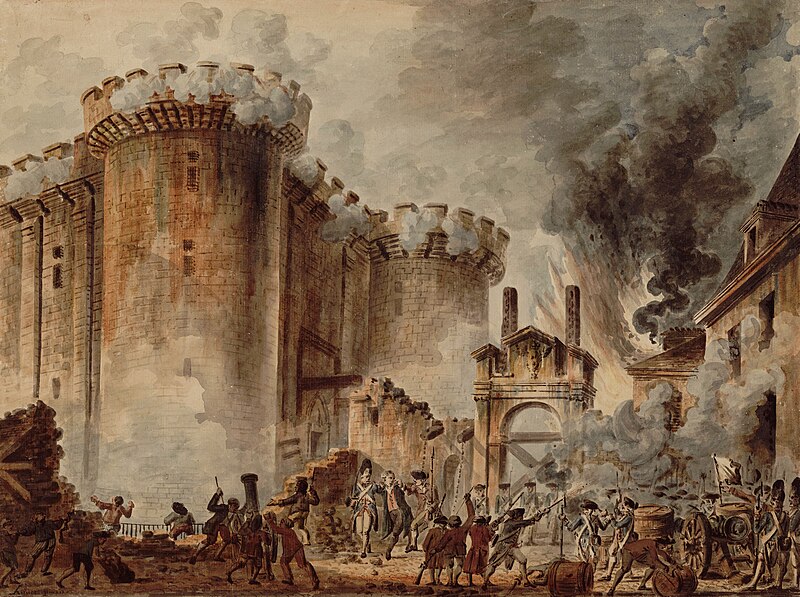
Today is the 235th anniversary of the storming of the Bastille, a 14th century fort and political prison, by a crowd of 1000 Parisian laborers. The historic event marked the beginning of the French Revolution and the symbolic end of absolute monarchy in France. What followed was eight decades of political and social unrest as France and Europe as a whole struggled with the concept of nationalism. In France, the holiday is known as National Day. In the English-speaking world it is known as Bastille Day.
For an expression of the patriotism this day represents, there is but one song and image:
We are reminded of the depth of the French nationalist struggle in the painting below by Eugene Delacroix depicting the July Revolution of 1830 or Second Revolution. A third revolution in France would follow in 1848. This event fueled political upheaval throughout Europe and forced several monarchies to grant reforms favoring the middle and working classes. Another generation would pass before the consitutional laws of 1875 would embody the full intent of liberty, equality, and fraternity for the people of France.
Liberty Leading the People Eugene Delacroix, 1830
Sources
Text:
The Anatomy of Revolution, Crane Brinton, Vantage, Revised edition, 1965
For a prescient and enigmatic 20th century personality it is hard to surpass that of the British social critic and writer, George Orwell. In 1949 he published his most significant work, the novel 1984. Can't speak about today but 60 years ago at the height of the Cold War with the Soviet Union virtually every high school graduate knew of the book and many of them read it or parts of it as required reading.
Orwell experienced the rise of collectivist thinking in Great Britain and other parts of the world including the United States. He was also well aware of the totalitarian collectivism in the Soviet Union. The totalitarianism he rejected outright but not all the elements of collectivist thought At the same time he raised issues with republican and democratic forms of government and the capitalism that sustained them. In other words Orwell was a critic at large whose observation and analysis would have broad appeal and give rise to thought-provoking quotes, including this one from 1949:
The new aristocracy was made up for the most part of bureaucrats, scientists, technicians, trade-union organizers, publicity experts, sociologists, teachers, journalists, and professional politicians.
Our volatile nation-wide experience over the last five years - our dance with the Covid-19 coronavirus, laptop coverups, the Russian disinformation hoax, and Soviet-style political trials - has brought us face to face with many members of this new aristocracy. The American democratic republic embraced many of these players in the 20th century first with Progressivism, then with Roosevelt's New Deal, but it was Lyndon Johnson who would embedded significant elements of the "new aristocracy" in his Great Society program. It was after all a national government initiative designed to end in a progressive utopia for the American people. I leave an evaluation of the program's success over the last two generations to my readers. Instead I choose to focus on Orwell who as time passes seems to be more and more a visitor from the future who spoke not in terms of political parties but in an exploration of the human condition, universal rights, classical liberalism, and the power of the individual.
George Orwell - Eric Arthur Blair - was born on this day in India in 1903 and educated at Eton College and through self-study and his experiences in Asia and Europe. Wikipedia defines him aptly as "an English novelist, essayist, journalist and critic. His work is marked by lucid prose, awareness of social injustice, opposition to totalitarianism, and commitment to democratic socialism."
George Orwell Press Photo, 1933
Most of us know him only as the author of 1984 but there is much more to read and appreciate from this man who is consistently described as one of the most influential writers of the last century. If you only know him as a novelist, I suggest you read some of his early essays, especially Down and Out in Paris and London (1933), The Road to Wigan Pier (1937), and Homage to Catalonia (1938). These works explore social justice themes in some of the finest, most vivid, objective, and descriptive writing to be found in modern English. More aspects of Orwell's insight appear in his literary criticisms which are available in several compilations.
For a man who passed away at 46, George Orwell left us an enormous and rich body of work that I am sure will influence social and political thought for a very long time.
Sources:
Photos and Illustrations: public domain, old accreditation for National Branch of Union Journalists, www.netcharles.com
In a few hours winter arrives in Atlanta. That event as well as the coot evening temperatures will be more than enough to awaken thoughts of sub-freezing temperatures, howling winds and depths of drifting snow measured in feet. Much of the nation won't have long to wait for that weather. Personally I don't look forward to cold temperatures, ice, assorted freezing slop, and black snow lining city streets for the next three months. On the other hand, the thought of lengthening days that arrived with today's solstice brings a big smile to my face. This rebirth of the sun has brought happiness to humans for quite a long time.
The Newgrange Tumulus in County Meath, Ireland, is a nice illustration of this long-standing respect for the rebirth of light and warmth to a culture. The burial mound has a passage that aligns perfectly with the winter solstice sunrise. People have observed the illumination of the keystone at Newgrange for over 4500 years. That's long before Stonehenge and the Giza pyramids existed.
The winter solstice is also know as Midwinter is some circles. Here is unquestionably the song of the day, In the Bleak Midwinter, a perfect blend of nature and the "coming of the light" in the celebration of the birth of Jesus.
In the bleak mid-winter
Frosty wind made moan,
Earth stood hard as iron,
Water like a stone;
Snow had fallen, snow on snow,
Snow on snow,
In the bleak mid-winter
Long ago.
Our God, Heaven cannot hold Him
Nor earth sustain;
Heaven and earth shall flee away
When He comes to reign:
In the bleak mid-winter
A stable-place sufficed
The Lord God Almighty,
Jesus Christ.
Enough for Him, whom cherubim
Worship night and day,
A breastful of milk,
And a mangerful of hay;
Enough for Him, whom angels
Fall down before,
The ox and ass and camel
Which adore.
Angels and archangels
May have gathered there,
Cherubim and seraphim
Thronged the air -
But only His mother
In her maiden bliss
Worshipped the Beloved
With a kiss.
What can I give Him,
Poor as I am?
If I were a shepherd
I would bring a lamb;
If I were a wise man
I would do my part;
Yet what I can, I give Him -
Give my heart.
For the next six months the sun will climb a bit higher every day in the Northern Hemisphere. We won't notice heat from the "rebirth" of the sun until a month or so into this cycle. While the lengthening days can give us hope that the "dead season" will soon come to an end, we can still enjoy the experience of a world at quiet rest.
Sources
Photos and Illustrations:
Newgrange aerial photo, gaia.com Newgrange plan and section, public domain illustration, William Frederick Wakeman, Wakeman's Handbook of Irish Heritage (1903), archives.org