Showing posts with label American history. Show all posts

Monday, January 19, 2026

Martin Luther King, Jr., Day 2026


Today is a national holiday observing the birth of the American civil rights leader, Martin Luther King, Jr. His story is well-known but as it slips further into the past we are less likely to recall the deeper and personal impact he had on American culture in his time. Much of that impact lives on in King's words written and spoken eloquently from the mind as well as the heart. In his Powerline post first published on this day in 2005, Scott Johnson captured King's essence so well with his comments inserted between the paragraphs of King's "Letter from Birmingham Jail" and the speech he delivered in Memphis the day before his assassination.
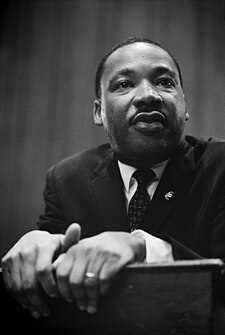

MLK at a press conference in 1964


Here are more words and images of King at his national memorial on the west shore of the Tidal Basin in Washington, D.C.


hotos and Illustrations:
News conference photo; Library of Congress
All others from National Park Service, Martin Luther King, Jr. Memorial webpage


Thursday, September 11, 2025

A Continuing Battle: Remembering 9/11

 For almost two months Muslim forces laid siege to the city of Vienna. Their objective was far larger than a city. It was in fact the defeat of Europe and an end to the Christian world. Fortunately it was not to be. The army of the Holy Roman Empire and the commonwealth of Poland-Lithuania defeated the much larger Army of the Ottoman Empire at the Battle of Vienna, September 11-12. The year was 1683. You can read more about this complex battle at the link. With their defeat the 300 year-long Muslim effort to conquer Europe ended.  That effort 


Battle of Vienna                              Franz Geffels (fl, 1635-1671)


inclued a first siege by Suleiman the Magnificent in 1529.  Wikipedia's Siege of Vienna entry has more on this event as well as others involving the history of this pivotal city over the past thousand years.  

By coincidence or intention the date of September 11 witnessed two significant events in the thousand year long history of religious conflict between Christians and Muslims. I doubt we have seen the last conflict as such history demands remenbrance and vigilance. 

Monday, August 4, 2025

Louis Armstrong: America's Jazzman


If there was one personality to play music as a joyful and universal language in the last century it was Louis Armstrong. He once wrote that "what we play is jazz." He indeed helped make a wonderful world during his near six decades in jazz and popular music. He was a phenomenal jazz trumpeter, performer, writer, stage personality and all around good will ambassador who was born on this day in New Orleans in 1901. He was nicknamed, "Satchmo," short for "satchelmouth," as a child because of his prominent mouth. The moniker stayed with him as he blazed a trail of unforgettable music throughout his life. Although he passed away in 1971 his imprint remains large in popular music and jazz in particular.


Louis Armstrong                                  Adi Holzer, 2002


Here is a short video by storyteller, Mick Carlon, relating Armstrong's impact on the 20th century in a TEDx program for students.


Readers can learn more about Armstrong life and impact at the Louis Armstrong House Museum site.

And here are two pieces of the master at his trade performing Now You Has Jazz at the 1960 Newport Jazz Festival, and his signature song, What A Wonderful World:


And here is Armstrong in 1956 with one of his most beloved collaborators, Ella Fitzgerald, and the Oscar Peterson Quartet in a masterful performance of April In Paris.  To this day the album, Ella and Louis, consistently appears in lists of the top ten jazz albums of all time. 


After just a few minutes of this talent on display, I'm sure readers will agree that Armstrong indeed helped make a wonderful world for his audience. May his smile, his sound, and his goodness stay with us for a long, long time.

Saturday, July 26, 2025

Jean Shepherd: The Man Behind Ralphie And His Unforgettable Christmas


Mention "Ralphie" and "Red Ryder BB gun" in the same breath and I'd say most people could make an immediate connection with the film, A Christmas Story. On the other hand, most people probably know very little about the remarkable personality behind that story. His name is Jean Shepherd.


He was born on July 26, 1921, on Chicago's south side and raised in nearby Hammond, Indiana. After serving in World War II, Shepherd began a career in broadcasting that expanded into writing, film, and live performance. He was heard on late night radio for over twenty years - all unscripted - on New York's WOR where he entertained listeners with his humorous stories, interviews, and practical jokes. Shepherd hosted a television show for WOR as well, but he is best remembered in video narrating a number of productions based on his stories of growing up in the Midwest. Many of the scripts were so popular they later appeared in print. Here is the storyteller at his best on his traditional Christmas Eve broadcast on WOR in 1974. A Christmas Story would emerge from these broadcasts in 1983.


Psychology tells us that humorists often do not have the happiest of life stories. Shepherd was no exception. Although he surely had the talent to become a well-known national treasure, radio did not provide him coast-to-coast exposure available with the new medium of television. He was fiercely independent, a maverick, and one not to take life too seriously. I can imagine he was a threat to the ego of more than one radio executive. Furthermore, he was a "night owl" on radio, broadcasting to a dedicated but smaller audience, and in direct competition with televised local news and the likes of Johnny Carson and The Tonight Show. In fact this warm story by a fan notes that Shepherd likely was in line to take over The Tonight Show with Steve Allen's departure in 1957 but Jack Paar had the right of first refusal with the NBC network. Paar unexpectedly accepted thus denying Shepherd his big break on one of television's most popular shows. Finally, from my research, it seems Shepherd maligned his radio work when he moved into writing film for television in the '70s. Indeed, it apparently was a clean break - maybe the execs were happier without him - and he did go on to success with films, including The Phantom of the Open HearthThe Great American Fourth of July and Other Disasters, and Ollie Hopnoodle's Haven of Bliss. Still, I think the fates denied him the opportunity to become a big television star in the 1950's and much better well-known in his lifetime.


Without question, his best known contribution to American humor is A Christmas Story, a compilation of stories and characters drawn from his earlier work. It was originally produced as a feature film in 1983 and made the transition into a television classic thanks to the persistence of Ted Turner. Almost any man born before 1950 has lived some or all of Ralphie's/Shep's childhood. Each man's path to adulthood is his own, but the markers are identical. Jean Shepherd was a genius at capturing them. And his skills as a narrator made him a natural at weaving life's common threads into humorous and entertaining listening.


". . . the soft glow of electric sex gleaming in the window."

Shepherd died 26 years ago on Sanibel Island, Florida, remembered for one film produced in 1983 when he was 62. There's much more to him than that and I hope more people come to enjoy his work. The settings now and in the future will be different but the collected experiences from childhood and adolescence remain similar and often age into fine wine. Thanks to Shepherd we can laugh at past times and enjoy the harvest.

If you want to explore more of Shepherd's work, the made-for-television film, The Phantom of the Open Hearth, is the place to start. It premiered at Christmas 1976 on public television as a humorous glimpse of Ralphie's teen angst during his high school years in the Midwest. You'll see many of the characters and storylines - yes, the leg lamp is there - that appear in A Christmas Story. These days Phantom is a cult classic among Shepherd fans. If you want to join the cult you can watch the film for free on You Tube.


Sunday, July 20, 2025

Footsteps On The Moon


Lunar Module Eagle in landing configuration, July 20, 1969


July 20, 1969, fifty-six years ago today, the Apollo Lunar Module Eagle landed on the moon. Millions watched at 10:56 PM, EDT, as Neil Armstrong, the commander of the Apollo 11 mission, descended the Eagle's ladder and made what he called a "giant leap for mankind" with his final step onto the powdery lunar surface. Learn more about the Apollo 11 mission here on Wikipedia where you can find scores of links to more National Aeronautics and Space Administration (NASA) reports and multimedia.


Armstrong and Buzz Aldrin, the lunar module pilot, spent almost 22 hours on the moon including their 150 minute walk where they erected an American flag, collected soil and rock samples, and deployed experiments. On their return to Earth much of the material they collected was eventually archived and displayed at the Smithsonian Institution. Some rocks entered our culture in some fascinating ways, including this one at the Washington National Cathedral, where one was embedded at the center of a red planet in what has become known as the Space Window.


Time is catching up with those first attempts at exploring our nearest celestial neighbor. Neil Armstrong passed away in 2012 at the age of 82. Buzz Aldrin turned 94 earlier this year. Michael Collins, the command module pilot, passed away in 2021 at the ago of 90. With the creation of the Artemis program in 2017, the US and its partners hope to return to the lunar surface with a crewed polar landing scheduled for 2025. That's an ambitious target date , but no more so than the private sector timetable for similar missions to Mars. Regardless of what the future holds, those early years including the mission we commemorate today were an exciting and almost magical time for science, exploration, and discovery of the frontier "out there."


Sources

Photos and Illustrations:
atlasobscura.com, Space Window detail
nasa.gov, Space Window, full photo

Text:
Wikipedia.com

Sunday, July 13, 2025

Andrew Wyeth: Master Of Fine Illustration


My career often involved planning and producing a broad variety of visual media including publications, audiovisuals, and museum exhibits. The work made me aware of any number of artists, illustrators and styles both historic and contemporary. It's led me to appreciate the work of two artists in particular. One is Walter Inglis Anderson. There'll be a post about him in September. On this day we note the birth of another favorite, Andrew Wyeth. He was born in Chadds Ford, Pennsylvania, in 1917 and died there in 2009 after a lifetime of painting individuals and landscapes near his home and at his summer residence in Maine. He represented the second of three generations of famous painters in the Wyeth family. His father, N. C. Wyeth, was a renowned illustrator and painter. His son, Jamie, who turned 75 last week, continues painting in his father's footsteps in Pennsylvania and Maine.


I can best characterize his work as compelling, thought-provoking dreamscapes on canvas, not quite real, not quite abstract. Here are three painting by Wyeth offering a comfortable contrast to the season of his birth. Readers can see the full range of his subjects at his authorized website.


Ice Pond 1969

My aim is to escape from the medium with which I work; to leave no residue of technical mannerisms to stand between my expression and the observer. To seek freedom through significant form and design rather than through the diversion of so-called free and accidental brush handling.

Branch in the Snow 1980

My aim is not to exhibit craft, but rather to submerge it, and make it rightfully the handmaiden of beauty, power and emotional content.

Shredded Wheat 1982

What you have to do is break all the rules.


Thanks to the BBC and Michael Palin we have a fine documentary of Andrew Wyeth, his craft and emotion, and especially his sense of place. Hope you take the time to enjoy it.


Sources

Text:
quotations, art-quotes.com

Wednesday, July 9, 2025

He Penned A Masterpiece At 21


Bob Dylan turned 84 earlier this year. That means he's been writing songs for over 60 years. He was only 21 on July 9, 1962 when he walked into the Columbia Recording Studios in New York to record a song to be included on his second album. The song, Blowin' in the Wind, brought him fame and recognition as one of the nation's leading folk poets of the twentieth century. The lyrics and Dylan's comments on the song were published in June 1962 in the folk journal, Sing Out. He said this:


Too many of these hip people are telling me where the answer is but oh I won’t believe that. I still say it’s in the wind and just like a restless piece of paper it’s got to come down some . . . But the only trouble is that no one picks up the answer when it comes down so not too many people get to see and know . . . and then it flies away.


Dylan and Joan Baez, March on Washington, August 8. 1963


The music critic, Andy Gill, said this about the song in his book, Classic Bob Dylan, 1962-1969: My Back Pages:

Blowin' in the Wind marked a huge jump in Dylan's songwriting. Prior to this, efforts like The Ballad of Donald White and The Death of Emmett Till had been fairly simplistic bouts of reportage songwriting. Blowin' in the Wind was different: for the first time, Dylan discovered the effectiveness of moving from the particular to the general. Whereas The Ballad of Donald White would become completely redundant as soon as the eponymous criminal was executed, a song as vague as Blowin' in the Wind could be applied to just about any freedom issue. It remains the song with which Dylan's name is most inextricably linked, and safeguarded his reputation as a civil libertarian through any number of changes in style and attitude.


Blowin' In the Wind is a poem for our time, perhaps all time.


Sources

Photos and Illustrations:
U.S. Archives and Records Service, Rowland Scherman Collection

Text:
wikipedia.com, Bob Dylan entry
history.com

Thursday, July 3, 2025

The Battle Of Gettysburg, July 1-3, 1863: Of Endings and Beginnings


Today marks the conclusion of the Battle of Gettysburg, fought July 1-3, 1863, and the beginning of the end for the Confederate States of America. A year later, in August 1864, the Union unconditionally controlled the Mississippi River and relentlessly pressed Confederate forces in Virginia. In the Deep South, General Sherman's army devastated Atlanta. Six months later, he would be in Savannah and poised to destroy the remains of the Confederacy as he moved north through the Carolinas.


The American Civil War is a perennial topic in our history. Indeed, it did preserve the Union as President Abraham Lincoln intended and left us with any number of consequences in our national experience, both good and bad. Regarding those consequences, we should not expect otherwise as that is the way events unfold in the great wheel of history. And so it is with our great wheels of personal experience. Now in  my seventh decade immersed in all of this I'm a bit surprised and certainly privileged to experience Gettysburg at 100 and 150 years after the pivotal battle. The place is a personal holy ground because three people cared.

The Old Ranger and his dad at Gettysburg in 1954

First of all. my parents always loved being in nature and its historical overlay. Living in the Potomac River watershed afforded our family many opportunities to enjoy any number of places of national significance. As is often the case, first impressions become lasting ones. I was seven years old when we spent a long weekend exploring almost every foot of Gettysburg National Military Park. It was a fascinating experience and I still have the souvenirs to prove it. About six years later I met George Landis, the third person in this story. Landis taught middle school history and social studies on the eve of the Civil War Centennial. A Pennsylvanian with a love of history and basketball, he devoted an entire school year to the study of the Civil War. He was a superb teacher, highly animated and far ahead of his time. He focused on learning that took his students beyond lectures into the world of role-playing, performance, critical thinking and more. I recall fondly seeing every chalkboard in his classroom filled with detailed maps of battles, each carefully drawn and labelled with colored chalk. A little more than a decade after my year with Landis, I began a long and rewarding career immersed in experiential learning in the sacred places and histories in our national parks.

The Old Ranger and his mom at Gettysburg in 1954

There will be tens of thousands of people visiting Gettysburg this holiday week as well as many thousands of volunteers recreating and commemorating the events that took place there. Lasting impressions will be made this week about the sacrifice, the consequences, and the wheels of history both national and personal. And somewhere in that crowd will be a seven year-old with a new enthusiasm for a defining moment in our national experience. The commemorative landscape at Gettysburg will wait with pride and serenity like an old veteran to welcome him on his return visit in 2063.

Sunday, June 29, 2025

Lena Horne: An American Legend


In the years around the turn of the century I was a member of the planning and design team for the newly established Tuskegee Airmen National Historic Site in Alabama. Fundraising was a big part of our mission and we asked a large core group of airmen who they would like to see as a national spokesman for the effort. To a man, the response was, "Lena Horne!" who made a number of visits to their two Tuskegee airfields during World War II. They adored her. She was beautiful, had a sultry voice, the perfect figure for a World War II pinup, and a highly successful musical career on stage and screen. She was also strong-willed and, at times, defiant, both characteristics that served her well in the American civil rights movement following the war. No wonder she appealed to them.


Horne publicity photo from 1964, NBC Bell Telephone Hour


Who was this international star and favorite pinup? Lena Horne was born on this day in Brooklyn in 1917. Those familiar with the singer will always remember her remarkable talent as a legendary performer with a sparkling personality and a beautiful smile, In her almost seventy years in entertainment she worked the big band and cabaret circuits, movies, Broadway, and television. She became politically active in the fight for civil rights following World War II, a decision that placed her on the federal entertainment blacklist for over a decade. Readers can learn more details about Horne's life and career in a New York Times obituary published following her death in May 2010.


Horne at Tuskegee Institute banquet, Tuskegee, Alabama, during World War II


Due to her age and disabilities, Horne was unable to take on the role the Tuskegee Airmen so enthusiastically desired but fundraising commenced in a different direction and eventually contributed to construction and interpretation at the park. Her image and the stories of her visits are embedded in those exhibits.

I remember Horne well from her frequent television performances and recordings beginning in the 1950's. She's always been a personal favorite among pop and jazz singers and the stories of her association with the Tuskegee Airmen tells me she was one very special lady.

Here she is performing her signature song, Stormy Weather, from the 1943 film of the same name.


And here is a fine synopsis of the life and times of Horne prepared for a segment of the PBS News Hour in 2010.


Sources

Photos and Illustrations:
public domain photograph, NBC Television, Wikipedia.org
banquet photo, Noel Parrish Collection, Manuscript Division, Library of Congress, Washington

Friday, June 27, 2025

Happy Birthday, Mel Brooks: He's 99 Years Young Today


When he was 14, Mel Brooks, began his career in show business as a comedian at several Catskill Mountain resorts north of New York City. After service in Germany in World War II - he dismantled booby traps and defused land mines among other duties - he returned home determined to establish a career in entertainment where he soon found himself enjoying writing more than performing. He honed that skill for several years on Sid Caesar's Show of Shows and Caesar's Hour. Around 1960 he teamed up with Carl Reiner, also a Caesar comedy writer, to develop a sketch that would make both of them famous.


Entitled "The 2000 Year-Old Man," the concept featured a comic Brooks as the old man being interviewed by Reiner as the straight man. Over fifty years the duo produced several recordings of the often ad lib sketches produced in studio as well as live on countless television programs. After this success and a move to Hollywood filmmaking wasn't far behind.

Today we wish the 2000 year-old man a very happy birthday. The performer, writer, director, producer, songwriter, and perpetually wacko comic personality is 99 years old. In his seventy year career he's brought us some of the finest comedy to grace the American stage, big screens in theaters, and the television screens in millions of our homes. And there's no end in sight either with his work in animated features and now rare television appearances. It's only a guess where his talents could emerge in the future.


Brooks in a still from Blazing Saddles, 1974


His film career began with The Producers in 1968. The rest is history, a laugh track of films including:

Blazing Saddles (1974) "Mongo only pawn...in game of life."

Young Frankenstein (1974) "Abby...Normal."

Silent Movie (1976) "Non!"

High Anxiety (1977) "Those who are tardy do not get fruit cup!"

History of the World Part I (1981) "It's good to be the king."

Spaceballs (1987) "May the schwartz be with you."

Robin Hood: Men in Tights (1993) "Actually Scarlet is my middle name. My whole name is Will Scarlet O'Hara. We're from Georgia."

Dracula: Dead and Loving It (1995) "I have been to many stakings - you have to know where to stand! You know, everything in life is location, location, location...."

The Producers (musical) 2001 "Will the dancing Hitlers please wait in the wings? We are only seeing singing Hitlers.

The Producers (film remake) 2005 "My blue blanket! Give me back my blue blanket!"

Young Frankenstein (musical) 2007 "He vas my boyfriend!"


The American Film Institute's 100 Greatest Comedies list has The Producers (1968), Blazing Saddles, and Young Frankenstein ranked at #11, #6, and #13. Here is the unforgettable three minutes and twenty seconds from the film he calls his personal favorite, the 1968 production of The Producers:


I think one reason why the 2000 year-old man is still laughing with us at 99 rests with the fact that the Mel Brooks on stage and film is most often the same man one finds in private life. How does he do it? I recall the many stories my National Park Service colleagues told of Brooks and his wife, Anne Bancroft. In the '70's and '80's they were frequent guests at Caneel Bay Resort inside Virgin Islands National Park on the island of St. John. Known for playing practical jokes on the younger park rangers and resort staff during the day, Brooks and Bancroft hosted them at after-hours gatherings where hilarity ruled. Given the public comedy we know, one can only imagine the memories to come out of the spontaneity of such an evening. The world would be a far happier place if all of us could have more evenings like that.

Today, instead of laughing at the comedy and satire Brooks gave us over the years the political correctness of the day would rather smother it and insure we never produce it again. So unfortunate. Regardless, with the passing of Carl Reiner at 98 in 2020, we're looking at Brooks as the last man standing from a remarkable era of comedy entertainment in the US. Here's wishing one of the funniest men on the planet a very happy birthday. It's my hope that we can laugh at his wacko genius for years to come. 


For more information as well as a most entertaining read this summer I recommend Brooks's memoir published in 2021. Without a doubt it will leave you smiling.


But wait, there's more. Brooks has two new projects under developement. First, there is Very Young Frankenstein, a television series influenced  by his earlier film, Young Frankenstein, in 1974. A pilot is expected soon. The second project is Spaceballs 2, a sequel to his 1987 film, Spaceballs. The film is expected to be released in 2027.


Wednesday, June 25, 2025

George Orwell: To Have A Mind For The Future


For a prescient and enigmatic 20th century personality it is hard to surpass that of the British social critic and writer, George Orwell. In 1949 he published his most significant work, the novel 1984. Can't speak about today but 60 years ago at the height of the Cold War with the Soviet Union virtually every high school graduate knew of the book and many of them read it or parts of it as required reading.


Orwell experienced the rise of collectivist thinking in Great Britain and other parts of the world including the United States. He was also well aware of the totalitarian collectivism in the Soviet Union. The totalitarianism he rejected outright but not all the elements of collectivist thought At the same time he raised issues with republican and democratic forms of government and the capitalism that sustained them. In other words Orwell was a critic at large whose observation and analysis would have broad appeal and give rise to thought-provoking quotes, including this one from 1949:

The new aristocracy was made up for the most part of bureaucrats, scientists, technicians, trade-union organizers, publicity experts, sociologists, teachers, journalists, and professional politicians.

Our volatile nation-wide experience over the last five years - our dance with the Covid-19 coronavirus, laptop coverups, the Russian disinformation hoax, and Soviet-style political trials - has brought us face to face with many members of this new aristocracy. The American democratic republic embraced many of these players in the 20th century first with Progressivism, then with Roosevelt's New Deal, but it was Lyndon Johnson who would embedded significant elements of the "new aristocracy" in his Great Society program. It was after all a national government initiative designed to end in a progressive utopia for the American people. I leave an evaluation of the program's success over the last two generations to my readers. Instead I choose to focus on Orwell who as time passes seems to be more and more a visitor from the future who spoke not in terms of political parties but in an exploration of the human condition, universal rights, classical liberalism, and the power of the individual.

George Orwell - Eric Arthur Blair - was born on this day in India in 1903 and educated at Eton College and through self-study and his experiences in Asia and Europe. Wikipedia defines him aptly as "an English novelist, essayist, journalist and critic. His work is marked by lucid prose, awareness of social injustice, opposition to totalitarianism, and commitment to democratic socialism."


George Orwell Press Photo, 1933


Most of us know him only as the author of 1984 but there is much more to read and appreciate from this man who is consistently described as one of the most influential writers of the last century. If you only know him as a novelist, I suggest you read some of his early essays, especially Down and Out in Paris and London (1933), The Road to Wigan Pier (1937), and Homage to Catalonia (1938). These works explore social justice themes in some of the finest, most vivid, objective, and descriptive writing to be found in modern English. More aspects of Orwell's insight appear in his literary criticisms which are available in several compilations.

For a man who passed away at 46, George Orwell left us an enormous and rich body of work that I am sure will influence social and political thought for a very long time.


Sources:

Photos and Illustrations:
public domain, old accreditation for National Branch of Union Journalists, www.netcharles.com

Text:
George Orwell, wikipedia.org

Monday, June 23, 2025

Two Pilots, One Single Engine Airplane, And A Flight Around The World


Wiley Post and Harold Gatty left New York on this day in 1931 on the first single-engine flight around the world.


The two successful ocean fliers during their stopover at the Central Airport in Berlin - Tempelhof about to start their flight to Moscow .

It's hard to believe this event occurred just fifteen years before my birth. We've come a long way in aviation and when you think about all the aircraft in flight around the world at this very minute the Post-Gatty flight seems insignificant. As readers of this blog know, I'm somewhat fond of aviation so I'm perfectly happy to give these pioneers the credit they deserve in a time when history seems little more than an afterthought. God willing, in fifteen years I may see history made by astronauts on the surface of Mars.


Leonardo Dreams of His Flying Machine

Music, Eric whitacre
Lyrics, Charles Anthony Silvestri

I.
Leonardo Dreams of his Flying Machine…
Tormented by visions of flight and falling,
More wondrous and terrible each than the last,
Master Leonardo imagines an engine
To carry a man up into the sun…

And as he’s dreaming the heavens call him,
softly whispering their siren-song:
“Leonardo. Leonardo, vieni á volare”. (“Leonardo. Leonardo, come fly”.)

L’uomo colle sua congiegniate e grandi ale,
facciendo forza contro alla resistente aria.
(A man with wings large enough and duly connected
might learn to overcome the resistance of the air.)

II.
Leonardo Dreams of his Flying Machine…

As the candles burn low he paces and writes,
Releasing purchased pigeons one by one
Into the golden Tuscan sunrise…

And as he dreams, again the calling,
The very air itself gives voice:
“Leonardo. Leonardo, vieni á volare”. (“Leonardo. Leonardo, come fly”.)

Vicina all’elemento del fuoco…
(Close to the sphere of elemental fire…)

Scratching quill on crumpled paper,

Rete, canna, filo, carta.
(Net, cane, thread, paper.)

Images of wing and frame and fabric fastened tightly.

…sulla suprema sottile aria.
(…in the highest and rarest atmosphere.)

III.
Master Leonardo Da Vinci Dreams of his Flying Machine…
As the midnight watchtower tolls,
Over rooftop, street and dome,
The triumph of a human being ascending
In the dreaming of a mortal man.

Leonardo steels himself,
takes one last breath,
and leaps…

“Leonardo, Vieni á Volare! Leonardo, Sognare!” (“Leonardo, come fly! Leonardo, Dream!”)


Sources:

kalw.org, almanac

Photo:
Deutsches Bundesarchiv, photo 102-11928

Lyrics:
 ericwhitacre.com

Thursday, June 19, 2025

Juneteenth 2025


Juneteenth? So, what is the new holiday about? If you are an American with African ancestry dating to the Civil War era you have known about Juneteenth from very early childhood; otherwise, the term may be vaguely familiar or perhaps even new. I think of Juneteenth as an ingredient in our national experience that is just now blending in the melting pot concept we learned about in elementary school. We're going to hear much more about the day as we should. This description from the Library of Virginia is a good place to start:


[Juneteenth] has grown into a popular event across the country to commemorate emancipation from slavery and celebrate African American culture. Juneteenth refers to June 19, the date in 1865 when the Union Army arrived in Galveston and announced that the Civil War was over and that slaves were free under the Emancipation Proclamation. Although the proclamation had become official more than two years earlier on January 1, 1863, freedmen in Texas adopted June 19th, later known colloquially as Juneteenth, as the date they celebrated emancipation. Juneteenth celebrations continued into the 20th century, and survived a period of declining participation because of the Great Depression and World War II. In the 1950s and 1960s Juneteenth celebrations witnessed a revival as they became catalysts for publicizing civil rights issues of the day. In 1980 the Texas state legislature established June 19 as a state holiday.


Emancipation Thomas Nast, American, 1865


Several significant days have competed to honor the subject including:

September 22: the day Lincoln issued his preliminary Emancipation Proclamation Order in 1862;

January 1: the day it took effect in 1863;

January 31: the date the 13th Amendment passed Congress in 1865, officially abolishing the institution of slavery, and;

December 6: the day the 13th Amendment was ratified in 1865.


The persistence of the celebration in Texas on June 19 embedded the celebration in the social fiber of former slaves and their families who carried it with them in their migrations to all corners of the nation and to urban areas in particular. Growing wealth among black communities in the 20th century enabled them to hold lengthier and more elaborate celebrations.

Despite a near-century of prejudice and racism, both de jure and de facto, Juneteenth survived across the nation. It was revitalized nationally by the assassination of Martin Luther King Jr. (April 4, 1968), in combination with his Poor People's March on Washington (planned for May 12 to June 24, and its early conclusion with the Solidarity March on June 19.

We extend our best wishes for a joyous day to all those celebrating Juneteenth. And it's the perfect time for all of us to "honor the countless contributions made by African Americans to our Nation and pledge to support America’s promise as the land of the free."

Visit Juneteenth to learn more about story and meaning of our newest national holiday.


Sources:

Photos and Illustrations:
Library of Congress at loc.gov

Text:
virginiamemory.com
loc.gov
wikipedia.com
pbs.org, The African-Americans: Many Rivers to Cross
"honor the countless" quote, whitehouse.gov

Saturday, June 14, 2025

Flag Day 2025 And The United States Army's 250th Birthday


Today is Flag Day, a day for commemorating the adoption of a design by Francis Hopkinson as the official Flag of the United States on this date in 1777. President Woodrow Wilson issued a proclamation in 1919 declaring June 14 as the official day.


Francis Hopkinson Flag, 1777


Here are some words about the Hopkinson flag from the link above:


Hopkinson is recognized as the designer of the official "first flag" of the United States. Although he sought compensation from Congress, the letter was somewhat comical. He asked for a quarter cask of wine in payment for the flag, the Great Seal, and various other contributions. Congress used the usual bureaucratic tactics of asking for an itemized bill. After some back and forth, Congress eventually refused on the pretext that Hopkinson was already paid as a public servant. The letter also mentioned that Hopkinson collaborated with others on his designs because he was one of many contributing to the Great Seal.
While there is no known Hopkinson flag in existence today, we do know from his rough sketch that it had thirteen stars and thirteen stripes. It is believed that his flag used red and white stripes and white stars on a field of blue. Because the original stars used in the Great Seal had six points, we might also assume that Hopkinson's flag intended the use of a 6-pointed star. This is bolstered by his original sketch that showed asterisks with six points.

The legend of Betsy Ross as the designer of the first flag entered into American consciousness about the time of the 1876 centennial celebrations. See Betsy Ross Flag for the full story. Today many Americans still cling to the legend that she designed the first flag with it's familiar circle of thirteen stars, At the same time most are unaware of Hopkinson's legacy.

There are any number of songs written about our national flag. Among the best of them is George M. Cohan's 1906 rouser, You're A Grand Old Rag, written in 1906 for his musical, George Washington, Jr. Here it is performed by Billy Murray, the best selling recording artist of the earthy 20th century.


That's right, you read and heard "rag" instead of "flag". Cohen wrote the song inspired by a Civil War veteran clutching a tattered US flag he referred to as a grand old rag. Although the song was an immediate success many individuals and patriotic groups were uncomfortable with "rag" referring to such a sacred symbol. Eager to please his audience, Cohan soon published a revision with new words and a new title, You're A Grand Old Flag. 

And while you admire the Grand Old Flag remember that today is the 250th birthday of the United States Army. These words from the America250 webpage say it all:

On June 14, 1775, the Second Continental Congress voted to establish the Continental Army. This action marked the creation of America’s first national military force, more than a year before the signing of the Declaration of Independence.

For 250 years, the United States Army has played a vital role in defending America. From the Revolutionary War to the present day, Americans have served selflessly–many sacrificing their lives–in defense of the country. Our service members’ courage, loyalty, and dedication have inspired generations. At the same time, Army-led innovations and breakthroughs–from radar and the internet to everyday items like wireless communications–have advanced our national security, transformed global commerce, and propelled America’s economic competitiveness.


Sources

Photos and Illustrations:
Hopkinson Flag, public domain image, Wikimedia.org
America250.org

Text:
Francis Hopkinson, entry, Wikipedia.org
"You're A Grand Old Flag," entry, Wikipedia.org


ShareThis