Showing posts with label science. Show all posts

Tuesday, July 22, 2025

It's "Wheels Up" At AirVenture Oshkosh 2025


The Experimental Aircraft Association's (EAA) annual week-long AirVenture gathering in Oshkosh, Wisconsin, is underway. It's better known as "Oshkosh" to aviation enthusiasts and you can be assured that every one of them has the event on their bucket list. There's good reason. Imagine a fly-in attracting around 7500 airplanes. Imagine 2500 aircraft exhibits, 800 commercial exhibitors, daily world-class airshows, and a total of around 700,000 guests.
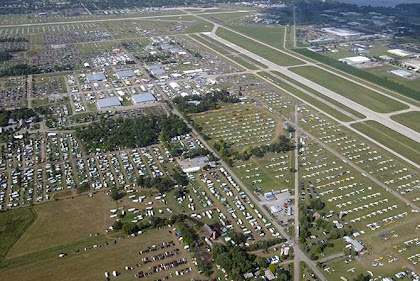


AirVenture at Oshkosh is far from your average fly-in


Organizers call the event "the world's greatest aviation celebration" and this year marks its seventy-second edition. The map below gives readers an idea of the scope and scale of Oshkosh and indicates why the event turns a rather sleepy Wittman Regional Airport into the busiest airport in the world for one week each year.


AirVenture grounds - for scale, that's an 8000 foot runway at the top 

AirVenture grounds looking east to Lake Winnebago


I had the privilege of attending the event several times in the last decade of my career. Energizing, informative, and significant, the show was a great vehicle for delivering an organizational message to a large, captured, and enthusiastic audience. You may ask why the National Park Service (NPS) would send a dozen or so employees and volunteers to work an air show. First, the agency has almost fifty out of its more than 400 units with a significant link to an aviation theme. In addition, the Service maintains a fleet of fixed and rotary wing aircraft contributing over 20,000 hours of flight time annually in support of park operations, maintenance, and resource and fire management. Add to that interagency cooperation across departments as well as airspace regulation over the parks and the justification become clearer. In recent years the NPS's presence at the event has been reduced significantly and folded into a more cooperative effort with other federal agencies. In summation, it's a grand and demanding opportunity to reach out face-to- face with thousands of guests who enjoy and impact resources and services in and ver the parks.


Nothing like fly-in camping with thousands of your best - in this case closest - friends


If you can't attend AirVenture, the EAA maintains a comprehensive up-to-the-second website where you can spend hours reading, watching and listening to events. I've been looking up at the sound of an aircraft engine ever since I could lift my head. If you are blessed with the same response make your plans to attend an Experimental Aircraft Association AirVenture. You will not be disappointed. Until then "wheels up" every chance you get!


Sunday, July 20, 2025

Footsteps On The Moon


Lunar Module Eagle in landing configuration, July 20, 1969


July 20, 1969, fifty-six years ago today, the Apollo Lunar Module Eagle landed on the moon. Millions watched at 10:56 PM, EDT, as Neil Armstrong, the commander of the Apollo 11 mission, descended the Eagle's ladder and made what he called a "giant leap for mankind" with his final step onto the powdery lunar surface. Learn more about the Apollo 11 mission here on Wikipedia where you can find scores of links to more National Aeronautics and Space Administration (NASA) reports and multimedia.


Armstrong and Buzz Aldrin, the lunar module pilot, spent almost 22 hours on the moon including their 150 minute walk where they erected an American flag, collected soil and rock samples, and deployed experiments. On their return to Earth much of the material they collected was eventually archived and displayed at the Smithsonian Institution. Some rocks entered our culture in some fascinating ways, including this one at the Washington National Cathedral, where one was embedded at the center of a red planet in what has become known as the Space Window.


Time is catching up with those first attempts at exploring our nearest celestial neighbor. Neil Armstrong passed away in 2012 at the age of 82. Buzz Aldrin turned 94 earlier this year. Michael Collins, the command module pilot, passed away in 2021 at the ago of 90. With the creation of the Artemis program in 2017, the US and its partners hope to return to the lunar surface with a crewed polar landing scheduled for 2025. That's an ambitious target date , but no more so than the private sector timetable for similar missions to Mars. Regardless of what the future holds, those early years including the mission we commemorate today were an exciting and almost magical time for science, exploration, and discovery of the frontier "out there."


Sources

Photos and Illustrations:
atlasobscura.com, Space Window detail
nasa.gov, Space Window, full photo

Text:
Wikipedia.com

Tuesday, December 17, 2024

A Dream Beyond Time Comes True


On this day in 1903 at Kitty Hawk on the outer banks of North Carolina, the 27-mph wind was harder than they would have liked since their predicted cruising speed was only 30-35 mph. The headwind would slow their ground speed to a crawl but they proceeded anyway. With a sheet they signaled the volunteers from the nearby lifesaving station that they were about to try again.

Now it was Orville's turn. Remembering Wilbur's experience, he positioned himself and tested the controls. The stick that moved the horizontal elevator controlled climb and descent. The cradle that he swung with his hips warped the wings and swung the vertical tails, which in combination turned the machine. A lever controlled the gas flow and airspeed recorder. The controls were simple and few, but Orville knew it would take all his finesse to handle the new and heavier aircraft. At 10:35, he released the restraining wire. The flyer moved down the rail as Wilbur steadied the wings. Just as Orville left the ground, John Daniels from the lifesaving station snapped the shutter on a preset camera, capturing the historic image of the airborne aircraft with Wilbur running alongside.


The Wright Flyer begins its first successful flight, December 17, 1903


Again, the flyer was unruly, pitching up and down as Orville overcompensated with the controls. But he kept it aloft until it hit the sand about 120 feet from the rail. Into the 27-mph wind, the ground speed had been 6.8 mph, for a total airspeed of 34 mph. The brothers took turns flying three more times that day, getting a feel for the controls and increasing their distance with each flight. Wilbur's second flight - the fourth and last of the day – was an impressive 852 feet in 59 seconds.

This was the real thing, transcending the powered hops and glides others had achieved. After four years of research and development the Wright machine had flown.


Monuments spanning the 120 feet of the first flight


On completing the flight the brothers walked four miles to Kitty Hawk and sent their father a telegram:


Success four flights Thursday morning all against twenty one mile wind started from level with engine power alone average speed through air thirty one miles longest 57 seconds inform Press home Christmas

Their pilot-controlled, sustained and powered flight by a heavier-than-air machine would soon change the world.

For comprehensive information on this historic event visit the National Park Service's Wright Brothers National Memorial web page.


Credits:

1903 photograph, unrestored version: Library of Congress
Monuments photo; text: National Park Service, Wright Brothers National Memorial


Tuesday, July 23, 2024

EAA AirVenture 2024 At Oshkosh


Today is Day 2 of the Experimental Aircraft Association's (EAA) annual week-long AirVenture gathering in Oshkosh, Wisconsin. It's better known as "Oshkosh" to aviation enthusiasts and you can be assured that every one of them has the event on their bucket list. There's good reason. Imagine a fly-in attracting around 7500 airplanes. Imagine 2500 aircraft exhibits, 800 commercial exhibitors, daily world-class airshows, and a total of over 600,000 guests.


It's far from your average fly-in


Organizers call the event "the world's greatest aviation celebration" and this year marks its 71st edition. The map below gives readers an idea of the scope and scale of Oshkosh and indicates why the event turns a rather sleepy Wittman Regional Airport into the busiest airport in the world for one week each year.


AirVenture grounds - for scale, that's an 8000 foot runway at the top


I had the privilege of attending the event several times in the last decade of my career. Energizing, informative, and significant, the show was a great vehicle for delivering an organizational message to a large, captured, and enthusiastic audience. You may ask why the National Park Service (NPS) would send a dozen or so employees and volunteers to work an air show. First, the agency has almost fifty out of its more than 400 units with a significant link to an aviation theme. In addition, the Service maintains a fleet of fixed and rotary wing aircraft contributing over 20,000 hours of flight time annually in support of park operations, maintenance, and resource and fire management. Add to that interagency cooperation across departments as well as airspace regulation over the parks and the justification become clearer. In recent years the NPS's presence at the event has been reduced significantly and folded into a more cooperative effort with other federal agencies. In summation, it's a grand and demanding opportunity to reach out face-to- face with thousands of guests who enjoy and impact agency resources and services.


Nothing like fly-in camping with thousands of your best - in this case closest - friends


If you can't attend AirVenture, the EAA maintains a comprehensive up-to-the-second website where you can spend hours reading, watching and listening to events. I've been looking up at the sound of an aircraft engine ever since I could lift my head. If you are blessed with the same response make your plans to attend an Experimental Aircraft Association AirVenture. You will not be disappointed. Until then "wheels up" every chance you get!


Saturday, July 20, 2024

Americans On The Moon 1969


Lunar Module Eagle in landing configuration, July 20, 1969


July 20, 1969, fifty-five years ago today, the Apollo Lunar Module Eagle landed on the moon. Millions watched at 10:56 PM, EDT, as Neil Armstrong, the commander of the Apollo 11 mission, descended the Eagle's ladder and made what he called a "giant leap for mankind" with his final step onto the powdery lunar surface. Learn more about the Apollo 11 mission here on Wikipedia where you can find scores of links to more National Aeronautics and Space Administration (NASA) reports and multimedia.


Armstrong and Buzz Aldrin, the module pilot, spent almost 22 hours on the moon including their 150 minute walk where they erected an American flag, collected soil and rock samples, and deployed experiments. On their return to Earth much of the material they collected was eventually archived and displayed at the Smithsonian Institution. Some rocks entered our culture in some fascinating ways, including this one at the Washington National Cathedral, where one was embedded at the center of a red planet in what has become known as the Space Window.


Time is catching up with those first attempts at exploring our nearest celestial neighbor. Neil Armstrong passed away in 2012 at the age of 82. Buzz Aldrin turned 94 earlier this year. With the creation of the Artemis program in 2017, the US and its partners hope to return to the lunar surface with a crewed polar landing scheduled for 2025. That's an ambitious target date , but no more so than the private sector timetable for similar missions to Mars. Regardless of what the future holds, those early years including the mission we commemorate today were an exciting and almost magical time for science, exploration, and discovery of the frontier "out there."


Sources

Photos and Illustrations:
atlasobscura.com, Space Window detail
nasa.gov, Space Window, full photo

Text:
Wikipedia.com

Friday, April 26, 2024

Chernobyl After 38 Years


Abandoned room in the Chernobyl Exclusion Zone


The Chernobyl Nuclear Power Plant (Ukraine) reactor explosion and fire occurred on this day in 1986. The event remains the worst accident of its kind. A precise number of casualties will never be known beyond the 41 who died during and in the few months following the event.

On the edge of the plant, a city died. Its 50,000 people were evacuated in two days leaving behind a photograph of interrupted lives. In the 38 years since the reactor meltdown and fire the decaying remains of Pripyat have become a prime destination for those seeking the disturbing presence of abandoned and decaying places.


The background radiation in Pripyat remains about three times above normal with hot spots exceeding fifty times normal. The situation has not prevented the growth of a robust tourist industry focused on the event and its aftermath. Although the recent Russian invasion of Ukraine has brought tourism to a halt this site is a good indicator of the response to curiosity surrounding the area. In time I have no doubt that tourists will return to experience what has become one of the strangest places on the planet.


Tuesday, February 20, 2024

John Glenn Makes History Aboard The Spacecraft, Freedom 7


Sixty-two years ago today, John Glenn rocketed into space history to become the first American to orbit Earth. In 1962, Glenn made three orbits then returned to a splashdown about 500 miles northeast of Puerto Rico. Over the years more 350 Americans have joined him in space travel.


John Glenn in orbit, February 20, 1962


The NASA website has a fine multimedia presentation on Mercury-Atlas 6, the mission that put Glenn and his spacecraft, Friendship 7, into orbit. Wikipedia has a page on the mission and some excellent recommendations for further reading online. To commemorate the event, The Ohio State University has a comprehensive look at Glenn's life and that of his wife, Annie. I also recommend The Right Stuff, Tom Wolfe's outstanding 1979 book on the formative days of the American space program and the seven astronauts - including Glenn - selected for the Mercury program.

When we look back at the American space program, this achievement was one of the nation's proudest moments. It's heartening to see a renewed interest in space exploration let alone definitive commitments to future astronauts, a return to the moon or a mission to Mars on the part of our national government. I imagine this is in part due to commercial competition. You can learn more about our reach into space by the private sector at this this Wired link.


Glenn in training, January 20, 1962


Sunday, December 17, 2023

The Wright Brothers: The Dividend Of Perseverance


On this day in 1903 at Kitty Hawk on the outer banks of North Carolina, the 27-mph wind was harder than they would have liked since their predicted cruising speed was only 30-35 mph. The headwind would slow their ground speed to a crawl but they proceeded anyway. With a sheet they signaled the volunteers from the nearby lifesaving station that they were about to try again.

Now it was Orville's turn. Remembering Wilbur's experience, he positioned himself and tested the controls. The stick that moved the horizontal elevator controlled climb and descent. The cradle that he swung with his hips warped the wings and swung the vertical tails, which in combination turned the machine. A lever controlled the gas flow and airspeed recorder. The controls were simple and few, but Orville knew it would take all his finesse to handle the new and heavier aircraft. At 10:35, he released the restraining wire. The flyer moved down the rail as Wilbur steadied the wings. Just as Orville left the ground, John Daniels from the lifesaving station snapped the shutter on a preset camera, capturing the historic image of the airborne aircraft with Wilbur running alongside.


The Wright Flyer begins its first successful flight, December 17, 1903


Again, the flyer was unruly, pitching up and down as Orville overcompensated with the controls. But he kept it aloft until it hit the sand about 120 feet from the rail. Into the 27-mph wind, the ground speed had been 6.8 mph, for a total airspeed of 34 mph. The brothers took turns flying three more times that day, getting a feel for the controls and increasing their distance with each flight. Wilbur's second flight - the fourth and last of the day – was an impressive 852 feet in 59 seconds.

This was the real thing, transcending the powered hops and glides others had achieved. After four years of research and development the Wright machine had flown.


Monuments spanning the 120 feet of the first flight


On completing the flight the brothers walked four miles to Kitty Hawk and sent their father a telegram:


Success four flights Thursday morning all against twenty one mile wind started from level with engine power alone average speed through air thirty one miles longest 57 seconds inform Press home Christmas


Their pilot-controlled, sustained and powered flight by a heavier-than-air machine would soon change the world.

For comprehensive information on this historic event visit the National Park Service's Wright Brothers National Memorial web page.


Credits:

1903 photograph, unrestored version: Library of Congress
Monuments photo; text: National Park Service, Wright Brothers National Memorial


Sunday, August 6, 2023

Special Bombing Mission Number 13, August 6, 1945


On August 6, 1945 at 8:15 a.m. Japan Local Time the world changed.

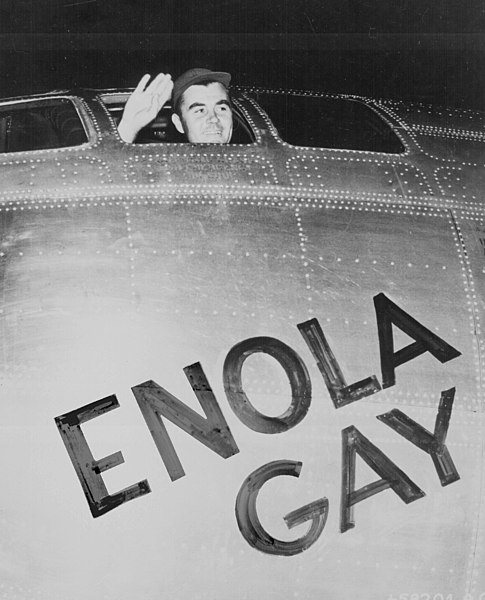
Forty-three seconds after releasing the bomb nicknamed "Little Boy," pilot Col. Paul Tibbets was alerted to the blast by radioactivity tingling in his teeth and the metallic taste from electrolysis on his tongue. Ten and a half miles away, tens of thousands of people had already vanished in a brilliant flash. A massive firestorm would grip the city within minutes and kills thousands more. This photo taken minutes after the blast at a distance of six miles was found in a suburban Hiroshima grade school in 2013:


The photo below was taken after the removal of street and lot debris and revealed the full extent of the destruction.


As the first use of an atomic weapon against an enemy, the decision to drop the bomb on Hiroshima - and Nagasaki three days later - was controversial. The decision assuredly brought a very quick end to the war with Japan and in the eyes of most historians and military experts saved the lives of millions of combatants and civilians. For more on this historic event and its aftermath readers should visit the Harry S. Truman Library & Museum's outstanding archive of primary sources relating to the story.


Tibbets, pilot and commander, in the cockpit prior to takeoff for Hiroshima


For a three minute assessment of the event by Tibbets visit this history.com link.


The last surviving Enola Gay crew member - Theodore "Dutch" Van Kirk - died at his home in Stone Mountain, Georgia, in 2014. It's one more indication that our greatest generation as an eyewitness to history is itself rapidly moving into history.


Sources

Photos and Illustrations:
Ground photo, gizmodo.com.au
Hiroshima aftermath, U.S. Navy Public Affairs Website, chinfo.navy.milEnola Gay photo, National Archives and Records Service


Monday, July 24, 2023

AirVenture Over Oshkosh 2023


The Experimental Aircraft Association's (EAA) annual week-long AirVenture gathering in Oshkosh, Wisconsin, kicks off today. It's better known as "Oshkosh" to aviation enthusiasts and you can be assured that every one of them has the event on their bucket list. There's good reason. Imagine a fly-in attracting around 7500 airplanes. Imagine 2500 aircraft exhibits, 800 commercial exhibitors, daily world-class airshows, and a total of over 600,000 guests.


AirVenture at Oshkosh is far from your average fly-in


Organizers call the event "the world's greatest aviation celebration" and this year marks its seventieth edition. The map below gives readers an idea of the scope and scale of Oshkosh and indicates why the event turns a rather sleepy Wittman Regional Airport into the busiest airport in the world for one week each year.


AirVenture grounds - for scale, that's an 8000 foot runway at the top 


I had the privilege of attending the event several times in the last decade of my career. Energizing, informative, and significant, the show was a great vehicle for delivering an organizational message to a large, captured, and enthusiastic audience. You may ask why the National Park Service (NPS) would send a dozen or so employees and volunteers to work an air show. First, the agency has almost fifty out of its more than 400 units with a significant link to an aviation theme. In addition, the Service maintains a fleet of fixed and rotary wing aircraft contributing over 20,000 hours of flight time annually in support of park operations, maintenance, and resource and fire management. Add to that interagency cooperation across departments as well as airspace regulation over the parks and the justification become clearer. In recent years the NPS's presence at the event has been reduced significantly and folded into a more cooperative effort with other federal agencies. In summation, it's a grand and demanding opportunity to reach out face-to- face with thousands of guests who enjoy and impact resources and services they provide.


Nothing like fly-in camping with thousands of your best - in this case closest - friends


If you can't attend AirVenture, the EAA maintains a comprehensive up-to-the-second website where you can spend hours reading, watching and listening to events. I've been looking up at the sound of an aircraft engine ever since I could lift my head. If you are blessed with the same response make your plans to attend an Experimental Aircraft Association AirVenture. You will not be disappointed. Until then "wheels up" every chance you get!


Thursday, July 20, 2023

A Leap Of Faith In One Small Step


Lunar Module Eagle in landing configuration, July 20, 1969


July 20, 1969, fifty-four years ago today, the Apollo Lunar Module Eagle landed on the moon. Millions watched at 10:56 PM, EDT, as Neil Armstrong, the commander of the Apollo 11 mission, descended the Eagle's ladder and made what he called a "giant leap for mankind" with his final step onto the powdery lunar surface. Learn more about the Apollo 11 mission here on Wikipedia where you can find scores of links to more National Aeronautics and Space Administration (NASA) reports and multimedia.


Armstrong and Buzz Aldrin, the module pilot, spent almost 22 hours on the moon including their 150 minute walk where they erected an American flag, collected soil and rock samples, and deployed experiments. On their return to Earth much of the material they collected was eventually archived and displayed at the Smithsonian Institution. Some rocks entered our culture in some fascinating ways, including this one at the Washington National Cathedral, where one was embedded at the center of a red planet in what has become known as the Space Window.


Time is catching up with those first attempts at exploring our nearest celestial neighbor. Neil Armstrong passed away in 2012 at the age of 82. Buzz Aldrin turned 92 earlier this year. With the creation of the Artemis program in 2017, the US and its partners hope to return to the lunar surface with a crewed polar landing scheduled for 2025. That's an ambitious target date , but no more so than the private sector timetable for similar missions to Mars. Regardless of what the future holds, those early years including the mission we commemorate today were an exciting and almost magical time for science, exploration, and discovery of the frontier "out there."


Sources

Photos and Illustrations:
atlasobscura.com, Space Window detail
nasa.gov, Space Window, full photo

Text:
Wikipedia.com

Sunday, July 16, 2023

Trinity Test: "Now I Am Become Death, The Destroyer Of Worlds"


Trinity explosion at 0.016 second after detonation, July 16, 1945


Today marks the 78th anniversary of the Trinity Test, the explosion of the world's first plutonium bomb and the beginning of the Atomic Age. Expectation among the scientists that morning in the New Mexico desert ranged from a dud bomb to a . Luckily, the result was reasonable and the success allowed the United States to pursue a quick and definitive end to war with Japan. 

I am sure the debate on using nuclear weapons against civilian targets in Japan will be an endless one. Also, I am sure that President Harry Truman's decision to use those weapons saved Japan and the United States and its allies millions of additional casualties. Regardless of your position on this question and the Atomic Age, the greater reality is simply that our world has been transformed by this new power. As the leader of the free world the United States has a huge responsibility regarding the use of nuclear power for creation and destruction as well as its proliferation. The events of July 16, 1945 and in the month that followed showed us the awesome power of the atom. Seventy years of nuclear history has only focused us even more on being careful to choose wisely in such matters.

The Department of Energy has a fine mixed media post on the Trinity Test and its context within the Manhattan Project. The Wikipedia entry for Trinity provides additional information, including several illustrations, and many interesting external links. Access the Wikipedia Trinity entry here.


Shiva Nataraja, the Lord of the Dance


Our title for this post is a quote taken from the Bhagavad Gita spoken by J. Robert Oppenheimer, the Manhattan Project's lead scientist, on the realization of what he and his fellow scientists accomplished in the Trinity Test. In the Gita, the speaker is Vishnu, a supreme god in the Hindu tradition. Perhaps Oppenheimer's pessimism and quote were justified. I like to recall that Vishnu, as supreme god, had many avatars or incarnations. One of them is Shiva, the Lord of the Cosmic Dance. As such, the dancer is the creator, sustainer, and destroyer of the world as he stands on the Dwarf of Ignorance. 

Only a few people were at Trinity that morning to see the flash and feel the heat and wind from the blast. I have no doubt it was quite a dance for all who witnessed this historic event given that some scientists believed nothing would happen while others hypothesized a nuclear chain reaction that would ignite a world-devouring atmospheric explosion. That small group of scientists would soon realize that somewhere between nothing and everything in that dome of boiling plasma, the Age of the Atom was upon us.

In just a few days you will be able to see a long-awaited film on this subject by the renowned blockbuster director, Christopher Nolan. The film is entitled Oppenheimer. It is an adaptation of the book, American Prometheus: The Triumph and Tragedy of J. Robert Oppenheimer, by Martin Sherman and Kai Bird.


Wednesday, April 26, 2023

Chernobyl and Pripyat: Disaster And Decay


The Chernobyl Nuclear Power Plant (Ukraine) reactor explosion and fire occurred on this day in 1986. The event remains the worst accident of its kind. A precise number of casualties will never be known beyond the 41 who died during and in the few months following the event. 

On the edge of the plant, a city died. Its 50,000 people were evacuated in two days leaving behind a photograph of interrupted lives. In the 37 years since the reactor meltdown and fire the decaying remains of Pripyat have become a prime destination for those seeking the disturbing presence of abandoned and decaying places.


The background radiation in Pripyat remains about three times above normal with hot spots exceeding fifty times normal. The situation has not prevented the growth of a robust tourist industry focused on the event and its aftermath. Although the recent Russian invasion of Ukraine has brought tourism to a halt this site is a good indicator of the response to curiosity surrounding the area. In time I have no doubt that tourists will return to experience what has become one of the strangest places on the planet.


Wednesday, April 19, 2023

Beware Victorian Diseases Among Us


With the Omicron and other variants of Covid-19 in what appears to be a steady decline and more than 75% of US adults vaccinated it's great to see the masks and isolation disappear and daily routines restored - with some adaptation - to pre-pandemic norms. At the same time we have to remember that this disease and its variants join a pantheon of respiratory infections we can expect to see every year. We'll learn to live with this risk as humans always have.


H.G. Wells probably got it right when nature's biological weapons took care of the Martians in his book, War of the Worlds. I watched George Pal's 1953 film adaptation of that book with a group of older cousins. We were lying on blankets at a drive-in theater under a canopy of stars. That night any one of those twinkling lights overhead could have been a Martian spacecraft on its way to Earth. I was seven that year, perhaps a bit young to be watching such an impressionable film, especially the scene of a slowly dying hand creeping out of the war machine. I survived and went on to enjoy all the decades of sci-fi and horror films Hollywood and England could produce.

Interestingly, the same year that War of the Worlds hit the screen for the first time, Dr. Jonas Salk announced a vaccine to prevent poliomyelitis. The disease had become the most terrifying public health issue in the post-war U.S. Attacking mostly children, there were tens of thousands of cases each year and, up to 1952, the numbers were increasing. Today polio is on the threshold of eradication. That could have been said for other diseases a decade ago, but now they are a growing threat, especially among what the London Daily Mail in 2009 called the "Victorian" diseases. The reason: unwarranted fear of the DTP and MMR vaccines.

Granted, any medical procedure or application of medical science involves some risk to health. Where there is too much risk or flawed research or outright crime, appropriate actions must be taken. But risk to life safety is inevitable. Weighing those risks is a personal decision that should be based on reasonable evidence. Too often, we do not hear the good news verifying low risk to health and safety. Instead, we hear the opposite, and it can be news based on the persuasive performances of trial lawyers out to win a living, not earn the truth. In this climate, exacerbated by mistrust, emotion and fear, we can lose site of that reasonable evidence and place ourselves and those we love at serious risk.

Diphtheria, tetanus. pertussis (whooping cough) - DTP - and measles, mumps, and rubella - MMR - the diseases that ravaged our ancestors, are now ascending in many parts of the developed world. All of these diseases could be prevented easily with injections of vaccines that have very, very low risks. Virtually all medical professionals recommend the vaccinations rather than risking damage or death from the diseases. Given the much higher risks we take for granted everyday, the risks from a vaccination seem more than acceptable. Why give these biological weapons the advantage? If we ignore them, they could win the war of this world.


Monday, February 20, 2023

John Glenn: First American To Orbit Earth


Sixty-one years ago today, John Glenn rocketed into history to become the first American to orbit Earth. In 1962, Glenn made three orbits then returned to a splashdown about 500 miles northeast of Puerto Rico. Over the years over 350 Americans have joined him in space travel.


John Glenn in orbit, February 20, 1962


The NASA website has a fine multimedia presentation on Mercury-Atlas 6, the mission that put Glenn and his spacecraft, Friendship 7, into orbit. Wikipedia has a page on the mission and some excellent recommendations for further reading online. To commemorate tomorrow's event, The Ohio State University has a comprehensive look at Glenn's life and that of his wife, Annie. I also recommend The Right Stuff, Tom Wolfe's outstanding 1979 book on the formative days of the American space program and the seven astronauts - including Glenn - selected for the Mercury program.

When we look back at the American space program, this achievement was one of the nation's proudest moments. It's heartening to see a renewed interest interest in space exploration let alone definitive commitments to future astronauts, a return to the moon or a mission to Mars on the part of our national government. I imagine this is in part due to commercial competition. You can learn more about our reach into space by the private sector at this this Wired link.


Glenn in training, January 20, 1962


Saturday, December 17, 2022

WIlbur And Orville Wright, December 17, 1903: "Success Four Flights Thursday Morning...."


On this day in 1903 at Kitty Hawk on the outer banks of North Carolina, the 27-mph wind was harder than they would have liked since their predicted cruising speed was only 30-35 mph. The headwind would slow their ground speed to a crawl but they proceeded anyway. With a sheet they signaled the volunteers from the nearby lifesaving station that they were about to try again.

Now it was Orville's turn. Remembering Wilbur's experience, he positioned himself and tested the controls. The stick that moved the horizontal elevator controlled climb and descent. The cradle that he swung with his hips warped the wings and swung the vertical tails, which in combination turned the machine. A lever controlled the gas flow and airspeed recorder. The controls were simple and few, but Orville knew it would take all his finesse to handle the new and heavier aircraft. At 10:35, he released the restraining wire. The flyer moved down the rail as Wilbur steadied the wings. Just as Orville left the ground, John Daniels from the lifesaving station snapped the shutter on a preset camera, capturing the historic image of the airborne aircraft with Wilbur running alongside.


The Wright Flyer begins its first successful flight, December 17, 1903


Again, the flyer was unruly, pitching up and down as Orville overcompensated with the controls. But he kept it aloft until it hit the sand about 120 feet from the rail. Into the 27-mph wind, the ground speed had been 6.8 mph, for a total airspeed of 34 mph. The brothers took turns flying three more times that day, getting a feel for the controls and increasing their distance with each flight. Wilbur's second flight - the fourth and last of the day – was an impressive 852 feet in 59 seconds.

This was the real thing, transcending the powered hops and glides others had achieved. The Wright machine had flown.


Monuments spanning the 120 feet of the first flight


On completing the flight the brothers walked four miles to Kitty Hawk and sent their father a telegram:

Success four flights Thursday morning all against twenty one mile wind started from level with engine power alone average speed through air thirty one miles longest 57 seconds inform Press home Christmas


Their pilot-controlled, sustained and powered flight by a heavier-than-air machine would soon chnage the world.

For comprehensive information on this historic event visit the National Park Services Wright Brothers National Memorial web page.


Credits:

1903 photograph, unrestored version: Library of Congress
Monuments photo; text: National Park Service, Wright Brothers National Memorial


Monday, August 8, 2022

Hiroshima: A New Weapon Ends A War


There's been almost no mention of this event in newscasts this week but I believe it's worth remembering.

On August 6, 1945 at 8:15 a.m. Japan Local Time the world changed.

Forty-three seconds after releasing the bomb nicknamed "Little Boy," pilot Col. Paul Tibbets was alerted to the blast by radioactivity tingling in his teeth and the metallic taste from electrolysis on his tongue. Ten and a half miles away, tens of thousands of people had already vanished in a brilliant flash. A massive firestorm would grip the city within minutes and kills thousands more. This photo taken minutes after the blast at a distance of six miles was found in a suburban Hiroshima grade school in 2013:


This photo taken after the removal of street and lot debris revealed the full extent of the destruction.


As the first use of an atomic weapon against an enemy, the decision to drop the bomb on Hiroshima - and Nagasaki three days later - was controversial. The decision assuredly brought a very quick end to the war with Japan and in the eyes of most historians and military experts saved the lives of millions of combatants and civilians. For more on this historic event and its aftermath readers should visit the Harry S. Truman Library & Museum's outstanding archive of primary sources relating to the story.


Tibbets, pilot and commander, in the cockpit prior to takeoff for Hiroshima


For a three minute assessment of the event by Tibbets visit this history.com link.


The last surviving Enola Gay crew member - Theodore "Dutch" Van Kirk - died at his home in Stone Mountain, Georgia, in 2014. It's one more indication that our greatest generation as an eyewitness to history is itself rapidly moving into history.


Sources


Photos and Illustrations:
Ground photo, gizmodo.com.au
Hiroshima aftermath, U.S. Navy Public Affairs Website, chinfo.navy.milEnola Gay photo, National Archives and Records Service


Wednesday, July 20, 2022

Eagle On The Moon


Lunar Module Eagle in landing configuration, July 20, 1969


July 20, 1969, fifty-two years ago today, the Apollo Lunar Module Eagle landed on the moon. Millions watched at 10:56 PM, EDT, as Neil Armstrong, the commander of the Apollo 11 mission, descended the Eagle's ladder and made what he called a "giant leap for mankind" with his final step onto the powdery lunar surface. Learn more about the Apollo 11 mission here on Wikipedia where you can find scores of links to more National Aeronautics and Space Administration (NASA) reports and multimedia.


Armstrong and Buzz Aldrin, the module pilot, spent almost 22 hours on the moon including their 150 minute walk where they erected an American flag, collected soil and rock samples, and deployed experiments. On their return to Earth much of the material they collected was eventually archived and displayed at the Smithsonian Institution. Some rocks entered our culture in some fascinating ways, including this one at the Washington National Cathedral, where one was embedded at the center of a red planet in what has become known as the Space Window.


Time is catching up with those first attempts at exploring our nearest celestial neighbor. Neil Armstrong passed away in 2012 at the age of 82. Buzz Aldrin turned 92 earlier this year. With the creation of the Artemis program in 2017, the US and its partners hope to return to the lunar surface with a crewed polar landing scheduled for 2925. That's an ambitious target date , but no more so than the private sector timetable for similar missions to Mars. Regardless of what the future holds, those early years including the mission we commemorate today were an exciting and almost magical time for science, exploration, and discovery of the frontier "out there."


Sources

Photos and Illustrations:
atlasobscura.com, Space Window detail
nasa.gov, Space Window, full photo

Text:
Wikipedia.com


Saturday, July 16, 2022

The Trinity Test: Now I Am Become Death


Trinity explosion at 0.016 second after detonation, July 16, 1945


Today marks the 77th anniversary of the Trinity Test, the explosion of the world's first plutonium bomb and the beginning of the Atomic Age. Expectation among the scientists that morning in the New Mexico desert ranged from a dud bomb to a world-devouring atmospheric explosion. Luckily, the result was reasonable and the success allowed the United States to pursue a quick and definitive ending to war with Japan. I am sure the debate on using nuclear weapons against civilian targets in Japan will be an endless one. Also, I am sure that President Harry Truman's decision to use those weapons saved Japan and the United States and its allies millions of additional casualties. Regardless of your position on this question and the Atomic Age, the greater reality is simply that our world has been transformed by this new power. As a leader of the free world, we have a huge responsibility regarding the use of nuclear power for creation and destruction as well as its proliferation. The events of July 16, 1945 and in the month that followed showed us the awesome power of the atom. Seventy years of nuclear history has only focused us even more on being careful to choose wisely in such matters.

The Department of Energy has a fine mixed media post on the Trinity Test and its context within the Manhattan Project. The Wikipedia entry for Trinity provides additional information, including several illustrations, and many interesting external links. Access the Wikipedia Trinity entry here.


Shiva Nataraja, the Lord of the Dance


Our title for this post is a quote taken from the Bhagavad Gita spoken by J. Robert Oppenheimer on the realization of what he and his fellow scientists accomplished in the Trinity Test. In the Gita, the speaker is Vishnu, a supreme god in the Hindu tradition. Perhaps Oppenheimer's pessimism and quote were justified. I like to recall that Vishnu, as supreme god, had many avatars or incarnations. One of them is Shiva, the Lord of the Cosmic Dance. As such, the dancer is the creator, sustainer, and destroyer of the world as he stands on the Dwarf of Ignorance. I wasn't at Trinity that morning, didn't see the flash or feel the heat or wind from the blast. Still, I have no doubt it was quite a dance for all who witnessed this historic event given that some scientists believed nothing would happen while others hypothesized a nuclear chain reaction that would destroy the planet.


Tuesday, April 26, 2022

Chernobyl After 36 Years


The Chernobyl Nuclear Power Plant (Ukraine) reactor explosion and fire occurred on this day in 1986. The event remains the worst accident of its kind. A precise number of casualties will never be known beyond the 41 who died during and in the few months following the event. On the edge of the plant, a city died. Its 50,000 people were evacuated in two days leaving behind a photograph of interrupted lives. In the 36 years since the reactor meltdown and fire the decaying remains of Pripyat have become a prime destination for those seeking the disturbing presence of abandoned and decaying places.


The background radiation in Pripyat remains about three times above normal with hot spots exceeding fifty times normal. The situation has not prevented the growth of a robust tourist industry focused on the event and its aftermath. Although the recent Russian invasion of Ukraine has brought tourism to a halt this site is a good indicator of the response to curiosity surrounding  the area. In time I have no doubt that tourists will return to experience what has become one of the strangest places on the planet. 


ShareThis