Showing posts with label religion. Show all posts

Tuesday, April 22, 2025

Earth Day 2025


Today we celebrate our planet, our earthly home. At our home in the woods a celebration of the planet takes place in some way every day. Perhaps it's a seed order, a letter about water quality in the creek that crosses our property, admiring a blooming orchid or slicing into an amazing tomato harvested a few yards from the kitchen. More often these days I simply watch nature flowing through the seasons.


Our appreciation of nature persists in spite of the full-on seizure and politicization of environmental themes by the radical left - the green movement - that came with the fall of the Soviet Union in 1990. Even the unhinged need an anchor and it is after all the birthday (1870) of the Communist butcher, Vladimir Lenin. Still, it's sad they selected such a universal idea. And now even our information technology isolates us from the outside making it more difficult to experience, understand, appreciate, and protect our planet. All of my adult life, I fought hard to dissolve the barriers between people and nature. Whether we like it or not we live IN nature. The sooner we recognize it the better off both we and the planet will coexist.


Father Mississippi                  Walter Inglis Anderson, U.S., ca. 1955


Experiencing the earth and the built environment upon it has been the greatest teacher over the years. The written word provided significant guidance along the way. First came the foundation heard from childhood:


Psalm 104


1 Praise the LORD, O my soul. O LORD my God, you are very great; you are clothed with splendor and majesty. 2 He wraps himself in light as with a garment; he stretches out the heavens like a tent 3 and lays the beams of his upper chambers on their waters. He makes the clouds his chariot and rides on the wings of the wind. 4 He makes winds his messengers, flames of fire his servants. 5 He set the earth on its foundations; it can never be moved. 6 You covered it with the deep as with a garment; the waters stood above the mountains. 7 But at your rebuke the waters fled, at the sound of your thunder they took to flight; 8 they flowed over the mountains, they went down into the valleys, to the place you assigned for them. 9 You set a boundary they cannot cross; never again will they cover the earth. 10 He makes springs pour water into the ravines; it flows between the mountains. 11 They give water to all the beasts of the field; the wild donkeys quench their thirst. 12 The birds of the air nest by the waters; they sing among the branches. 13 He waters the mountains from his upper chambers; the earth is satisfied by the fruit of his work. 14 He makes grass grow for the cattle, and plants for man to cultivate-- bringing forth food from the earth: 15 wine that gladdens the heart of man, oil to make his face shine, and bread that sustains his heart. 16 The trees of the LORD are well watered, the cedars of Lebanon that he planted. 17 There the birds make their nests; the stork has its home in the pine trees. 18 The high mountains belong to the wild goats; the crags are a refuge for the coneys. 19 The moon marks off the seasons, and the sun knows when to go down. 20 You bring darkness, it becomes night, and all the beasts of the forest prowl. 21 The lions roar for their prey and seek their food from God. 22 The sun rises, and they steal away; they return and lie down in their dens. 23 Then man goes out to his work, to his labor until evening. 24 How many are your works, O LORD! In wisdom you made them all; the earth is full of your creatures. 25 There is the sea, vast and spacious, teeming with creatures beyond number-- living things both large and small. 26 There the ships go to and fro, and the leviathan, which you formed to frolic there. 27 These all look to you to give them their food at the proper time. 28 When you give it to them, they gather it up; when you open your hand, they are satisfied with good things. 29 When you hide your face, they are terrified; when you take away their breath, they die and return to the dust. 30 When you send your Spirit, they are created, and you renew the face of the earth. 31 May the glory of the LORD endure forever; may the LORD rejoice in his works-- 32 he who looks at the earth, and it trembles, who touches the mountains, and they smoke. 33 I will sing to the LORD all my life; I will sing praise to my God as long as I live. 34 May my meditation be pleasing to him, as I rejoice in the LORD. 35 But may sinners vanish from the earth and the wicked be no more. Praise the LORD, O my soul. Praise the LORD.

And here, from 1971, are words that to me reinforce that foundation:

...If you think that the world is going somewhere, that there are certain things that are supposed to happen and there are certain things that are supposed not to happen you never see the way it is like music. Music has no destination. We don' play it in order to get somewhere. If that were the way, the best orchestras would be those who got to the end of the piece the fastest. Music is a pattern which we listen to and enjoy as it unfolds. In the same way, "Where is the water going?" Where do the leaves go? Where are the clouds going? There not going anywhere because nature understands that the point of the whole thing is to be here, to be wide awake to the now that is going on. So when you listen to music you don't try to hold in your memory what is past or to think about what's coming. You listen to the pattern as it unfolds and so watch it as it moves now. It's a dance. And dancing is like music for when you dance you dance just to dance. You don't aim at a particular place on the floor that is your destination of the dance. You listen to the music and you move your body with it [as if] your eyes are following the patterns of the water.


The secret of...life is to spend some time every day in which you don't think but just watch, in which you don't form any ideas about life but look at it, listen to it, smell it, feel it. And when you get rid of all the talk in your head, all the ideas about what I do as distinct from what happen to me or what's the difference between man and nature or between what's mine and what's yours it all goes. And it's just the dancing pattern, what the Chinese call "li," the word that originally meant the markings in jade, the grain in wood, or...the pattern on water. When you let go of the definitions, of the attempt to try to pin down nature, to pin down life in your mind so that you can feel you are completely in control of it, its all based on the idea that you're different from it, that you have to master it. When you don't pin it down anymore, when you don't try to cling to it as if it was something different from you then your whole life has about it the sensation of flowing like water. It always goes away. but it always comes back because away and back are two sides of the same thing. Let it go!


Earth Day 2025 will soon be over in my woods but these passages where East meets West tell me that every day is an Earth day. For me the celebration indeed flows like water. Every day is a day to spend some time in observing nature and practicing its wise stewardship.

Five generations ago the Czech composer, Antonin Dvorak, spent his last summer in the United States in the Czech settlement of Spillville, Iowa. In two weeks there surrounded by a landscape of fields, farms, and families under the open skies of the prairie he composed what has become known as the American Quartet. It is a beautiful expression of the optimism of the American experience (see Alexis de Toqueville's Democracy in America) and a fine way to conclude remarks on what should be an uplifting celebration of the "big blue marble" we call Earth.


I hope this post encourages you to go OUTside and find your INside.


Sources

Text:
Psalm 104, Holy Bible, NIV
Alan Watts, writer/narrator, Buddhism, Man and Nature, Hartley Foundation, Inc., Cos Cob, Connecticut, 1968

Photos and Illustrations:
Anderson painting, porterbriggs.com

Tuesday, January 7, 2025

Alan Watts: Forever Dancing In The Here And Now


By the late 1960s he had become rather well-known on the American scene as much for living "in the moment" in alcohol, experimental drugs, and other excesses as for his writing and vast collection of audiovisual productions. Classical Zen masters criticized him for practicing a light version of Buddhism. Many in the counterculture of the time latched on to his eccentrism and independent thought as a beacon in what they viewed as a western world in decline. Either way, he would say that he was what he did. We can do nothing more or less than accept the full man. So who was this man whose portraits seemed to remind me of a clever and mischievous child?


His name was Alan Watts. He was born January 6, 1915, in Britain where he developed a keen interest in Asian studies. He moved to the U.S. in the late 1930’s and became an Episcopal priest in 1943. After seven years Watts left the church and returned to the study of Asian philosophy and religion full-time. When he died in November 1973 he left the world over two dozen books, hundreds of pamphlets and briefs, countless audio tapes, and well over a thousand hours of audiovisual recordings offering his original thoughts on the Western expression of Zen/ Zen Buddhism and Asian thought. For further reading I recommend his autobiography, In My Own Way, published in 1972. It is an lively book providing readers with a memorable glimpse at American culture and character in the generation following World War II.

And how did I come to know of Watts and his world? In 1968 documentary filmmakers, Irving and Elda Hartley, produced a fourteen-minute film entitled Buddhism: Man and Nature. Watts wrote the script and provided the narration. For the Hartleys, it was an award winning addition to their series on spirituality and religion. For others, particularly those studying or working in natural resource management, ecology and related fields, the film was a compelling prescription for understanding and appreciating our natural world. It is in that context that I encountered it in the early 1970’s as a new employee of the National Park Service.


Within days after seeing Buddhism: Man and Nature I transcribed the narration and proceeded to carry it with me for more than 36 years fulfilling my employer's mission to help people appreciate, understand, and preserve some of the finest natural and cultural landscapes throughout the nation.

The film never influenced my personal religious convictions but it certainly impacted my understanding of the human place and role in natural landscapes. Alan Watts’s powerful script writing as well as his transcendent narration motivated me to look deeper into the man and his writings. Over the next decade his books on Zen, Asian philosophy and the West's response, and human behavior grew to occupy well over two feet of shelf space in my library.

What happened to the transcript I typed on my trusty Smith-Corona portable way back when? Well-tattered and coffee stained, it sits enshrined in the household safe. Its message is still on my mind as I work with a group dedicated to the preservation of Watt's last residence. The rustic home and library is in Druid Heights across the Golden Gate from San Francisco. Now essentially abandoned this cultural landscape and cluster of vernacular architecture designed and built a band of mid-20th century  beats, bohemians, and activists sits quietly on Mount Tamalpais in what is now Muir Woods National Monument.hile the

Whilte the remnants of Watts's last residence and the community he knew slips away into the fog-shrouded forest, dedicated pilgrims from around the world visit the site. At the same time millions of people continue to explore and enjoy his contributions to human behavior, philosophy, and religion as they walk their lives in their own way.


rld 
Photos and Illustration:
kpfa.org

Text:
title: from a self-descriptive quote in his autobiography, In My Own Way
wikipedia.org
alanwatts.com

Friday, November 22, 2024

A Day of Deaths Remembered And Forgotten


On November 22, 1963, C. S. Lewis, Aldous Huxley, and John F. Kennedy died in the span of seventy minutes. It is common knowledge that Kennedy died on this day but his death and funeral will forever overshadow the passing of two internationally famous and influential personalities of the 20th century. Although they could hardly come from three more distinct and disparate perspectives, all three of them shared deep concerns about the future of the planet and its inhabitants.

Clive Staples (C. S.) Lewis was one of the last century's leading scholars, novelists, and Christian apologists. Most readers likely know his name, but many may not be familiar with the depth and breadth of his literary accomplishments. From my perspective, if you cannot enjoy a Lewis book you simply haven't read enough of his work. I was introduced to the author through a gift. My best friend gave me a copy of The Four Loves (1960) as medication for some perplexing developments in a relationship with Marti, the girl of my dreams at the time. Eventually, Marti moved on with a professor of English at UNC Chapel Hill. I was left with a life-long literary relationship with Lewis. I trust Marti found the stars in a life of happiness with the prof.

Although Lewis was far from reclusive, he appreciated his privacy. For that reason, we have few interviews and recordings of the man. Fortunately, we do have a portrayal that gives some insight into what made him a beloved writer:


Aldous Huxley shared the life of the mind with Lewis but little else outside of his English background and writing skills. A humanist and lifelong pacifist, Huxley was a prolific writer best known for his novels and essays. Among the novels is Brave New World, a dystopic world view written in 1931 as a parody of utopian novels popular earlier in the century. From a spiritual perspective he was an agnostic who maintained a strong interest in mysticism, universalism. and Vedanta. Later in his life, Huxley would be remembered for his experiments with hallucinogenic drugs and his accounts thereof including, The Door of Perception (1954) and Heaven and Hell (1956). Here he is in a 1958 television interview discussing threats to freedom in the United States:


Both Lewis and Huxley cast long intellectual shadows across the globe while Kennedy's thousand days left us with "a fleeting wisp of glory" that follows us to this day. A random day in November brought them together in death, each worthy of remembrance of who they were, what they did and, in one case, what they could have become.

Lest we forget Lewis, Huxley, and Kennedy.  


Monday, April 22, 2024

Earth Day 2024


Today we celebrate our planet, our earthly home. At our home in the woods a celebration of the planet takes place in some way every day. Perhaps it's a seed order, a letter about water quality in the creek that crosses our property, admiring a blooming orchid or slicing into an amazing tomato harvested a few yards from the kitchen. More often these days I simply watch nature flowing through the seasons.

Our appreciation of nature persists in spite of the full-on seizure and politicization of environmental themes by the radical left - the green movement - that came with the fall of the Soviet Union in 1990. Even the unhinged need an anchor and it is after all the birthday (1870) of the Communist butcher, Vladimir Lenin. Still, it's sad they selected such a universal idea. And now even our information technology isolates us from the outside making it more difficult to experience, understand, appreciate, and protect our planet. All of my adult life, I fought hard to dissolve the barriers between people and nature. Whether we like it or not we live IN nature. The sooner we recognize it the better off both we and the planet will coexist.


Father Mississippi Walter Inglis Anderson, U.S., ca. 1955


Experiencing the earth and the built environment upon it has been the greatest teacher over the years. The written word provided significant guidance along the way. First came the foundation heard from childhood:


Psalm 104


1 Praise the LORD, O my soul. O LORD my God, you are very great; you are clothed with splendor and majesty. 2 He wraps himself in light as with a garment; he stretches out the heavens like a tent 3 and lays the beams of his upper chambers on their waters. He makes the clouds his chariot and rides on the wings of the wind. 4 He makes winds his messengers, flames of fire his servants. 5 He set the earth on its foundations; it can never be moved. 6 You covered it with the deep as with a garment; the waters stood above the mountains. 7 But at your rebuke the waters fled, at the sound of your thunder they took to flight; 8 they flowed over the mountains, they went down into the valleys, to the place you assigned for them. 9 You set a boundary they cannot cross; never again will they cover the earth. 10 He makes springs pour water into the ravines; it flows between the mountains. 11 They give water to all the beasts of the field; the wild donkeys quench their thirst. 12 The birds of the air nest by the waters; they sing among the branches. 13 He waters the mountains from his upper chambers; the earth is satisfied by the fruit of his work. 14 He makes grass grow for the cattle, and plants for man to cultivate-- bringing forth food from the earth: 15 wine that gladdens the heart of man, oil to make his face shine, and bread that sustains his heart. 16 The trees of the LORD are well watered, the cedars of Lebanon that he planted. 17 There the birds make their nests; the stork has its home in the pine trees. 18 The high mountains belong to the wild goats; the crags are a refuge for the coneys. 19 The moon marks off the seasons, and the sun knows when to go down. 20 You bring darkness, it becomes night, and all the beasts of the forest prowl. 21 The lions roar for their prey and seek their food from God. 22 The sun rises, and they steal away; they return and lie down in their dens. 23 Then man goes out to his work, to his labor until evening. 24 How many are your works, O LORD! In wisdom you made them all; the earth is full of your creatures. 25 There is the sea, vast and spacious, teeming with creatures beyond number-- living things both large and small. 26 There the ships go to and fro, and the leviathan, which you formed to frolic there. 27 These all look to you to give them their food at the proper time. 28 When you give it to them, they gather it up; when you open your hand, they are satisfied with good things. 29 When you hide your face, they are terrified; when you take away their breath, they die and return to the dust. 30 When you send your Spirit, they are created, and you renew the face of the earth. 31 May the glory of the LORD endure forever; may the LORD rejoice in his works-- 32 he who looks at the earth, and it trembles, who touches the mountains, and they smoke. 33 I will sing to the LORD all my life; I will sing praise to my God as long as I live. 34 May my meditation be pleasing to him, as I rejoice in the LORD. 35 But may sinners vanish from the earth and the wicked be no more. Praise the LORD, O my soul. Praise the LORD.

And here, from 1971, are words that to me reinforce that foundation:

...If you think that the world is going somewhere, that there are certain things that are supposed to happen and there are certain things that are supposed not to happen you never see the way it is like music. Music has no destination. We don' play it in order to get somewhere. If that were the way, the best orchestras would be those who got to the end of the piece the fastest. Music is a pattern which we listen to and enjoy as it unfolds. In the same way, "Where is the water going?" Where do the leaves go? Where are the clouds going? There not going anywhere because nature understands that the point of the whole thing is to be here, to be wide awake to the now that is going on. So when you listen to music you don't try to hold in your memory what is past or to think about what's coming. You listen to the pattern as it unfolds and so watch it as it moves now. It's a dance. And dancing is like music for when you dance you dance just to dance. You don't aim at a particular place on the floor that is your destination of the dance. You listen to the music and you move your body with it [as if] your eyes are following the patterns of the water.


The secret of...life is to spend some time every day in which you don't think but just watch, in which you don't form any ideas about life but look at it, listen to it, smell it, feel it. And when you get rid of all the talk in your head, all the ideas about what I do as distinct from what happen to me or what's the difference between man and nature or between what's mine and what's yours it all goes. And it's just the dancing pattern, what the Chinese call "li," the word that originally meant the markings in jade, the grain in wood, or...the pattern on water. When you let go of the definitions, of the attempt to try to pin down nature, to pin down life in your mind so that you can feel you are completely in control of it, its all based on the idea that you're different from it, that you have to master it. When you don't pin it down anymore, when you don't try to cling to it as if it was something different from you then your whole life has about it the sensation of flowing like water. It always goes away. but it always comes back because away and back are two sides of the same thing. Let it go!


Earth Day 2023 will soon be over in my woods but these passages where East meets West tell me that every day is an Earth day. For me the celebration indeed flows like water. Every day is a day to spend some time in observing nature and practicing its wise stewardship. Five generations ago the Czech composer, Antonin Dvorak, spent his last summer in the United States in the Czech settlement of Spillville, Iowa. In two weeks there surrounded by a landscape of fields, farms, and families under the open skies of the prairie he composed what has become known as the American Quartet. It is a beautiful expression of the optimism of the American experience (see Alexis de Toqueville's Democracy in America) and a fine way to conclude remarks on what should be an uplifting celebration of the "big blue marble" we call Earth.


I hope this post encourages you to go OUTside and find your INside.


Sources

Text:
Psalm 104, Holy Bible, NIV
Alan Watts, writer/narrator, Buddhism, Man and Nature, Hartley Foundation, Inc., Cos Cob, Connecticut, 1968

Photos and Illustrations:
Andrew Weyth, Airborne (1996), porterbriggs.com


Saturday, January 6, 2024

Alan Watts: A Contemplative Epicurean Who Danced In The Present


By the late 1960s he had become rather well-known on the American scene as much for living "in the moment" in alcohol, experimental drugs, and other excesses as for his writing and vast collection of audiovisual productions. Classical Zen masters criticized him for practicing a light version of Buddhism. Many in the counterculture of the time latched on to his eccentrism and independent thought as a beacon in what they viewed as a western world in decline. Either way, he would say that he was what he did. We can do nothing more or less than accept the full man. So who was this man whose portraits seemed to remind me of a clever and mischievous child?


His name was Alan Watts. He was born January 6, 1915, in Britain where he developed a keen interest in Asian studies. He moved to the U.S. in the late 1930’s and became an Episcopal priest in 1943. After seven years Watts left the church and returned to the study of Asian philosophy and religion full-time. When he died in November 1973 he left the world over two dozen books, hundreds of pamphlets and briefs, and well over a thousand hours of audiovisual recordings offering his original thoughts on the Western expression of Zen/ Zen Buddhism and Asian thought. For further reading I recommend his autobiography, In My Own Way, published in 1972. It is an entertaining book providing readers with a memorable glimpse at American culture and character in the generation following World War II.

And how did I come to know of Watts and his world? In 1968 documentary filmmakers, Irving and Elda Hartley, produced a fourteen-minute film entitled Buddhism: Man and Nature. Watts wrote the script and provided the narration. For the Hartleys, it was an award winning addition to their series on spirituality and religion. For others, particularly those studying or working in natural resource management, ecology and related fields, the film was a compelling prescription for understanding and appreciating our natural world. It is in that context that I encountered it in the early 1970’s as a new employee of the National Park Service.


Within days after seeing Buddhism: Man and Nature I transcribed the narration and proceeded to carry it with me for more than 36 years fulfilling my employer's mission to help people appreciate, understand, and preserve some of the finest natural and cultural landscapes throughout the nation.

The film never influenced my personal religious convictions but it certainly impacted my understanding of the human place and role in natural landscapes. Alan Watts’s powerful script writing as well as his transcendent narration motivated me to look deeper into the man and his writings. Over the next decade his books on Zen, Asian philosophy and the West's response, and human behavior grew to occupy well over two feet of shelf space in my library.

What happened to the transcript I typed on my trusty Smith-Corona portable way back when? Well-tattered and coffee stained, it sits enshrined in the household safe. Its message is still on my mind as I work with a group dedicated to the preservation of Watt's last residence. The rustic home and library is in Druid Heights across the Golden Gate from San Francisco. Now essentially abandoned and overgrown, this cultural landscape and cluster of vernacular architecture these mid-20th century  beats, bohemians, and activists sits quietly on Mount Tamalpais in what is now Muir Woods National Monument.


Sources

Photos and Illustration:
kpfa.org

Text:
title: from a self-descriptive quote in his autobiography, In My Own Way
wikipedia.org
alanwatts.com


Saturday, April 22, 2023

Earth Day 2023


Today we celebrate our planet, our earthly home. At our home in the woods a celebration of the planet takes place in some way every day. Perhaps it's a seed order, a letter about water quality in the creek that crosses our property, admiring a blooming orchid or slicing into an amazing tomato harvested a few yards from the kitchen. More often these days I simply watch nature flowing through the seasons.

Our appreciation of nature persists in spite of the full-on seizure and politicization of environmental themes by the radical left - the green movement - that came with the fall of the Soviet Union in 1990. Even the unhinged need an anchor and it is after all the birthday (1870) of the Communist butcher, Vladimir Lenin. Still, it's sad they selected such a universal idea. And now even our information technology isolates us from the outside making it more difficult to experience, understand, appreciate, and protect our planet. All of my adult life, I fought hard to dissolve the barriers between people and nature. Whether we like it or not we live IN nature. The sooner we recognize it the better off both we and the planet will coexist.


Father Mississippi Walter Inglis Anderson, U.S., ca. 1955


Experiencing the earth and the built environment upon it has been the greatest teacher over the years. The written word provided significant guidance along the way. First came the foundation heard from childhood:


Psalm 104


1 Praise the LORD, O my soul. O LORD my God, you are very great; you are clothed with splendor and majesty. 2 He wraps himself in light as with a garment; he stretches out the heavens like a tent 3 and lays the beams of his upper chambers on their waters. He makes the clouds his chariot and rides on the wings of the wind. 4 He makes winds his messengers, flames of fire his servants. 5 He set the earth on its foundations; it can never be moved. 6 You covered it with the deep as with a garment; the waters stood above the mountains. 7 But at your rebuke the waters fled, at the sound of your thunder they took to flight; 8 they flowed over the mountains, they went down into the valleys, to the place you assigned for them. 9 You set a boundary they cannot cross; never again will they cover the earth. 10 He makes springs pour water into the ravines; it flows between the mountains. 11 They give water to all the beasts of the field; the wild donkeys quench their thirst. 12 The birds of the air nest by the waters; they sing among the branches. 13 He waters the mountains from his upper chambers; the earth is satisfied by the fruit of his work. 14 He makes grass grow for the cattle, and plants for man to cultivate-- bringing forth food from the earth: 15 wine that gladdens the heart of man, oil to make his face shine, and bread that sustains his heart. 16 The trees of the LORD are well watered, the cedars of Lebanon that he planted. 17 There the birds make their nests; the stork has its home in the pine trees. 18 The high mountains belong to the wild goats; the crags are a refuge for the coneys. 19 The moon marks off the seasons, and the sun knows when to go down. 20 You bring darkness, it becomes night, and all the beasts of the forest prowl. 21 The lions roar for their prey and seek their food from God. 22 The sun rises, and they steal away; they return and lie down in their dens. 23 Then man goes out to his work, to his labor until evening. 24 How many are your works, O LORD! In wisdom you made them all; the earth is full of your creatures. 25 There is the sea, vast and spacious, teeming with creatures beyond number-- living things both large and small. 26 There the ships go to and fro, and the leviathan, which you formed to frolic there. 27 These all look to you to give them their food at the proper time. 28 When you give it to them, they gather it up; when you open your hand, they are satisfied with good things. 29 When you hide your face, they are terrified; when you take away their breath, they die and return to the dust. 30 When you send your Spirit, they are created, and you renew the face of the earth. 31 May the glory of the LORD endure forever; may the LORD rejoice in his works-- 32 he who looks at the earth, and it trembles, who touches the mountains, and they smoke. 33 I will sing to the LORD all my life; I will sing praise to my God as long as I live. 34 May my meditation be pleasing to him, as I rejoice in the LORD. 35 But may sinners vanish from the earth and the wicked be no more. Praise the LORD, O my soul. Praise the LORD.

And here, from 1971, are words that to me reinforce that foundation:

...If you think that the world is going somewhere, that there are certain things that are supposed to happen and there are certain things that are supposed not to happen you never see the way it is like music. Music has no destination. We don' play it in order to get somewhere. If that were the way, the best orchestras would be those who got to the end of the piece the fastest. Music is a pattern which we listen to and enjoy as it unfolds. In the same way, "Where is the water going?" Where do the leaves go? Where are the clouds going? There not going anywhere because nature understands that the point of the whole thing is to be here, to be wide awake to the now that is going on. So when you listen to music you don't try to hold in your memory what is past or to think about what's coming. You listen to the pattern as it unfolds and so watch it as it moves now. It's a dance. And dancing is like music for when you dance you dance just to dance. You don't aim at a particular place on the floor that is your destination of the dance. You listen to the music and you move your body with it [as if] your eyes are following the patterns of the water.


The secret of...life is to spend some time every day in which you don't think but just watch, in which you don't form any ideas about life but look at it, listen to it, smell it, feel it. And when you get rid of all the talk in your head, all the ideas about what I do as distinct from what happen to me or what's the difference between man and nature or between what's mine and what's yours it all goes. And it's just the dancing pattern, what the Chinese call "li," the word that originally meant the markings in jade, the grain in wood, or...the pattern on water. When you let go of the definitions, of the attempt to try to pin down nature, to pin down life in your mind so that you can feel you are completely in control of it, its all based on the idea that you're different from it, that you have to master it. When you don't pin it down anymore, when you don't try to cling to it as if it was something different from you then your whole life has about it the sensation of flowing like water. It always goes away. but it always comes back because away and back are two sides of the same thing. Let it go!


Earth Day 2023 will soon be over in my woods but these passages where East meets West tell me that every day is an Earth day. For me the celebration indeed flows like water. Every day is a day to spend some time in observing nature and practicing its wise stewardship. Five generations ago the Czech composer, Antonin Dvorak, spent his last summer in the United States in the Czech settlement of Spillville, Iowa. In two weeks there surrounded by a landscape of fields, farms, and families under the open skies of the prairie he composed what has become known as the American Quartet. It is a beautiful expression of the optimism of the American experience (see Alexis de Toqueville's Democracy in America) and a fine way to conclude remarks on what should be an uplifting celebration of the "big blue marble" we call Earth.


I hope this post encourages you to go OUTside and find your INside.


Sources

Text:
Psalm 104, Holy Bible, NIV
Alan Watts, writer/narrator, Buddhism, Man and Nature, Hartley Foundation, Inc., Cos Cob, Connecticut, 1968

Photos and Illustrations:
Andrew Weyth, Airborne (1996), porterbriggs.com


Saturday, January 7, 2023

The Remarkable Way Of Alan Watts


By the late 1960s he had become rather well-known on the American scene as much for living "in the moment" in alcohol, experimental drugs, and other excesses as for his writing and vast collection of audiovisual productions. Classical Zen masters criticized him for practicing a light version of Buddhism. Many in the counterculture of the time latched on to his eccentrism and independent thought as a beacon in what they viewed as a western world in decline. Either way, he would say that he was what he did. We can do nothing more or less than accept the full man. So who was this man whose portraits seemed to remind me of a clever and mischievous child?


His name was Alan Watts. He was born January 6, 1915, in Britain where he developed a keen interest in Asian studies. He moved to the U.S. in the late 1930’s and became an Episcopal priest in 1943. After seven years Watts left the church and returned to the study of Asian philosophy and religion full-time. When he died in November 1973 he left the world over two dozen books, hundreds of pamphlets and briefs, and well over a thousand hours of audiovisual recordings offering his original thoughts on the Western expression of Zen/ Zen Buddhism and Asian thought. For further reading I recommend his autobiography, In My Own Way, published in 1972. It is an entertaining book providing readers with a memorable glimpse at American culture and character in the generation following World War II.

And how did I come to know of Watts and his world? In 1968 documentary filmmakers, Irving and Elda Hartley, produced a fourteen-minute film entitled Buddhism: Man and Nature. Watts wrote the script and provided the narration. For the Hartleys, it was an award winning addition to their series on spirituality and religion. For others, particularly those studying or working in natural resource management, ecology and related fields, the film was a compelling prescription for understanding and appreciating our natural world. It is in that context that I encountered it in the early 1970’s as a new employee of the National Park Service.


Within days after seeing Buddhism: Man and Nature I transcribed the narration and proceeded to carry it with me for more than 36 years fulfilling my employer's mission to help people appreciate, understand, and preserve some of the finest natural and cultural landscapes throughout the nation.

The film never influenced my personal religious convictions but it certainly impacted my understanding of the human place and role in natural landscapes. Alan Watts’s powerful script writing as well as his transcendent narration motivated me to look deeper into the man and his writings. Over the next decade his books on Zen, Asian philosophy and the West's response, and human behavior grew to occupy well over two feet of shelf space in my library.

What happened to the transcript I typed on my trusty Smith-Corona portable way back when? Well-tattered and coffee stained, it sits enshrined in the household safe. Its message is still on my mind as I work with a group dedicated to the preservation of Watt's last residence. The rustic home and library is in Druid Heights across the Golden Gate from San Francisco. Now essentially abandoned and overgrown, this cluster of homes of beats, bohemians, and activists sits quietly on  Mount Tamalpais in what is now Muir Woods National Monument. 


Sources

Photos and Illustration:
kpfa.org

Text:
wikipedia.org
alanwatts.com


Monday, January 17, 2022

"...By The Content Of Their Character."


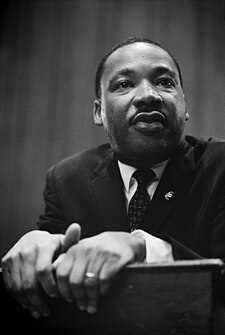
Today is a national holiday observing the birth of the American civil rights leader, Martin Luther King, Jr. His story is well-known but as it slips further into the past we are less likely to recall the deeper and personal impact he had on American culture in his time. Much of that impact lives on in King's words written and spoken eloquently from the mind as well as the heart. In his Powerline post first published on this day in 2005, Scott Johnson captured King's essence so well with his comments inserted between the paragraphs of King's "Letter from Birmingham Jail" and the speech he delivered in Memphis the day before his assassination.


MLK at a press conference in 1964


Here are more words and images of King at his national memorial on the west shore of the Tidal Basin in Washington, D.C.


Sources


Photos and Illustrations:
News conference photo; Library of Congress
All others from National Park Service, Martin Luther King, Jr. Memorial webpage

Thursday, January 6, 2022

The Very Own Way Of Alan Watts


By the 1960's he had become rather well-known on the American scene as much for living "in the moment" in alcohol, experimental drugs, and other excesses as for his writings on Asian and Chinese philosophy and region. Furthermore, classical Zen masters criticized him for practicing what they called a light version of Buddhism. Many in the youth rebellion of the time latched on to his eccentric and independent thought as a beacon in what they viewed as a western world in decline. Either way, he would say that he was what he did. We can do nothing more or less than accept the complete man.


His name was Alan Watts. He was born January 6, 1915, in Britain where he developed a keen interest in Asian studies. He moved to the U.S. in the late 1930’s and became an Episcopal priest in 1943. After seven years Watts left the church and returned to the study of Asian philosophy and religion full-time. When he died in November 1973 he left the world over two dozen books, hundreds of pamphlets and briefs, and well over a thousand hours of audiovisual recordings offering his original thoughts on the Western expression of Zen, Zen Buddhism, and Asian philosophy. For further reading I recommend, In My Own Way: An Autobiography, published in 1972 . It is an entertaining book providing readers with a memorable glimpse at American culture and character in the generation following World War II.

And how did I come to know of Watts and his world? In 1968 the documentary filmmaking team of Irving and Elda Hartley produced a fourteen-minute film entitled Buddhism: Man and Nature. Watts wrote the script and provided the narration. For the Hartleys, it was an award winning addition to their series on spirituality and religion. For others, particularly those studying or working in natural resource management, education/interpretation, and related fields, the film was a compelling prescription for understanding and appreciating our natural world. in that context I saw the film in the early 1970’s as part of an employee orientation. 


Within days of seeing Buddhism: Man and Nature I found myself alone on a summer evening at a place I had known from early childhood. Over those years there I grew to love a landscape of woods, fields, and water, all framed by distant mountains. The intersection of place, early experience, career choice, and a fourteen minute film was a revelation. Later that night I transcribed the narration that I would carry with me daily for the next 36 years as I fulfilled a mission helping people appreciate, understand, and preserve some of the finest natural and cultural landscapes throughout the nation.

The film never influenced my personal religious convictions but it certainly impacted my understanding of the human place in natural landscapes. Alan Watts’s powerful script as well as his transcendent narration motivated me to look deeper into the man and his writings. Over the next decade his books on Zen, Asian philosophy and the West's response, and human behavior grew to occupy well over two feet of shelf space in my library.

And what about the transcript I pounded out on my trusty Smith-Corona portable typewriter that evening? Now fragile, well-tattered, torn and coffee stained, it sits enshrined in the household safe.


Sources

Photos and Illustration:
kpfa.org

Text:
wikipedia.org
alanwatts.com

Sunday, November 28, 2021

William Blake's Worlds Of Imagination


To see a world in a grain of sand
And heaven in a wild flower
Hold infinity in the palm of your hand
And eternity in an hour

from Auguries of Innocence, William Blake, 1803


On this day in 1757 the British artist and writer, William Blake, was born in London. He is without a doubt my favorite anarchist. In his own time he was so eccentric his neighbors and friends thought he was a madman. As an engraver and illustrator he was caught between the decline of the guilds and the rise of industrialization. It was a time when men saw the value of their labors swept away from the cottage and into the factory under the watchful eye of the manager. For workers, the loss of autonomy, the shift in control and production, and the helplessness in the face of change led to a revolt against the Age of Reason and a rage against technologies it spawned. Two centuries later he would be recognized as both one whose vision, imagination and sensitivity were unmatched in the age of Romanticism, and a truly unique influence in the history of the Western world.

There is one certainty about Blake's work and that is its complexity. He is by far one of the most interesting visionaries to come out of the West and its traditions. I hope you will take time to examine him and his extraordinary contributions to our experience. To explore his work appropriately is beyond the intent of this blog and capability of its author. For readers who want to learn more about Blake, to me there's no finer work available than Jacob Bronowski's A Man Without A Mask, published in 1944, and it's expanded version, William Blake and the Age of Revolution, published in 1972.


William Blake             Thomas Phillips, English, 1807


I have learned much from the artist and philosopher, William Blake, in an effort to balance my life between intellect and emotion. So far it's been a beautiful, productive, and fascinating journey. These works have been a part of that experience:

In the following illustration Blake depicts his character, Urizen, [You rising] as reason shaping the world and its experience. This engraving is also interpreted as God the Father [and often God the Son] as divining existence. It is a prime example of the complex and often confounding world of Blake's imagination.


The Ancient of Days                         William Blake, 1793


Here Blake depicts Isaac Newton [and the Age of Reason] at the bottom of the sea shaping (the dividers, once more) the world of humankind on the earth. Newton has turned his back on the organic beauty of God's natural world.


Newton                                                William Blake, 1795


Here, the Angel of Peace descends forcibly out of heaven illustrating God's reason (the dividers) brought into the world in the form of his Son to reconcile Nature (the recline female nude) and a redeemed humanity


The Descent of Peace         William Blake, ca. 1815


One of Blake's most familiar pieces is his preface to Milton: A Poem. The preface says much about Blake's philosophy opposing the Age of Reason as embodied in Greek and Roman thought and the dangers a reliance on intellect can bring to a world based equally on emotion. Furthermore, the preface is a perfect illustration of Blake's religious mysticism as well as his veneration of Milton.


The stolen and perverted writings of Homer and Ovid, of Plato and Cicero, which all men ought to contemn, are set up by artifice against the Sublime of the Bible; but when the New Age is at leisure to pronounce, all will be set right, and those grand works of the more ancient, and consciously and professedly Inspired men will hold their proper rank, and the Daughters of Memory shall become the Daughters of Inspiration, Shakspeare and Milton were curb'd by the general malady and infection from the silly Greek and Latin slaves of the sword. Rouse up, O Young Men of the New Age! Set your foreheads against the ignorant hirelings! For we have hirelings in the camp, the Court, and the University, who would, if they could, for ever depress mental, and prolong corporeal war. Painters! on you I call. Sculptors! Architects! suffer not the fashionable fools to depress your powers by the prices they pretend to give for contemptible works, or the expensive advertising boasts that they make of such works; believe Christ and His Apostles that there is a class of men whose whole delight is in destroying. We do not want either Greek or Roman models if we are but just and true to our own Imaginations, those Worlds of Eternity in which we shall live for ever, in Jesus our Lord.


And did those feet in ancient time
Walk upon England's mountains green?
And was the holy lamb of God
On England's pleasant pastures seen?


And did the Countenance Divine
Shine forth upon our clouded hills?
And was Jerusalem builded here
Among these dark Satanic mills.


Bring me my bow of burning gold!
Bring me my arrows of desire!
Bring me my spear! O clouds, unfold!
Bring me my chariot of fire!


I will not cease from mental fight,
Nor shall my sword sleep in my hand,
Till we have built Jerusalem
In England's green and pleasant land.


Would to God that all the Lord's people were Prophets. Numbers xi, ch. 26


Readers may be more familiar with Blake's poem through this medium:


As this tribute comes to a close, I'd like to reference one of Blake's poems that virtually all children read before the end of their middle schools years a half century ago. It's remarkably simple in form yet its questions brim with imagination and wonder. I so hope that "The Tyger" is still read and heard by young students so they can remember its message over their varied lifetimes.


Tyger, Tyger, burning bright,
In the forests of the night:
What immortal hand or eye,
Could frame thy fearful symmetry?


In what distant deeps or skies,
Burnt the fire in thine eyes?
On what wings dare he aspire?
What the hand, dare seize the fire?


And what shoulder & what art,
Could twist the sinews of thy heart?
And when thy heart began to beat,
What dread hand? & what dread feet?


What the hammer? What the chain,
In what furnace was thy brain?
What the anvil? what dread grasp.
Dare its deadly terrors clasp?


When the stars threw down their spears
And water'd heaven with their tears:
Did he smile his work to see?
Did he who made the Lamb make thee?


Tyger, Tyger burning bright,
In the forests of the night:
What immortal hand or eye,
Could frame thy fearful symmetry?


William Blake                     John Linnell, English, 1863


He who binds himself to a joy
Doth the winged life destroy
But he who kisses the joy as it flies
Lives in Eternity's sunrise

Eternity, William Blake, 1803


Sources

Photos and Illustrations:
wikipedia.com
Blake portrait, National Portrait Gallery, Washington, D.C.
Newton, Tate Gallery, London, U.K.blakearchive.org/Blake

Text:
wikipedia.com, Blake entry
blakearchive.org/Blake
bartleby.com/235/284.html
Jacob Bronowski, A Man Without A Mask, Seeker and Warburg, London, 1944


Sunday, October 31, 2021

Reformation Day 2021


On this day in 1517, Martin Luther posted ninety-five theses on the door of All Saints Church in Wittenburg, Germany. He could no longer tolerate what he thought were errors within the Catholic church, including the collection of indulgences from sinners seeking salvation. Today, Protestants commemorate this event every October 31 as Reformation Day. He chose this day, All Hallows Eve, because he knew the church would be filled with influential people within and outside the church as they gathered to celebrate All Saints Day on November 1. Luther's action became the tipping point for reformation within the Christian church.


Luther As An Augustinian Monk Lucas Cranack the Elder, 16th century


Eight years later, Johann Sebastian Bach, the musical voice of the Reformation in the Baroque period, wrote the following cantata for Reformation Day 1725:


Gott der Her ist Sonn und Schild


1. Chorus

God the Lord is sun and shield. The Lord gives grace and honor, He will allow no good to be lacking from the righteous.


2. Aria A

God is our sun and shield!
Therefore this goodness
shall be praised by our grateful heart,
which He protects like His little flock.
For He will protect us from now on,
although the enemy sharpens his arrows
and a vicious hound already barks.

3. Chorale

Now let everyone thank God
with hearts, mouths, and hands,
Who does great things
for us and to all ends,
Who has done for us from our mother's wombs
and childhood on
many uncountable good things
and does so still today.

4. Recitative B

Praise God, we know
the right way to blessedness;
for, Jesus, You have revealed it to us through Your word,
therefore Your name shall be praised for all time.
Since, however, many yet
at this time
must labor under a foreign yoke
out of blindness,
ah! then have mercy
also on them graciously,
so that they recognize the right way
and simply call You their Intercessor.

5. Aria (Duet) S B

God, ah God, abandon Your own ones
never again!
Let Your word shine brightly for us;
although harshly
against us the enemy rages,
yet our mouths shall praise You.

6. Chorale

Uphold us in the truth,
grant eternal freedom,
to praise Your name
through Jesus Christ. Amen.


We can only imagine the exhilaration Luther had on posting his objections. He placed his worldly apprehensions in the hands of Jesus, continued to call for reform within the Catholic Church, and eventually developed a new vision of faith.


Sources:

Photo, Conrad Schmitt Studios, Milwaukee, Wisconsin
Bach translation, emmanuelmusic,org


Wednesday, January 6, 2021

The Way Of Alan Watts: It's Just The Dancing Pattern


By the 1960's he had become rather well-known on the American scene as much for living "in the moment" in alcohol, experimental drugs, and other excesses as for his writings. Classical Zen masters criticized him for practicing a light version of Buddhism. Many in the youth rebellion of the time latched on to his eccentricities and independent thought as a beacon in what they viewed as a western world in decline. Either way, he would say that he was what he did. We can do nothing more or less than accept the full man. 


His name was Alan Watts. He was born January 6, 1915, in Britain where he developed a keen interest in Asian studies. He moved to the U.S. in the late 1930’s and became an Episcopal priest in 1943. After seven years Watts left the church and returned to the study of Asian philosophy and religion full-time. When he died in November 1973 he left the world over two dozen books, hundreds of pamphlets and briefs, and well over a thousand hours of audiovisual recordings offering his original thoughts on the Western expression of Zen/ Zen Buddhism and Asian philosophy. For further reading I recommend his autobiography, In My Own Way, published in 1972. It is an entertaining book providing readers with a memorable glimpse of American culture and character in the generation following World War II.

And how did I come to know of Watts and his world? In 1968 documentary filmmakers, Irving and Elda Hartley, produced a fourteen-minute film entitled Buddhism: Man and Nature. Watts wrote the script and provided the narration. For the Hartleys, it was an award winning addition to their series on spirituality and religion. For others, particularly those studying or working in natural resource management, education/interpretation, and related fields, the film was a compelling prescription for understanding and appreciating our natural world. It is in that context that I encountered it in the early 1970’s as a new employee of the National Park Service.


Within days of seeing Buddhism: Man and Nature I found myself alone on a summer evening at a place I had known from early childhood. In my years there I grew to love a rich landscape of distant mountains, woods, fields, and water, an attachment that shaped my career. The film narration I transcribed later that night would travel with me for the next 36 years as I fulfilled a mission helping people appreciate, understand, and preserve some of the finest natural and cultural landscapes throughout the nation.

The film never influenced my personal religious convictions but the Zen concepts certainly impacted my understanding of the human place and role in natural landscapes. Alan Watts’s powerful script as well as his transcendent narration motivated me to look deeper into the man and his writings. Over the next decade his books on Zen, human behavior, and Asian philosophy and the West's response, grew to occupy well over three feet of shelf space in my library.

And what about the transcript I pounded out on my trusty Smith-Corona portable typewriter that evening? Now fragile, well-tattered, torn and coffee stained, it sits enshrined in the household safe.


Sources

Photos and Illustration:
kpfa.org

Text:
wikipedia.org
alanwatts.com

Saturday, October 31, 2020

Reformation Day 2020

Wisconsin Lutheran Seminary, Mequon, Wisconsin


Martin Luther posted his ninety-five theses on the door of All Saints Church in Wittenburg, Germany on this day in 1517. He could no longer tolerate the Catholic practice of collecting indulgences from sinners seeking salvation. Today, Protestants commemorate this event every October 31 as Reformation Day.

Johann Sebastian Bach, the musical voice of the Reformation in the Baroque period, wrote Cantata BWV 79 for Reformation Day 1725:


1. Chorus

God the Lord is sun and shield. The Lord gives grace and honor, He will allow no good to be lacking from the righteous.


2. Aria A

God is our sun and shield!
Therefore this goodness
shall be praised by our grateful heart,
which He protects like His little flock.
For He will protect us from now on,
although the enemy sharpens his arrows
and a vicious hound already barks.

3. Chorale

Now let everyone thank God
with hearts, mouths, and hands,
Who does great things
for us and to all ends,
Who has done for us from our mother's wombs
and childhood on
many uncountable good things
and does so still today.

4. Recitative B

Praise God, we know
the right way to blessedness;
for, Jesus, You have revealed it to us through Your word,
therefore Your name shall be praised for all time.
Since, however, many yet
at this time
must labor under a foreign yoke
out of blindness,
ah! then have mercy
also on them graciously,
so that they recognize the right way
and simply call You their Intercessor.

5. Aria (Duet) S B

God, ah God, abandon Your own ones
never again!
Let Your word shine brightly for us;
although harshly
against us the enemy rages,
yet our mouths shall praise You.

6. Chorale

Uphold us in the truth,
grant eternal freedom,
to praise Your name
through Jesus Christ. Amen.


We can only imagine the apprehension Luther had on posting his objections. At the same time, we can imagine his relief at having this huge burden lifted from him personally and moved into a larger realm. 


Thanks be to God!


Sources:

Photo, Conrad Schmitt Studios, Milwaukee, Wisconsin
Bach translation, emmanuelmusic,org

Monday, January 6, 2020

Life His Way: Alan Watts Here And Now


By the 1960's he had become rather well-known on the American scene as much for living "in the moment" in alcohol, experimental drugs, and other excesses as for his writings. Classical Zen masters criticized him for practicing a light version of Buddhism. Many in the youth rebellion of the time latched on to his eccentrism and independent thought as a beacon in what they viewed as a western world in decline. Either way, he would say that he was what he did. We can do nothing more or less than accept the full man. 


His name was Alan Watts. He was born January 6, 1915, in Britain where he developed a keen interest in Asian studies. He moved to the U.S. in the late 1930’s and became an Episcopal priest in 1943. After seven years Watts left the church and returned to the study of Asian philosophy and religion full-time. When he died in November 1973 he left the world over two dozen books, hundreds of pamphlets and briefs, and well over a thousand hours of audiovisual recordings offering his original thoughts on the Western expression of Zen/ Zen Buddhism and Asian philosophy. For further reading I recommend his autobiography, In My Own Way, published in 1972. It is an entertaining book providing readers with a memorable glimpse at American culture and character in the generation following World War II.

And how did I come to know of Watts and his world? In 1968 documentary filmmakers, Irving and Elda Hartley, produced a fourteen-minute film entitled Buddhism: Man and Nature. Watts wrote the script and provided the narration. For the Hartleys, it was an award winning addition to their series on spirituality and religion. For others, particularly those studying or working in natural resource management, education/interpretation, and related fields, the film was a compelling prescription for understanding and appreciating our natural world. It is in that context that I encountered it in the early 1970’s as a new employee of the National Park Service.


Within days of seeing Buddhism: Man and Nature I found myself alone on a summer evening at a place I had known from early childhood. Over the years there I grew to love a landscape of woods, fields, and water, an attachment that shaped my career.  The film narration I transcribed later that night would travel with me for the next 36 years as I fulfilled a mission helping people appreciate, understand, and preserve some of the finest natural and cultural landscapes throughout the nation.

The film never influenced my personal religious convictions but it certainly impacted my understanding of the human place and role in natural landscapes. Alan Watts’s powerful script as well as his transcendent narration motivated me to look deeper into the man and his writings. Over the next decade his books on Zen, Asian philosophy and the West's response, and human behavior grew to occupy well over two feet of shelf space in my library.

And what about the transcript I pounded out on my trusty Smith-Corona portable typewriter that evening? Now fragile, well-tattered, torn and coffee stained, it sits enshrined in the household safe.


Sources

Photos and Illustration:
kpfa.org

Text:
wikipedia.org
alanwatts.com

Monday, January 15, 2018

Martin Luther King Jr. Day 2018


Today is a national holiday observing the birth of the American civil rights leader, Martin Luther King Jr. His story is well-known but as it slips further into the past we are less likely to recall the deeper and personal impact he had on American culture in his time. Much of that impact lives on in King's words written and spoken eloquently from the mind as well as the heart. In his Powerline post, first published on this day in 2005, Scott Johnson captured King's essence so well with his comments inserted between the paragraphs of King's "Letter from Birmingham Jail" and the speech he delivered in Memphis the day before his assassination. 

Martin Luther King press conference 01269u edit.jpg


That essence also emerges from words and images of King at his national memorial on the west shore of the Tidal Basin in Washington, D.C. Here are two examples:


Sources

Photos and Illustrations:
News conference photo; Library of Congress
All others; National Park Service, Martin Luther King, Jr. Memorial webpage


ShareThis