Showing posts with label entertainment. Show all posts

Saturday, May 3, 2025

Crosby And Seeger: Two Very Different Voices In American Music History


Two iconic American entertainers share May 3 as a birthday. 


Bing Crosby 1930s.jpg
Crosby publicity photo from the 1930's

Born in 1903, Bing Crosby used his baritone voice and recording technology to develop a personal singing style that made him the nation's top entertainer for a generation beginning in the mid-1930s. Young people probably know little if anything about Crosby. He died in 1977 but I think he sits at the pinnacle of the American entertainment industry in that era - along with Bob Hope - and is well worth exploring if you enjoy popular culture. The Crosby family has authorized a comprehensive site about The Crooner if readers want more information. For a small taste of his talent, here is Crosby singing to Grace Kelly in the 1956 film, High Society:


Our second birthday celebrant is Pete Seeger, an entertainer who has been described as the most successful communist in the United States. I'll let readers discover the politics for themselves and focus instead on Seeger as singer and songwriter. 

File:PeteSeeger2.jpg
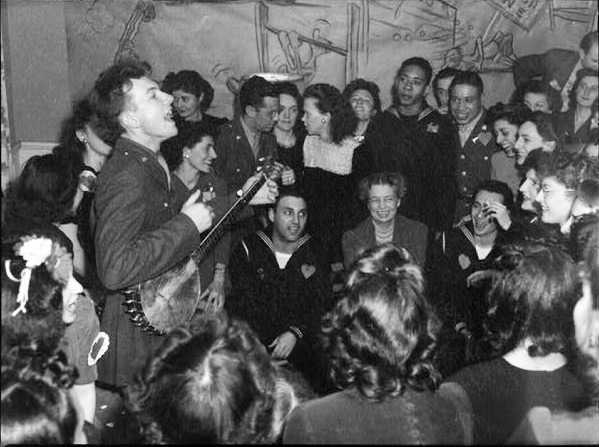
Entertaining at labor canteen opening, Washington, DC, February 1944

Seeger was born in 1919 into a musical family, took up the family's leftist politics, and made a name for himself as a "protest singer" in the 1940s. In 1950, he was a member of the folk group, The Weavers, and in the bow wave of a folk music revival in the U.S. It was short-lived, however, as the group was blacklisted in 1953 for suspected political reasons. A decade later Seeger found himself at the forefront of the 1960's folk revival embedded in antiwar activities and the Youth Revolution.  He continued singing and pursuing his social, political, and environmental activism around the world almost to the day he died at 94 in 2014. For more information and a host of links, here is his Wikipedia entry.

For a taste of Pete Seeger the performer, here he is singing lead and playing his banjo on the first recording (1949) of If I Had A Hammer, co-written with Lee Hays, also with The Weavers:


Although this video highlights Seeger, it does not do justice to the beautiful harmony The Weavers produced. Readers may want to explore the Internet for more of their recordings. Their 1981 reunion concert at Carnegie Hall is a particularly moving statement on the American music experience.


Sources

Photos and Illustrations:
commons.wikimedia.org/wiki/File:Bing_Crosby_1930s.jpg
loc.gov/pictures/resource/fsa.8d41983/

Wednesday, October 23, 2024

Here's Johnny! The King Of Late Night Television


Johnny Carson as Carnac the Magnificent


In light of the accelerating freefall of late night television at the hands of increasingly unfunny progressive democrat hosts and their managers it's a perfect time to mention Johnny Carson. He was born on this day in Corning, Iowa, in 1925. As an unbiased host - he was a liberal Republican in private life - of The Tonight Show Starring Johnny Carson for thirty years (1962-1992) he brought celebrity, entertainment, and his own brand of wacky comedy to millions of viewers. He was a major influence in the entertainment world and widely recognized as the king of late night television but his impact may never be well understood or appreciated because he led a shy, guarded, and oftened troubled life beyond the studio lights. A PBS American Masters documentary film by Peter Jones did much to open Carson's world to the public when it was broadcast in 2012 seven years after his death.

Here is a look at the master at work with his usual cast members and a host of notable entertainers and comedians. It's a one hour clip of the best of his first 25 years as host . If you watch the first ten minutes there's a good bet you'll watch the rest.


Without a doubt Johnny Carson does indeed remain the king of late night television. His final show in 1992 drew at least 55 million viewers. On an average night today around 9 million tune in, a number which exceeds today's top three late night shows (hosted by Stephen Colbert, Jimmy Fallon, and Jimmy Kimmel) combined. It's been 32 years since Carson left his late night show and he's still the king. I doubt that reign will end.


Wednesday, May 3, 2023

Two Voices From Two Worlds Of 20th Century American Music


Two iconic 20th century entertainers who were world apart in American music share May 3 as a birthday. 


Crosby publicity photo from the 1930's


Born in 1903, Bing Crosby used his baritone voice and recording technology to develop a personal singing style that made him the nation's top entertainer for a generation beginning in the mid-1930s. Many jazz and pop singers adopted his style and technique over the next thirty years. Young people probably know little if anything about Crosby. He died in 1977 but I think he sits at the pinnacle of the American entertainment industry in that era - along with Bob Hope - and is well worth exploring if you enjoy popular culture. The Crosby family has authorized a comprehensive site about The Crooner if readers want more information. For a small taste of his talent, here is Crosby singing to Grace Kelly in the 1956 film, High Society:


Our second birthday celebrant is Pete Seeger, an entertainer who has been described as the most successful communist in the United States. I'll let readers discover the politics for themselves and focus instead on Seeger as singer and songwriter.


Entertaining at labor canteen opening, Washington, DC, February 1944


He was born in 1919 into a musical family, took up their leftist politics, and made a name for himself as a "protest singer" in the 1940s. In 1950, he was a member of the folk group, The Weavers, and in the bow wave of a folk music revival in the U.S. It was short-lived, however, as the group was blacklisted in 1953 for suspected political reasons. A decade later Seeger found himself at the forefront of the 1960's folk revival embedded in antiwar activities and the Youth Revolution. He continued singing and pursuing his social, political, and environmental activism around the world almost to the day he died at 94 in 2014. For more information and a host of links, here is his Wikipedia entry.

For a taste of Pete Seeger the performer, here he is singing lead and playing his banjo on the first recording (1949) of If I Had A Hammer, co-written with Lee Hays, also with The Weavers:


Although this video highlights Seeger, it does not do justice to the beautiful harmony The Weavers produced. Readers may want to explore the Internet for more of their recordings. Their 1981 reunion concert at Carnegie Hall is a particularly moving statement on the American music experience.


Sources

Photos and Illustrations:
commons.wikimedia.org/wiki/File:Bing_Crosby_1930s.jpg
loc.gov/pictures/resource/fsa.8d41983/

Tuesday, May 3, 2022

Crosby And Seeger: One Birthday And Two Very Different Worlds


Two iconic American entertainers share May 3 as a birthday but that's where the similarity ends.


Crosby publicity photo from the 1930's


Born in 1903, Bing Crosby used his baritone voice and recording technology to develop a personal singing style that made him the nation's top entertainer for a generation beginning in the mid-1930s. Many jazz and pop singers adopted his style and technique over the next thirty years. Young people probably know little if anything about Crosby. He died in 1977 but I think he sits at the pinnacle of the American entertainment industry in that era - along with Bob Hope - and is well worth exploring if you enjoy popular culture. The Crosby family has authorized a comprehensive site about The Crooner if readers want more information. For a small taste of his talent, here is Crosby singing to Grace Kelly in the 1956 film, High Society:


Our second birthday celebrant is Pete Seeger, an entertainer who has been described as the most successful communist in the United States. I'll let readers discover the politics for themselves and focus instead on Seeger as singer and songwriter.


Entertaining at labor canteen opening, Washington, DC, February 1944


He was born in 1919 into a musical family, took up their leftist politics, and made a name for himself as a "protest singer" in the 1940s. In 1950, he was a member of the folk group, The Weavers, and in the bow wave of a folk music revival in the U.S. It was short-lived, however, as the group was blacklisted in 1953 for suspected political reasons. A decade later Seeger found himself at the forefront of the 1960's folk revival embedded in antiwar activities and the Youth Revolution. He continued singing and pursuing his social, political, and environmental activism around the world almost to the day he died at 94 in 2014. For more information and a host of links, here is his Wikipedia entry.

For a taste of Pete Seeger the performer, here he is singing lead and playing his banjo on the first recording (1949) of If I Had A Hammer, co-written with Lee Hays, also with The Weavers:


Although this video highlights Seeger, it does not do justice to the beautiful harmony The Weavers produced. Readers may want to explore the Internet for more of their recordings. Their 1981 reunion concert at Carnegie Hall is a particularly moving statement on the American music experience.


Sources

Photos and Illustrations:
commons.wikimedia.org/wiki/File:Bing_Crosby_1930s.jpg
loc.gov/pictures/resource/fsa.8d41983/

Thursday, May 3, 2018

Remembering Two Musical Icons Of The 20th Century


Two iconic American entertainers share May 3 as a birthday. 

Bing Crosby 1930s.jpg
Crosby publicity photo from the 1930's

Born in 1903, Bing Crosby used his baritone voice and recording technology to develop a personal singing style that made him the nation's top entertainer for a generation beginning in the mid-1930s. Young people probably know little if anything about Crosby. He died in 1977 but I think he sits at the pinnacle of the American entertainment industry in that era - along with Bob Hope - and is well worth exploring if you enjoy popular culture. The Crosby family has authorized a comprehensive site about The Crooner if readers want more information. For a small taste of his talent, here is Crosby singing to Grace Kelly in the 1956 film, High Society:


Our second birthday celebrant is Pete Seeger, an entertainer who has been described as the most successful communist in the United States. I'll let readers discover the politics for themselves and focus instead on Seeger as singer and songwriter. 

File:PeteSeeger2.jpg
Entertaining at labor canteen opening, Washington, DC, February 1944

Seeger was born in 1919 into a musical family, took up the family's leftist politics, and made a name for himself as a "protest singer" in the 1940s. In 1950, he was a member of the folk group, The Weavers, and in the bow wave of a folk music revival in the U.S. It was short-lived, however, as the group was blacklisted in 1953 for suspected political reasons. A decade later Seeger found himself at the forefront of the 1960's folk revival embedded in antiwar activities and the Youth Revolution.  He continued singing and pursuing his social, political, and environmental activism around the world almost to the day he died at 94 in 2014. For more information and a host of links, here is his Wikipedia entry.

For a taste of Pete Seeger the performer, here he is singing lead and playing his banjo on the first recording (1949) of If I Had A Hammer, co-written with Lee Hays, also with The Weavers:


Although this video highlights Seeger, it does not do justice to the beautiful harmony The Weavers produced. Readers may want to explore the Internet for more of their recordings. Their 1981 reunion concert at Carnegie Hall is a particularly moving statement on the American music experience.


Sources

Photos and Illustrations:
commons.wikimedia.org/wiki/File:Bing_Crosby_1930s.jpg
loc.gov/pictures/resource/fsa.8d41983/


Wednesday, May 3, 2017

Commemorating Bing Crosby


The American entertainer, Bing Crosby (1903-1977), used his baritone voice in combination with new recording technology to develop a personal singing style that made him the nation's top entertainer for a generation beginning in the mid-1930's. Young people probably know little if anything about Crosby but I think he sits at the pinnacle of the 20th century American entertainment industry along with his close friend, Bob Hope. Crosby's contributions are well worth exploring if you enjoy popular culture, and are essential if you are a fan of the Great American Songbook. 


Bing Crosby 1930s.jpg
Crosby publicity photo from the 1930's


I remember him for four reasons. First is his recording of Irving Berlin's White Christmas. As long as people think about the security and warmth of home and family - and when will that stop - they will appreciate Crosby's recording. His version has sold the most copies - over 100,000,000 - of any song ever recorded (Guinness World Records). Second is the series of "Road picture" comedies he made with co-stars Bob Hope and Dorothy Lamour between 1940 and 1962. Third is his role in two films, Holiday Inn (1942) and its remake, White Christmas (1954). Crosby premiered the song, White Christmas, in 1942 to a receptive public already weary from the early months of World War II. [Holiday Inn is a better film than its lavish, colorful, but still enjoyable remake.] Fourth is his series of Christmas specials for television.

Crosby's career may have peaked about 50 years ago but his impact on the entertainment industry, as both a star and entrepreneur, is still with us. Just how much of a star was he? The 2014 Public Broadcasting Service program, American Masters, stated: 

Bing Crosby has sold close to one billion records, tapes, compact disks and digital downloads around the world. He may be the biggest recording artist of all time. Only The Beatles, Elvis Presley, and Michael Jackson can rival Bing's sales record. 

For the full story, I suggest readers visit his official site after reading the Wikipedia link above. 

It would be inappropriate to write about Crosby without providing readers with a few examples of his talent. Here is Swinging On A Star, a song he introduced in the 1944 film, Going My Way. The song was an Academy Award winner that year.


And here Crosby sings the lyrics of his good friend, Johnny Mercer, who as songwriter, singer, and entrepreneur, was another major presence shaping American entertainment in the 20th century.


May 3 marks the 114th anniversary of Crosby's birth.


Tuesday, May 3, 2016

The Birthday Of Der Bingle, Bing Crosby


Here's a short note this evening on Bing Crosby, born on this day in 1903 in Spokane, Washington. His death in 1977 ended a remarkable entertainment career covering more than fifty years. I remember him for four reasons. First is his recording of Irving Berlin's White Christmas. As long as people think about the security and warmth of home and family - and when will that stop - they will appreciate Crosby's recording. His version has sold the most copies - over 100,000,000 - of any song ever recorded (Guinness World Records). Second is the series of "Road picture" comedies he made with co-stars Bob Hope and Dorothy Lamour between 1940 and 1962. Third is his role in two films, Holiday Inn (1942) and its remake, White Christmas (1954). Crosby premiered the song, "White Christmas," in 1942 to a receptive public already weary from the early months of World War II. [Holiday Inn is a better film than its lavish, colorful remake but it's still a fine film.] Fourth is his series of Christmas specials for television.


Crosby and family in a still from his 1974 Christmas special

Crosby's career peaked about 50 years ago, but his impact on the entertainment industry, as both a star and entrepreneur, is still with us. For the full story, I suggest readers visit his official site after reading the Wikipedia link above.

Can't end this article without a link or two to Bing in song. Here he is with the Andrews Sisters in 1944 singing a Grammy Hall of Fame entry, Don't Fence Me In. 


And here's Bing singing upbeat, comedic and conversational with Jane Wyman in the 1951 film, Here Comes the Groom. The song, "In the Cool, Cool, Cool of the Evening" (Hoagy Carmichael and Johnny Mercer) won the Oscar that year for best music, original song.


Bing Crosby used his baritone voice in combination with new recording technology to develop a personal singing style that made him the nation's top entertainer for a generation beginning in the mid-1930s. Young people probably know little if anything about Crosby. He died in 1977 but I think he sits at the pinnacle of the 20th century American entertainment industry--along with his close friend, Bob Hope--and is well worth learning about if you enjoy popular culture. If you enjoy the Great American Songbook, Bing is an essential.

Sources

Photos and Illustrations:
public domain photograph, Bell System, eBay item


Friday, June 19, 2015

Happy National Dry Martini Day


Yes. There really is a national day for that delicious beverage staple, the dry martini. It is a classic though, no vodka allowed. Wikipedia has an informative post about the drink, including a few recipes.


It's after dinner here in the eastern U.S. and about time for a relaxing drink if one is so inclined. If so, here is some perfect jazz to accompany the progression of Friday evening and the close of National Dry Martini Day.


Enjoy.


n.b. John Coltrane's Blue Train, released in 1957, consistently ranks among the top jazz albums of all time. Another fine jazz album for even easier listening is John Coltrane and Johnny Hartman, released in 1963 and also ranked among the very best jazz vocal albums of all time.


Monday, April 7, 2014

NRO Tribute Captures Mickey Rooney Perfectly


Rooney in 1945

National Review publisher, Jack Fowler, captures the essence of Mickey Rooney's 84 year career in the American experience of our time, our parents' time, and their parents' time.  That's entertainment! Make 'em laugh, Mickey.

Wednesday, October 23, 2013

Remembering Johnny Carson


NBC's The Tonight Show is sixty years old. For half of those years, 1962-1992, Johnny Carson hosted the program. There's no question he was the king of late night television and an entertainment icon whose influence is very much alive. Unfortunately, his impact may not be well understood or appreciated in part because Carson carefully guarded his private life. When he left the studio, he left the world of celebrity.

Carson in 1970

There is a new "tell all" book about Carson written by one of his former associates. I suspect it confirms many of the less savory aspects of the star's life that have arisen in the eight years since his death. Such words will reconfirm that human nature's strengths and weaknesses extend even to our icons. With that in mind, here is a glimpse of the king at his best:


Johnny Carson was born on this day, October 23, in 1925.

Sunday, August 11, 2013

Reprising Entertainment From Another Time

Having the world's library at your fingertips by way of the Internet is a curse and blessing. As an eclectic surfer I wouldn't have it any other way.


Singing not your thing? How about some dancing and acrobatics?


Maybe just some reading? The DeZurik Sisters, The Ross Sisters.


This post is a rewrite of earlier posts appearing in 2009.

Monday, May 6, 2013

Orson Welles


Today marks the birthday - in 1915 - of Orson Welles. He was a remarkable entertainment talent as an actor, writer, director, producer and more. Before he was thirty, he had terrified the nation with his realistic Halloween night presentation of H.G. Wells's War of the Worlds (1938) and awed film audiences with Citizen Kane (1941). Welles was already a rather contentious artist when he achieved almost instant fame. Both elements helped label him as a difficult, if not reckless, personality and he never endeared himself to the Hollywood in-crowd. The consequence of "all that" was a limited number of noteworthy films and a long list of unfinished projects, "may have beens." and the question,"Whatever happened to Orson Welles?"

Welles has now been missing from the world scene for over a generation. The film and stage industries will always owe him immensely for what he brought to them and for the treatment his genius received at the hands of the motion picture cartel.

Here is a sample of Welles's cinematic genius, the famous "crane shot" from the opening scene of his film, Touch of Evil (1958):


And here is a brief television obituary including an interview Welles made eight days before his death:


Friday, April 12, 2013

Jonathan Winters: The Passing Of A Great American Comedian


The text in this post originally appeared in 2012. The videos are a new addition.

Winters appearing on the NBC Comedy Hour in 1956

When OTR began his search for a comedian for this performance series, he thought at first that the honor belonged to Robin Williams. After watching what seemed like hours - enjoyable as ever - of Williams routines and interviews, he realized that this versatile comic owed so much to another comedy genius who is still with us but rarely performing. That individual is Jonathan Winters. In the last decade, he has appeared in and provided the voice of characters for a few films; otherwise, he is not well known to younger generations. To appreciate fully this remarkable talent, OTR's readers need to look back through the last fifty years of his career. Once they do, they will understand why Robin Williams has identified Winters as his mentor and inspiration.

So...if you want entertainment instead of warblers, screamers, low-rent vaudeville, obnoxious and over-rated pseudo-star panelists and eight minutes of commercials every half hour, here is something you can really enjoy:


Winters died today at age 87. He is indeed a treasure in the world of American comedy, and now he brings laughter to the angels.

Tuesday, March 19, 2013

How The Federal Cabaret Tax Of 1944 Killed The Great Swing Era

For fifty years I thought the end of the Swing and Big Band eras was simply a result of the evolution of popular culture in a nation well-known for reinventing itself. Though my wife and I were toddlers when those eras ended, we both came to embrace the music and enjoy it to this day. How stunning it was for me to learn  today that this music did not die a natural death. It was killed by something called the Cabaret Tax of 1944.  Given a federal government desperate for revenue following World War II and the astounding success of the cabaret industry since the mid-1930's, it's reasonable to see ballrooms with their dancing, orchestras and alcohol as a tax target. So desperation on the part of the government led to a 30% tax on cabarets in 1944. The industry wobbled for three years, bearing its tax burden and other issues involving unions and music rights, then died like a goose, along with the golden eggs, in 1947. A few bands survived, but most were broken up, often reforming into smaller groups that played non-dance music. The Age of Bebop was upon us. There's superb music there, but I'd say 99% of Americans today wouldn't know Bebop if it hit them in the ears.

And what is to be learned from all of this? It's always a good lesson to remember that actions have consequences, especially when a government goes looking for money when money is tight. This afternoon, while panicked Cypriots try to empty their bank accounts before their government confiscates the cash, you can bet there are more than a few Americans wondering if our "leaders" s had the nerve to try confiscation here.

There's no doubt we've come a long way from the Founding Fathers's intentions of a citizenry shaping a government. Thanks to our friends at Instapundit, here's your link to the story of how our government tax policy unintentionally destroyed a multi-billion dollar industry that was enjoyed by millions of Americans. Be sure to click on the "cabaret tax" hyperlink in the fourth paragraph to be taken to a 2010 article that provides more information on the story.

For your enjoyment, here is Benny Goodman's band at Carnegie Hall in January 1938, one of the most important musical events in the U.S. in the 20th century. Piano improv at the end always leaves me speechless. BTW this recording has never been out of print since its issue in 1950.


If you didn't tap your feet, you need to see a doctor stat!

Thursday, January 17, 2013

The Life And Death Of The Game Arcade

Marty's Playland                     Ocean City, Maryland
OTR was introduced to game arcades in Ocean City, Maryland, in his late childhood. He enjoyed carnival arcades previously, but the enjoyment paled in comparison to the immersive experiences in those permanent playlands along the boardwalk. The noise, the lights, the aroma of the sea mingled with floor wax and ozone. And then there were all those winning tickets to redeem for more play tokens, a tacky souvenir or simply keep for the next trip to the beach. Almost thirty years would elapse before he would take his own children into the world of the arcade. Of course, it was a far different place with the advent of the electronic video game.

Today, Instapundit's Glenn Reynolds posts a link to a Time.com article about the impact another two decades has made on the arcade industry: The Tragic, World-Changing Loss of the Great American Arcade.
The first paragraph has a link to a "must see" Verge article by Laura June. It may be a bit long for today's attention spans, but the information and illustrations - creative layout, as well - make it worthwhile.

OTR would like to think the game arcade, at least the amusement arcade of his childhood, will have a place in the American experience to come.


Friday, December 28, 2012

Oscar Levant: The Unsurpassed Wit Of Hollywood


OTR is a day late with this post, but it won't stop him from honoring one of Hollywood's most brilliant and talented personalities, Oscar Levant (1906-1972). We're approaching fifty years since he was active as a concert pianist, composer, author, actor, and comedy genius, and he's likely unknown by many young people who would appreciate him.  Here are some memorable moments from his career:


Levant was a close friend of George Gershwin and considered the best interpreter of Gershwin's piano music after the composer's death. In this clip, Levant  plays the piano and sings in the 1951 film, American in Paris:


And here is Levant in The Band Wagon (1953), a production often considered with Singing in the Rain as the best of the MGM musicals:


Levant was a psychiatric wreck for a good part of his life. He turned his illness into laughter through a notable series of appearances on late night television's  The Jack Paar Show:


Finally, there is Levant, the writer. He wrote three memoirs, two of them best-sellers. His Memoirs of An Amnesiac (1965) is a recollection of his often weird and tattered life as well as a tour de force of wit and wisdom aimed at Hollywood's famous and infamous personalities beginning in the 1930s. Though a bit dated,  readers with some knowledge of the golden age of Hollywood would certainly find it an entertaining read.

Recently, there was some talk in Hollywood of making a feature length film biography of Levant. OTR thinks it is about time this often overlooked entertainment genius got some notice. For certain, there is enough material out there to fill a series of films.

Wednesday, September 26, 2012

Andy Williams: Crossing In Style

Williams, one of the nation's most popular singers of the 20th century has passed away.


Earlier this year, he marked his 75th year in entertainment. He spent nearly a decade on television hosting The Andy Williams Show beginning in 1962. He also hosted countless specials well into the 1990s, the most notably being the Christmas shows. OTR recalls those Christmas specials as top notch entertainment.  His many Christmas albums are timeless and likely to be enjoyed for decades to come.

Friday, September 7, 2012

Never Underestimate An Aging Actor


Clint Eastwood knew exactly what he was doing when he delivered his rambling, ragged speech at the Republican National Convention last week. Today, he talked about it. One could say the mission was accomplished as we are likely to hear more about his performance up to and long after the election.

Friday, August 3, 2012

Performance Perfection, Or: Why Television Talent Shows Don't Matter, Part 10

Jonathan Winters appearing on the NBC Comedy Hour in 1956

When OTR began his search for a comedian for this performance series, he thought at first that the honor belonged to Robin Williams. After watching what seemed like hours - enjoyable as ever - of Williams routines and interviews, he realized that this versatile comic owed so much to another comedy genius who is still with us but rarely performing. That individual is Jonathan Winters. In the last decade, he has appeared in and provided the voice of characters for a few films; otherwise, he is not well known to younger generations. To appreciate fully this remarkable talent, OTR's readers need to look back through the last fifty years of his career. Once they do, they will understand why Robin Williams has identified Winters as his mentor and inspiration.

So...if you want entertainment instead of warblers, screamers, low-rent vaudeville, obnoxious and over-rated pseudo-star panelists and eight minutes of commercials every half hour, you can enjoy this even if the art form is at the bottom of your list:


Winters turns 87 in a few months. He is indeed a treasure in the world of American entertainment.

Monday, June 25, 2012

Performance Perfection, Or: Why Television Talent Shows Don't Matter, Part 7

First depiction of juggling                              Egypt, about 1900BCE


If you want entertainment instead of warblers, screamers, and low-rent vaudeville, you can experience this even if the art form is at the bottom of your list:


ShareThis