Showing posts with label aviation. Show all posts

Tuesday, July 22, 2025

It's "Wheels Up" At AirVenture Oshkosh 2025


The Experimental Aircraft Association's (EAA) annual week-long AirVenture gathering in Oshkosh, Wisconsin, is underway. It's better known as "Oshkosh" to aviation enthusiasts and you can be assured that every one of them has the event on their bucket list. There's good reason. Imagine a fly-in attracting around 7500 airplanes. Imagine 2500 aircraft exhibits, 800 commercial exhibitors, daily world-class airshows, and a total of around 700,000 guests.


AirVenture at Oshkosh is far from your average fly-in


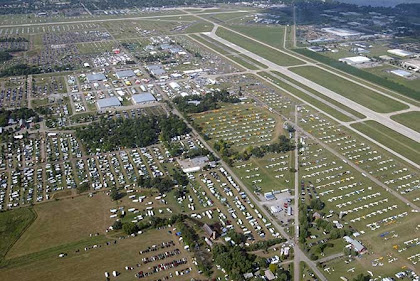
Organizers call the event "the world's greatest aviation celebration" and this year marks its seventy-second edition. The map below gives readers an idea of the scope and scale of Oshkosh and indicates why the event turns a rather sleepy Wittman Regional Airport into the busiest airport in the world for one week each year.


AirVenture grounds - for scale, that's an 8000 foot runway at the top 

AirVenture grounds looking east to Lake Winnebago


I had the privilege of attending the event several times in the last decade of my career. Energizing, informative, and significant, the show was a great vehicle for delivering an organizational message to a large, captured, and enthusiastic audience. You may ask why the National Park Service (NPS) would send a dozen or so employees and volunteers to work an air show. First, the agency has almost fifty out of its more than 400 units with a significant link to an aviation theme. In addition, the Service maintains a fleet of fixed and rotary wing aircraft contributing over 20,000 hours of flight time annually in support of park operations, maintenance, and resource and fire management. Add to that interagency cooperation across departments as well as airspace regulation over the parks and the justification become clearer. In recent years the NPS's presence at the event has been reduced significantly and folded into a more cooperative effort with other federal agencies. In summation, it's a grand and demanding opportunity to reach out face-to- face with thousands of guests who enjoy and impact resources and services in and ver the parks.


Nothing like fly-in camping with thousands of your best - in this case closest - friends


If you can't attend AirVenture, the EAA maintains a comprehensive up-to-the-second website where you can spend hours reading, watching and listening to events. I've been looking up at the sound of an aircraft engine ever since I could lift my head. If you are blessed with the same response make your plans to attend an Experimental Aircraft Association AirVenture. You will not be disappointed. Until then "wheels up" every chance you get!


Monday, June 23, 2025

Two Pilots, One Single Engine Airplane, And A Flight Around The World


Wiley Post and Harold Gatty left New York on this day in 1931 on the first single-engine flight around the world.


The two successful ocean fliers during their stopover at the Central Airport in Berlin - Tempelhof about to start their flight to Moscow .

It's hard to believe this event occurred just fifteen years before my birth. We've come a long way in aviation and when you think about all the aircraft in flight around the world at this very minute the Post-Gatty flight seems insignificant. As readers of this blog know, I'm somewhat fond of aviation so I'm perfectly happy to give these pioneers the credit they deserve in a time when history seems little more than an afterthought. God willing, in fifteen years I may see history made by astronauts on the surface of Mars.


Leonardo Dreams of His Flying Machine

Music, Eric whitacre
Lyrics, Charles Anthony Silvestri

I.
Leonardo Dreams of his Flying Machine…
Tormented by visions of flight and falling,
More wondrous and terrible each than the last,
Master Leonardo imagines an engine
To carry a man up into the sun…

And as he’s dreaming the heavens call him,
softly whispering their siren-song:
“Leonardo. Leonardo, vieni á volare”. (“Leonardo. Leonardo, come fly”.)

L’uomo colle sua congiegniate e grandi ale,
facciendo forza contro alla resistente aria.
(A man with wings large enough and duly connected
might learn to overcome the resistance of the air.)

II.
Leonardo Dreams of his Flying Machine…

As the candles burn low he paces and writes,
Releasing purchased pigeons one by one
Into the golden Tuscan sunrise…

And as he dreams, again the calling,
The very air itself gives voice:
“Leonardo. Leonardo, vieni á volare”. (“Leonardo. Leonardo, come fly”.)

Vicina all’elemento del fuoco…
(Close to the sphere of elemental fire…)

Scratching quill on crumpled paper,

Rete, canna, filo, carta.
(Net, cane, thread, paper.)

Images of wing and frame and fabric fastened tightly.

…sulla suprema sottile aria.
(…in the highest and rarest atmosphere.)

III.
Master Leonardo Da Vinci Dreams of his Flying Machine…
As the midnight watchtower tolls,
Over rooftop, street and dome,
The triumph of a human being ascending
In the dreaming of a mortal man.

Leonardo steels himself,
takes one last breath,
and leaps…

“Leonardo, Vieni á Volare! Leonardo, Sognare!” (“Leonardo, come fly! Leonardo, Dream!”)


Sources:

kalw.org, almanac

Photo:
Deutsches Bundesarchiv, photo 102-11928

Lyrics:
 ericwhitacre.com

Tuesday, December 17, 2024

A Dream Beyond Time Comes True


On this day in 1903 at Kitty Hawk on the outer banks of North Carolina, the 27-mph wind was harder than they would have liked since their predicted cruising speed was only 30-35 mph. The headwind would slow their ground speed to a crawl but they proceeded anyway. With a sheet they signaled the volunteers from the nearby lifesaving station that they were about to try again.

Now it was Orville's turn. Remembering Wilbur's experience, he positioned himself and tested the controls. The stick that moved the horizontal elevator controlled climb and descent. The cradle that he swung with his hips warped the wings and swung the vertical tails, which in combination turned the machine. A lever controlled the gas flow and airspeed recorder. The controls were simple and few, but Orville knew it would take all his finesse to handle the new and heavier aircraft. At 10:35, he released the restraining wire. The flyer moved down the rail as Wilbur steadied the wings. Just as Orville left the ground, John Daniels from the lifesaving station snapped the shutter on a preset camera, capturing the historic image of the airborne aircraft with Wilbur running alongside.


The Wright Flyer begins its first successful flight, December 17, 1903


Again, the flyer was unruly, pitching up and down as Orville overcompensated with the controls. But he kept it aloft until it hit the sand about 120 feet from the rail. Into the 27-mph wind, the ground speed had been 6.8 mph, for a total airspeed of 34 mph. The brothers took turns flying three more times that day, getting a feel for the controls and increasing their distance with each flight. Wilbur's second flight - the fourth and last of the day – was an impressive 852 feet in 59 seconds.

This was the real thing, transcending the powered hops and glides others had achieved. After four years of research and development the Wright machine had flown.


Monuments spanning the 120 feet of the first flight


On completing the flight the brothers walked four miles to Kitty Hawk and sent their father a telegram:


Success four flights Thursday morning all against twenty one mile wind started from level with engine power alone average speed through air thirty one miles longest 57 seconds inform Press home Christmas

Their pilot-controlled, sustained and powered flight by a heavier-than-air machine would soon change the world.

For comprehensive information on this historic event visit the National Park Service's Wright Brothers National Memorial web page.


Credits:

1903 photograph, unrestored version: Library of Congress
Monuments photo; text: National Park Service, Wright Brothers National Memorial


Monday, October 14, 2024

To Fly Faster Than The Speed Of Sound


The legendary test pilot, Chuck Yeager, passed away in December 2020 at 97. About twenty years earlier I had the good fortune to attend a conversation he had with his best friend and fellow flying ace, Bud Anderson, recalling their exploits over Europe in World War II. It was one of the most memorable events in the aviation history aspect of my career. Listening to them left me wondering how either had survived their antics let alone the combat. And although I had read hundreds of pages about them it took seeing them in person as old warriors to understand just how extraordinary they were.

On October 14, 1947, Yeager was in California and about to achieve a landmark in aviation when he flew his Bell X-1 into history on the shoulders of scores of aerospace pioneers who helped him pass through an imaginary doorway and reach the supersonic speedway in the sky.


From his autobiography, here is his description of that event:


. . . Bob Cardenas, the B-29 driver, asked if I was ready.

"Hell, yes," I said. "Let's get it over with.

"He dropped the X-1 at 20,000 feet, but his dive speed was once again too slow and the X-1 started to stall. I fought it with the control wheel for about five hundred feet, and finally got her nose down. The moment we picked up speed I fired all four rocket chambers in rapid sequence. We climbed at .88 Mach and began to buffet, so I flipped the stabilizer switch and changed the setting two degrees. We smoothed right out, and at 36,000 feet, I turned off two rocket chambers. At 40,000 feet, we were still climbing at a speed of .92 Mach. Leveling off at 42,000 feet, I had thirty percent of my fuel, so I turned on rocket chamber three and immediately reached .96 Mach. I noticed the faster I got, the smoother the ride. Suddenly the Mach needle began to fluctuate. It went up to .965 Mach - then tipped right off the scale. I thought I was seeing things! We were flying supersonic! And it was as smooth as a baby's bottom: Grandma could be sitting up there sipping lemonade. I kept the speed off the scale for about twenty seconds, and raised the nose to slow down. I was thunderstruck. After all the anxiety, breaking the sound barrier turned out to be a perfectly paved speedway.

I radioed Jack in the B-29,

"Hey, Ridley, that Machmeter is acting screwy. It just went off the scale on me."
"Fluctuated off?"
"Yeah, at point nine-six-five."

"Son, you is imagining things."

"Must be. I'm still wearing my ears and nothing else fell off, neither."

. . .

And so I was a hero this day. As usual, the fire trucks raced out to where the ship had rolled to a stop on the lakebed. As usual, I hitched a ride back to the hangar with the fire chief. That warm desert sun really felt wonderful. My ribs ached.


His ribs ached but that ache had nothing to do with his record flight. He cracked two of them in a horseback riding accident a day and a half earlier but wasn't about to let the issue keep him from an important mission. This was but one example of many obstacles Yeager overcame on his way to legendary status in American aviation history.

Interested readers can learn more about the man and the early years of the nation's military aviation and aerospace history in Yeager: An Autobiography, an outstanding read originally published in 1985. A valuable companion book providing context and additional history on the nation's early manned space program is Tom Wolfe's 1979 classic, The Right Stuff.


Sources

Photos and Illustrations:
Yeager with Bell X-1, U.S. Air Force, www.af.mil
Cover photo, Yeager: An Autobiography, General Chuck Yeager and Leo Janus, Bantam, 1985.

Text:
quotation, Yeager: An Autobiography, General Chuck Yeager and Leo Janus, Bantam, 1985.
www.wikipedia.com
www.chuckyeager.com


Tuesday, July 23, 2024

EAA AirVenture 2024 At Oshkosh


Today is Day 2 of the Experimental Aircraft Association's (EAA) annual week-long AirVenture gathering in Oshkosh, Wisconsin. It's better known as "Oshkosh" to aviation enthusiasts and you can be assured that every one of them has the event on their bucket list. There's good reason. Imagine a fly-in attracting around 7500 airplanes. Imagine 2500 aircraft exhibits, 800 commercial exhibitors, daily world-class airshows, and a total of over 600,000 guests.


It's far from your average fly-in


Organizers call the event "the world's greatest aviation celebration" and this year marks its 71st edition. The map below gives readers an idea of the scope and scale of Oshkosh and indicates why the event turns a rather sleepy Wittman Regional Airport into the busiest airport in the world for one week each year.


AirVenture grounds - for scale, that's an 8000 foot runway at the top


I had the privilege of attending the event several times in the last decade of my career. Energizing, informative, and significant, the show was a great vehicle for delivering an organizational message to a large, captured, and enthusiastic audience. You may ask why the National Park Service (NPS) would send a dozen or so employees and volunteers to work an air show. First, the agency has almost fifty out of its more than 400 units with a significant link to an aviation theme. In addition, the Service maintains a fleet of fixed and rotary wing aircraft contributing over 20,000 hours of flight time annually in support of park operations, maintenance, and resource and fire management. Add to that interagency cooperation across departments as well as airspace regulation over the parks and the justification become clearer. In recent years the NPS's presence at the event has been reduced significantly and folded into a more cooperative effort with other federal agencies. In summation, it's a grand and demanding opportunity to reach out face-to- face with thousands of guests who enjoy and impact agency resources and services.


Nothing like fly-in camping with thousands of your best - in this case closest - friends


If you can't attend AirVenture, the EAA maintains a comprehensive up-to-the-second website where you can spend hours reading, watching and listening to events. I've been looking up at the sound of an aircraft engine ever since I could lift my head. If you are blessed with the same response make your plans to attend an Experimental Aircraft Association AirVenture. You will not be disappointed. Until then "wheels up" every chance you get!


Monday, July 22, 2024

One Man, One Plane: The First Circumnavigation By Air


July is an important month in the history of flight. On July 14, 1914, the US Signal Corps organized an Aviation Section that would eventually grow into the US Air Force. And on July 19, 1969, the Apollo 11 mission first landed humans on the moon. So far in July 2022 NASA released the first images from its spectaculat Webb telescope and both NASA and SpaceX continued their ambitious rocket development and launch programs aimed at the moon and Mars. All of these endeavors were preceded by the work of a number of aviation pioneers whose own achievements often get lost in history. Today we remember another July event and the famous American aviator who achieved it. His name was Wiley Post. After a journey of eight days he returned to his starting point at Floyd Bennett Field in Brooklyn, New York, to complete the first solo flight around the world. The year was 1933. Here is a map of the journey:


And here is what This Day In History (history.com) says about the flight:


Two years earlier, Post had won fame when he successfully flew around the northern part of the earth with aviator Harold Gatty. For his solo around-the-world flight in 1933, he flew a slightly greater distance–15,596 miles–in less time. For both flights, he used the Winnie Mae, a Lockheed Vega monoplane that was equipped with a Sperry automatic pilot and a direction radio for Post’s solo journey.

His aircraft, Winnie Mae, was as well known as its pilot. The Smithsonian National Air and Space Museum's summary description of the plane say this:


Flying this specially modified Lockheed 5C Vega, famed aviator Wiley Post set many records and pioneered several aviation technologies. In 1931 Post and navigator Harold Gatty flew it around the world in eight days, and in 1933 Post became the first to fly around the world solo, taking only seven days. In 1935, while wearing the world's first pressure suit, which he helped design, Post flew the Vega into the stratosphere, reaching 547 kilometers (340 miles) per hour while cruising in the jet stream. The Winnie Mae was named for the daughter of F. C. Hall, the original owner and a close friend of Post.


Designed by John K. "Jack" Northrop, the Lockheed Vega first flew in 1927. It was the first aircraft with a NACA [National Advisory Committee for Aeronautics] cowl that decreased drag and increased power plant cooling by streamlining airflow around and through the engine.

Winnie Mae at her place of honor in the Time and Navigation exhibit at the Smithsonian National Air and Space Museum, Washington, DC


Over the next two years Post explored the development of a suit for high altitude flight. During his experimental flights he became the first man to encounter the high speed air currents we know as jet streams. On August 15, 1935, he and the American cowboy humorist, Will Rogers, died in the crash of Post's hybrid Lockheed home-built aircraft while exploring the possibilities of an air mail route across Alaska. Below is a photograph of the pair taken shortly before their fatal accident:


Will Rogers (on wing) and Wiley Post (by prop) as they prepare to depart Point Barrow, AK, August 15, 1935


In many ways Post's interest in science, experimentation and controlled, powered flight mirrors that of Wilbur and Orville Wright. The brothers enabled Post to make his contribution to aviation history as a pilot, inventor, and trailblazer. Today, his name and achievments continue to inspire and enable new air and space pioneers to go higher, faster, and farther than ever.


Sources

Photos and Illustrations:

Map, fiddlersgreen.net
Winnie Mae, Smithsonian National Air and Space Museum
Post and Rogers, Library of Congress, Prints and Photographs Division

Text:

wikipedia.com
history.com
airandspace.si.edu
gendisasters.com
acepilots.com


Sunday, June 23, 2024

The First Single-Engine Flight Around The World


Wiley Post and Harold Gatty left New York on this day in 1931 on the first single-engine flight around the world. The flight began at Roosevelt Field on Long Island, New York, and took them to Newfoundland, across the Atlantic Ocean to Wales, then to Germany, Russia, Alaska, and Canada, before returning to Roosevelt Field after a refueling stop in Cleveland. In all they made thirteen stops during a mission of eight days, fifteen hours, and fifty-one minutes.


The two successful ocean fliers during their stopover at the Central Airport in Berlin - Tempelhof about to start their flight to Moscow.


It's hard to believe this event occurred just fifteen years before my birth. We've come a long way in aviation and when you think about all the aircraft in flight around the world at this very minute the Post-Gatty flight seems insignificant. As readers of this blog know, I'm somewhat fond of aviation so I'm perfectly happy to give these pioneers the credit they deserve in a time when history seems little more than an afterthought.


Leonardo Dreams of His Flying Machine

Eric Whitacre, composer, with lyrics by Charles Anthony Silvestri


I.
Leonardo Dreams of his Flying Machine…
Tormented by visions of flight and falling,
More wondrous and terrible each than the last,
Master Leonardo imagines an engine
To carry a man up into the sun…

And as he’s dreaming the heavens call him,
softly whispering their siren-song:
“Leonardo. Leonardo, vieni á volare”. (“Leonardo. Leonardo, come fly”.)

L’uomo colle sua congiegniate e grandi ale,
facciendo forza contro alla resistente aria.
(A man with wings large enough and duly connected
might learn to overcome the resistance of the air.)


II.
Leonardo Dreams of his Flying Machine…

As the candles burn low he paces and writes,
Releasing purchased pigeons one by one
Into the golden Tuscan sunrise…

And as he dreams, again the calling,
The very air itself gives voice:
“Leonardo. Leonardo, vieni á volare”. (“Leonardo. Leonardo, come fly”.)

Vicina all’elemento del fuoco…
(Close to the sphere of elemental fire…)

Scratching quill on crumpled paper,

Rete, canna, filo, carta.
(Net, cane, thread, paper.)

Images of wing and frame and fabric fastened tightly.

…sulla suprema sottile aria.
(…in the highest and rarest atmosphere.)


III.
Master Leonardo Da Vinci Dreams of his Flying Machine…
As the midnight watchtower tolls,
Over rooftop, street and dome,
The triumph of a human being ascending
In the dreaming of a mortal man.

Leonardo steels himself,
takes one last breath,
and leaps…

“Leonardo, Vieni á Volare! Leonardo, Sognare!” (“Leonardo, come fly! Leonardo, Dream!”)


I wonder if, as aviation pioneers, Post and Gatty ever thought about Leonardo during their aerial circumnavigation of our planet. I'm sure Leonardo dreamed about them and their journey.


Sources:

Photos and Illustrations:
Deutsches Bundesarchiv, photo 102-11928

Text:
lyrics, ericwhitacre.com
kalw.org, almanac


Saturday, April 27, 2024

A Birthday For The Airbus A380: The World's Biggest Passenger Aircraft


In 1970 Airbus was formed as a multinational corporation to compete with the highly successful commercial aviation industry in the United States led primarily by Boeing and McDonnell Douglas. By the late 1980s Airbus began studying the potential for a wide-bodied aircraft to compete with Boeing's highly successful 747 which entered service in 1970. Airbus research led the company's management to proceed with development based on significant market interest in the Middle East and Asia. After a decade of design based on efficiency, passenger comfort and innovative aeronautical engineering, the aircraft went into production in 2000. It would go on to makes its maiden flight as the A380 on this day in 2005.The A380 took to the air as - and remains - the world's largest passenger plane. It has a wingspan of almost 262 feet, a length of just over 238 feet, and almost 6000 square feet of floor space on two full length levels that can accommodate up to 853 people. Since production began the aircraft has flown more than 7.5 million flight hours without an aircraft loss or fatality.


Airbus A380 during a landing Paris Air Show 2007


Singapore Airlines was the first to introduce the aircraft to commercial service in late 2007. When production ended in 2021, 251 A380s had been delivered to about two dozen customers with Emirates Airline being the largest at 128 aircraft. By the end of production the cost of each aircraft was $445 million. In addition, the development cost of the 380 program, estimated at $34 billion, had not been recovered.

Most of the aircraft have been configured with typical seating for 525 people, generally divided into the standard three classes. The high option accomodation on some planes is a 130 square foot, three room “Residence” located forward on the upper deck. Other configurations can include bars, beauty salons, shops, cafes and extra features for premium cabins, including showers. The following video will attest that not all the comfort is reserved for the high end traveler.


Despite having 50% less cabin noise, 50% more cabin area and volume, larger windows, bigger overhead bins, and two feet more headroom than the 747-400, the A380 was not a commercial success. Unfortunately, it was developed just as the industry was shifting away from the need for larger aircraft serving hubs and toward a to point to point operation that could be served with smaller planes.


As more and more A380s are being removed from service, sixteen airlines continue to fly it on long range international routes. Emirates operates the largest fleet with 121 aircraft. Only four are based in the United Kingdom and the Middle East, the remainder in Asia and Australia. Every month in 2023 will bring a decline in A380 use despite growing international travel.

There will come a time when the A380 is a museum piece but it will always be remembered as an extraordinary technological achievement that provided in flight luxury unseen since the 1930s.


Singapore Airlines First Class Suite


Sources

Text and Illustrations:
Airbus A380, wikipedia,com
production costs, forbes.com

Tuesday, February 13, 2024

Remembering Chuck Yeager, An American Hero


Today we remember the legendary test pilot, Chuck Yeager, on what would have been his 101st birthday. Yeager was a World War II double ace - 13 kills - and a notable test pilot we best remember for one landmark achievement in aviation. On October 14, 1947. he flew his Bell X-1 beyond the sound barrier and into history on the shoulders of scores of aerospace pioneers who helped him reach that speedway in the sky.


Thanks to my interest in aviation history I had several opportunities to attend Yeager's presentations at Oshkosh, Wisconsin, and actually talked with him a few times. He was always confident, friendly and entertaining with his common sense personality punctuated by humor that boiled up frequently. In addition, he dealt with fame well, being comfortable with his achievement and its accompanying limelight. At the same time, genuine or not, you always got the feeling he could be equally happy in a rocking chair on someone's front porch. Regardless, he certainly earned the right to rock or rocket until his final "flight west" took him from us in 2020.

Readers can learn more about the man and the early years of the nation's military aviation and aerospace history in Yeager: An Autobiography, an outstanding memoir originally published in 1985. A valuable companion book providing context and additional history on the nation's early manned space program is Tom Wolfe's 1979 classic, The Right Stuff.


Sources

Photos and Illustrations:
Cover photo, Yeager: An Autobiography, General Chuck Yeager and Leo Janus, Bantam, 1985.


Text:www.wikipedia.com
www.chuckyeager.com

Sunday, December 17, 2023

The Wright Brothers: The Dividend Of Perseverance


On this day in 1903 at Kitty Hawk on the outer banks of North Carolina, the 27-mph wind was harder than they would have liked since their predicted cruising speed was only 30-35 mph. The headwind would slow their ground speed to a crawl but they proceeded anyway. With a sheet they signaled the volunteers from the nearby lifesaving station that they were about to try again.

Now it was Orville's turn. Remembering Wilbur's experience, he positioned himself and tested the controls. The stick that moved the horizontal elevator controlled climb and descent. The cradle that he swung with his hips warped the wings and swung the vertical tails, which in combination turned the machine. A lever controlled the gas flow and airspeed recorder. The controls were simple and few, but Orville knew it would take all his finesse to handle the new and heavier aircraft. At 10:35, he released the restraining wire. The flyer moved down the rail as Wilbur steadied the wings. Just as Orville left the ground, John Daniels from the lifesaving station snapped the shutter on a preset camera, capturing the historic image of the airborne aircraft with Wilbur running alongside.


The Wright Flyer begins its first successful flight, December 17, 1903


Again, the flyer was unruly, pitching up and down as Orville overcompensated with the controls. But he kept it aloft until it hit the sand about 120 feet from the rail. Into the 27-mph wind, the ground speed had been 6.8 mph, for a total airspeed of 34 mph. The brothers took turns flying three more times that day, getting a feel for the controls and increasing their distance with each flight. Wilbur's second flight - the fourth and last of the day – was an impressive 852 feet in 59 seconds.

This was the real thing, transcending the powered hops and glides others had achieved. After four years of research and development the Wright machine had flown.


Monuments spanning the 120 feet of the first flight


On completing the flight the brothers walked four miles to Kitty Hawk and sent their father a telegram:


Success four flights Thursday morning all against twenty one mile wind started from level with engine power alone average speed through air thirty one miles longest 57 seconds inform Press home Christmas


Their pilot-controlled, sustained and powered flight by a heavier-than-air machine would soon change the world.

For comprehensive information on this historic event visit the National Park Service's Wright Brothers National Memorial web page.


Credits:

1903 photograph, unrestored version: Library of Congress
Monuments photo; text: National Park Service, Wright Brothers National Memorial


Saturday, October 14, 2023

A War Ace Goes Supersonic


The legendary test pilot, Chuck Yeager, passed away in December 2020 at 97. About twenty years earlier I had the good fortune to attend a conversation he had with his best friend and fellow flying ace, Bud Anderson, recalling their exploits over Europe in World War II. It was one of the most memorable events in the aviation history aspect of my career. Listening to them left me wondering how either had survived their antics let alone the combat. And although I had read hundreds of pages about them it took seeing them in person as old warriors to understand just how extraordinary they were.

On October 14, 1947, Yeager was in California and about to achieve a landmark in aviation when he flew his Bell X-1 into history on the shoulders of scores of aerospace pioneers who helped him pass through an imaginary doorway and reach the supersonic speedway in the sky.


Here, from is autobiography, is his description of that event:


. . . Bob Cardenas, the B-29 driver, asked if I was ready.

"Hell, yes," I said. "Let's get it over with.

"He dropped the X-1 at 20,000 feet, but his dive speed was once again too slow and the X-1 started to stall. I fought it with the control wheel for about five hundred feet, and finally got her nose down. The moment we picked up speed I fired all four rocket chambers in rapid sequence. We climbed at .88 Mach and began to buffet, so I flipped the stabilizer switch and changed the setting two degrees. We smoothed right out, and at 36,000 feet, I turned off two rocket chambers. At 40,000 feet, we were still climbing at a speed of .92 Mach. Leveling off at 42,000 feet, I had thirty percent of my fuel, so I turned on rocket chamber three and immediately reached .96 Mach. I noticed the faster I got, the smoother the ride. Suddenly the Mach needle began to fluctuate. It went up to .965 Mach - then tipped right off the scale. I thought I was seeing things! We were flying supersonic! And it was as smooth as a baby's bottom: Grandma could be sitting up there sipping lemonade. I kept the speed off the scale for about twenty seconds, and raised the nose to slow down. I was thunderstruck. After all the anxiety, breaking the sound barrier turned out to be a perfectly paved speedway.

I radioed Jack in the B-29,

"Hey, Ridley, that Machmeter is acting screwy. It just went off the scale on me."
"Fluctuated off?"
"Yeah, at point nine-six-five."

"Son, you is imagining things."

"Must be. I'm still wearing my ears and nothing else fell off, neither."

 . . .


And so I was a hero this day. As usual, the fire trucks raced out to where the ship had rolled to a stop on the lakebed. As usual, I hitched a ride back to the hangar with the fire chief. That warm desert sun really felt wonderful. My ribs ached.


His ribs ached but that ache had nothing to do with his record flight. He cracked two of them in a horseback riding accident a day and a half earlier but wasn't about to let the issue keep him from an important mission. This was but one example of many obstacles Yeager overcame on his way to legendary status in American aviation history.

Interested readers can learn more about the man and the early years of the nation's military aviation and aerospace history in Yeager: An Autobiography, an outstanding read originally published in 1985. A valuable companion book providing context and additional history on the nation's early manned space program is Tom Wolfe's 1979 classic, The Right Stuff.


Sources

Photos and Illustrations:
Yeager with Bell X-1, U.S. Air Force, www.af.mil
Cover photo, Yeager: An Autobiography, General Chuck Yeager and Leo Janus, Bantam, 1985.

Text:
quotation, Yeager: An Autobiography, General Chuck Yeager and Leo Janus, Bantam, 1985.
www.wikipedia.com
www.chuckyeager.com


Monday, July 24, 2023

AirVenture Over Oshkosh 2023


The Experimental Aircraft Association's (EAA) annual week-long AirVenture gathering in Oshkosh, Wisconsin, kicks off today. It's better known as "Oshkosh" to aviation enthusiasts and you can be assured that every one of them has the event on their bucket list. There's good reason. Imagine a fly-in attracting around 7500 airplanes. Imagine 2500 aircraft exhibits, 800 commercial exhibitors, daily world-class airshows, and a total of over 600,000 guests.


AirVenture at Oshkosh is far from your average fly-in


Organizers call the event "the world's greatest aviation celebration" and this year marks its seventieth edition. The map below gives readers an idea of the scope and scale of Oshkosh and indicates why the event turns a rather sleepy Wittman Regional Airport into the busiest airport in the world for one week each year.


AirVenture grounds - for scale, that's an 8000 foot runway at the top 


I had the privilege of attending the event several times in the last decade of my career. Energizing, informative, and significant, the show was a great vehicle for delivering an organizational message to a large, captured, and enthusiastic audience. You may ask why the National Park Service (NPS) would send a dozen or so employees and volunteers to work an air show. First, the agency has almost fifty out of its more than 400 units with a significant link to an aviation theme. In addition, the Service maintains a fleet of fixed and rotary wing aircraft contributing over 20,000 hours of flight time annually in support of park operations, maintenance, and resource and fire management. Add to that interagency cooperation across departments as well as airspace regulation over the parks and the justification become clearer. In recent years the NPS's presence at the event has been reduced significantly and folded into a more cooperative effort with other federal agencies. In summation, it's a grand and demanding opportunity to reach out face-to- face with thousands of guests who enjoy and impact resources and services they provide.


Nothing like fly-in camping with thousands of your best - in this case closest - friends


If you can't attend AirVenture, the EAA maintains a comprehensive up-to-the-second website where you can spend hours reading, watching and listening to events. I've been looking up at the sound of an aircraft engine ever since I could lift my head. If you are blessed with the same response make your plans to attend an Experimental Aircraft Association AirVenture. You will not be disappointed. Until then "wheels up" every chance you get!


Saturday, July 22, 2023

Wiley Post Completes First Solo Flight Around The World in 1933


July is an important month in the history of flight. On July 14, 1914, the US Signal Corps organized an Aviation Section that would eventually grow into the US Air Force. And on July 19, 1969, the Apollo 11 mission first landed humans on the moon. So far in July 2022 NASA released the first images from its spectaculat Webb telescope and both NASA and SpaceX continued their ambitious rocket development and launch programs aimed at the moon and Mars. All of these endeavors were preceded by the work of a number of aviation pioneers whose own achievements often get lost in history. Today we remember another July event and the famous American aviator who achieved it. His name was Wiley Post. After a journey of eight days he returned to his starting point at Floyd Bennett Field in Brooklyn, New York, to complete the first solo flight around the world. Here is a map of the journey:


And here is what This Day In History (history.com) says about the flight:

Two years earlier, Post had won fame when he successfully flew around the northern part of the earth with aviator Harold Gatty. For his solo around-the-world flight in 1933, he flew a slightly greater distance–15,596 miles–in less time. For both flights, he used the Winnie Mae, a Lockheed Vega monoplane that was equipped with a Sperry automatic pilot and a direction radio for Post’s solo journey.


His aircraft, Winnie Mae, was as well known as its pilot. The Smithsonian National Air and Space Museum's summary description of the plane say this:


Flying this specially modified Lockheed 5C Vega, famed aviator Wiley Post set many records and pioneered several aviation technologies. In 1931 Post and navigator Harold Gatty flew it around the world in eight days, and in 1933 Post became the first to fly around the world solo, taking only seven days. In 1935, while wearing the world's first pressure suit, which he helped design, Post flew the Vega into the stratosphere, reaching 547 kilometers (340 miles) per hour while cruising in the jet stream. The Winnie Mae was named for the daughter of F. C. Hall, the original owner and a close friend of Post.

Designed by John K. "Jack" Northrop, the Lockheed Vega first flew in 1927. It was the first aircraft with a NACA [National Advisory Committee for Aeronautics] cowl that decreased drag and increased power plant cooling by streamlining airflow around and through the engine.


Winnie Mae at her place of honor in the Time and Navigation exhibit at the Smithsonian National Air and Space Museum, Washington, DC


Over the next two years Post explored the development of a suit for high altitude flight. During his experimental flights he became the first man to encounter the high speed air currents we know as jet streams. On August 15, 1935, he and the American cowboy humorist, Will Rogers, died in the crash of Post's hybrid Lockheed home-built aircraft while exploring the possibilities of an air mail route across Alaska. Below is a photograph of the pair taken shortly before their fatal accident:


Will Rogers (on wing) and Wiley Post (by prop) as they prepare to depart Point Barrow, AK, August 15, 1935


In many ways Post's interest in science, experimentation and controlled, powered flight mirrors that of Wilbur and Orville Wright. The brothers enabled Post to make his contribution to aviation history as a pilot, inventor, and trailblazer. Today, his name and achievments continue to inspire and enable new air and space pioneers to go higher, faster, and farther than ever. 


Sources

Photos and Illustrations:

Map, fiddlersgreen.net
Winnie Mae, Smithsonian National Air and Space Museum
Post and Rogers, Library of Congress, Prints and Photographs Division

Text:

wikipedia.com
history.com
airandspace.si.edu
gendisasters.com
acepilots.com

Friday, June 23, 2023

First Around The World: One Plane. One Engine, Two Aviation Pioneers


Wiley Post and Harold Gatty left New York on this day in 1931 on the first single-engine flight around the world. The flight began at Roosevelt Field on Long Island, New York, and took them to Newfoundland, across the Atlantic Ocean to Wales, then to Germany, Russia, Alaska, and Canada, before returning to Roosevelt Field after a refueling stop in Cleveland. In all they made thirteen stops during a mission of eight days, fifteen hours, and fifty-one minutes. 


The two successful ocean fliers during their stopover at the Central Airport in Berlin - Tempelhof about to start their flight to Moscow. 


It's hard to believe this event occurred just fifteen years before my birth. We've come a long way in aviation and when you think about all the aircraft in flight around the world at this very minute the Post-Gatty flight seems insignificant. As readers of this blog know, I'm somewhat fond of aviation so I'm perfectly happy to give these pioneers the credit they deserve in a time when history seems little more than an afterthought.


"Leonardo Dreams of His Flying Machine"

Eric Whitacre, composer, with lyrics by Charles Anthony Silvestri


I.
Leonardo Dreams of his Flying Machine…
Tormented by visions of flight and falling,
More wondrous and terrible each than the last,
Master Leonardo imagines an engine
To carry a man up into the sun…

And as he’s dreaming the heavens call him,
softly whispering their siren-song:
“Leonardo. Leonardo, vieni á volare”. (“Leonardo. Leonardo, come fly”.)

L’uomo colle sua congiegniate e grandi ale,
facciendo forza contro alla resistente aria.
(A man with wings large enough and duly connected
might learn to overcome the resistance of the air.)

II.
Leonardo Dreams of his Flying Machine…

As the candles burn low he paces and writes,
Releasing purchased pigeons one by one
Into the golden Tuscan sunrise…

And as he dreams, again the calling,
The very air itself gives voice:
“Leonardo. Leonardo, vieni á volare”. (“Leonardo. Leonardo, come fly”.)

Vicina all’elemento del fuoco…
(Close to the sphere of elemental fire…)

Scratching quill on crumpled paper,

Rete, canna, filo, carta.
(Net, cane, thread, paper.)

Images of wing and frame and fabric fastened tightly.

…sulla suprema sottile aria.
(…in the highest and rarest atmosphere.)

III.
Master Leonardo Da Vinci Dreams of his Flying Machine…
As the midnight watchtower tolls,
Over rooftop, street and dome,
The triumph of a human being ascending
In the dreaming of a mortal man.

Leonardo steels himself,
takes one last breath,
and leaps…

“Leonardo, Vieni á Volare! Leonardo, Sognare!” (“Leonardo, come fly! Leonardo, Dream!”)


I wonder if Post and Gatty ever thought about Leonardo during their aerial circumnavigation of our planet.  I'm sure Leonardo dreamed about them and their journey.


Sources:

Photos and Illustrations:
Deutsches Bundesarchiv, photo 102-11928

Text:
lyrics, ericwhitacre.com
kalw.org, almanac

Thursday, April 27, 2023

For Now, It's Still The King Of The Skies


In 1970 Airbus was formed as a multinational corporation to compete with the highly successful commercial aviation industry in the United States led primarily by Boeing and McDonnell Douglas. By the late 1980s Airbus began studying the potential for a wide-bodied aircraft to compete with Boeing's highly successful 747 which entered service in 1970. Airbus research led the company's management to proceed with development based on significant market interest in the Middle East and Asia. After a decade of design based on efficiency, passenger comfort and innovative aeronautical engineering, the aircraft went into production in 2000. It would go on to makes its maiden flight as the A380 on this day in 2005.
The A380 took to the air as - and remains - the world's largest passenger plane. It has a wingspan of almost 262 feet, a length of just over 238 feet, and almost 6000 square feet of floor space on two full length levels that can accommodate up to 853 people. Since production began the aircraft has flown more than 7.5 million flight hours without an aircraft loss or fatality.


Airbus A380 during a landing Paris Air Show 2007


Singapore Airlines was the first to introduce the aircraft to commercial service in late 2007. When production ended in 2021, 251 A380s had been delivered to about two dozen customers with Emirates Airline being the largest at 128 aircraft. By the end of production the cost of each aircraft was $445 million.

Most of the aircraft have been configured with typical seating for 525 people, generally divided into the standard three classes. The high option accomodation on some planes is a 130 square foot, three room “Residence” located forward on the upper deck. Other configurations can include bars, beauty salons, shops, cafes and extra features for premium cabins, including showers. The following video will attest that not all the comfort is reserved for the high end traveler.


Despite having 50% less cabin noise, 50% more cabin area and volume, larger windows, bigger overhead bins, and two feet more headroom than the 747-400, the A380 was not a commercial success. Unfortunately, it was developed just as the industry was shifting away from the need for larger aircraft serving hubs and toward a to point to point operation that could be served with smaller planes.

As more and more A380s are being removed from service, sixteen airlines continue to fly it on long range international routes. Emirates operates the largest fleet with 121 aircraft. Only four are based in the United Kingdom and the Middle East, the remainder in Asia and Australia. Every month in 2023 will bring a decline in A380 use despite growing international travel.  

There will come a time when the A380 is a museum piece but it will always be remembered as an extraordinary technological achievement that provided in flight luxury unseen since the 1930s.


Sources


Text:

aerospace-technology.com

wikipedia.org


Photos and Illustrations:

commons.wikimedia.org

Tuesday, February 14, 2023

Chuck Yeager Centennial


Yesterday, February 13, was the centenary of the legendary test pilot, Chuck Yeager, who made his "flight west" in 2020. Yeager was a World War II double ace - 13 kills - and a notable test pilot we best remember for one landmark achievement in aviation. On October 14, 1947. he flew his Bell X-1 beyond the sound barrier and into history on the shoulders of scores of aerospace pioneers who helped him reach that speedway in the sky.


Thanks to my interest in aviation history I had several opportunities to attend Yeager's presentations at Oshkosh, Wisconsin, and actually talked with him a few times. He was always confident, friendly and entertaining with his common sense personality punctuated by humor that boiled up frequently. In addition, he dealt with fame well, being comfortable with his achievement and its accompanying limelight. At the same time, genuine or not, you always got the feeling he could be equally happy in a rocking chair on someone's front porch. Regardless, he certainly earned the right to rock or rocket.

Readers can learn more about the man and the early years of the nation's military aviation and aerospace history in Yeager: An Autobiography, an outstanding memoir originally published in 1985. A valuable companion book providing context and additional history on the nation's early manned space program is Tom Wolfe's 1979 classic, The Right Stuff.


Sources

Photos and Illustrations:
Cover photo, Yeager: An Autobiography, General Chuck Yeager and Leo Janus, Bantam, 1985.


Text:www.wikipedia.com
www.chuckyeager.com

ShareThis