Showing posts with label historic preservation. Show all posts

Tuesday, July 22, 2025

It's "Wheels Up" At AirVenture Oshkosh 2025


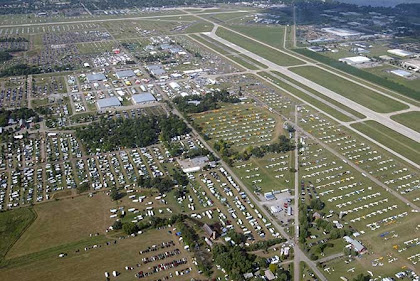
The Experimental Aircraft Association's (EAA) annual week-long AirVenture gathering in Oshkosh, Wisconsin, is underway. It's better known as "Oshkosh" to aviation enthusiasts and you can be assured that every one of them has the event on their bucket list. There's good reason. Imagine a fly-in attracting around 7500 airplanes. Imagine 2500 aircraft exhibits, 800 commercial exhibitors, daily world-class airshows, and a total of around 700,000 guests.


AirVenture at Oshkosh is far from your average fly-in


Organizers call the event "the world's greatest aviation celebration" and this year marks its seventy-second edition. The map below gives readers an idea of the scope and scale of Oshkosh and indicates why the event turns a rather sleepy Wittman Regional Airport into the busiest airport in the world for one week each year.


AirVenture grounds - for scale, that's an 8000 foot runway at the top 

AirVenture grounds looking east to Lake Winnebago


I had the privilege of attending the event several times in the last decade of my career. Energizing, informative, and significant, the show was a great vehicle for delivering an organizational message to a large, captured, and enthusiastic audience. You may ask why the National Park Service (NPS) would send a dozen or so employees and volunteers to work an air show. First, the agency has almost fifty out of its more than 400 units with a significant link to an aviation theme. In addition, the Service maintains a fleet of fixed and rotary wing aircraft contributing over 20,000 hours of flight time annually in support of park operations, maintenance, and resource and fire management. Add to that interagency cooperation across departments as well as airspace regulation over the parks and the justification become clearer. In recent years the NPS's presence at the event has been reduced significantly and folded into a more cooperative effort with other federal agencies. In summation, it's a grand and demanding opportunity to reach out face-to- face with thousands of guests who enjoy and impact resources and services in and ver the parks.


Nothing like fly-in camping with thousands of your best - in this case closest - friends


If you can't attend AirVenture, the EAA maintains a comprehensive up-to-the-second website where you can spend hours reading, watching and listening to events. I've been looking up at the sound of an aircraft engine ever since I could lift my head. If you are blessed with the same response make your plans to attend an Experimental Aircraft Association AirVenture. You will not be disappointed. Until then "wheels up" every chance you get!


Monday, April 21, 2025

John Muir: To Cherish Wildness In Nature


The great American naturalist and conservationist, John Muir, was born in Dunbar, East Lothian, Scotland, on this day in 1838. Eleven years later he immigrated with his family to a farm in Portage, Wisconsin. Through his personal efforts and the movements he supported with such fervor - he founded the Sierra Club - we can enjoy the spectacular wildness that is Yosemite National Park.


President Theodore Roosevelt and John Muir on Glacier Point, Yosemite Valley, 1903


His efforts also help establish the national park movement that today preserves and interprets 429 units administered by the National Park Service. And modeled after the national park idea, there are more than 6500 state parks and thousands of local parks and preserves to enjoy. Although Muir focused on the preservation of wilderness his work provided a structure for cultural resource preservation and management. That movement originated largely with Civil War commemorations late in the 19th century and accelerated through the benevolence of industrialists including Henry Ford (The Henry Ford Museum of American Innovation and Greenfield Village) and John D. Rockefeller Jr. (Colonial Williamsburg).


Muir in his beloved Yosemite Valley in 1890


Muir was a wanderer both physically and intellectualy building upon his studies in botany and geology as he traveled. In 1868 he saw Yosemite Valley for the first time and soon realized he had found his calling in the world of the Sierra Nevada Mountains. This is how he described the revelation in his autobiographical notebook:


There are eight members in our family....All are useful members of society - save me. One is a healer of the sick. Another, a merchant, and a deacon in good standing. The rest school teachers and farmers' wives - all exemplary, stable, anti-revolutionary. Surely then, I thought, one may be spared for so fine an experiment.

. . . the remnants of compunction - the struggle covering the serious business of settling down -gradually wasted and melted, and at length left me wholly free - born again! I will follow my instincts, be myself for good or ill, and see what will be the upshot...As long as I live, I'll hear the waterfalls and birds and winds sing. I'll interpret the rocks, learn the language of flood, storm and the avalanche. I'll acquaint myself with the glaciers and wild gardens, and get as near the heart of the world as I can.

Muir lived to see the creation of Yosemite National Park in 1890 and the consolidation of control of the park - California had retained management of the Yosemite Valley and Mariposa Grove - by the federal government in 1906.


John Muir, seated. reading a book ca. 1912 May 29


Two years following his death in 1914 Congress created the National Park Service to manage the preservation and use of the growing number of national parks and monuments under federal jurisdictions.

To learn more about John Muir. Visit the John Muir Exhibit at the Sierra Club website. Yosemite National Park also has a fine tribute to Muir at this link.


Sources

Photos and Illustrations:
public domain photos, Library of Congress, Washington

Text:
wikipedia entry, John Muir


Tuesday, January 7, 2025

Alan Watts: Forever Dancing In The Here And Now


By the late 1960s he had become rather well-known on the American scene as much for living "in the moment" in alcohol, experimental drugs, and other excesses as for his writing and vast collection of audiovisual productions. Classical Zen masters criticized him for practicing a light version of Buddhism. Many in the counterculture of the time latched on to his eccentrism and independent thought as a beacon in what they viewed as a western world in decline. Either way, he would say that he was what he did. We can do nothing more or less than accept the full man. So who was this man whose portraits seemed to remind me of a clever and mischievous child?


His name was Alan Watts. He was born January 6, 1915, in Britain where he developed a keen interest in Asian studies. He moved to the U.S. in the late 1930’s and became an Episcopal priest in 1943. After seven years Watts left the church and returned to the study of Asian philosophy and religion full-time. When he died in November 1973 he left the world over two dozen books, hundreds of pamphlets and briefs, countless audio tapes, and well over a thousand hours of audiovisual recordings offering his original thoughts on the Western expression of Zen/ Zen Buddhism and Asian thought. For further reading I recommend his autobiography, In My Own Way, published in 1972. It is an lively book providing readers with a memorable glimpse at American culture and character in the generation following World War II.

And how did I come to know of Watts and his world? In 1968 documentary filmmakers, Irving and Elda Hartley, produced a fourteen-minute film entitled Buddhism: Man and Nature. Watts wrote the script and provided the narration. For the Hartleys, it was an award winning addition to their series on spirituality and religion. For others, particularly those studying or working in natural resource management, ecology and related fields, the film was a compelling prescription for understanding and appreciating our natural world. It is in that context that I encountered it in the early 1970’s as a new employee of the National Park Service.


Within days after seeing Buddhism: Man and Nature I transcribed the narration and proceeded to carry it with me for more than 36 years fulfilling my employer's mission to help people appreciate, understand, and preserve some of the finest natural and cultural landscapes throughout the nation.

The film never influenced my personal religious convictions but it certainly impacted my understanding of the human place and role in natural landscapes. Alan Watts’s powerful script writing as well as his transcendent narration motivated me to look deeper into the man and his writings. Over the next decade his books on Zen, Asian philosophy and the West's response, and human behavior grew to occupy well over two feet of shelf space in my library.

What happened to the transcript I typed on my trusty Smith-Corona portable way back when? Well-tattered and coffee stained, it sits enshrined in the household safe. Its message is still on my mind as I work with a group dedicated to the preservation of Watt's last residence. The rustic home and library is in Druid Heights across the Golden Gate from San Francisco. Now essentially abandoned this cultural landscape and cluster of vernacular architecture designed and built a band of mid-20th century  beats, bohemians, and activists sits quietly on Mount Tamalpais in what is now Muir Woods National Monument.hile the

Whilte the remnants of Watts's last residence and the community he knew slips away into the fog-shrouded forest, dedicated pilgrims from around the world visit the site. At the same time millions of people continue to explore and enjoy his contributions to human behavior, philosophy, and religion as they walk their lives in their own way.


rld 
Photos and Illustration:
kpfa.org

Text:
title: from a self-descriptive quote in his autobiography, In My Own Way
wikipedia.org
alanwatts.com

Sunday, October 27, 2024

Theodore Roosevelt: A Conservation President Like No Other


Teddy Roosevelt at Union Station, Washington,DC, 1916


Theordore Roosevelt was born into a prominent New York family on this day in 1858. Through his strong determination and a robust program of excercise and outdoor activity, he overcame severe asthma in his youth to become our 26th President, serving from 1901 to 1909. On his way to the White House his extraordinary vigor, curiosity, and ambition brought him a world of experiences. You can read a rather detailed outline of his life at his Wikipedia entry. For purposes of this post I would like to focus primarily on activities within our national park system that contributed to him being known as our conservation president. It is a remarkable record including law and policy that continues to impact us more than a century after its creation.

In his eight years as President, Teddy Roosevelt signed legislation creating five national parks:

Crater Lake, Oregon

Wind Cave, South Dakota

Sullys Hill, North Dakota (later deignated a wildlife preserve)

Mesa Verde, Colorado

Platt, Oklahoma (now a portion of Chickasaw National Recreation Area


Although the new national parks were landmarks in his presidency, his signing of legislation expressed in the Antiquities Act of 1906 would come to have a huge impact on our national landscape through the creation of national monuments. The act established the nation's first broad national historic preservation policy in addition to protecting natural resources. Futhermore, it allowed for the establishment of such monuments through administrative action rather than legislation as had been done in the creation of Yellowstone National Park, Wyoming, in 1872 and Casa Grande Ruins, Arizona, in 1892. In a matter of months following his signature of the act, Roosevelt proclaimed four monuments:

Devils Tower, Wyoming

El Morro, New Mexico

Montezuma's Castle, Arizona

Petrified Forest, Arizona (now Petrified Forest National Park)

Grand Canyon, Arizona, (now Grand Canyon National Park)


In addition he proclaimed several monuments that would later be transferred to the Department of the Interior and eventually administered by the National Park Service following its creation in 1916.


Theordore Roosevelt's role as an American president and conservationist is now commemorated at six legacy units established over the last century:

Theodore Roosevelt Birthplace National Historic Site, New York City

Sagamore Hill National Historic Site, Oyster, Bay, New York

Theodore Roosevelt Inaugural National Historic Site, Buffalo, New York

Theordore Roosevelt National Park, North Dakota

Theodore Roosevelt Island, Washington, DC

Mount Rushmore National Memorial, South Dakota


The next time you visit a National Park Service unit, large or small, there's a very good chance Theodore Roosevelt had either a direct link to its creation or to his remarkable conservation and preservation legacy. Although he never established the agency his work certainly shaped its creation and mission ten years after he left the presidency. It's also important to remember that his work extended beyond the national parks to include 150 national forests, 51 federal bird reserves, and four national game preserves. And in many ways his work has never ended. Our current generation and those to come will be far richer because Theodore Roosevelt, the conservation president, cared.


Sources
Photos and Illustrations:
All photos are public domain

Text:
https://www.nps.gov/thrb/learn/historyculture/trandthenpsystem.htm
https://www.nps.gov/thro/learn/historyculture/theodore-roosevelt-and-conservation.htm
https://en.wikipedia.org/wiki/Theodore_Roosevelt


Tuesday, July 23, 2024

EAA AirVenture 2024 At Oshkosh


Today is Day 2 of the Experimental Aircraft Association's (EAA) annual week-long AirVenture gathering in Oshkosh, Wisconsin. It's better known as "Oshkosh" to aviation enthusiasts and you can be assured that every one of them has the event on their bucket list. There's good reason. Imagine a fly-in attracting around 7500 airplanes. Imagine 2500 aircraft exhibits, 800 commercial exhibitors, daily world-class airshows, and a total of over 600,000 guests.


It's far from your average fly-in


Organizers call the event "the world's greatest aviation celebration" and this year marks its 71st edition. The map below gives readers an idea of the scope and scale of Oshkosh and indicates why the event turns a rather sleepy Wittman Regional Airport into the busiest airport in the world for one week each year.


AirVenture grounds - for scale, that's an 8000 foot runway at the top


I had the privilege of attending the event several times in the last decade of my career. Energizing, informative, and significant, the show was a great vehicle for delivering an organizational message to a large, captured, and enthusiastic audience. You may ask why the National Park Service (NPS) would send a dozen or so employees and volunteers to work an air show. First, the agency has almost fifty out of its more than 400 units with a significant link to an aviation theme. In addition, the Service maintains a fleet of fixed and rotary wing aircraft contributing over 20,000 hours of flight time annually in support of park operations, maintenance, and resource and fire management. Add to that interagency cooperation across departments as well as airspace regulation over the parks and the justification become clearer. In recent years the NPS's presence at the event has been reduced significantly and folded into a more cooperative effort with other federal agencies. In summation, it's a grand and demanding opportunity to reach out face-to- face with thousands of guests who enjoy and impact agency resources and services.


Nothing like fly-in camping with thousands of your best - in this case closest - friends


If you can't attend AirVenture, the EAA maintains a comprehensive up-to-the-second website where you can spend hours reading, watching and listening to events. I've been looking up at the sound of an aircraft engine ever since I could lift my head. If you are blessed with the same response make your plans to attend an Experimental Aircraft Association AirVenture. You will not be disappointed. Until then "wheels up" every chance you get!


Wednesday, July 17, 2024

Once Upon A Time When The Nancy Roared Across Georgia


When I moved to Savannah in 1977 people were still talking about "The Nancy." It was the familiar name for the Nancy Hanks II, a daily Central of Georgia - later the Southern Railway - train that ran round trip from Savannah to Atlanta from 1947 t0 1971. Abraham Lincoln's mother seemed like an odd choice as a name for anything in the South until I quickly learned that, at the turn of the 20th century, "Nancy Hanks" was also a record breaking trotting mare from Lexington, Kentucky.


Nancy Hanks in 1892 shortly after her record breaking run


The Central of Georgia Railroad is best remembered for two trains named after fast and famous race horses, the other being the much better known Man o' War. That train made two 117 mile runs a day from Atlanta to Columbus. But it is the Nancy that gained fame among Georgians. The name was first used on a short-lived train in 1892-93. The train featured reserved-seat deluxe coaches, a grille and lounge car, a dome car in its later years, and maid service. The color scheme was a mix of blue and gray inside and out with a logo on each car.


The Nancy Hanks at Wadley, Georgia, in 1948


Central of Georgia Depot and Train Shed in Savannah (now a visitor center and museum)


At 7:00 a.m. every day the Nancy pulled out of the Central of Georgia Depot and Train Shed in Savannah for its 294 mile, five hour and forty minute run to Atlanta. For twenty years the train was popular with a wide variety of travelers ranging from businessmen to children on school field trips to families visiting relatives and friends to shoppers - the famous Rich's flagship store was across the street from the Atlanta Terminal. Day-trippers had about four hours of useful time before they had to return to the terminal for the 6:00 p.m. departure and return to Savannah.


An Atlanta advertisement for the Nancy Hanks II


Atlanta's Terminal Station in 1955. Demolished 1972.


By the late '60's improved highways, government regulations, labor issues, taxes, and subsidized competition spelled the end of privately-owned passenger rail service across the country, a service that had rarely made a profit for railroads for decades. So it was with the Nancy Hanks II. She made her last run on April 30, 1971 just one day before the creation of Amtrak, a publicly funded rail passenger service.

Twenty-four years earlier, on July 17, 1947, the Nancy Hanks II made her first run from the Georgia coast across the blistering midland to the state capital. Today, people still talk fondly about that trip. Some would be thrilled at the prospect of taking it again. Should a ride on the Nancy Hanks III become a reality I hope to be among the happy riders racing on the rails across Georgia.


In case you have any question, the horse was indeed named for Lincoln's mother. The train was definitely named for the horse.


Sources

Photos and illustrations:
Kentuckiana Digital Library
rebelrails.com
carrtracks.com
railga.com
georgiaencyclopedia.org


Text:
wikipedia
georgiaencyclopedia.org
chsgeorgia.org
railga.com
cofga.org
american-rails.com

Sunday, April 21, 2024

John Muir: "The Snow Is Melting Into Music...."


The great American naturalist and conservationist, John Muir, was born in Dunbar, East Lothian, Scotland, on this day in 1838. Eleven years later he immigrated with his family to a farm in Portage, Wisconsin. Through his personal efforts and the movements he supported with such fervor - he founded the Sierra Club - we can enjoy the spectacular wildness that is Yosemite National Park.


President Theodore Roosevelt and John Muir on Glacier Point, Yosemite Valley, 1903


His efforts also help establish the national park movement that today preserves and interprets 429 units administered by the National Park Service. And modeled after the national park idea, there are more than 6500 state parks and thousands of local parks and preserves to enjoy. Although Muir focused on the preservation of wilderness his work provided a structure for cultural resource preservation and management. That movement originated largely with Civil War commemorations late in the 19th century and accelerated through the benevolence of industrialists including Henry Ford (The Henry Ford Museum of American Innovation and Greenfield Village) and John D. Rockefeller Jr. (Colonial Williamsburg).


Muir in his beloved Yosemite Valley in 1890


Muir was a wanderer both physically and intellectualy building upon his studies in botany and geology as he traveled. In 1868 he saw Yosemite Valley for the first time and soon realized he had found his calling in the world of the Sierra Nevada Mountains. This is how he described the revelation in his autobiographical notebook:


There are eight members in our family....All are useful members of society - save me. One is a healer of the sick. Another, a merchant, and a deacon in good standing. The rest school teachers and farmers' wives - all exemplary, stable, anti-revolutionary. Surely then, I thought, one may be spared for so fine an experiment.

. . . the remnants of compunction - the struggle covering the serious business of settling down -gradually wasted and melted, and at length left me wholly free - born again! I will follow my instincts, be myself for good or ill, and see what will be the upshot...As long as I live, I'll hear the waterfalls and birds and winds sing. I'll interpret the rocks, learn the language of flood, storm and the avalanche. I'll acquaint myself with the glaciers and wild gardens, and get as near the heart of the world as I can.

Muir lived to see the creation of Yosemite National Park in 1890 and the consolidation of control of the park - California had retained management of the Yosemite Valley and Mariposa Grove - by the federal government in 1906.


John Muir, seated. reading a book ca. 1912 May 29


Two years following his death in 1914 Congress created the National Park Service to manage the preservation and use of the growing number of national parks and monuments under federal jurisdictions.

To learn more about John Muir. Visit the John Muir Exhibit at the Sierra Club website. Yosemite National Park also has a fine tribute to Muir at this link.


Sources

Photos and Illustrations:
public domain photos, Library of Congress, Washington

Text:
wikipedia entry, John Muir
title,  John of the Mountains: The Unpublished Journals of John Muir, ed. Linnie Marsh Wolfe, University of Wisconsin Press, 1979

Saturday, January 6, 2024

Alan Watts: A Contemplative Epicurean Who Danced In The Present


By the late 1960s he had become rather well-known on the American scene as much for living "in the moment" in alcohol, experimental drugs, and other excesses as for his writing and vast collection of audiovisual productions. Classical Zen masters criticized him for practicing a light version of Buddhism. Many in the counterculture of the time latched on to his eccentrism and independent thought as a beacon in what they viewed as a western world in decline. Either way, he would say that he was what he did. We can do nothing more or less than accept the full man. So who was this man whose portraits seemed to remind me of a clever and mischievous child?


His name was Alan Watts. He was born January 6, 1915, in Britain where he developed a keen interest in Asian studies. He moved to the U.S. in the late 1930’s and became an Episcopal priest in 1943. After seven years Watts left the church and returned to the study of Asian philosophy and religion full-time. When he died in November 1973 he left the world over two dozen books, hundreds of pamphlets and briefs, and well over a thousand hours of audiovisual recordings offering his original thoughts on the Western expression of Zen/ Zen Buddhism and Asian thought. For further reading I recommend his autobiography, In My Own Way, published in 1972. It is an entertaining book providing readers with a memorable glimpse at American culture and character in the generation following World War II.

And how did I come to know of Watts and his world? In 1968 documentary filmmakers, Irving and Elda Hartley, produced a fourteen-minute film entitled Buddhism: Man and Nature. Watts wrote the script and provided the narration. For the Hartleys, it was an award winning addition to their series on spirituality and religion. For others, particularly those studying or working in natural resource management, ecology and related fields, the film was a compelling prescription for understanding and appreciating our natural world. It is in that context that I encountered it in the early 1970’s as a new employee of the National Park Service.


Within days after seeing Buddhism: Man and Nature I transcribed the narration and proceeded to carry it with me for more than 36 years fulfilling my employer's mission to help people appreciate, understand, and preserve some of the finest natural and cultural landscapes throughout the nation.

The film never influenced my personal religious convictions but it certainly impacted my understanding of the human place and role in natural landscapes. Alan Watts’s powerful script writing as well as his transcendent narration motivated me to look deeper into the man and his writings. Over the next decade his books on Zen, Asian philosophy and the West's response, and human behavior grew to occupy well over two feet of shelf space in my library.

What happened to the transcript I typed on my trusty Smith-Corona portable way back when? Well-tattered and coffee stained, it sits enshrined in the household safe. Its message is still on my mind as I work with a group dedicated to the preservation of Watt's last residence. The rustic home and library is in Druid Heights across the Golden Gate from San Francisco. Now essentially abandoned and overgrown, this cultural landscape and cluster of vernacular architecture these mid-20th century  beats, bohemians, and activists sits quietly on Mount Tamalpais in what is now Muir Woods National Monument.


Sources

Photos and Illustration:
kpfa.org

Text:
title: from a self-descriptive quote in his autobiography, In My Own Way
wikipedia.org
alanwatts.com


Friday, October 27, 2023

Theodore Roosevelt And Conservation: A Legacy From Sea To Shining Sea


Teddy Roosevelt at Union Station, Washington,DC, 1916


Theordore Roosevelt was born into a prominent New York family on this day in 1858. Through his strong determination and a robust program of excercise and outdoor activity, he overcame severe asthma in his youth to become our 26th President, serving from 1901 to 1909. On his way to the White House he wrung about as much out of life as possible. You can read a rather detailed outline of his life at his Wikipedia entry. For purposes of this post I would like to focus primarily on activities within our national park system that contributed to him being known as our conservation president. It is a remarkable record including law and policy that continues to impact us more than a century after its creation.

In his eight years as President, Teddy Roosevelt signed legislation creating five national parks:

Crater Lake, Oregon

Wind Cave, South Dakota

Sullys Hill, North Dakota (later deignated a wildlife preserve)

Mesa Verde, Colorado

Platt, Oklahoma (now a portion of Chickasaw National Recreation Area


Although the new national parks were landmarks in his presidency, his signing of legislation expressed in the Antiquities Act of 1906 would come to have a huge impact on our national landscape through the creation of national monuments. The act established the nation's first broad national historic preservation policy in addition to protecting natural resources. Futhermore, it allowed for the establishment of such monuments through administrative action rather than legislation as had been done in the creation of Yellowstone National Park, Wyoming, in 1872 and Casa Grande Ruins, Arizona, in 1892. In a matter of months following his signature of the act, Roosevelt proclaimed four monuments:

Devils Tower, Wyoming

El Morro, New Mexico

Montezuma's Castle, Arizona

Petrified Forest, Arizona (now Petrified Forest National Park)

Grand Canyon, Arizona, (now Grand Canyon National Park)


In addition he proclaimed several monuments that would later be transferred to the Department of the Interior and eventually administered by the National Park Service following its creation in 1916.


Theordore Roosevelt's role as an American president and conservationist is now commemorated at six legacy units established over the last century:

Theodore Roosevelt Birthplace National Historic Site, New York City

Sagamore Hill National Historic Site, Oyster, Bay, New York

Theodore Roosevelt Inaugural National Historic Site, Buffalo, New York

Theordore Roosevelt National Park, North Dakota

Theodore Roosevelt Island, Washington, DC

Mount Rushmore National Memorial, South Dakota


The next time you visit a National Park Service unit, large or small, there's a very good chance Theodore Roosevelt had either a direct link to its creation or to his remarkable conservation and preservation legacy. Although he never established the agency his work certainly formed its foundation ten years after he left the presidency. It's also important to remember that his work extended beyond the national parks to include 150 national forests, 51 federal bird reserves, and four national game preserves. And in many ways his work has never ended. Our current generation and those to come will be far richer because Theodore Roosevelt, the conservation president, cared.


Sources
Photos and Illustrations:
All photos are public domain

Text:
https://www.nps.gov/thrb/learn/historyculture/trandthenpsystem.htm
https://www.nps.gov/thro/learn/historyculture/theodore-roosevelt-and-conservation.htm
https://en.wikipedia.org/wiki/Theodore_Roosevelt


Sunday, October 15, 2023

Remembering Ike: General, President, Farmer, First Citizen Of The World


This weekend we recall the birthday (October 14) and significance of Dwight Eisenhower, the 34th president of the United States (1953-61). 

Dwight Eisenhower's high school classmates knew he liked history and they envisioned him as a history professor at Yale. His older brother, Edgar, impressed them as well. They thought he would become President.


Dwight D. Eisenhower Official Presidential Portrait


There was no mention of Dwight Eisenhower's birthday in the long list of newsy bookmarks I review almost every day. That's a bit surprising because his stature among American presidents has increased greatly since he left office portrayed by many as an aging, mediocre, and out of touch executive. The C-SPAN Presidential Historians Survey of 2021 ranked him #5  behind Abraham Lincoln, George Washington, Franklin D. Roosevelt, and Theodore Roosevelt. The following quote from the Eisenhower National Historic Site credits him with these top five accomplishments:


1. He kept the nation at peace:
2, He ended the Korean War:
3. He balanced the budget not once, but three times:
4. He sponsored and signed the Federal Aid Highway Act of 1956:
5. He sponsored and signed the Civil Rights Bill of 1957:
Eisenhower was confronted with major Cold War crises every year he was in office: Korea, Vietnam, Formosa, Suez, Hungary, Berlin, and the U-2. While more than once America seemed on the brink of war and those around him clamored to drop the Bomb, Eisenhower always kept a level head. He dealt calmly and rationally with each situation, always finding a solution that avoided war without diminishing America's prestige.
He alone had the prestige to persuade Americans to accept a negotiated peace and convince the Chinese that failure to reach an agreement would lead to dire consequences. Eisenhower considered this to be his greatest presidential accomplishment.
Despite much pressure to do otherwise, he also refused to cut taxes and raise defense spending. His fiscal policy contributed to the prosperity of the 1950's.
This gave birth to America's interstate highway system. Eisenhower worked hard to get the bill passed and it was his favorite piece of legislation.
This was the first civil rights bill since Reconstruction. Much to Eisenhower's dismay, Congress amended the bill and critically weakened its effectiveness.


Here are some links to the home places that were significant to Dwight Eisenhower. Each of them provides additional biographical information for readers who may want to learn more about one of our most significant presidents.


Eisenhower Birthplace, Denison, Texas


Born in 1890, Dwight David Eisenhower spent his first two years living in the small railroad town of Denison, Texas. Visit the Eisenhower Birthplace State Historic Site webpage for more information.


Eisenhower Family Hone, Abilene, Kansas


Eisenhower spent his formative years from 1892 to 1911 in the old cow town of Abilene, Kansas. He always called Abilene his hometown. It is the site of the Eisenhower Presidential Library, Museum & Boyhood Home.


Eisenhower may have appreciated the meaning and value of "home," but as a military careerist he and his wife, Mamie, often had nowhere to call their own. Their roaming ended in 1950 when they purchased a farm at Gettysburg, Pennsylvania. It was in fact the only home they ever owned. Today, the National Park Service maintains the home and farm as the Eisenhower National Historic Site.


Sources:
title reference, "first citizen of the world," eulogy, President Richard M. Nixon, 1969, Dwight Eisenhower page, Wikipedia.com 
first quotation, Eisenhower Presidential Library, Museum, and Boyhood Home website.


Monday, July 24, 2023

AirVenture Over Oshkosh 2023


The Experimental Aircraft Association's (EAA) annual week-long AirVenture gathering in Oshkosh, Wisconsin, kicks off today. It's better known as "Oshkosh" to aviation enthusiasts and you can be assured that every one of them has the event on their bucket list. There's good reason. Imagine a fly-in attracting around 7500 airplanes. Imagine 2500 aircraft exhibits, 800 commercial exhibitors, daily world-class airshows, and a total of over 600,000 guests.


AirVenture at Oshkosh is far from your average fly-in


Organizers call the event "the world's greatest aviation celebration" and this year marks its seventieth edition. The map below gives readers an idea of the scope and scale of Oshkosh and indicates why the event turns a rather sleepy Wittman Regional Airport into the busiest airport in the world for one week each year.


AirVenture grounds - for scale, that's an 8000 foot runway at the top 


I had the privilege of attending the event several times in the last decade of my career. Energizing, informative, and significant, the show was a great vehicle for delivering an organizational message to a large, captured, and enthusiastic audience. You may ask why the National Park Service (NPS) would send a dozen or so employees and volunteers to work an air show. First, the agency has almost fifty out of its more than 400 units with a significant link to an aviation theme. In addition, the Service maintains a fleet of fixed and rotary wing aircraft contributing over 20,000 hours of flight time annually in support of park operations, maintenance, and resource and fire management. Add to that interagency cooperation across departments as well as airspace regulation over the parks and the justification become clearer. In recent years the NPS's presence at the event has been reduced significantly and folded into a more cooperative effort with other federal agencies. In summation, it's a grand and demanding opportunity to reach out face-to- face with thousands of guests who enjoy and impact resources and services they provide.


Nothing like fly-in camping with thousands of your best - in this case closest - friends


If you can't attend AirVenture, the EAA maintains a comprehensive up-to-the-second website where you can spend hours reading, watching and listening to events. I've been looking up at the sound of an aircraft engine ever since I could lift my head. If you are blessed with the same response make your plans to attend an Experimental Aircraft Association AirVenture. You will not be disappointed. Until then "wheels up" every chance you get!


Monday, July 17, 2023

Racing Across Georgia On The Nancy Hanks


When I moved to Savannah in 1977 people were still talking about "The Nancy." It was the familiar name for the Nancy Hanks II, a daily Central of Georgia 
- later the Southern Railway - train that ran round trip from Savannah to Atlanta until 1971. Abraham Lincoln's mother seemed like an odd choice as a name for anything in the South until I quickly learned that, at the turn of the 20th century, "Nancy Hanks" was also a record breaking trotting mare from Lexington, Kentucky.


Nancy Hanks in 1892 shortly after her record breaking run


The Central of Georgia Railroad is best remembered for two trains named after fast and famous race horses, the other being the much better known Man o' War. That train made two 117 mile runs a day from Atlanta to Columbus. But it is the Nancy that gained fame among Georgians. The name was first used on a short-lived train in 1892-93. It was revived in 1947 and remained in use until 1971 when railroad across the nation ended virtually all of their passenger service. The train featured reserved-seat deluxe coaches, a grille and lounge car, a dome car in its later years, and maid service. The color scheme was a mix of blue and gray inside and out with a logo on each car.


The Nancy Hanks at Wadley, Georgia, in 1948


Central of Georgia Depot and Train Shed in Savannah (now a visitor center and museum)


At 7:00 a.m. every day the Nancy pulled out of the Central of Georgia Depot and Train Shed in Savannah for its 294 mile, five hour and forty minute run to Atlanta. For twenty years the train was popular with a wide variety of travelers ranging from businessmen to children on school field trips to families visiting relatives and friends to shoppers - the famous Rich's flagship store was across the street from the Atlanta Terminal. Day-trippers had about four hours of useful time before they had to return to the terminal for the 6:00 p.m. departure and return to Savannah.


An Atlanta advertisement for the Nancy Hanks II


Atlanta's Terminal Station in 1955. Demolished 1972.


By the late '60's improved highways, government regulations, labor issues, taxes, and subsidized competition spelled the end of privately-owned passenger rail service across the country, a service that had rarely made a profit for railroads for decades. So it was with the Nancy Hanks II. She made her last run on April 30, 1971 just one day before the creation of Amtrak, a publicly funded rail passenger service.

Twenty-four years earlier, on July 17, 1947, the Nancy Hanks II made her first run from the Georgia coast across the blistering midland to the state capital. Today, people still talk fondly about that trip. Some would be thrilled at the prospect of taking it again. Should a ride on the Nancy Hanks III become a reality I hope to be among the happy riders racing on the rails across Georgia.


By the way, the horse was indeed named for Lincoln's mother. The train  was definitely named for the horse.


Sources

Photos and illustrations:
Kentuckiana Digital Library
rebelrails.com
carrtracks.com
railga.com
georgiaencyclopedia.org


Text:
wikipedia
georgiaencyclopedia.org
chsgeorgia.org
railga.com
cofga.org
american-rails.com


Friday, April 21, 2023

John Muir: Going Out Was Coming Home


Today is the birthday (1839) of the great American naturalist and conservationist, John Muir. Through his personal efforts and the movements he supported with such fervor - he founded the Sierra Club - we can enjoy the spectacular wildness that is Yosemite National Park. His efforts also help establish the national park movement that today provides us with more than 400 units administered by the National Park Service. And modeled after the national park idea, there are more than 6500 state parks and thousands of local parks and preserves to enjoy. Although Muir focused on the preservation of wilderness his work provided a structure for cultural resource preservation and management. That movement originated largely with Civil War commemorations late in the 19th century and accelerated through the benevolence of industrialist including Henry Ford (The Henry Ford Museum of American Innovation and Greenfield Village) and John D. Rockefeller Jr. (Colonial Williamsburg).


Muir in his beloved Yosemite Valley in 1890


Muir was a wanderer both physically and emotionally building upon his studies in botany and geology as he traveled. In 1868 he saw Yosemite Valley for the first time and soon realized he had found his calling in the world of the Sierra Nevada Mountains. This is how he described the revelation in his autobiographical notebook:


There are eight members in our family....All are useful members of society - save me. One is a healer of the sick. Another, a merchant, and a deacon in good standing. The rest school teachers and farmers' wives - all exemplary, stable, anti-revolutionary. Surely then, I thought, one may be spared for so fine an experiment.

... the remnants of compunction - the struggle covering the serious business of settling down -gradually wasted and melted, and at length left me wholly free - born again! I will follow my instincts, be myself for good or ill, and see what will be the upshot...As long as I live, I'll hear the waterfalls and birds and winds sing. I'll interpret the rocks, learn the language of flood, storm and the avalanche. I'll acquaint myself with the glaciers and wild gardens, and get as near the heart of the world as I can.


Muir lived to see the creation of Yosemite National Park in 1890 and the consolidation of control of the park - California had retained management of the Yosemite Valley and Mariposa Grove - by the federal government in 1906.


John Muir, seated. reading a book ca. 1912 May 29


Two years following his death in 1914 Congress created the National Park Service to manage the preservation and use of the growing number of natural areas under federal jurisdictions.

To learn more about John Muir. Visit the John Muir Exhibit at the Sierra Club website. Yosemite National Park also has a fine tribute to Muir at this link.


Sources


Photos and Illustrations:
public domain photos, Library of Congress, Washington


Text:
wikipedia entry, John Muir
title paraphrse, John of the Mountains:The Unpublished Journals of John Muir, ed. Linnie Marsh Wolfe, University of Wisconsin Press, 1979


Saturday, January 7, 2023

The Remarkable Way Of Alan Watts


By the late 1960s he had become rather well-known on the American scene as much for living "in the moment" in alcohol, experimental drugs, and other excesses as for his writing and vast collection of audiovisual productions. Classical Zen masters criticized him for practicing a light version of Buddhism. Many in the counterculture of the time latched on to his eccentrism and independent thought as a beacon in what they viewed as a western world in decline. Either way, he would say that he was what he did. We can do nothing more or less than accept the full man. So who was this man whose portraits seemed to remind me of a clever and mischievous child?


His name was Alan Watts. He was born January 6, 1915, in Britain where he developed a keen interest in Asian studies. He moved to the U.S. in the late 1930’s and became an Episcopal priest in 1943. After seven years Watts left the church and returned to the study of Asian philosophy and religion full-time. When he died in November 1973 he left the world over two dozen books, hundreds of pamphlets and briefs, and well over a thousand hours of audiovisual recordings offering his original thoughts on the Western expression of Zen/ Zen Buddhism and Asian thought. For further reading I recommend his autobiography, In My Own Way, published in 1972. It is an entertaining book providing readers with a memorable glimpse at American culture and character in the generation following World War II.

And how did I come to know of Watts and his world? In 1968 documentary filmmakers, Irving and Elda Hartley, produced a fourteen-minute film entitled Buddhism: Man and Nature. Watts wrote the script and provided the narration. For the Hartleys, it was an award winning addition to their series on spirituality and religion. For others, particularly those studying or working in natural resource management, ecology and related fields, the film was a compelling prescription for understanding and appreciating our natural world. It is in that context that I encountered it in the early 1970’s as a new employee of the National Park Service.


Within days after seeing Buddhism: Man and Nature I transcribed the narration and proceeded to carry it with me for more than 36 years fulfilling my employer's mission to help people appreciate, understand, and preserve some of the finest natural and cultural landscapes throughout the nation.

The film never influenced my personal religious convictions but it certainly impacted my understanding of the human place and role in natural landscapes. Alan Watts’s powerful script writing as well as his transcendent narration motivated me to look deeper into the man and his writings. Over the next decade his books on Zen, Asian philosophy and the West's response, and human behavior grew to occupy well over two feet of shelf space in my library.

What happened to the transcript I typed on my trusty Smith-Corona portable way back when? Well-tattered and coffee stained, it sits enshrined in the household safe. Its message is still on my mind as I work with a group dedicated to the preservation of Watt's last residence. The rustic home and library is in Druid Heights across the Golden Gate from San Francisco. Now essentially abandoned and overgrown, this cluster of homes of beats, bohemians, and activists sits quietly on  Mount Tamalpais in what is now Muir Woods National Monument. 


Sources

Photos and Illustration:
kpfa.org

Text:
wikipedia.org
alanwatts.com


ShareThis