Showing posts with label World War II. Show all posts

Sunday, June 29, 2025

Lena Horne: An American Legend


In the years around the turn of the century I was a member of the planning and design team for the newly established Tuskegee Airmen National Historic Site in Alabama. Fundraising was a big part of our mission and we asked a large core group of airmen who they would like to see as a national spokesman for the effort. To a man, the response was, "Lena Horne!" who made a number of visits to their two Tuskegee airfields during World War II. They adored her. She was beautiful, had a sultry voice, the perfect figure for a World War II pinup, and a highly successful musical career on stage and screen. She was also strong-willed and, at times, defiant, both characteristics that served her well in the American civil rights movement following the war. No wonder she appealed to them.


Horne publicity photo from 1964, NBC Bell Telephone Hour


Who was this international star and favorite pinup? Lena Horne was born on this day in Brooklyn in 1917. Those familiar with the singer will always remember her remarkable talent as a legendary performer with a sparkling personality and a beautiful smile, In her almost seventy years in entertainment she worked the big band and cabaret circuits, movies, Broadway, and television. She became politically active in the fight for civil rights following World War II, a decision that placed her on the federal entertainment blacklist for over a decade. Readers can learn more details about Horne's life and career in a New York Times obituary published following her death in May 2010.


Horne at Tuskegee Institute banquet, Tuskegee, Alabama, during World War II


Due to her age and disabilities, Horne was unable to take on the role the Tuskegee Airmen so enthusiastically desired but fundraising commenced in a different direction and eventually contributed to construction and interpretation at the park. Her image and the stories of her visits are embedded in those exhibits.

I remember Horne well from her frequent television performances and recordings beginning in the 1950's. She's always been a personal favorite among pop and jazz singers and the stories of her association with the Tuskegee Airmen tells me she was one very special lady.

Here she is performing her signature song, Stormy Weather, from the 1943 film of the same name.


And here is a fine synopsis of the life and times of Horne prepared for a segment of the PBS News Hour in 2010.


Sources

Photos and Illustrations:
public domain photograph, NBC Television, Wikipedia.org
banquet photo, Noel Parrish Collection, Manuscript Division, Library of Congress, Washington

Wednesday, June 18, 2025

Let Us Therefore Brace Ourselves To Our Duties....


Eighty-five years ago today, Prime Minister Winston Churchill delivered his most memorable speech during Britain's war against Adolf Hitler. The threat of invasion by German ground forces was high. The British people descended almost nightly into their bomb shelters as waves of Luftwaffe bombers flew overheard dropping their terror on thousands of victims.


Churchill was a master of the English language but even he struggled for the right words to both describe the reality his countrymen faced and rally them to endure what he knew would be their darkest hour:

The whole fury and might of the enemy must very soon be turned on us. Hitler knows that he will have to break us in this island or lose the war. If we can stand up to him, all Europe may be freed and the life of the world may move forward into broad, sunlit uplands. But if we fail, then the whole world, including the United States, including all that we have known and cared for, will sink into the abyss of a new dark age made more sinister, and perhaps more protracted, by the lights of perverted science. Let us therefore brace ourselves to our duties, and so bear ourselves, that if the British Empire and its Commonwealth last for a thousand years, men will still say, This was their finest hour.


Churchill would go on to receive the Nobel Prize in literature in 1953 for his many volumes of history, biography and other works. He possessed a vivid, lively writing style well worth reading for information as well as enjoyment. For more on this remarkable leader, here is a link to his Wikipedia entry.

And here is a link to the "finest hour" speech in its entirety of thirty minutes. All of it is worth hearing but as one would expect the conclusion is remarkably powerful beginning at 26:13


Sources

Photos and Illustrations:
public domain photo, Imperial War Museums

Text
Winston Churchill, wikipedia.org


Friday, June 6, 2025

D-Day: It Was The Largest Amphibious Invasion In History


Into The Jaws Of Death, US Troops Wading Through Water And Nazi Gunfire


Eighty years ago on June 6, 1944, 160,000 Allied troops landed along a 50-mile stretch of heavily-fortified French coastline to fight Nazi Germany on the beaches of Normandy, France. General Dwight D. Eisenhower called the operation a crusade in which “we will accept nothing less than full victory.” More than 5,000 Ships and 13,000 aircraft supported the D-Day invasion, and by day’s end on June 6 the Allies gained a foothold in Normandy. The cost was high - more than 9,000 Allied soldiers were killed or wounded - but more than 100,000 soldiers began the march across Europe to defeat Hitler.


We don't teach history much these days. If students simply learned that "more than 100,000 soldiers began the march across Europe to defeat Hitler" and his National Socialist movement, I would be somewhat pleased. I'd also like every student to know that 16 million Americans served during World War II. About 66143 are still alive. Last year that number was 119550.D-Da In a short time all of these eyewitnesses to history will be gone. There will be no one to thank, no one to question. Only our memories will survive.

For more on the significance of this day link to the U.S. Army D-Day Page.


A portion of 9388 interments at Normandy American Cemetery adjacent Omaha Beach


Sources

Photos and Illustrations:photo, Franklin D. Roosevelt Library, Public Domain Photographs, 1882-1962
map, Department of History, United States Military Academy

Text:

U.S. Army D-Day Page
statistics, U.S. Army D-Day Page

Saturday, December 7, 2024

National Pearl Harbor Remembrance Day 2024


Today marks the 83rd anniversary of the Imperial Japanese Navy's attack on the U.S. Navy's base at Pearl Harbor, Hawaii.

Below is Pearl Harbor as it appeared on October 30, 1941.


Below is a photo taken by a Japanese pilot 38 days later on December 7 during the torpedo attack on Battleship Row visible on the far side of Ford Island.


There were almost 4000 casualties that day including 2400 dead.

The attack led to a war effort that included 16,000,000 American men and women in uniform. The Department of Veterans Affairs reports that around 66,000 of these veterans survive. Soon, the relics, memorials and ceremony will be all that is left to testify to America's greatest generation at war. If we are to survive, we need to remember them now and in the future for what they did to crush evil in the world.


USS Arizona Memorial, Pearl Harbor, Hawaii, 2004


Today the youngest of the sixteen surviving veteran of Pearl Harbor would be 100 years old. Many of them can no longer travel and according to officials only two will attend the ceremony along with perhaps thirty World War II veterans.


Sunday, June 30, 2024

Lena Horn: Entertainment And Activism At Its Best


In the years around the turn of the century I was a member of the planning and design team for the newly established Tuskegee Airmen National Historic Site in Alabama. Fundraising was a big part of our mission and we asked a large core group of airmen who they would like to see as a national spokesman for the effort. To a man, the response was, "Lena Horne!" who made a number of visits to their two Tuskegee airfields during World War II. They adored her. She was beautiful, had a sultry voice, the perfect figure for a World War II pinup, and a highly successful musical career on stage and screen. She was also strong-willed and, at times, defiant, both characteristics that served her well in the American civil rights movement following the war. No wonder she appealed to them.


Horne publicity photo from 1964, NBC Bell Telephone Hour


Who was this international star and favorite pinup? Lena Horne was born on this day in Brooklyn in 1917. Those familiar with the singer will always remember her remarkable talent as a legendary performer with a sparkling personality and a beautiful smile, In her almost seventy years in entertainment she worked the big band and cabaret circuits, movies, Broadway, and television. She became politically active in the fight for civil rights following World War II, a decision that placed her on the federal entertainment blacklist for over a decade. Readers can learn more details about Horne's life and career in a New York Times obituary published following her death in May 2010.


Horne at Tuskegee Institute banquet, Tuskegee, Alabama, during World War II


Due to her age and disabilities, Horne was unable to take on the role the Tuskegee Airmen so enthusiastically desired but fundraising commenced in a different direction and eventually contributed to construction and interpretation at the park. Her image and the stories of her visits are embedded in those exhibits.

I remember Horne well from her frequent television performances and recordings beginning in the 1950's. She's always been a personal favorite among pop and jazz singers and the stories of her association with the Tuskegee Airmen tells me she was one very special lady.

Here she is performing her signature song, Stormy Weather, from the 1943 film of the same name.


And here is a fine synopsis of the life and times of Horne prepared for a segment of the PBS News Hour in 2010.


Sources

Photos and Illustrations:
public domain photograph, NBC Television, Wikipedia.org
banquet photo, Noel Parrish Collection, Manuscript Division, Library of Congress, Washington

Thursday, June 6, 2024

D-Day: The Cost Of Freedom


Into The Jaws Of Death, US Troops Wading Through Water And Nazi Gunfire


Eighty years ago on June 6, 1944, 160,000 Allied troops landed along a 50-mile stretch of heavily-fortified French coastline to fight Nazi Germany on the beaches of Normandy, France. General Dwight D. Eisenhower called the operation a crusade in which “we will accept nothing less than full victory.” More than 5,000 Ships and 13,000 aircraft supported the D-Day invasion, and by day’s end on June 6 the Allies gained a foothold in Normandy. The cost was high - more than 9,000 Allied soldiers were killed or wounded - but more than 100,000 soldiers began the march across Europe to defeat Hitler.


We don't teach history much these days. If students simply learned that "more than 100,000 soldiers began the march across Europe to defeat Hitler" and his National Socialist movement, I would be somewhat pleased. I'd also like every student to know that 16 million Americans served during World War II. About 119,550 are still alive. About 110,000 die each year. In a short time all of these eyewitnesses to history will be gone. There will be no one to thank, no one to question. Only our memories will survive.

For more on the significance of this day link to the U.S. Army D-Day Page.


View of a portion of 9388 interments at Normandy American Cemetery adjacent Omaha Beach


Sources

Photos and Illustrations:photo, Franklin D. Roosevelt Library, Public Domain Photographs, 1882-1962
map, Department of History, United States Military Academy

Text:
U.S. Army D-Day Page

statistics, U.S. Army D-Day Page

Saturday, April 20, 2024

Adolf Has A Birthday - And A Pin In His Cushion


Yes, today is Der Fuhrer's birthday. We remember him solely as the last century's foremost mass murderer, challenged only by Mao Zedong, and followed by runners-up, Vladimir Lenin, Joseph Stalin, and Pol Pot. Perhaps this day will remind us that our president is pandering for votes from his party's Jew hating faction as they chant "Death to Israel" and equally disturbing, "Death to America". Already, analysts are saying the group could easily cost him the presidential election in November. It reminds me that our national experience today walks uncomfortably close to that of Weimar Germany, the breeding ground for the rise of Adolf and his National Socialist party to victory in 1933. Given the Holocaust and World War II that followed we cannot associate Adolf and his party with any kind of win. 

We could remember Der Fuhrer by listing his atrocities which remain well documented and commemorated in western culture. I choose to build on that foundation through the forms of humor we know as satire and parody. Both have been described as the most effective forms of ridicule by far and a staple in public discourse and entertainment beginning with the Greeks 2500 years ago. Therefore, I present to you the Adolph Hitler Pin Cushion, a most popular item in American households during World War II. The fine specimen pictured below comes from my great aunt's home.


In our time the film industry has produced some wonderful examples of humor applied to Der Fuhrer. For some individuals and groups it is difficult to understand. In a 2018 National Public Radio interview, Mel Brooks, the comic who brought us The Producers (1967 and 2005) and many other masterful comedies, explained his motivations for making the original film:

. . . Listen, get on a soapbox with Hitler, you're gonna lose — he was a great orator. But if you can make fun of him, if you can have people laugh at him, you win. . . . The comedy writer is like the conscience of the king . . . . He's got to tell him the truth. And that's my job: to make terrible things entertaining.

I would add the terrible things not only become entertaining but also allow us to survive, understand, and accept their reality. Yes, there is healing in this humor.

Here are four examples of satire and parody at work from Charlie Chaplin's, The Great Dictator (1940) where Hitler meets Italy's Mussolini; Mel Brooks's, The Producers (1967); and the British Ministry of Information's Schichlegruber Doing The Lambeth Walk (1942).


Horrible voice, bad breeding, vulgar manners, you have everything you need to be a politician.
          from The Knights, a play by Aristophanes, 424 BCE


Sources

Photos and Illustrations:
Hitler pin cushion figurine, World War II era, OTR personal collection

Text:
NPR Morning Edition interview with Susan Stamberg, April 26, 2018, https://www.npr.org/2018/04/26/605297774/mel-brooks-says-its-his-job-to-make-terrible-things-entertaining

Tuesday, April 16, 2024

Charlie Chaplin: The Consumate Comedian


If you took a photograph of the "Little Tramp" to almost any corner of the world touched by Western culture, chances are, someone would recognize it. That's a powerful statement given that the character hasn't appeared in a film for over seventy years. Greatness persists. And so it is with Charlie Chaplin, born on this date in London in 1889.


In his 88 years, he graced the world of entertainment as a performer, director, producer, businessman, and composer. His concern for everyday people and their often difficult lives was a common theme in virtually all his films as well as his private life. Such humanitarian sympathies led him to ally with well-known leftist in the U.S. and eventually leave the country in the early 1950s'. Through it all, his endearing, bumbling yet refined tramp brought laughter and awareness to millions.


Take some time today to visit Chaplin's official site. The biography page is especially useful, providing information about nine "masterpiece features" and a complete filmography. Chaplin has three films on the American Film Institute's Greatest Films of All Time list. They are: City Lights (1931) at #11, The Gold Rush (1925) at #58, and Modern Times (1936) at #78. It's important to keep in mind that Chaplin was the director, producer, writer, star, composer, and editor for all of these films except Modern Times, edited by Willard Nico.

My personal favorite among all of his films is The Great Dictator (1940). Interestingly, this film was Chaplin's first "talkie." In it Chaplin portrays two characters, the "Little Tramp" variation of a Jewish veteran of World War I attempting to reestablish his life as a barber, and Adenoid Hynkel, dictator of Tomainia. Any resemblance between Adenoid Hynkel and Adolph Hitler is completely intentional. The film is a masterful piece of political satire made as an appeal to Americans and their leadership to wake up to the threat of Nazi Germany. It's often cited as the finest example of the use of ridicule in film in the twentieth century.

Here are two clips from The Great Dictator. First is the famous "globe scene," and second, "Benzino Napaloni - played to ridiculous perfection by Jack Oakie - meets Adenoid Hynkel at the train station." These clips are restricted and can be viewed by clicking on the YouTube link provided. 


Happy birthday, Little Tramp. Thank you for being the comedian you were and for helping shape the comedy we enjoy today.


A day without laughter is a day wasted.

                    Charlie Chaplin


Thursday, December 7, 2023

At Pearl Harbor 82 Years Ago


Today marks the 82nd anniversary of the Imperial Japanese Navy's attack on the U.S. Navy's base at Pearl Harbor, Hawaii.

Below is Pearl Harbor as it appeared on October 30, 1941.


Below is a photo taken by a Japanese pilot 38 days later on December 7 during the torpedo attack on Battleship Row visible on the far side of Ford Island.


There were almost 4000 casualties that day including 2400 dead.

The attack led to a war effort that included 16,000,000 American men and women in uniform. The National WWII Museum in New Orleans reports that only 119,500 of these veterans survive. Soon, the relics, memorials and ceremony will be all that is left to testify to America's greatest generation at war. If we are to survive, we need to remember them now and in the future for what they did to crush evil in the world.


USS Arizona Memorial, Pearl Harbor, Hawaii, 2004


Today the youngest surviving veteran of Pearl Harbor would be 99 years old. Many of them can no longer travel and according to the officials only one or two will attend the ceremony along with perhaps thirty World War II veterans.


Saturday, October 7, 2023

Happy Birthday. Dad!


Below is my dad's high school graduation photo. He was an honor grad and holder of class medals in English and debate. The year was 1925. He was seventeen. My dad was a mill town boy with high ambitions beyond the mountains of western Maryland but he had the security of a well-paying full-time job waiting for him after graduation in the midst of the Roaring Twenties. That job won out and he never pursued the college degree he wanted. Nevertheless he was successful, building on his strong Christian faith, steady employment, solid marriage, and remarkable work ethic.


1925


When I look at this picture I am reminded that he only had four "good" years before the Great Depression and World War II brought him and the country he loved into sixteen years of hard times. What I don't see are his weakened legs and slight limp caused by polio when he was a young boy. Through it all he survived as a member of the "Greatest Generation" and saw his nation prosper.

One hundred and sixteen years have passed since his birth on this day in 1907. That's a long time and one indication of why my value programming is different from that of most people my age. In short, I was raised by parents from the Roaring Twenties and the Jazz Age while the majority of my classmates, friends, and many colleagues had parents come of age in the 1930's and early '40's. The often vast difference in attitudes, opinions and beliefs borne out of such a circumstance brings both opportunity and challenge in the real world for those born somewhat "out of synch" with their peers.

My children never knew my dad - he's been gone for over forty years - but I think they know him well. I've done my best to teach them who he was and honor him by carrying on his many traditions. How fortunate I was to have him as a beacon in my life. He was a great and careful teacher and, though we had our differences, a constant and trusted friend. Most of all he was my loving dad. I thank him every day,  will love him forever, and look forward to seeing him again.


4th Grade class photo, 1917-18


Friday, September 1, 2023

Even More Feckless Leaders And Warm Fuzzy Diplomacy


This post first appeared eight years ago to commemorate the beginning of World War II in 1939. I never dreamed, as our leadership continues negotiations, known or unknown, with fanatics who seek our destruction, that I could post it today, changing only the players and their georgraphy. 


This is going a brief post about the most important September 1 in the twentieth century. Today in 1939, Adolph Hitler launched a massive invasion of Poland and plunged the world into war. Eleven months earlier Hitler had signed the Munich Agreement pledging to end his aggression in exchange for certain borderlands in Czechoslovakia inhabited by German-speaking people. Most of us know this history in the context of British Prime Minister Neville Chamberlain triumphantly returning to London and waving the agreement while declaring "peace for our time."


In the coming months our government may have an opportunity to pass judgement on a nuclear agreement with Iran and perhaps a cease fire in Russia's war against Ukraine. We don't know if these steps back from the brink will produce peace for our time. We almost assuredly know any agreement with Iran will produce, with the assistance of the West, an advanced nuclear program and possibly nuclear arms for a nation in the hands of religious fanatics. The prospects have already produced a nuclear arms race in the Middle East. Those who recognize the phrase, "balance of terror," may see a new parallel developing in the region. With history as our example and virtual wholesale trust as our principle, I believe those who accept such agreements  and proudly wave them over the heads of their admirers will become the feckless Chamberlains of the twenty-first century.

Many writers have warned us about the perils of ignoring history. Even in plain sight, we don't seem to listen well.


Sources

Photo: huffingtonpost.com

Sunday, August 6, 2023

Special Bombing Mission Number 13, August 6, 1945


On August 6, 1945 at 8:15 a.m. Japan Local Time the world changed.

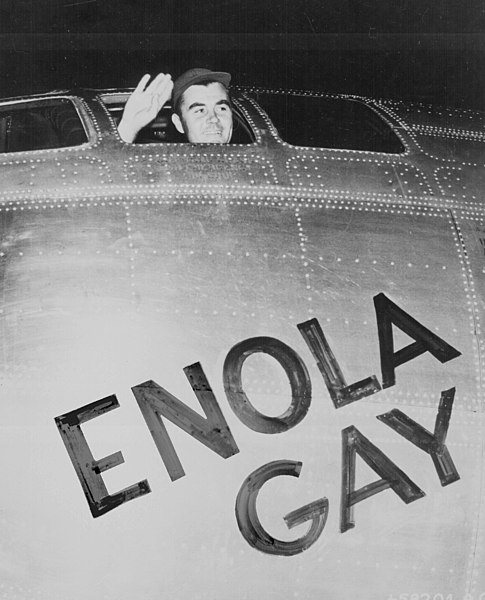
Forty-three seconds after releasing the bomb nicknamed "Little Boy," pilot Col. Paul Tibbets was alerted to the blast by radioactivity tingling in his teeth and the metallic taste from electrolysis on his tongue. Ten and a half miles away, tens of thousands of people had already vanished in a brilliant flash. A massive firestorm would grip the city within minutes and kills thousands more. This photo taken minutes after the blast at a distance of six miles was found in a suburban Hiroshima grade school in 2013:


The photo below was taken after the removal of street and lot debris and revealed the full extent of the destruction.


As the first use of an atomic weapon against an enemy, the decision to drop the bomb on Hiroshima - and Nagasaki three days later - was controversial. The decision assuredly brought a very quick end to the war with Japan and in the eyes of most historians and military experts saved the lives of millions of combatants and civilians. For more on this historic event and its aftermath readers should visit the Harry S. Truman Library & Museum's outstanding archive of primary sources relating to the story.


Tibbets, pilot and commander, in the cockpit prior to takeoff for Hiroshima


For a three minute assessment of the event by Tibbets visit this history.com link.


The last surviving Enola Gay crew member - Theodore "Dutch" Van Kirk - died at his home in Stone Mountain, Georgia, in 2014. It's one more indication that our greatest generation as an eyewitness to history is itself rapidly moving into history.


Sources

Photos and Illustrations:
Ground photo, gizmodo.com.au
Hiroshima aftermath, U.S. Navy Public Affairs Website, chinfo.navy.milEnola Gay photo, National Archives and Records Service


Friday, June 30, 2023

Lena Horne: Entertainer, Activist, American Icon


In the years around the turn of the century I was a member of the planning and design team for the newly established Tuskegee Airmen National Historic Site in Alabama. Fundraising was a big part of our mission and we asked a large core group of airmen who they would like to see as a national spokesman for the effort. To a man, the response was, "Lena Horne!" who made a number of visits to their two Tuskegee airfields during World War II. They adored her. She was beautiful, had a sultry voice, the perfect figure for a World War II pinup, and a highly successful musical career on stage and screen. She was also strong-willed and, at times, defiant, both characteristics that served her well in the American civil rights movement following the war. No wonder she appealed to them.


Horne publicity photo from 1964, NBC Bell Telephone Hour


Who was this international star and favorite pinup? Lena Horne was born on this day in Brooklyn in 1917. Those familiar with the singer will always remember her remarkable talent as a legendary performer with a sparkling personality and a beautiful smile, In her almost seventy years in entertainment she worked the big band and cabaret circuits, movies, Broadway, and television. She became politically active in the fight for civil rights following World War II, a decision that placed her on the federal entertainment blacklist for over a decade. Readers can learn more details about Horne's life and career in a New York Times obituary published following her death in May 2010.


Horne at Tuskegee Institute banquet, Tuskegee, Alabama, during World War II


Due to her age and disabilities, Horne was unable to take on the role the Tuskegee Airmen so enthusiastically desired but fundraising commenced in a different direction and eventually contributed to construction and interpretation at the park. Her image and the stories of her visits are embedded in those exhibits.

I remember Horne well from her frequent television performances and recordings beginning in the 1950's. She's always been a personal favorite among pop and jazz singers and the stories of her association with the Tuskegee Airmen tells me she was one very special lady.

Here she is performing her signature song, Stormy Weather, from the 1943 film of the same name.


And here is a fine synopsis of the life and times of Horne prepared for a segment of the PBS News Hour in 2010.


Sources

Photos and Illustrations:
public domain photograph, NBC Television, Wikipedia.org
banquet photo, Noel Parrish Collection, Manuscript Division, Library of Congress, Washington


Tuesday, June 6, 2023

D-Day: Win The Cliffs, Win The Continent, Win The War


Into The Jaws Of Death, US Troops Wading Through Water And Nazi Gunfire


June 6, 1944, 160,000 Allied troops landed along a 50-mile stretch of heavily-fortified French coastline to fight Nazi Germany on the beaches of Normandy, France. It remains the largest amphibious invasion in history. General Dwight D. Eisenhower called the operation a crusade in which “we will accept nothing less than full victory.” More than 5,000 ships and 13,000 aircraft supported the D-Day invasion, and by day’s end on June 6 the Allies gained a foothold in Normandy. The D-Day cost was high - more than 9,000 Allied soldiers were killed or wounded - but more than 100,000 soldiers began the march across Europe to defeat Hitler.


We don't teach history much these days. If students simply learned that "more than 100,000 soldiers began the march across Europe to defeat Hitler" and his National Socialist movement, I would be somewhat pleased. I'd also like every student to know that 16 million Americans served during World War II. About 130,000 are still alive. About 110,000 die each year. In a short time all of these eyewitnesses to history will be gone. There will be no one to thank, no one to question. We can only remember.

For more on the significance of this day link to the U.S. Army D-Day Page.


A portion of 9388 interments at Normandy American Cemetery adjacent Omaha Beach


Sources


Photos and Illustrations:
photo, Franklin D. Roosevelt Library, Public Domain Photographs, 1882-1962
map, Department of History, United States Military Academy

Text:
title derived from a quote by President Ronald Reagan, www.army.mil/d-day, U.S. Army D-Day Page
statistics, U.S. Army D-Day Page


Thursday, April 20, 2023

A Birthday For Adolf


Yes, today is Der Fuhrer's birthday. We remember him only as the last century's foremost mass murderer, challenged only by Mao Zedong, and followed by runners-up, Vladimir Lenin, Joseph Stalin, and Pol Pot.


We could remember Der Fuhrer by listing his atrocities which remain well documented and commemorated in western culture. I choose to build on that foundation through the forms of humor we know as satire and parody. Both have been described as most effective forms of ridicule by far and a staple in public discourse and entertainment beginning with the Greeks 2500 years ago.

In our time the film industry has produced some wonderful examples of humor applied to Der Fuhrer. For some it is difficult to understand. In a 2018 National Public Radio interview, Mel Brooks, the comic who brought us The Producers (1967 and 2005) explained his motivations for making the original film:

. . . Listen, get on a soapbox with Hitler, you're gonna lose — he was a great orator. But if you can make fun of him, if you can have people laugh at him, you win. . . . The comedy writer is like the conscience of the king . . . . He's got to tell him the truth. And that's my job: to make terrible things entertaining.

I would add the terrible things not only become entertaining but also allow us to survive, understand, and accept their reality. Yes, there is healing in this humor.

Here are four examples of satire and parody at work from Charlie Chaplin's, The Great Dictator (1940), Mel Brooks's, The Producers (1967), and the British Ministry of Information's Schichlegruber Doing The Lambeth Walk (1942). 


Horrible voice, bad breeding, vulgar manners, you have everything you need to be a politician.

                                      Aristophanes 


Sources

Photos and Illustrations:
Hitler pin cushion figurine, World War II era, OTR personal collection

Text:
NPR Morning Edition interview with Susan Stamberg, April 26, 2018, https://www.npr.org/2018/04/26/605297774/mel-brooks-says-its-his-job-to-make-terrible-things-entertaining

Sunday, April 16, 2023

The Little Tramp: Charlie Chaplin So Very Much Remembered


If you took a photograph of the "Little Tramp" to almost any corner of the world touched by Western culture, chances are, someone would recognize it. That's a powerful statement given that the character hasn't appeared in a film for over seventy years. Greatness persists. And so it is with Charlie Chaplin, born on this date in London in 1889.


In his 88 years, he graced the world of entertainment as a performer, director, producer, businessman, and composer. His concern for everyday people and their often difficult lives was a common theme in virtually all his films as well as his private life. Such humanitarian sympathies led him to ally with well-known leftist in the U.S. and eventually leave the country in the early 1950s'. Through it all, his endearing, bumbling yet refined tramp brought laughter and awareness to millions.

Take some time today to visit Chaplin's official site. The biography page is especially useful, providing information about nine "masterpiece features" and a complete filmography. Chaplin has three films on the American Film Institute's Greatest Films of All Time list. They are: City Lights (1931) at #11, The Gold Rush (1925) at #58, and Modern Times (1936) at #78. It's important to keep in mind that Chaplin was the director, producer, writer, star, composer, and editor for all of these films except Modern Times, edited by Willard Nico.

My personal favorite among all of his films is The Great Dictator (1940). Interestingly, this film was Chaplin's first "talkie." In it Chaplin portrays two characters, the "Little Tramp" variation of a Jewish veteran of World War I attempting to reestablish his life as a barber, and Adenoid Hynkel, dictator of Tomainia. Any resemblance between Adenoid Hynkel and Adolph Hitler is completely intentional. The film is a masterful piece of political satire made as an appeal to Americans and their leadership to wake up to the threat of Nazi Germany. It's often cited as the finest example of the use of ridicule in film in the twentieth century.

Here are two clips from The Great Dictator. First is the famous "globe scene," and second, "Benzino Napaloni - played to ridiculous perfection by Jack Oakie - meets Adenoid Hynkel at the train station."


  A day without laughter is a day wasted.

                                                                               Charlie Chaplin

Wednesday, December 7, 2022

National Pearl Harbor Remembrance Day 2022


Today marks the 81st anniversary of the Imperial Japanese Navy's attack on the U.S. Navy's base at Pearl Harbor, Hawaii.


Below is Pearl Harbor as it appeared on October 30, 1941.


Below is a photo taken by a Japanese pilot 38 days later on December 7 during the torpedo attack on Battleship Row, visible on the far side of Ford Island.


There were almost 4000 casualties that day, including 2400 dead.

The attack led to a war effort that included 16,000,000 American men and women in uniform. The National WWII Museum in New Orleans reports that only 167,000 of these veterans survive. Soon, the relics, memorials and ceremony will be all that is left to testify to America's greatest generation at war. If we are to survive, we need to remember them now and in the future for what they did to crush evil in the world.


USS Arizona Memorial, Pearl Harbor, Hawaii, 2004


Today the youngest surviving veteran of Pearl Harbor would be 98 years old. Many of them can no longer travel and according the officials only one or two will attend the ceremony along with perhaps thirty World War II veterans. 


Thursday, September 1, 2022

Feckless Leaders And Warm Fuzzy Diplomacy


This post first appeared seven years ago to commemorate the beginning of World War II. Never dreamed, as our leadership negotiates another nuclear agreement with fanatics who seek our destruction, that I could post it today without changing a single word.


This is going a brief post about the most important September 1 in the twentieth century. Today in 1939, Adolph Hitler launched a massive invasion of Poland and plunged the world into war. Eleven months earlier Hitler had signed the Munich Agreement pledging to end his aggression in exchange for certain borderlands in Czechoslovakia inhabited by German-speaking people. Most of us know this history in the context of British Prime Minister Neville Chamberlain triumphantly returning to London and waving the agreement while declaring "peace for our time."


In the coming months the United States Senate will have an opportunity to pass judgement on a nuclear agreement with Iran. We don't know if this agreement will produce peace for our time. We almost assuredly know the agreement will produce, with the assistance of the West, an advanced nuclear program for Iran, and possibly a nuclear armed Iran. The prospects have already produced a nuclear arms race in the Middle East. Those who recognize the phrase, "balance of terror," may see a new parallel developing in the region. With history as our example and virtual wholesale trust as our principle, I believe those who accept the agreement and proudly wave it over the heads of their admirers will become the feckless Chamberlains of the twenty-first century.

Many writers have warned us about the perils of ignoring history. Even in plain sight, we don't seem to listen well.


Sources

Photo: huffingtonpost.com


Monday, August 8, 2022

Hiroshima: A New Weapon Ends A War


There's been almost no mention of this event in newscasts this week but I believe it's worth remembering.

On August 6, 1945 at 8:15 a.m. Japan Local Time the world changed.

Forty-three seconds after releasing the bomb nicknamed "Little Boy," pilot Col. Paul Tibbets was alerted to the blast by radioactivity tingling in his teeth and the metallic taste from electrolysis on his tongue. Ten and a half miles away, tens of thousands of people had already vanished in a brilliant flash. A massive firestorm would grip the city within minutes and kills thousands more. This photo taken minutes after the blast at a distance of six miles was found in a suburban Hiroshima grade school in 2013:


This photo taken after the removal of street and lot debris revealed the full extent of the destruction.


As the first use of an atomic weapon against an enemy, the decision to drop the bomb on Hiroshima - and Nagasaki three days later - was controversial. The decision assuredly brought a very quick end to the war with Japan and in the eyes of most historians and military experts saved the lives of millions of combatants and civilians. For more on this historic event and its aftermath readers should visit the Harry S. Truman Library & Museum's outstanding archive of primary sources relating to the story.


Tibbets, pilot and commander, in the cockpit prior to takeoff for Hiroshima


For a three minute assessment of the event by Tibbets visit this history.com link.


The last surviving Enola Gay crew member - Theodore "Dutch" Van Kirk - died at his home in Stone Mountain, Georgia, in 2014. It's one more indication that our greatest generation as an eyewitness to history is itself rapidly moving into history.


Sources


Photos and Illustrations:
Ground photo, gizmodo.com.au
Hiroshima aftermath, U.S. Navy Public Affairs Website, chinfo.navy.milEnola Gay photo, National Archives and Records Service


Thursday, June 30, 2022

Nobody Else Like Lena Horne!


About twenty years ago I was a member of the planning and design team for the newly established Tuskegee Airmen National Historic Site in Alabama. Fundraising was a big part of our mission and we asked a large core group of airmen who they would like to see as a national spokesman for the effort. To a man, the response was, "Lena Horne!" who made a number of visits to their two Tuskegee airfields during World War II. They adored her. She was beautiful, had a sultry voice, the perfect figure for a World War II pinup, and a highly successful musical career on stage and screen. She was also strong-willed and, at times, defiant, both characteristics that served her well in the American civil rights movement following the war. No wonder she appealed to them.


Horne publicity photo from 1964, NBC Bell Telephone Hour


Who was this international star and favorite pinup? Lena Horne was born on this day in Brooklyn in 1917. Those familiar with the singer will always remember her remarkable talent as a legendary performer with a sparkling personality and a beautiful smile, In her almost seventy years in entertainment she worked the big band and cabaret circuits, movies, Broadway, and television. She became politically active in the fight for civil rights following World War II, a decision that placed her on the federal entertainment blacklist for over a decade. Readers can learn more details about Horne's life and career in a New York Times obituary published following her death in May 2010.


Horne at Tuskegee Institute banquet, Tuskegee, Alabama, during World War II


Due to her age and disabilities, Horne was unable to take on the role the Tuskegee Airmen so enthusiastically desired but fundraising commenced in a different direction and eventually contributed to construction and interpretation at the park. Her image and the stories of her visits are embedded in the exhibits.

I remember Horne well from her frequent television performances and recordings beginning in the 1950's. She's always been a personal favorite among pop and jazz singers and the stories of her association with the Tuskegee Airmen tells me she was one very special lady.

Here she is performing her signature song, Stormy Weather, from the 1943 film of the same name.


And here is a fine synopsis of the life and times of Horne prepared for a segment of the PBS News Hour in 2010.


Sources

Photos and Illustrations:
public domain photograph, NBC Television, Wikipedia.org
banquet photo, Noel Parrish Collection, Manuscript Division, Library of Congress, Washington


ShareThis