Showing posts with label national parks. Show all posts

Thursday, July 3, 2025

The Battle Of Gettysburg, July 1-3, 1863: Of Endings and Beginnings


Today marks the conclusion of the Battle of Gettysburg, fought July 1-3, 1863, and the beginning of the end for the Confederate States of America. A year later, in August 1864, the Union unconditionally controlled the Mississippi River and relentlessly pressed Confederate forces in Virginia. In the Deep South, General Sherman's army devastated Atlanta. Six months later, he would be in Savannah and poised to destroy the remains of the Confederacy as he moved north through the Carolinas.


The American Civil War is a perennial topic in our history. Indeed, it did preserve the Union as President Abraham Lincoln intended and left us with any number of consequences in our national experience, both good and bad. Regarding those consequences, we should not expect otherwise as that is the way events unfold in the great wheel of history. And so it is with our great wheels of personal experience. Now in  my seventh decade immersed in all of this I'm a bit surprised and certainly privileged to experience Gettysburg at 100 and 150 years after the pivotal battle. The place is a personal holy ground because three people cared.

The Old Ranger and his dad at Gettysburg in 1954

First of all. my parents always loved being in nature and its historical overlay. Living in the Potomac River watershed afforded our family many opportunities to enjoy any number of places of national significance. As is often the case, first impressions become lasting ones. I was seven years old when we spent a long weekend exploring almost every foot of Gettysburg National Military Park. It was a fascinating experience and I still have the souvenirs to prove it. About six years later I met George Landis, the third person in this story. Landis taught middle school history and social studies on the eve of the Civil War Centennial. A Pennsylvanian with a love of history and basketball, he devoted an entire school year to the study of the Civil War. He was a superb teacher, highly animated and far ahead of his time. He focused on learning that took his students beyond lectures into the world of role-playing, performance, critical thinking and more. I recall fondly seeing every chalkboard in his classroom filled with detailed maps of battles, each carefully drawn and labelled with colored chalk. A little more than a decade after my year with Landis, I began a long and rewarding career immersed in experiential learning in the sacred places and histories in our national parks.

The Old Ranger and his mom at Gettysburg in 1954

There will be tens of thousands of people visiting Gettysburg this holiday week as well as many thousands of volunteers recreating and commemorating the events that took place there. Lasting impressions will be made this week about the sacrifice, the consequences, and the wheels of history both national and personal. And somewhere in that crowd will be a seven year-old with a new enthusiasm for a defining moment in our national experience. The commemorative landscape at Gettysburg will wait with pride and serenity like an old veteran to welcome him on his return visit in 2063.

Monday, April 21, 2025

John Muir: To Cherish Wildness In Nature


The great American naturalist and conservationist, John Muir, was born in Dunbar, East Lothian, Scotland, on this day in 1838. Eleven years later he immigrated with his family to a farm in Portage, Wisconsin. Through his personal efforts and the movements he supported with such fervor - he founded the Sierra Club - we can enjoy the spectacular wildness that is Yosemite National Park.


President Theodore Roosevelt and John Muir on Glacier Point, Yosemite Valley, 1903


His efforts also help establish the national park movement that today preserves and interprets 429 units administered by the National Park Service. And modeled after the national park idea, there are more than 6500 state parks and thousands of local parks and preserves to enjoy. Although Muir focused on the preservation of wilderness his work provided a structure for cultural resource preservation and management. That movement originated largely with Civil War commemorations late in the 19th century and accelerated through the benevolence of industrialists including Henry Ford (The Henry Ford Museum of American Innovation and Greenfield Village) and John D. Rockefeller Jr. (Colonial Williamsburg).


Muir in his beloved Yosemite Valley in 1890


Muir was a wanderer both physically and intellectualy building upon his studies in botany and geology as he traveled. In 1868 he saw Yosemite Valley for the first time and soon realized he had found his calling in the world of the Sierra Nevada Mountains. This is how he described the revelation in his autobiographical notebook:


There are eight members in our family....All are useful members of society - save me. One is a healer of the sick. Another, a merchant, and a deacon in good standing. The rest school teachers and farmers' wives - all exemplary, stable, anti-revolutionary. Surely then, I thought, one may be spared for so fine an experiment.

. . . the remnants of compunction - the struggle covering the serious business of settling down -gradually wasted and melted, and at length left me wholly free - born again! I will follow my instincts, be myself for good or ill, and see what will be the upshot...As long as I live, I'll hear the waterfalls and birds and winds sing. I'll interpret the rocks, learn the language of flood, storm and the avalanche. I'll acquaint myself with the glaciers and wild gardens, and get as near the heart of the world as I can.

Muir lived to see the creation of Yosemite National Park in 1890 and the consolidation of control of the park - California had retained management of the Yosemite Valley and Mariposa Grove - by the federal government in 1906.


John Muir, seated. reading a book ca. 1912 May 29


Two years following his death in 1914 Congress created the National Park Service to manage the preservation and use of the growing number of national parks and monuments under federal jurisdictions.

To learn more about John Muir. Visit the John Muir Exhibit at the Sierra Club website. Yosemite National Park also has a fine tribute to Muir at this link.


Sources

Photos and Illustrations:
public domain photos, Library of Congress, Washington

Text:
wikipedia entry, John Muir


Monday, April 14, 2025

Abraham Lincoln Goes On To Glory


Abraham Lincoln Photo Portrait, early 1865 Alexander Gardner


Today marks the 160th anniversary of the assassination (1865) of President Abraham Lincoln at Ford's Theatre in Washington. He was taken across the street to the home of William and Anna Peterson where died shortly after 7:00 a.m. the following morning (April 15). The theatre remained closed for over a century. It reopened in 1968 as a performance venue and national historic site that included the Peterson House. Today it is owned by the National Park Service and operated through a partnership agreement with the Ford's Theatre Society.


Ford's Theatre 514 10th Street NW, Washington, DC


President Lincoln and his son, Tad. February 5, 1865


For more information on this event, the place where it occurred, and its impact on the American experience explore the Ford's Theatre National Historic Site web page.


Lincoln Memorial, The Mall, Washington


Sources


Photographs and Illustrations:

Ford Theatre photographs, Ford's Theatre National Historic Site
Lincoln photograph, Alexander Gardner. Abraham Lincoln with his son Tad (Thomas), February 5, 1865. Prints and Photographs Division, Library of Congress (140) Digital ID # cph-3a05994

Lincoln Memorial, Official White House Photo, Chuck Kennedy, 2013, public domain


Wednesday, February 26, 2025

Grand Canyon National Park Celebrates 106 Years


Today marks the 106th birthday of Grand Canyon National Park. I first saw it in 1970 on a cross country trip that introduced me to several National Park Service sites. That was long before any indication that the agency would become my career and its mission a life long pursuit. The Canyon is far removed from my early park experiences in the reaches of the Potomac River Valley from Shenandoah to Gettysburg and east to the Mall in Washington. In addition, all of my career assignments were well east of the Mississippi River. It may seem odd but, outside of them, I spent more time - almost one yrar - on temporary duty and vacation at the Canyon than any other place during my career. That makes the sight, touch, taste, smell, and sound of Grand Canyon very special.


Hermit Rapids on the Colorado River, Grand Canyon National Park, 1974


Although the scenic drives, visitor centers, museums, and accommodations are outstanding, the park is really an outdoor, immersive experience. And it's unfortunate that far too few visitors choose the immersion. Thankfully I spent most of my time there when such an orientation was commonplace. Like most people my age, I was ready because Mom sent me out the door after a summer lunch and didn't expect to see me until the street lights came on. Lots of time for adventure then and now. At the Canyon I ran untold miles on trails through the Ponderosa Pine forests along the South Rim. On many occasions I went over the rim into the Inner Canyon on trails named Grandview, Kaibab, Bright Angel, Hermit, Dripping Springs, and Tonto. Each was its own experience as was the day I climbed 5200 feet out of an 80 degree summer into a blizzard and two feet of snow at the South Rim.


 Grand Canyon National Park Poster, 1938


The Grand Canyon wasn't well known to most Americans until around 1900 and the completion of an Acheson, Topeka and Santa Fe Railroad link to the South Rim. There had been interest in making it a national park as early as 1882 but the first protection afforded the canyon came in 1906 with its proclamation by President Theodore Roosevelt as a game preserve and later in 1908 as a national monument. With the conservation movement in full swing across the nation, Congress finally passed the Grand Canyon National Park Act. It was signed into law by President Woodrow Wilson on February 26, 1919.


El Tovar, the AT&SF hotel, Grand Canyon, early 1900s


In the century following its national park designation, Grand Canyon has witnessed millions of visitors. The park wears its World Heritage Site designation proudly with its multi-faceted display of nature and culture. It does so even when less than one percent of visitors - around 45,000 in 2020 - actually leave its rims to explore the Inner Canyon. Today, the computer and its games, the focus on the automobile as transportation, an aging population, and other demographic and cultural variables may take a bigger toll on an already dismal number. For most of my life I've enjoyed the adventure, walking the beaches and trails end to end on Georgia's Cumberland Island National Seashore and almost every mile of the C&O Canal National Historical Park's 184 mile long towpath across Maryland and the District of Columbia. That's not to mention the hundreds of miles "in the traces" in parks from the Mississippi River southeast to the U.S. Virgin Islands. All in a day's work then. Today? No question there is less walking in my retirement but I can still recall the wonder-filled experiences on the traces in one of the grandest places in the world. It's even more enjoyable to do so on a very special day that very likely made all those experiences possible.


Post-hike at Hermit Rest trailhead. Old Tybee Ranger kneeling, right.


If the Grand Canyon is on your bucket list, be sure to visit. If you've been there many times, go again. Either way, go over the rim. Go into the Canyon. Be the beauty and mystery of this sacred place.


Sources

Photos and Illustrations:
National Park Service
Library of Congress
Personal photo


Text:
wikipedia.org. National Park Service
National Park Service

Saturday, February 22, 2025

Remembering George Washington On His 293rd Birthday


George Washington,  Gilbert Stuart, American, 1796


We had a federal holiday a few days ago commemorating Washington's birthday but it was simply another one of those government manipulations to provide us with three-day weekends. Washington was actually born on February 22, 1732. Perhaps a few days don't matter much in a nation that has lost its appreciation for history and reality over the past decades. Still there are some personalities and events worthy of authentic remembrance. George Washington, fondly recalled as the Father of His Country, is one of them. Here is what Scott Johnson (Powerline) has to say about the subject:


Of all the great men of the revolutionary era to whom we owe our freedom, Washington's greatness was the rarest and most needed. At this remove in time it is also the hardest to comprehend.


Today as we contend with the contemporary equivalent of "the Babylonish empire," let us send up our thanks to the Ancient of Days for this indispensable man.

Johnson originally posted these words in 2006 and it's worth reading the rest of his brief and notable remarks. Very uplifting.


Learn more about the young adventurer who became the father of his country at the following sources:


 Washington's birthplace - the original site is in the foreground


In 1747, when Washington was 15 years old, he accompanied his friend, George William Fairfax, on a surveying expedition to the Virginia - now West Virginia - frontier and the headwaters of Patterson Creek, a tributary of the South Branch of the Potomac River. I got to know well over a thousand feet of Patterson Creek intimately over the span of a quarter century. The creek was a great source of recreation, leisure, study and contemplation. It was a powerful force in shaping my future. I learned of Washington's trip there long after I'd left the place but I still think about what it would have been like sitting on the creek bank in 1960 and suddenly seeing a teenage boy and his companions in colonial dress come slogging around the bend about 50 yeards downriver. That small stretch of Patterson Creek is a sacred place and although I havent sat on its bank or skipped stones across its quiet pools for fifty years this landscape I remember still speaks to me about our imaginary conversation. I'm quite sure that young Washington would have no expectation of becoming in the words of his eulogy delivered by Henry Lee, "first in war, first in peace, and first in the hearts of his contrymen." 

In my experience every sacred place opens dimensions and portals as time exposes layers of its past. Listen carefully next time you stand alone immersed in the experience of your sacred place. There you recall your personal stories. Add  imagination and who knows what you may encounter on the banks and bends of your river through time.


Sources


Illustrations:
Stuart portrait, a copy known as the Lansdowne Portrait, hangs in the White House. The original is located in the National Portrait Gallery, Washington, D.C.
Postcards are from the author's archive.

Sunday, October 27, 2024

Theodore Roosevelt: A Conservation President Like No Other


Teddy Roosevelt at Union Station, Washington,DC, 1916


Theordore Roosevelt was born into a prominent New York family on this day in 1858. Through his strong determination and a robust program of excercise and outdoor activity, he overcame severe asthma in his youth to become our 26th President, serving from 1901 to 1909. On his way to the White House his extraordinary vigor, curiosity, and ambition brought him a world of experiences. You can read a rather detailed outline of his life at his Wikipedia entry. For purposes of this post I would like to focus primarily on activities within our national park system that contributed to him being known as our conservation president. It is a remarkable record including law and policy that continues to impact us more than a century after its creation.

In his eight years as President, Teddy Roosevelt signed legislation creating five national parks:

Crater Lake, Oregon

Wind Cave, South Dakota

Sullys Hill, North Dakota (later deignated a wildlife preserve)

Mesa Verde, Colorado

Platt, Oklahoma (now a portion of Chickasaw National Recreation Area


Although the new national parks were landmarks in his presidency, his signing of legislation expressed in the Antiquities Act of 1906 would come to have a huge impact on our national landscape through the creation of national monuments. The act established the nation's first broad national historic preservation policy in addition to protecting natural resources. Futhermore, it allowed for the establishment of such monuments through administrative action rather than legislation as had been done in the creation of Yellowstone National Park, Wyoming, in 1872 and Casa Grande Ruins, Arizona, in 1892. In a matter of months following his signature of the act, Roosevelt proclaimed four monuments:

Devils Tower, Wyoming

El Morro, New Mexico

Montezuma's Castle, Arizona

Petrified Forest, Arizona (now Petrified Forest National Park)

Grand Canyon, Arizona, (now Grand Canyon National Park)


In addition he proclaimed several monuments that would later be transferred to the Department of the Interior and eventually administered by the National Park Service following its creation in 1916.


Theordore Roosevelt's role as an American president and conservationist is now commemorated at six legacy units established over the last century:

Theodore Roosevelt Birthplace National Historic Site, New York City

Sagamore Hill National Historic Site, Oyster, Bay, New York

Theodore Roosevelt Inaugural National Historic Site, Buffalo, New York

Theordore Roosevelt National Park, North Dakota

Theodore Roosevelt Island, Washington, DC

Mount Rushmore National Memorial, South Dakota


The next time you visit a National Park Service unit, large or small, there's a very good chance Theodore Roosevelt had either a direct link to its creation or to his remarkable conservation and preservation legacy. Although he never established the agency his work certainly shaped its creation and mission ten years after he left the presidency. It's also important to remember that his work extended beyond the national parks to include 150 national forests, 51 federal bird reserves, and four national game preserves. And in many ways his work has never ended. Our current generation and those to come will be far richer because Theodore Roosevelt, the conservation president, cared.


Sources
Photos and Illustrations:
All photos are public domain

Text:
https://www.nps.gov/thrb/learn/historyculture/trandthenpsystem.htm
https://www.nps.gov/thro/learn/historyculture/theodore-roosevelt-and-conservation.htm
https://en.wikipedia.org/wiki/Theodore_Roosevelt


Sunday, August 25, 2024

The National Park Service Celebrates A Birthday


National parks are the best idea we ever had. Absolutely American, absolutely democratic, they reflect us at our best rather than our worst.
                                                                    Wallace Stegner


Guidon of the United States National Park Service


The National Park Service celebrates its 108th birthday today. It's always an important day in my household. My wife and I devoted over sixty memorable years of work as independent contractors and employees dedicated to achieving its noble mission so vividly stated in the enabling legislation of 1916:

...to conserve the scenery and the natural and historic objects and the wild life therein and to provide for the enjoyment of the same in such manner and by such means as will leave them unimpaired for the enjoyment of future generations.

Seeking a working balance between preservation and use was often a serious challenge but overall the work was extraordinarily satisfying. Even after several years of retirement my blood still runs green with the memories of us working in eight sites and one regional office in eight states and the District of Columbia. Our work took us from coast to coast in the lower 48 states and to Alaska as well as Puerto Rico and the U.S. Virgin Islands.

The journey from a single idea to a complex resource management agency charged with overseeing more than 425 sites has been challenging. Here is part of the chapter, "Early Growth and Administration," taken from a Department of the Interior publication, A Brief History of the National Park Service (1940). It describes the national park movement leading up to the formation of the NPS.


The United States had a system of national parks for many years before it had a National Park Service. Even before establishment of Yellowstone National Park in 1872 as "a public park or pleasuring-ground for the benefit and enjoyment of the people," the Government had shown some interest in public ownership of lands valuable from a social use standpoint. An act of Congress in 1852 established the Hot Springs Reservation in Arkansas (which became a national park in 1921), although this area was set aside not for park purposes, but because of the medicinal qualities believed to be possessed by its waters. It was not until 1890 that action was taken to create more national parks. That year saw establishment of Yosemite, General Grant, and Sequoia National Parks in California, and nine years later Mount Rainier National Park was set aside in Washington.


Soon after the turn of the century the chain of national parks grew larger. Most important since the Yellowstone legislation was an act of Congress approved June 8, 1906, known as the Antiquities Act, which gave the President authority "to declare by public proclamation historic landmarks, historic and prehistoric structures, and other objects of scientific interest that are situated upon the lands owned or controlled by the Government of the United States to be national monuments.


In these early days the growing system of national parks and monuments was administered under no particular organization. National parks were administered by the Secretary of the Interior, but patrolled by soldiers detailed by the Secretary of War much in the manner of forts and garrisons. This, of course, was quite necessary, in the early days, for the protection of areas situated in the "wild and woolly" West. it is a fact that in this era highwaymen held up coaches and robbed visitors to Yellowstone National Park, and poachers operated within the park boundaries. The national monuments were administered in various ways. Under the Act of 1906 monuments of military significance were turned over to the Secretary of War, those within or adjacent to national forests were placed under the Department of Agriculture, and the rest—and greater number—were under the jurisdiction of the Department of the Interior. Chickamauga-Chattanooga National Military Park, established in 1890 as the first Federal area of its type, was administered by the War Department.


Under this disjointed method of operation, national parks and monuments continued to be added to the list until 1915 when its very deficiencies exposed the plan as unsatisfactory and inefficient. The various authorities in charge of the areas began to see the need for systematic administration which would provide for the adoption of definite policies and make possible proper and adequate planning, development, protection, and conservation in the public interest.


Within two years, Secretary of the Interior, Franklin Lane, had secured the help of the philanthropist, Stephen Tyng Mather, to develop a management system to propose to Congress. Mather did so promptly and by 1917 it had been established and officially organized.

For more information, NPS Historians, Barry Mackintosh and Janet McDonnell, have written an excellent brief history documenting the agency to 2005. Their work, The National Parks: Shaping the System, is available online here.

The former directors of the National Park Service have left us some candid, and in some cases historic, commentary on managing the preservation-use dichotomy referred to above. I highly recommend their books, along with a biography of Stephen Tyng Mather, if readers are so inclined:

Albright, Horace M. (as told to Robert Cahn). The Birth of the National Park Service. Salt Lake City: Howe Brothers, 1985.

Albright, Horace M, and Marian Albright Schenck. Creating the National Park Service: The Missing Years. Norman: University of Oklahoma Press, 1999.

Hartzog, George B. Jr; Battling for the National Parks; Moyer Bell Limited; Mt. Kisco, New York; 1988

Ridenour, James M. The National Parks Compromised: Pork Barrel Politics and America's Treasures. Merrillville, IN: ICS Books, 1994.

Wirth, Conrad L. Parks, Politics, and the People. Norman, Oklahoma: University of Oklahoma Press, 1980.

Shankland, Robert; Steve Mather of the National Parks; Alfred A. Knopf, New York; 1970


As of August 2024 the National Park Service administers 431 units from the Caribbean to Alaska to the South Pacific. Its varied sites recorded 327,000,000 recreation visits in 2019. In all likelihood the future holds both more units and visits all in the face of declining funds, shrinking staffs, and a maintenance backlog of around $12 billion. The situation presents a bold challenge particularly for those staffing field operations who often see their work as a calling rather than a career. We can only hope their enthusiasm and dedication outlasts the obstacles that threaten their mission.


National Park Service arrowhead insignia


Sources

Illustration and text:
National Park Service entry, Wikipedia.org
www.nps.gov


Sunday, April 21, 2024

John Muir: "The Snow Is Melting Into Music...."


The great American naturalist and conservationist, John Muir, was born in Dunbar, East Lothian, Scotland, on this day in 1838. Eleven years later he immigrated with his family to a farm in Portage, Wisconsin. Through his personal efforts and the movements he supported with such fervor - he founded the Sierra Club - we can enjoy the spectacular wildness that is Yosemite National Park.


President Theodore Roosevelt and John Muir on Glacier Point, Yosemite Valley, 1903


His efforts also help establish the national park movement that today preserves and interprets 429 units administered by the National Park Service. And modeled after the national park idea, there are more than 6500 state parks and thousands of local parks and preserves to enjoy. Although Muir focused on the preservation of wilderness his work provided a structure for cultural resource preservation and management. That movement originated largely with Civil War commemorations late in the 19th century and accelerated through the benevolence of industrialists including Henry Ford (The Henry Ford Museum of American Innovation and Greenfield Village) and John D. Rockefeller Jr. (Colonial Williamsburg).


Muir in his beloved Yosemite Valley in 1890


Muir was a wanderer both physically and intellectualy building upon his studies in botany and geology as he traveled. In 1868 he saw Yosemite Valley for the first time and soon realized he had found his calling in the world of the Sierra Nevada Mountains. This is how he described the revelation in his autobiographical notebook:


There are eight members in our family....All are useful members of society - save me. One is a healer of the sick. Another, a merchant, and a deacon in good standing. The rest school teachers and farmers' wives - all exemplary, stable, anti-revolutionary. Surely then, I thought, one may be spared for so fine an experiment.

. . . the remnants of compunction - the struggle covering the serious business of settling down -gradually wasted and melted, and at length left me wholly free - born again! I will follow my instincts, be myself for good or ill, and see what will be the upshot...As long as I live, I'll hear the waterfalls and birds and winds sing. I'll interpret the rocks, learn the language of flood, storm and the avalanche. I'll acquaint myself with the glaciers and wild gardens, and get as near the heart of the world as I can.

Muir lived to see the creation of Yosemite National Park in 1890 and the consolidation of control of the park - California had retained management of the Yosemite Valley and Mariposa Grove - by the federal government in 1906.


John Muir, seated. reading a book ca. 1912 May 29


Two years following his death in 1914 Congress created the National Park Service to manage the preservation and use of the growing number of national parks and monuments under federal jurisdictions.

To learn more about John Muir. Visit the John Muir Exhibit at the Sierra Club website. Yosemite National Park also has a fine tribute to Muir at this link.


Sources

Photos and Illustrations:
public domain photos, Library of Congress, Washington

Text:
wikipedia entry, John Muir
title,  John of the Mountains: The Unpublished Journals of John Muir, ed. Linnie Marsh Wolfe, University of Wisconsin Press, 1979

Sunday, April 14, 2024

Abraham Lincoln: An Honest Man Enshrined For Eternity


Abraham Lincoln Photo Portrait, early 1865 Alexander Gardner


Today marks the 159th anniversary of the assassination (1865) of President Abraham Lincoln at Ford's Theatre in Washington. He was taken across the street to the home of William and Anna Peterson where died shortly after 7:00 a.m. the following morning (April 15). The theatre remained closed for over a century. It reopened in 1968 as a performance venue and national historic site that included the Peterson House. Today it is owned by the National Park Service and operated through a partnership agreement with the Ford's Theatre Society.


Ford's Theatre 514 10th Street NW, Washington, DC


President Lincoln and his son, Tad. February 5, 1865


For more information on this event, the place where it occurred, and its impact on the American experience explore the Ford's Theatre National Historic Site web page.


Lincoln Memorial, The Mall, Washington


Sources


Photographs and Illustrations:

Ford Theatre photographs, Ford's Theatre National Historic Site
Lincoln photograph, Alexander Gardner. Abraham Lincoln with his son Tad (Thomas), February 5, 1865. Prints and Photographs Division, Library of Congress (140) Digital ID # cph-3a05994

Lincoln Memorial, Official White House Photo, Chuck Kennedy, 2013, public domain


Thursday, February 22, 2024

The Real Washington's Birthday


George Washington,  Gilbert Stuart, American, 1796


We had a federal holiday a few days ago commemorating Washington's birthday but it was simply another one of those government manipulations to provide us with three-day weekends. Washington was actually born on February 22. Perhaps a few days don't matter much in a nation that has lost its appreciation for history and reality over the past decades. Still there are some personalities and events worthy of authentic remembrance. George Washington, fondly recalled as the Father of His Country, is one of them. Here is what Scott Johnson (Powerline) has to say about the subject:


Of all the great men of the revolutionary era to whom we owe our freedom, Washington's greatness was the rarest and most needed. At this remove in time it is also the hardest to comprehend.


Today as we contend with the contemporary equivalent of "the Babylonish empire," let us send up our thanks to the Ancient of Days for this indispensable man.

Johnson originally posted these words in 2006 and it's worth reading the rest of his brief and notable remarks. Very uplifting.


Learn more about the young adventurer who became the father of his country at the following sources:


 Washington's birthplace - the original site is in the foreground


In 1747, when Washington was 15 years old, he accompanied his friend, George William Fairfax, on a surveying expedition to the Virginia - now West Virginia - frontier and the headwaters of Patterson Creek, a tributary of the South Branch of the Potomac River. I got to know well over a thousand feet of Patterson Creek intimately over the span of a quarter century. The creek was a great source of recreation, leisure, study and contemplation. It was a powerful force in shaping my future. I learned of Washington's trip there long after I'd left the place but I still think about what it would have been like sitting on the creek bank in 1960 and suddenly seeing a teenage boy in colonial dress come slogging around the bend about 50 yeards downriver. That small stretch of Patterson Creek is a sacred place and although I havent sat on its bank or skipped stones across its quiet pools for fifty years this landscape I remember still speaks to me about our imaginary conversation. I'm quite sure that young Washington would have no expectation of becoming in the words of his eulogy delivered by Henry Lee, "first in war, first in peace, and first in the hearts of his contrymen." 

In my experience every sacred place opens dimensions and portals as time exposes layers of its past. Listen carefully next time you stand slone in the "riffles of your favorite creek. You will hear your own stories there. Some of you may have your own talk with George. 


Sources


Illustrations:
Stuart portrait, a copy known as the Lansdowne Portrait, hangs in the White House. The original is located in the National Portrait Gallery, Washington, D.C.
Postcards are from the author's archive.

Monday, February 12, 2024

Honest Old Abe/The People's Choice


Abraham Lincoln, 16th President of the United States, was born on this day 215 years ago at Sinking Spring Farm near Hodgenville, Kentucky. Today, his grand marble likeness gazes down on millions of visitors drawn to his memorial on the Mall in Washington.


As visitors climb the marble steps, pass marble columns, and enter the chamber of the Lincoln Memorial, they are awestruck by Daniel Chester French’s enormous marble statue of Abraham Lincoln. To what part of the Georgia marble figure is the eye drawn first? Possibly, the serious look on Lincoln’s face will remind the visitor of the critical time of Civil War through which the president guided our nation. Maybe the reeds wrapped together in the arms of Lincoln’s chair will prompt the visitor to remember the way that Lincoln wanted to keep us bound together as one nation.

If you want to settle into an evening with Lincoln and his age, your choice of titles will number in the thousands and in a variety of media. I am inclined to recommend Carl Sandburg's Abraham Lincoln: The Prairie Years and The War Years. It is available as a one-volume abridgement of the original six-volume version of the biography. Not always accurate, not always "organized" as a traditional biography, Sandburg tells the story of Lincoln in the same manner a wise elder would deliver oral histories to those who wonder who they are and what they may become. It's romantic, rich, warm, organic, meandering, sometimes stormy, sometimes calm. I think the approach works well because the Lincoln story is in so many respects the American story. Also keep in mind that although well-known as a poet Sandburg soon was revered in the U.S. as a poet/writer for the people once the first volumes appeared . With that in mind, I believe Old Abe would have been proud to select a writer of popular history and culture as his official biographer.


Abraham Lincoln Photo Portrait, early 1865 Alexander Gardner


As you can see from the photo below, Lincoln and I go back a bit. That picture was taken in the spring of 1952 - complete with what would become my signature pose with binoculars - during my first visit to Washington. It began a long association with Old Abe and his American experience that peaked during the last thirty years of my career. What an honor it was to know him well and work to preserve his story for future generations visiting our national parks. For more about Abe Lincoln's early years at Sinking Spring and Knob Creek farms visit the Abraham Lincoln Birthplace National Historical Park website.


Beyond the photographs worth a thousand words we sometimes find a thousand words worth far more than the images and snippets we'll see and hear today about Abraham Lincoln. In 1959, the 150th anniversary of Lincoln's birth, Sandburg was asked to address a joint session of Congress on Old Abe's legacy. Here is his conclusion:


The people of many other countries take Lincoln now for their own. He belongs to them. He stands for decency, honest dealing, plain talk, and funny stories. "Look where he came from—don‘t he know all us strugglers and wasn‘t he a kind of tough struggler all his life right up to the finish?" Something like that you can hear in any nearby neighborhood and across the seas. Millions there are who take him as a personal treasure. He had something they would like to see spread everywhere over the world. Democracy? We can‘t say exactly what it is, but he had it. In his blood and bones he carried it. In the breath of his speeches and writings it is there. Popular government? Republican institutions? Government where the people have the say-so, one way or another telling their elected rulers what they want? He had the idea. It‘s there in the lights and shadows of his personality, a mystery that can be lived but never fully spoken in words.


Our good friend the poet and playwright Mark Van Doren, tells us, ―To me, Lincoln seems, in some ways, the most interesting man who ever lived . . . He was gentle but this gentleness was combined with a terrific toughness, an iron strength.‖ How did he say he would like to be remembered? His beloved friend, Representative Owen Lovejoy of Illinois, had died in May of 1864, and friends wrote to Lincoln and he replied that the pressure of duties kept him from joining them in efforts for a marble monument to Lovejoy. The last sentence of his letter saying, ―Let him have the marble monument along with the well assured and more enduring one in the hearts of those who love liberty, unselfishly, for all men.‖ So perhaps we may say that the well assured and most enduring memorial to Lincoln is invisibly there, today, tomorrow and for a long time yet to come in the hearts of lovers of liberty, men and women who understand that wherever there is freedom there have been those who fought and sacrificed for it.


Powerful words. And if your interested in hearing Sandburg's complete address it's available here. If you have never heard him speak, at least take a few minutes to experience the compelling voice and style of a master orator, one of our most beloved poets and perceptive participant-observers of the American experience.


Sources

Photos and Illustrations:
Lincoln photograph, Gardner collection, Library of Congress, Washington, D.C.
Abraham Lincoln statue, commons.wikimedia.org
Lincoln Memorial, personal photo 1952, author's archive


Text:
Title, from an 1860 campaign lapel ribbon, Lincoln Financial Foundation Collection
First quotation, National Park Service, Lincoln Memorial webpage, www.nps.gov/linc


Friday, November 10, 2023

United States Marine Corps Founded 248 Years Ago


The Second Continental Congress established the Continental Marines, later designated the United States Marine Corps, on this day in 1775 in Philadelphia. Marines have served in every American armed conflict.


Marines' Hymn


We fight our country's battles
In the air, on land, and sea;
First to fight for right and freedom
And to keep our honor clean;
We are proud to claim the title
Of United States Marine.

Our flag's unfurled to every breeze
From dawn to setting sun;
We have fought in every clime and place
Where we could take a gun;
In the snow of far-off Northern lands
And in sunny tropic scenes;
You will find us always on the job
The United States Marines.

Here's health to you and to our Corps
Which we are proud to serve;
In many a strife we've fought for life
And never lost our nerve;
If the Army and the Navy
Ever look on Heaven’s scenes;
They will find the streets are guarded
By United States Marines.


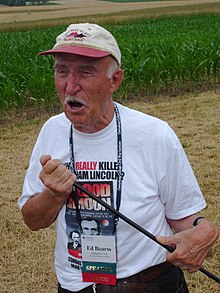
Thanks and best wishes to Marines everywhere and a special remembrance to my fellow historian, never-ending inspiration, former National Park Service colleague, and Marine, Edwin Cole (Ed) Bearss, who passed away in September 2020 at the age of 97. Ed had a vast curiosity about the world, a wicked sense of humor, a 
endless repetoire of personal stories that he generously shared with colleages and friends, and an amazing ability to use storytelling to interpret in great detail every aspect of every military action in the American Civil War. I'm not exaggerating that last aspect of his character. He was indeed a walking encyclopedia of military history and a master interpreter the likes of which the National Park Service will never see again.


Ed leading a tour at Gettysburg in 2005


Friday, October 27, 2023

Theodore Roosevelt And Conservation: A Legacy From Sea To Shining Sea


Teddy Roosevelt at Union Station, Washington,DC, 1916


Theordore Roosevelt was born into a prominent New York family on this day in 1858. Through his strong determination and a robust program of excercise and outdoor activity, he overcame severe asthma in his youth to become our 26th President, serving from 1901 to 1909. On his way to the White House he wrung about as much out of life as possible. You can read a rather detailed outline of his life at his Wikipedia entry. For purposes of this post I would like to focus primarily on activities within our national park system that contributed to him being known as our conservation president. It is a remarkable record including law and policy that continues to impact us more than a century after its creation.

In his eight years as President, Teddy Roosevelt signed legislation creating five national parks:

Crater Lake, Oregon

Wind Cave, South Dakota

Sullys Hill, North Dakota (later deignated a wildlife preserve)

Mesa Verde, Colorado

Platt, Oklahoma (now a portion of Chickasaw National Recreation Area


Although the new national parks were landmarks in his presidency, his signing of legislation expressed in the Antiquities Act of 1906 would come to have a huge impact on our national landscape through the creation of national monuments. The act established the nation's first broad national historic preservation policy in addition to protecting natural resources. Futhermore, it allowed for the establishment of such monuments through administrative action rather than legislation as had been done in the creation of Yellowstone National Park, Wyoming, in 1872 and Casa Grande Ruins, Arizona, in 1892. In a matter of months following his signature of the act, Roosevelt proclaimed four monuments:

Devils Tower, Wyoming

El Morro, New Mexico

Montezuma's Castle, Arizona

Petrified Forest, Arizona (now Petrified Forest National Park)

Grand Canyon, Arizona, (now Grand Canyon National Park)


In addition he proclaimed several monuments that would later be transferred to the Department of the Interior and eventually administered by the National Park Service following its creation in 1916.


Theordore Roosevelt's role as an American president and conservationist is now commemorated at six legacy units established over the last century:

Theodore Roosevelt Birthplace National Historic Site, New York City

Sagamore Hill National Historic Site, Oyster, Bay, New York

Theodore Roosevelt Inaugural National Historic Site, Buffalo, New York

Theordore Roosevelt National Park, North Dakota

Theodore Roosevelt Island, Washington, DC

Mount Rushmore National Memorial, South Dakota


The next time you visit a National Park Service unit, large or small, there's a very good chance Theodore Roosevelt had either a direct link to its creation or to his remarkable conservation and preservation legacy. Although he never established the agency his work certainly formed its foundation ten years after he left the presidency. It's also important to remember that his work extended beyond the national parks to include 150 national forests, 51 federal bird reserves, and four national game preserves. And in many ways his work has never ended. Our current generation and those to come will be far richer because Theodore Roosevelt, the conservation president, cared.


Sources
Photos and Illustrations:
All photos are public domain

Text:
https://www.nps.gov/thrb/learn/historyculture/trandthenpsystem.htm
https://www.nps.gov/thro/learn/historyculture/theodore-roosevelt-and-conservation.htm
https://en.wikipedia.org/wiki/Theodore_Roosevelt


ShareThis