Showing posts with label Great American Songbook. Show all posts

Sunday, June 29, 2025

Lena Horne: An American Legend


In the years around the turn of the century I was a member of the planning and design team for the newly established Tuskegee Airmen National Historic Site in Alabama. Fundraising was a big part of our mission and we asked a large core group of airmen who they would like to see as a national spokesman for the effort. To a man, the response was, "Lena Horne!" who made a number of visits to their two Tuskegee airfields during World War II. They adored her. She was beautiful, had a sultry voice, the perfect figure for a World War II pinup, and a highly successful musical career on stage and screen. She was also strong-willed and, at times, defiant, both characteristics that served her well in the American civil rights movement following the war. No wonder she appealed to them.


Horne publicity photo from 1964, NBC Bell Telephone Hour


Who was this international star and favorite pinup? Lena Horne was born on this day in Brooklyn in 1917. Those familiar with the singer will always remember her remarkable talent as a legendary performer with a sparkling personality and a beautiful smile, In her almost seventy years in entertainment she worked the big band and cabaret circuits, movies, Broadway, and television. She became politically active in the fight for civil rights following World War II, a decision that placed her on the federal entertainment blacklist for over a decade. Readers can learn more details about Horne's life and career in a New York Times obituary published following her death in May 2010.


Horne at Tuskegee Institute banquet, Tuskegee, Alabama, during World War II


Due to her age and disabilities, Horne was unable to take on the role the Tuskegee Airmen so enthusiastically desired but fundraising commenced in a different direction and eventually contributed to construction and interpretation at the park. Her image and the stories of her visits are embedded in those exhibits.

I remember Horne well from her frequent television performances and recordings beginning in the 1950's. She's always been a personal favorite among pop and jazz singers and the stories of her association with the Tuskegee Airmen tells me she was one very special lady.

Here she is performing her signature song, Stormy Weather, from the 1943 film of the same name.


And here is a fine synopsis of the life and times of Horne prepared for a segment of the PBS News Hour in 2010.


Sources

Photos and Illustrations:
public domain photograph, NBC Television, Wikipedia.org
banquet photo, Noel Parrish Collection, Manuscript Division, Library of Congress, Washington

Saturday, May 3, 2025

Crosby And Seeger: Two Very Different Voices In American Music History


Two iconic American entertainers share May 3 as a birthday. 


Bing Crosby 1930s.jpg
Crosby publicity photo from the 1930's

Born in 1903, Bing Crosby used his baritone voice and recording technology to develop a personal singing style that made him the nation's top entertainer for a generation beginning in the mid-1930s. Young people probably know little if anything about Crosby. He died in 1977 but I think he sits at the pinnacle of the American entertainment industry in that era - along with Bob Hope - and is well worth exploring if you enjoy popular culture. The Crosby family has authorized a comprehensive site about The Crooner if readers want more information. For a small taste of his talent, here is Crosby singing to Grace Kelly in the 1956 film, High Society:


Our second birthday celebrant is Pete Seeger, an entertainer who has been described as the most successful communist in the United States. I'll let readers discover the politics for themselves and focus instead on Seeger as singer and songwriter. 

File:PeteSeeger2.jpg
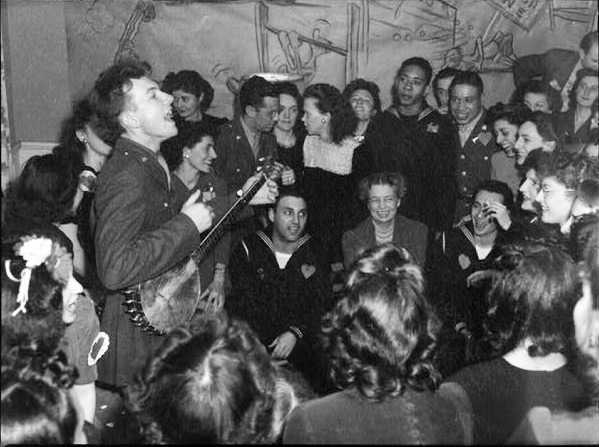
Entertaining at labor canteen opening, Washington, DC, February 1944

Seeger was born in 1919 into a musical family, took up the family's leftist politics, and made a name for himself as a "protest singer" in the 1940s. In 1950, he was a member of the folk group, The Weavers, and in the bow wave of a folk music revival in the U.S. It was short-lived, however, as the group was blacklisted in 1953 for suspected political reasons. A decade later Seeger found himself at the forefront of the 1960's folk revival embedded in antiwar activities and the Youth Revolution.  He continued singing and pursuing his social, political, and environmental activism around the world almost to the day he died at 94 in 2014. For more information and a host of links, here is his Wikipedia entry.

For a taste of Pete Seeger the performer, here he is singing lead and playing his banjo on the first recording (1949) of If I Had A Hammer, co-written with Lee Hays, also with The Weavers:


Although this video highlights Seeger, it does not do justice to the beautiful harmony The Weavers produced. Readers may want to explore the Internet for more of their recordings. Their 1981 reunion concert at Carnegie Hall is a particularly moving statement on the American music experience.


Sources

Photos and Illustrations:
commons.wikimedia.org/wiki/File:Bing_Crosby_1930s.jpg
loc.gov/pictures/resource/fsa.8d41983/

Friday, April 25, 2025

She's Still The First Lady Of Song


The incomparable jazz singer, Ella Fitzgerald, was born on this day in Newport News, Virginia, 108 years ago. When she was 17, Ella Jane Fitzgerald wanted to dance at an amateur night at the Apollo in Harlem, but was intimidated by other dancers and decided to sing instead. It was the beginning of a career that took her magnificent voice through the big bands, to jazz, bop, and the Great American Songbook. With a voice ranging from smoky to bright she put her signature on every note and sharp diction on every word. For people who like to immerse themselves in lyrics, Ella was unbeatable. And when she forgot those lyrics or let the spontaneity flow, the scat singing was priceless.


The First Lady of Song in 1960     Erling Mandelmann


Only once did I see her perform and that was in an overcrowded and hot venue in Washington. After a few songs, the crowd didn't mind the environment. She had us wrapped in music for over two hours and left us wanting more after several encores. Everyone had a great time that evening, especially Ella. Looking back on that concert, I realize how significant it was. She had turned 50 and completed recording her famous Songbook series a few years earlier. And though her peak years were coming to an end, what she had left exceeded the best of what most 20th century singers ever offered. She went on to perform another quarter of a century dazzling audiences everywhere. Ella passed away twenty-eight years ago, but she's still entertaining fans through a huge discography and video record. In all, it is an immense if not iconic legacy.


Fitzgerald and President Reagan at the White House in October 1981


Throughout her very public life, Ella Fitzgerald remained a private if not shy person. Were she receiving a birthday cake today, I can envision a broad, approving smile and nervous glances from squinting eyes behind those big bottle bottom glasses. She'd respond with a heart-felt "Thank you, thank you," and move into the comfort and safety of song.

Here she is in 1964 performing two Johnny Mercer jazz standards for the last of her now legendary Songbook albums - eight in all - produced by Norman Grantz and released over an eight year period. The series has never been out of print and remains a hot seller over fifty years after its release.


In almost sixty years, few jazz vocalists - there are many fine ones performing today - can approach the significance and near-perfection of Fitzgerald's interpretation of the Great American Songbook. To me, nothing since has quite matched it and I doubt anything in the future will without some extraordinary changes within the music industry and jazz itself.

Though she left us in 1996, Ella simply "is." I can only imagine the look on the faces of the heavenly hosts when she waltzed through those pearly gates scat singing all the way. So here's a happy birthday wish going up to the First Lady of Song. Simply incomparable and yes, sometimes too marvelous for words.


Sources

Photos and Illustrations:
Mandelmann photo, commons.wikimedia.org
White House, Item C4495-9A, President Reagan with Ella Fitzgerald after her performance for King Juan Carlos I of Spain in the east room, 10/13/81; Ronald Reagan Presidential Library and Museum, Simi Valley, California.

Friday, November 29, 2024

A Genius Behind The Music


For jazz, pop and Great American Songbook enthusiasts today marks another important birthday, that of Billy Strayhorn in 1915. He was the genius songwriter and arranger behind many of Duke Ellington's hits including, Take the A Train, Chelsea Bridge, My Little Brown Book, Day Dream, Something to Live For, and Lotus Blossom. I have written about Strayhorn in a few posts over the years but never devoted one to him until I found Scott Johnson's Power Line tribute, Lush Life, from 2013. Do check it out and make a note of his mention of Terry Teachout's biography of Duke Ellington, a study that explores the Ellington-Strayhorn musical partnership at length.

Here's an added treat for some context: the Ellington-Fitzgerald version of Lush Life that Johnson references is again available on You Tube.


That song has a remarkable number of fine interpretations. He makes mention of my favorite version. And thanks to You Tube, readers can listen to the Johnny Hartman-John Coltrane offering and make their own decision.


To me, it's the best. Given Strayhorn's remarkable tapestry of words and music, Hartman is superb here. No equal. Add Coltrane and we have even greater music history in that it is the only recording he made with a vocalist.


Unfortunately, Strayhorn never emerged from Ellington's shadow to enjoy the limelight. His full contribution to the world of music emerged only after his death in 1967, the publication of Ellington's autobiography in 1973, and further research on their collaboration.

Sunday, October 13, 2024

Art Tatum: Magician At The Keyboard


He had perfect pitch and came from a musical family. He was virtually blind but that did not stop him from reaching the pinnacle of piano jazz. Tatum's piano technique was all his own. As a child he learned compositions by ear listening to recordings, piano rolls, and the radio. He often had no idea that he was copying in two hands a musical performance by four hands. After basing his early performance on the stride piano style of James P. Johnson and Fats Waller Tatum's piano technique soon evolved into a flying lyric in the right hand riding on a modified stride in the left. In time his skills made him a magician at the keyboard. Here is his famous 1933 rendition of Tea For Two:


And a bit more up-tempo, here is the master of improvisation with the tune, Tiger Rag, also recorded in 1933:


When you have enjoyed jazz for fifty years and listen to Art Tatum you'll hear Oscar Peterson, Billy Taylor, Thelonious Monk, Johnny Costa and many others as Tatum dances effortlessly across the keyboard. He was so good, his legacy in music may be timeless. In fact, the great stride pianist, Fats Waller, once said upon seeing Tatum enter the club where Waller was performing, "I only play the piano, but tonight God is in the house."


At the Vogue Room, New York, 1948


Tatum was born on this day in Toledo, Ohio, in 1909 and died in Los Angeles in 1956. 


Sources

Photos and Illustrations:
William P. Gottlieb Collection, Library of Congress, Washington, DC

Text:
Art Tatum entry, wikipedia,com (for quote source see note 2)

Friday, September 13, 2024

Mel Torme: A Singer "Too Little Known And Vastly Under-Appreciated"


Scott Johnson, my kindred spirit when it comes to music history, posted a belated birthday tribute to Mel Torme on Powerline a few years ago. He rightfully described Torme as "one of the great all-time American artists, too little known and vastly under-appreciated." A few of the songs he mentions may not load correctly but you can hear them by going directly to You Tube. Many readers may not know the artist - he passed away in 1999 - but they would certainly recognize one of his most famous compositions, The Christmas Song, from its opening line, "Chestnuts roasting on an open fire...." That song is one of around 300 Torme wrote but in addition to his singing he also contributed to the world of entertainment as a composer, arranger, musician, actor and writer over his 65 year career.


Although I've had a life-long interest in popular music and jazz I never much listened to Torme until his death. After hearing so much praise for him in remembrances from the industry, I began listening more carefully to his performances and soon developed an appreciation of his crisp timing, perfect pitch, impeccable diction, and playfulness. Here's a fine example of the master at work with his idol, Ella Fitzgerald, in an unforgettable moment in jazz performance.


And just in case you want to associate "The Velvet Fog" with his signature song - he called it his "annuity" - here is Torme performing it late in his career.


There's no question that Mel Torme, one of he earliest singers of what the music industry would know as "cool jazz", left quite a mark on the world of entertainment. For that we're pleased to remember him on his birthday, September 13, 1925. What memories we have of the man and his music.


Sunday, June 30, 2024

Lena Horn: Entertainment And Activism At Its Best


In the years around the turn of the century I was a member of the planning and design team for the newly established Tuskegee Airmen National Historic Site in Alabama. Fundraising was a big part of our mission and we asked a large core group of airmen who they would like to see as a national spokesman for the effort. To a man, the response was, "Lena Horne!" who made a number of visits to their two Tuskegee airfields during World War II. They adored her. She was beautiful, had a sultry voice, the perfect figure for a World War II pinup, and a highly successful musical career on stage and screen. She was also strong-willed and, at times, defiant, both characteristics that served her well in the American civil rights movement following the war. No wonder she appealed to them.


Horne publicity photo from 1964, NBC Bell Telephone Hour


Who was this international star and favorite pinup? Lena Horne was born on this day in Brooklyn in 1917. Those familiar with the singer will always remember her remarkable talent as a legendary performer with a sparkling personality and a beautiful smile, In her almost seventy years in entertainment she worked the big band and cabaret circuits, movies, Broadway, and television. She became politically active in the fight for civil rights following World War II, a decision that placed her on the federal entertainment blacklist for over a decade. Readers can learn more details about Horne's life and career in a New York Times obituary published following her death in May 2010.


Horne at Tuskegee Institute banquet, Tuskegee, Alabama, during World War II


Due to her age and disabilities, Horne was unable to take on the role the Tuskegee Airmen so enthusiastically desired but fundraising commenced in a different direction and eventually contributed to construction and interpretation at the park. Her image and the stories of her visits are embedded in those exhibits.

I remember Horne well from her frequent television performances and recordings beginning in the 1950's. She's always been a personal favorite among pop and jazz singers and the stories of her association with the Tuskegee Airmen tells me she was one very special lady.

Here she is performing her signature song, Stormy Weather, from the 1943 film of the same name.


And here is a fine synopsis of the life and times of Horne prepared for a segment of the PBS News Hour in 2010.


Sources

Photos and Illustrations:
public domain photograph, NBC Television, Wikipedia.org
banquet photo, Noel Parrish Collection, Manuscript Division, Library of Congress, Washington

Tuesday, June 25, 2024

Savannah's Johnny Mercer: His Music Is With Us Every Day


For over fifteen years I've spent many happy hours blogging about famous people on their birthdays but sometimes circumstance warrant remembering their deaths especially when it involves personal experience. That was the case when I transferred to a new job in Savannah in early 1977. There, I found a city in mourning over the loss of their most beloved and famous personality, Johnny Mercer (1909-1976).

It's hard to believe that today marks the 48th anniversary of his death. As a sentimental gentleman from Georgia and the favorite son of Savannah, he went on to New York and Hollywood to become one of the most significant figures in American music history.

He died in Los Angeles after almost fifty years in a wide-ranging career as a prolific lyricist and songwriter, popular singer, music industry innovator, entrepreneur and benefactor. No matter how souccessful he became he jumped at every opportunity to return to his hometown and the source of so much of the character and imagery preserved in his catalog of more than 1400 published songs and another 3500 or so unpublished songs and song fragments.


Johnny Mercer statue by Susie Chisholm, erected in Ellis Square, Savannah, in 2009


For those who may not be familiar with his work, here is a list of what Mercer considered his "bread and butter songs," including his four Academy Award-winning efforts (in bold) and several nominations (underlined):

Lazybones (1933), music by Hoagy Carmichael

Goody, Goody (1936), music by Marty Malneck

Too Marvelous For Words (1937), music by Richard A. Whiting

Jeepers Creepers (1938), music by Harry Warren

Satin Doll (1958), written with Duke Ellington and Billy Strayhorn

You Must Have Been A Beautiful Baby (1938), music by Harry Warren

That Old Black Magic (1943), music by Harold Arlen

Accentuate the Positive (1944) music by Harold Arlen

Fools Rush In (1940), music by Rube Bloom

I Remember You (1942), music by Victor Schertzinger

Day In - Day Out (1939), music by Rube Bloom

Dearly Beloved (1942), music by Jerome Kern

Come Rain or Come Shine (1946), music by Harold Arlen

Tangerine (1942), music by Victor Schertzinger

Hooray For Hollywood (1938), music by Richard A. Whiting

Laura (1945), music by David Raksin

Dream (1944), words and music by Johnny Mercer

On the Atcheson, Topeka and the Santa Fe (1946, Academy Award for Best Music, Original Song), music by Harry Warren

Something's Gotta Give (1954), words and music by Johnny Mercer

One For My Baby (1943), music by Harold Arlen

In the Cool, Cool, Cool of the Evening (1951, Academy Award for Best Music, Oroginal Song), music by Hoagy Carmichael

Skylark (1941), music by Hoagy Carmichael

Autumn Leaves (1950), music by Joseph Kosma

I Wanna Be Around (1962), words and music by Johnny Mercer and Sadie Vimmerstedt

Blues in the Night (1941), music by Harold Arlen

Charade (1963), music by Henry Mancini

Summer Wind (1965), music by Henry Mayer

Moon River (1961, Academy Award for Best Music, Original Song), music by Henry Mancini

Days of Wine and Roses (1962, Academy Award for Best Music, Original Song), music by Henry Mancini


Hardly a day passes that even a casual music listener will not hear a Johnny Mercer song. For those who enjoy the Great American Songbook and jazz/pop vocals, the Mercer magic remains very much alive in contemporary music. Looks like the music of the man once described by the lyricist, Yip Harburg, as "one of our great folk poets" will be around for a long, long time. How lucky we are!


Mercer self-portrait and signature, Mercer grave, Bonaventure Cemetery, Savannah, GA


Sources

Photos and Illustrations:
grave site photo, Emily E. Beck

Text:
Harburg quote, Portrait of Johnny: The Life and Times of John Herndon Mercer, Gene Lees, Hal Leonard, February 2006.


Thursday, April 25, 2024

Ella Fitzgerald: America's Unforgettable Jazz Icon


The incomparable jazz singer, Ella Fitzgerald, was born on this day in Newport News, Virginia, 107 years ago. When she was 17, Ella Jane Fitzgerald wanted to dance at an amateur night at the Apollo in Harlem, but was intimidated by other dancers and decided to sing instead. It was the beginning of a career that took her magnificent voice through the big bands, to jazz, bop, and the Great American Songbook. With a voice ranging from smoky to bright she put her signature on every note and sharp diction on every word. For people who like to immerse themselves in lyrics, Ella was unbeatable. And when she forgot those lyrics or let the spontaneity flow, the scat singing was priceless.


The First Lady of Song in 1960     Erling Mandelmann


Only once did I see her perform and that was in an overcrowded and hot venue in Washington. After a few songs, the crowd didn't mind the environment. She had us wrapped in music for over two hours and left us wanting more after several encores. Everyone had a great time that evening, especially Ella. Looking back on that concert, I realize how significant it was. She had turned 50 and completed her famous Songbook series a few years earlier. And though her peak years were coming to an end, what she had left exceeded the best of what most 20th century singers ever offered. She went on to perform another quarter of a century dazzling audiences everywhere. Ella passed away twenty-seven years ago, but she's still entertaining fans through a huge discography and video record. In all, it is an immense if not iconic legacy.


Fitzgerald and President Reagan at the White House in October 1981


Throughout her very public life, Ella Fitzgerald remained a private if not shy person. Were she receiving a birthday cake today, I can envision a broad, approving smile and nervous glances from squinting eyes behind those big bottle bottom glasses. She'd respond with a heart-felt "Thank you, thank you," and move into the comfort and safety of song.

Here she is in 1964 performing two Johnny Mercer jazz standards for the last of her now legendary Songbook albums - eight in all - produced by Norman Grantz and released over an eight year period. The series has never been out of print and remains a hot seller over fifty years after its release.


In almost sixty years, few jazz vocalists - there are many fine ones performing today - can approach the significance and near-perfection of Fitzgerald's interpretation of the Great American Songbook. To me, nothing since has quite matched it and I doubt anything in the future will without some extraordinary changes within the music industry and jazz itself.

Though she left us in 1996, Ella simply "is." I can only imagine the look on the faces of the heavenly hosts when she waltzed through those pearly gates scat singing all the way. So here's a happy birthday wish going up to the First Lady of Song. Simply incomparable and yes, sometimes too marvelous for words.


Sources

Photos and Illustrations:
Mandelmann photo, commons.wikimedia.org
White House, Item C4495-9A, President Reagan with Ella Fitzgerald after her performance for King Juan Carlos I of Spain in the east room, 10/13/81; Ronald Reagan Presidential Library and Museum, Simi Valley, California.

Tuesday, December 12, 2023

Frank Sinatra: Six Decades Of Song


Frank Sinatra, the American singer and actor whose phenomenal career spanned sixty years ending in 1995, was born in Hoboken, New Jersey, on this day in 1915. During his career he produced a discography spanning the eras of jazz, swing, big band, and pop music. I had the good fortune to attend two Sinatra concerts during the '60's. Both were unforgettable opportunities to see this American icon at work as a storm of rock music swept the nation and displaced the popular song as the dominant music genre in our culture.


Sinatra at The White House, Washington, D.C., 1973


Writing at nationalreview.com on the centennial (2015) of Sinatra's birth, Deroy Murdock begins his exploration of the life, times, and legacy of "Ol' Blue Eyes" with this:

Saturday completes a century since Francis Albert Sinatra belted out his first note as a newborn, 13-and-a-half-pound baby in Hoboken, N.J. He grew up to become the finest male vocalist of the 20th Century, alongside his female counterpart and occasional partner in rhyme, Ella Fitzgerald.
But Frank was much more than just a crooner. He excelled as an actor, dancer, TV host, entrepreneur, record-company executive, and even music conductor. His timeless fashion sense defined style and elegance for gentlemen from the 1940s until today. He left enormous footprints on popular culture and was as original an American as this nation has produced. After 100 years, a hundred superlatives barely could do Sinatra justice. Rather than wade through the many adjectives that define the man, the best way to appreciate Sinatra and his gigantic contribution is to savor his artistry and epic life story.


For those who simply want to remember and enjoy Sinatra at his best I offer his version of One For My Baby (And One More For The Road) (1943), music by Harold Arlen, words by Johnny Mercer:


Known first as The Voice, then Ol' Blue Eyes, and finally as The Chairman of the Board, Sinatra left us in 1998 as a man who had a way with a song quite unlike that of any other singer in the 20th century.


Sources

Photos and Illustrations:
public domain photo in the United States, Modified version of Image:Andreotti Sinatra Nixon.jpg (NARA - ARC Identifier: 194505)


Wednesday, December 6, 2023

The Poet Gershwin


Mention the name "Gershwin" today and just about everyone will think you have "George" on your mind. Granted he wrote some spectacular music between 1917 and 1937, much of it as fresh today as the day it was written. But George and his melodies were only half of the story. His brother, Ira, born on December 6, 1896, added the poetry. Together they formed one of the most successful collaborations in American music history. While George's music has lived on in the concert hall, Ira's words survive primarily in the world of jazz and in the Great American Songbook niche among leading popular singers.


George (l) and Ira (r) Gershwin, Newark Airport, 1936


This excerpt from the Ira Gershwin bio at the Song Writers Hall of Fame website will give readers an idea of the scope of their collaboration and bring to mind some of Ira's lyrics:

Their first collaborations were for Broadway: Lady, Be Good! (1924, including "Fascinating Rhythm" and, although it was cut from the show, "The Man I Love"), Tip Toes (1925, including "Sweet and Low Down"), Oh Kay! (1926, including "Clap Yo' Hands", "Do-Do-Do", "Maybe", and "Someone To Watch Over Me"), Funny Face (1927, including '"S Wonderful"), Rosalie (1928, including "How Long Has This Been Going On"), Show Girl (1929, including "Liza"), Strike Up the Band (1930, including "I've Got A Crush On You" and "Soon"), Girl Crazy (1930, including "But Not For Me", "Embraceable You", "Bidin' My Time", and "I Got Rhythm"), Delicious (1931, including "Blah Blah Blah. "), Of Thee I Sing (1931, the first musical to win the Pulitzer Prize and which included "Of Thee I Sing", "Love Is Sweeping The Country", and "Who Cares").


The complete picture includes their work in Hollywood, the Broadway folk opera Porgy and Bess, and Ira's collaboration with a host of songwriters following his brother's death in 1937. Forty years before his own passing in 1983 Ira Gershwin began a long collaboration with the Library of Congress to collect and preserve their legacy. Today the George and Ira Gershwin Collection is the leading archive for the study of the Gershwin brothers and their impact on cultural history around the world. Read more about the collection
here.


Sources

Text:

Songwriters Hall of Fame, songwritershalloffame.org
Library of Congress, loc.gov

Photos:

Library of Congress, loc.gov

Wednesday, November 29, 2023

The Musical Genius That Helped Propel Duke Ellington To International Fame


For jazz, pop and Great American Songbook enthusiasts today marks another important birthday, that of Billy Strayhorn. He was the genius songwriter and arranger behind many of Duke Ellington's hits including, Take the A Train, Chelsea Bridge, My Little Brown Book, Day Dream, Something to Live For, and Lotus Blossom. I have written about Strayhorn in a few posts over the years but never devoted one to him until I found Scott Johnson's Power Line tribute, Lush Life, from 2013. Do check it out and make a note of his mention of Terry Teachout's biography of Duke Ellington, a study that explores the Ellington-Strayhorn musical partnership at length.

Here's an added treat for some context: the Ellington-Fitzgerald version of Lush Life that Johnson references is again available on You Tube.


That song has a remarkable number of fine interpretations. He makes mention of my favorite version. And thanks to You Tube, readers can listen to the Johnny Hartman-John Coltrane offering and make their own decision.


To me, it's the best. Given Strayhorn's remarkable tapestry of words and music,  Hartman is superb here. No equal. Add Coltrane and we have even greater music history in that it is the only recording he made with a vocalist. 

Unfortunately, Strayhorn never emerged from Ellington's shadow to enjoy the limelight. His full contribution to the world of music emerged only after his death in 1967, the publication of Ellington's autobiography in 1973, and further research on their collaboration.


Friday, October 13, 2023

The Flying Lyric And Modified Stride Of Art Tatum


He had perfect pitch and came from a musical family. He was virtually blind but that did not stop him from reaching the pinnacle of piano jazz. Tatum's piano technique was all his own. As a child he learned compositions by ear listening to recordings, piano rolls, and the radio. He often had no idea that he was copying in two hands a musical performance by four hands.
After basing his early performance on the stride piano style of James P. Johnson and Fats Waller Tatum's piano technique soon evolved into a flying lyric in the right hand riding on a modified stride in the left. In time his skills made him a magician at the keyboard. Here is his famous 1933 rendition of Tea For Two:


And a bit more up-tempo, here is the master of improvisation with the tune, Tiger Rag, also recorded in 1933:


When you have enjoyed jazz for fifty years and listen to Art Tatum you'll hear Oscar Peterson, Billy Taylor, Thelonious Monk, Johnny Costa and many others as Tatum dances effortlessly across the keyboard. He was so good, his legacy in music may be timeless. In fact, the great stride pianist, Fats Waller, once said upon seeing Tatum enter the club where Waller was performing, "I only play the piano, but tonight God is in the house."


At the Vogue Room, New York, 1948

Tatum was born on this day in Toledo, Ohio, in 1909 and died in Los Angeles in 1956. He was 47.


Sources

Photos and Illustrations:
William P. Gottlieb Collection, Library of Congress, Washington, DC

Text:
Art Tatum entry, wikipedia,com (for quote source see note 2)

Wednesday, September 13, 2023

Mel Torme: The Velvet Fog


Scott Johnson, my kindred spirit when it comes to music history, posted a belated birthday tribute to Mel Torme in 2012. He rightfully described Torme as "one of the great all-time American artists, too little known and vastly under-appreciated." A few of the songs he mentions may not load correctly but you can hear them by going directly to You Tube. Many readers may not know the artist - he passed away in 1999 - but they would certainly recognize one of his most famous compositions, The Christmas Song, from its opening line, "Chestnuts roasting on an open fire...." That song is one of around 300 Torme wrote, but in addition to his singing he also contributed to the world of entertainment as a composer, arranger, musician, actor and writer over his 65 year career.


Although I've had a life-long interest in popular music and jazz I never much listened to Torme until his death. After hearing so much praise for him in remembrances from the industry, I began listening more carefully to his performances and soon developed an appreciation of his crisp timing, perfect pitch, impeccable diction, and playfulness. Here's a fine example of the master at work with his idol, Ella Fitzgerald, in an unforgettable moment in jazz performance.


And just in case you want to associate "The Velvet Fog" with his signature song - he called it his "annuity" - here is Torme performing it late in his career.


There's no question that Mel Torme, one of he earliest singers of what the music industry would know as "cool jazz", left quite a mark on the world of entertainment. For that we're pleased to remember him on his birthday, September 13, 1925. What memories we have of the man and his music.


Friday, August 4, 2023

Remembering Tony Bennett


Tony Bennett passed away two weeks ago just shy of his 97th birthday which happens to be today. In his honor here is last year's birthday post. 

Anthony Benedetto, better known as Tony Bennett, turns 96 this week. He is the last in a long line of great crooners from the 20th century. For more than seventy years on stage he drew huge audiences to his annual full concert schedule of tunes from jazz, to Broadway, to the Great American Songbook. Early last year it was announced that he would no longer be touring due to the progressive Alzheimer's disease originally diagnosed in 2016. A few months later he had quite a retirement party at Radio City Muusic Hall with Lady Gaga to celebrate his birthday and the upcoming release of their new album. He's been retiredf from the the stage for about a year.

Bennett in 2018


Bennett has been at the business so long he's had two careers, a fifteen-year affair with the Greatest Generation, and a now forty-year reinvention with new artists, music, and audiences following a brief lull during the rock and roll era. Bennett has also been in the forefront of introducing current generations to the Great American Songbook.

He is an interesting blend of vocal talent and showmanship, a well-perfected entertainer with a not so perfect voice. You have to learn how to appreciate the value of a permanent vocal strain and a sound out of vaudeville. For me, it was a long learning process, but I've come to appreciate and enjoy the total Bennett experience. Here he is performing with the sensational jazz/pop vocalist, Diana Krall:


Lately the entertainer has reached deep into the past for material and produced a series of duet albums with vocalist young and old. In addition to Krall, Bennett recorded albums with Paul McCartney, Josh Groban, Lady Gaga, Stevie Wonder, Norah Jones, and Marc Anthony. Here is a cut from his first album with Lady Gaga:


Thank you for the music, Tony. Here's wishing you a happy 96th birthday and many more to come.

If you like what you hear, buy the music and help keep jazz, swing, and the Great American Songbook alive and well.


Sources

Photos and Illustrations:
public domain photo, Bob Elyea

Text:
Tony Bennett, Wikipedia.org
Tony Bennett, tonybennett.com

Friday, June 30, 2023

Lena Horne: Entertainer, Activist, American Icon


In the years around the turn of the century I was a member of the planning and design team for the newly established Tuskegee Airmen National Historic Site in Alabama. Fundraising was a big part of our mission and we asked a large core group of airmen who they would like to see as a national spokesman for the effort. To a man, the response was, "Lena Horne!" who made a number of visits to their two Tuskegee airfields during World War II. They adored her. She was beautiful, had a sultry voice, the perfect figure for a World War II pinup, and a highly successful musical career on stage and screen. She was also strong-willed and, at times, defiant, both characteristics that served her well in the American civil rights movement following the war. No wonder she appealed to them.


Horne publicity photo from 1964, NBC Bell Telephone Hour


Who was this international star and favorite pinup? Lena Horne was born on this day in Brooklyn in 1917. Those familiar with the singer will always remember her remarkable talent as a legendary performer with a sparkling personality and a beautiful smile, In her almost seventy years in entertainment she worked the big band and cabaret circuits, movies, Broadway, and television. She became politically active in the fight for civil rights following World War II, a decision that placed her on the federal entertainment blacklist for over a decade. Readers can learn more details about Horne's life and career in a New York Times obituary published following her death in May 2010.


Horne at Tuskegee Institute banquet, Tuskegee, Alabama, during World War II


Due to her age and disabilities, Horne was unable to take on the role the Tuskegee Airmen so enthusiastically desired but fundraising commenced in a different direction and eventually contributed to construction and interpretation at the park. Her image and the stories of her visits are embedded in those exhibits.

I remember Horne well from her frequent television performances and recordings beginning in the 1950's. She's always been a personal favorite among pop and jazz singers and the stories of her association with the Tuskegee Airmen tells me she was one very special lady.

Here she is performing her signature song, Stormy Weather, from the 1943 film of the same name.


And here is a fine synopsis of the life and times of Horne prepared for a segment of the PBS News Hour in 2010.


Sources

Photos and Illustrations:
public domain photograph, NBC Television, Wikipedia.org
banquet photo, Noel Parrish Collection, Manuscript Division, Library of Congress, Washington


Sunday, June 25, 2023

Johnny Mercer: The South's Musical Ambassador To The World


For almost fifteen years I've spent many happy hours blogging about famous people on their birthdays but sometimes circumstance warrant remembering their deaths especially when it involves personal experience. That was the case when I transferred to a new job in Savannah in early 1977. There, I found a city in mourning over the loss of their most beloved and famous personality, Johnny Mercer (1909-1976).

It's hard to believe that this week marks the 47th anniversary of his death. As a sentimental gentleman from Georgia and the favorite son of Savannah, he went on to New York and Hollywood to become one of the most significant figures in American music history. 

He died in Los Angeles after almost fifty years in a wide-ranging career as a prolific lyricist and songwriter, popular singer, music industry innovator, entrepreneur and benefactor. No matter how souccessful he became he jumped at every opportunity to return to his hometown and the source of so much of the character and imagery preserved in his catalog of more than 1400 songs.


Johnny Mercer statue by Susie Chisholm, erected in Ellis Square, Savannah, in 2009


For those who may not be familiar with his work, here is a list of what Mercer considered his "bread and butter songs," including his four Academy Award-winning efforts (in bold) and several nominations (underlined):

Lazybones (1933), music by Hoagy Carmichael

Goody, Goody (1936), music by Marty Malneck

Too Marvelous For Words (1937), music by Richard A. Whiting

Jeepers Creepers (1938), music by Harry Warren

Satin Doll (1958), written with Duke Ellington and Billy Strayhorn

You Must Have Been A Beautiful Baby (1938), music by Harry Warren

That Old Black Magic (1943), music by Harold Arlen

Accentuate the Positive (1944) music by Harold Arlen

Fools Rush In (1940), music by Rube Bloom

I Remember You (1942), music by Victor Schertzinger

Day In - Day Out (1939), music by Rube Bloom

Dearly Beloved (1942), music by Jerome Kern

Come Rain or Come Shine (1946), music by Harold Arlen

Tangerine (1942), music by Victor Schertzinger

Hooray For Hollywood (1938), music by Richard A. Whiting

Laura (1945), music by David Raksin

Dream (1944), words and music by Johnny Mercer

On the Atcheson, Topeka and the Santa Fe (1946, Academy Award for Best Music, Original Song), music by Harry Warren

Something's Gotta Give (1954), words and music by Johnny Mercer

One For My Baby (1943), music by Harold Arlen

In the Cool, Cool, Cool of the Evening (1951, Academy Award for Best Music, Oroginal Song), music by Hoagy Carmichael

Skylark (1941), music by Hoagy Carmichael

Autumn Leaves (1950), music by Joseph Kosma

I Wanna Be Around (1962), words and music by Johnny Mercer and Sadie Vimmerstedt

Blues in the Night (1941), music by Harold Arlen

Charade (1963), music by Henry Mancini

Summer Wind (1965), music by Henry Mayer

Moon River (1961, Academy Award for Best Music, Original Song), music by Henry Mancini

Days of Wine and Roses (1962, Academy Award for Best Music, Original Song), music by Henry Mancini


Hardly a day passes that even a casual music listener will not hear a Johnny Mercer song. For those who enjoy the Great American Songbook and jazz/pop vocals, the Mercer magic remains very much alive in contemporary music. Looks like the music of the man once described by the lyricist, Yip Harburg, as "one of our great folk poets" will be around for a long, long time. How lucky we are!


Mercer self-portrait and signature, Mercer grave, Bonaventure Cemetery, Savannah, GA


Sources

Photos and Illustrations:
grave site photo, Emily E. Beck

Text:
Harburg quote, Portrait of Johnny: The Life and Times of John Herndon Mercer, Gene Lees, Hal Leonard, February 2006.

Wednesday, May 3, 2023

Two Voices From Two Worlds Of 20th Century American Music


Two iconic 20th century entertainers who were world apart in American music share May 3 as a birthday. 


Crosby publicity photo from the 1930's


Born in 1903, Bing Crosby used his baritone voice and recording technology to develop a personal singing style that made him the nation's top entertainer for a generation beginning in the mid-1930s. Many jazz and pop singers adopted his style and technique over the next thirty years. Young people probably know little if anything about Crosby. He died in 1977 but I think he sits at the pinnacle of the American entertainment industry in that era - along with Bob Hope - and is well worth exploring if you enjoy popular culture. The Crosby family has authorized a comprehensive site about The Crooner if readers want more information. For a small taste of his talent, here is Crosby singing to Grace Kelly in the 1956 film, High Society:


Our second birthday celebrant is Pete Seeger, an entertainer who has been described as the most successful communist in the United States. I'll let readers discover the politics for themselves and focus instead on Seeger as singer and songwriter.


Entertaining at labor canteen opening, Washington, DC, February 1944


He was born in 1919 into a musical family, took up their leftist politics, and made a name for himself as a "protest singer" in the 1940s. In 1950, he was a member of the folk group, The Weavers, and in the bow wave of a folk music revival in the U.S. It was short-lived, however, as the group was blacklisted in 1953 for suspected political reasons. A decade later Seeger found himself at the forefront of the 1960's folk revival embedded in antiwar activities and the Youth Revolution. He continued singing and pursuing his social, political, and environmental activism around the world almost to the day he died at 94 in 2014. For more information and a host of links, here is his Wikipedia entry.

For a taste of Pete Seeger the performer, here he is singing lead and playing his banjo on the first recording (1949) of If I Had A Hammer, co-written with Lee Hays, also with The Weavers:


Although this video highlights Seeger, it does not do justice to the beautiful harmony The Weavers produced. Readers may want to explore the Internet for more of their recordings. Their 1981 reunion concert at Carnegie Hall is a particularly moving statement on the American music experience.


Sources

Photos and Illustrations:
commons.wikimedia.org/wiki/File:Bing_Crosby_1930s.jpg
loc.gov/pictures/resource/fsa.8d41983/

Tuesday, April 25, 2023

Always The Legendary First Lady Of Song


The incomparable jazz singer, Ella Fitzgerald, was born on this day in Newport News, Virginia, 106 years ago. When she was 17, Ella Jane Fitzgerald wanted to dance at an amateur night at the Apollo in Harlem, but was intimidated by other dancers and decided to sing instead. It was the beginning of a career that took her magnificent voice through the big bands, to jazz, bop, and the Great American Songbook. With a voice ranging from smoky to bright she put her signature on every note and sharp diction on every word. For people who like to immerse themselves in lyrics, Ella was unbeatable. And when she forgot those lyrics or let the spontaneity flow, the scat singing was priceless.


The First Lady of Song in 1960           Erling Mandelmann


Only once did I see her perform and that was in an overcrowded and hot venue in Washington. After a few songs, the crowd didn't mind the environment. She had us wrapped in music for over two hours and left us wanting more after several encores. Everyone had a great time that evening, especially Ella. Looking back on that concert, I realize how significant it was. She had turned 50 and completed her famous Songbook series a few years earlier. And though her peak years were coming to an end, what she had left exceeded the best of what most 20th century singers ever offered. She went on to perform another quarter of a century dazzling audiences everywhere. Ella passed away twenty-seven years ago, but she's still entertaining fans through a huge discography and video record. In all, it is an immense if not iconic legacy.


Fitzgerald and President Reagan at the White House in October 1981


Throughout her very public life, Ella Fitzgerald remained a private if not shy person. Were she receiving a birthday cake today, I can envision a broad, approving smile and nervous glances from squinting eyes behind those big bottle bottom glasses. She'd respond with a heart-felt "Thank you, thank you," and move into the comfort and safety of song.

Here she is in 1964 performing two Johnny Mercer jazz standards for the last of her now legendary Songbook albums - eight in all - produced by Norman Grantz and released over an eight year period. The series has never been out of print and remains a hot seller over fifty years after its release.


In almost sixty years, few jazz vocalists - there are many fine ones performing today - can approach the significance and near-perfection of Fitzgerald's interpretation of the Great American Songbook. To me, nothing since has quite matched it and I doubt anything in the future will without some extraordinary changes within the music industry and jazz itself.

Though she left us in 1996, Ella simply "is." I can only imagine the look on the faces of the heavenly hosts when she waltzed through those pearly gates scat singing all the way. So here's a happy birthday wish going up to the First Lady of Song. Simply incomparable and yes, sometimes too marvelous for words.


Sources

Photos and Illustrations:
Mandelmann photo, commons.wikimedia.org
White House, Item C4495-9A, President Reagan with Ella Fitzgerald after her performance for King Juan Carlos I of Spain in the east room, 10/13/81; Ronald Reagan Presidential Library and Museum, Simi Valley, California.

ShareThis