Showing posts with label space. Show all posts

Tuesday, July 22, 2025

It's "Wheels Up" At AirVenture Oshkosh 2025


The Experimental Aircraft Association's (EAA) annual week-long AirVenture gathering in Oshkosh, Wisconsin, is underway. It's better known as "Oshkosh" to aviation enthusiasts and you can be assured that every one of them has the event on their bucket list. There's good reason. Imagine a fly-in attracting around 7500 airplanes. Imagine 2500 aircraft exhibits, 800 commercial exhibitors, daily world-class airshows, and a total of around 700,000 guests.
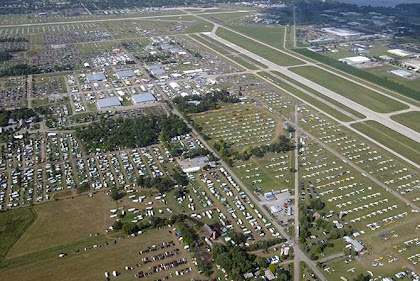


AirVenture at Oshkosh is far from your average fly-in


Organizers call the event "the world's greatest aviation celebration" and this year marks its seventy-second edition. The map below gives readers an idea of the scope and scale of Oshkosh and indicates why the event turns a rather sleepy Wittman Regional Airport into the busiest airport in the world for one week each year.


AirVenture grounds - for scale, that's an 8000 foot runway at the top 

AirVenture grounds looking east to Lake Winnebago


I had the privilege of attending the event several times in the last decade of my career. Energizing, informative, and significant, the show was a great vehicle for delivering an organizational message to a large, captured, and enthusiastic audience. You may ask why the National Park Service (NPS) would send a dozen or so employees and volunteers to work an air show. First, the agency has almost fifty out of its more than 400 units with a significant link to an aviation theme. In addition, the Service maintains a fleet of fixed and rotary wing aircraft contributing over 20,000 hours of flight time annually in support of park operations, maintenance, and resource and fire management. Add to that interagency cooperation across departments as well as airspace regulation over the parks and the justification become clearer. In recent years the NPS's presence at the event has been reduced significantly and folded into a more cooperative effort with other federal agencies. In summation, it's a grand and demanding opportunity to reach out face-to- face with thousands of guests who enjoy and impact resources and services in and ver the parks.


Nothing like fly-in camping with thousands of your best - in this case closest - friends


If you can't attend AirVenture, the EAA maintains a comprehensive up-to-the-second website where you can spend hours reading, watching and listening to events. I've been looking up at the sound of an aircraft engine ever since I could lift my head. If you are blessed with the same response make your plans to attend an Experimental Aircraft Association AirVenture. You will not be disappointed. Until then "wheels up" every chance you get!


Sunday, July 20, 2025

Footsteps On The Moon


Lunar Module Eagle in landing configuration, July 20, 1969


July 20, 1969, fifty-six years ago today, the Apollo Lunar Module Eagle landed on the moon. Millions watched at 10:56 PM, EDT, as Neil Armstrong, the commander of the Apollo 11 mission, descended the Eagle's ladder and made what he called a "giant leap for mankind" with his final step onto the powdery lunar surface. Learn more about the Apollo 11 mission here on Wikipedia where you can find scores of links to more National Aeronautics and Space Administration (NASA) reports and multimedia.


Armstrong and Buzz Aldrin, the lunar module pilot, spent almost 22 hours on the moon including their 150 minute walk where they erected an American flag, collected soil and rock samples, and deployed experiments. On their return to Earth much of the material they collected was eventually archived and displayed at the Smithsonian Institution. Some rocks entered our culture in some fascinating ways, including this one at the Washington National Cathedral, where one was embedded at the center of a red planet in what has become known as the Space Window.


Time is catching up with those first attempts at exploring our nearest celestial neighbor. Neil Armstrong passed away in 2012 at the age of 82. Buzz Aldrin turned 94 earlier this year. Michael Collins, the command module pilot, passed away in 2021 at the ago of 90. With the creation of the Artemis program in 2017, the US and its partners hope to return to the lunar surface with a crewed polar landing scheduled for 2025. That's an ambitious target date , but no more so than the private sector timetable for similar missions to Mars. Regardless of what the future holds, those early years including the mission we commemorate today were an exciting and almost magical time for science, exploration, and discovery of the frontier "out there."


Sources

Photos and Illustrations:
atlasobscura.com, Space Window detail
nasa.gov, Space Window, full photo

Text:
Wikipedia.com

Tuesday, August 27, 2024

Krakatoa Then, Hunga Tonga-Hunga Ha'apal Now


The Scream                     Edvard Munch 1893


Imagine waking up on this fine Tuesday morning to hear that a gigantic magnetic storm will disrupt much of the planet's electronics and communication networks in two days. This event simply isn't going to break up your digital reception of Saturday's big game  - Go Dawgs. It's going to require months of reconstruction - software and hardware - on power grids, communication systems and circuit boards on land, sea, air, and in space. I raise this issue not to alarm but to use coronal mass ejection (CME) and similar electromagnetic pulse (EMP) events as modern-day examples of climate issues that need to compete with the longer term phenomenon of global climate change. Furthermore, I am not about to deny or denigrate the existence and significance of global warming and cooling. It happens and I have no issue with mitigation and preparation for the consequences. On the other hand, sometimes our priorities don't seem to match the serious short-term and potentially catastrophic threats we face. Scientists and engineers already know of an event in 1859 that, had it occurred this morning in our high tech electronic world, would have caused widespread threats to social, political, and economic systems worldwide.

Why raise the issue today? This day marks the 141st anniversary of the massive volcanic explosion of the Indonesian island known as Krokatoa. The event killed over 36,000 people, sent a measurable shock wave around the world seven times and produced the loudest noise heard in recorded history, a noise heard in Perth, Australia, more than 2800 miles from the island. Geophysical impacts included a decline of over 2 degrees in the planet's average global temperatures and more than a decade of memorable atmospheric events including, vivid sunsets, lavender suns, and noctilucent clouds.

This was an astounding event in earth history and a modern-day lesson in the fragile nature of the planet and its inhabitants. As I've said before, nature in all her beauty can be a cruel mother. In light of the recent events like Mount St. Helens, record setting earthquakes, earth-grazing fireballs, and meteors, it's also a lesson that radical global climate change could occur tomorrow as well as a century from now. Granted, the sciences in question are little more than 150 years old but we have come a long way in understanding, yet we know there are some events beyond knowledge and control.


This is a timely anniversary given that an underwater volcano (Hunga Tonga-Hunga Ha'apal) in Tonga, a Pacific island nation, erupted in January 2022 and thrust as much as 160 million tons of water vapor into the stratosphere. Climatologists soon determined this instantaneous 5% increase in water vapor could likely increase global temperatures for some years to come. For climate scientists this is a unique event as it is the first eruption of its kind that can be effectively measured and analyzed. In other words there is no forecast model for the Tonga volcano. All science can do is observe, provide some analysis, and issue essentially speculative forecasts on the impacts of the event. If this year's high temperatures - it's called weather - tell us anything it's that climate scientists seem to be on to something.

Do keep the faith, my friends. There's a really good probability for sunrise tomorrow. The chances for more tomorrows are equally high because some of our finest earth and space scientists study and stand watch for these threats, short-term and long-term. I can't imagine a more exciting career than one exploring the far reaches of the planet and its journey in the universe.

In case you're wondering: Edvard Muunch painted four versions of The Scream of Nature over a seventeen year period beginning in 1893. Some experts believe his depiction of the vivid orange-red sky came from his observations of similar sunsets caused by the explosion of Krakatoa a decade earlier. I wonder how many artists will be incorporating the effects of Hunga Tonga-Hunga Ha'apal on our environment over the next few decades.


Sources


Text:
The Tonga Volcano Shook the World: It May Also Affect the Climate, The New York Times, September 22, 2022

Tuesday, July 23, 2024

EAA AirVenture 2024 At Oshkosh


Today is Day 2 of the Experimental Aircraft Association's (EAA) annual week-long AirVenture gathering in Oshkosh, Wisconsin. It's better known as "Oshkosh" to aviation enthusiasts and you can be assured that every one of them has the event on their bucket list. There's good reason. Imagine a fly-in attracting around 7500 airplanes. Imagine 2500 aircraft exhibits, 800 commercial exhibitors, daily world-class airshows, and a total of over 600,000 guests.


It's far from your average fly-in


Organizers call the event "the world's greatest aviation celebration" and this year marks its 71st edition. The map below gives readers an idea of the scope and scale of Oshkosh and indicates why the event turns a rather sleepy Wittman Regional Airport into the busiest airport in the world for one week each year.


AirVenture grounds - for scale, that's an 8000 foot runway at the top


I had the privilege of attending the event several times in the last decade of my career. Energizing, informative, and significant, the show was a great vehicle for delivering an organizational message to a large, captured, and enthusiastic audience. You may ask why the National Park Service (NPS) would send a dozen or so employees and volunteers to work an air show. First, the agency has almost fifty out of its more than 400 units with a significant link to an aviation theme. In addition, the Service maintains a fleet of fixed and rotary wing aircraft contributing over 20,000 hours of flight time annually in support of park operations, maintenance, and resource and fire management. Add to that interagency cooperation across departments as well as airspace regulation over the parks and the justification become clearer. In recent years the NPS's presence at the event has been reduced significantly and folded into a more cooperative effort with other federal agencies. In summation, it's a grand and demanding opportunity to reach out face-to- face with thousands of guests who enjoy and impact agency resources and services.


Nothing like fly-in camping with thousands of your best - in this case closest - friends


If you can't attend AirVenture, the EAA maintains a comprehensive up-to-the-second website where you can spend hours reading, watching and listening to events. I've been looking up at the sound of an aircraft engine ever since I could lift my head. If you are blessed with the same response make your plans to attend an Experimental Aircraft Association AirVenture. You will not be disappointed. Until then "wheels up" every chance you get!


Saturday, July 20, 2024

Americans On The Moon 1969


Lunar Module Eagle in landing configuration, July 20, 1969


July 20, 1969, fifty-five years ago today, the Apollo Lunar Module Eagle landed on the moon. Millions watched at 10:56 PM, EDT, as Neil Armstrong, the commander of the Apollo 11 mission, descended the Eagle's ladder and made what he called a "giant leap for mankind" with his final step onto the powdery lunar surface. Learn more about the Apollo 11 mission here on Wikipedia where you can find scores of links to more National Aeronautics and Space Administration (NASA) reports and multimedia.


Armstrong and Buzz Aldrin, the module pilot, spent almost 22 hours on the moon including their 150 minute walk where they erected an American flag, collected soil and rock samples, and deployed experiments. On their return to Earth much of the material they collected was eventually archived and displayed at the Smithsonian Institution. Some rocks entered our culture in some fascinating ways, including this one at the Washington National Cathedral, where one was embedded at the center of a red planet in what has become known as the Space Window.


Time is catching up with those first attempts at exploring our nearest celestial neighbor. Neil Armstrong passed away in 2012 at the age of 82. Buzz Aldrin turned 94 earlier this year. With the creation of the Artemis program in 2017, the US and its partners hope to return to the lunar surface with a crewed polar landing scheduled for 2025. That's an ambitious target date , but no more so than the private sector timetable for similar missions to Mars. Regardless of what the future holds, those early years including the mission we commemorate today were an exciting and almost magical time for science, exploration, and discovery of the frontier "out there."


Sources

Photos and Illustrations:
atlasobscura.com, Space Window detail
nasa.gov, Space Window, full photo

Text:
Wikipedia.com

Tuesday, February 20, 2024

John Glenn Makes History Aboard The Spacecraft, Freedom 7


Sixty-two years ago today, John Glenn rocketed into space history to become the first American to orbit Earth. In 1962, Glenn made three orbits then returned to a splashdown about 500 miles northeast of Puerto Rico. Over the years more 350 Americans have joined him in space travel.


John Glenn in orbit, February 20, 1962


The NASA website has a fine multimedia presentation on Mercury-Atlas 6, the mission that put Glenn and his spacecraft, Friendship 7, into orbit. Wikipedia has a page on the mission and some excellent recommendations for further reading online. To commemorate the event, The Ohio State University has a comprehensive look at Glenn's life and that of his wife, Annie. I also recommend The Right Stuff, Tom Wolfe's outstanding 1979 book on the formative days of the American space program and the seven astronauts - including Glenn - selected for the Mercury program.

When we look back at the American space program, this achievement was one of the nation's proudest moments. It's heartening to see a renewed interest in space exploration let alone definitive commitments to future astronauts, a return to the moon or a mission to Mars on the part of our national government. I imagine this is in part due to commercial competition. You can learn more about our reach into space by the private sector at this this Wired link.


Glenn in training, January 20, 1962


Saturday, September 2, 2023

Why Climate Change Is Way Beyond Fossil Fuel And Potentially Our Ability To Manage It


For the past two months or so some serious solar flares have washed our planet. The series of solar storms emitting these strong flares from the surface of the sun has rotated from view and no longer pose a threat to Earth. On the other hand as we approach 2025 and the peak of the current sunspot cycle we could soon be washed in an abundance of electromagnetic energy. Although a very, very minimal threat to life thanks to our ozone layer these storms could be a serious threat to a society that relies on electricity.


Solar flares are a frequent occurrence and scientists have measured their strength for a century. The last flare to seriously impact the world's electrical systems and components was in 1972. That event degraded satellite performance, blocked radio frequencies, disrupted electrical grids, produced high current surges in telephone lines, detonated magnetic sea mines, and produced auroras so bright they cast shadows. To say the least it was a dramatic happening.

In February 2022 Elon Musk's SpaceX program launched another series of Starlink telecommunications satellites. Before they could be moved to their final orbit the headwinds of a strong solar flare doomed them to a degrading orbit and an eventual fiery end in our atmosphere. It's only the latest consequence of our experience with solar winds.

On September 1-2, 1859, the high technology of the day had a similar experience that heliophyisicists call the Carrington Event. It was named after British astronomer Richard Carrington who with fellow astronomer Richard Hodgson first documented a solar flare in detail. We can only imagine the impact of that event given our reliance on electricity today. 

The Carrington Event literally "turned on the lights." Our friends at spaceweather.com wrote this about the event:

...a billion-ton coronal mass ejection (CME) slammed into Earth's magnetic field. Campers in the Rocky Mountains woke up in the middle of the night, thinking that the glow they saw was sunrise. No, it was the Northern Lights. People in Cuba read their morning paper by the red illumination of aurora borealis. Earth was peppered by particles so energetic, they altered the chemistry of polar ice.


Orange dots mark sighting of auroras on the morning of September 2, 1859


The geomagnetic storm that day was so powerful that telegraph keys sparked and caught fire. Even with power lost in the lines, the storm electrified them to the point that messages could still be sent. Given our dependence on technology today, such storms pose a significant threat. Here's more from NASA's Science News page:

...a huge solar flare on August 4, 1972, knocked out long-distance telephone communication across Illinois. That event, in fact, caused AT&T to redesign its power system for transatlantic cables. A similar flare on March 13, 1989, provoked geomagnetic storms that disrupted electric power transmission from the Hydro Québec generating station in Canada, blacking out most of the province and plunging 6 million people into darkness for 9 hours; aurora-induced power surges even melted power transformers in New Jersey. In December 2005, X-rays from another solar storm disrupted satellite-to-ground communications and Global Positioning System (GPS) navigation signals for about 10 minutes.

Read more about past CME events in this link on the spaceweather.com page.

There is one certainty and that is the more our knowledge expands the more we understand how little we really know. Perhaps it is time to pay as much attention to coronal mass ejections and solar flares as we do to climate change. Both could pose significant world-wide threats. Both deserve more study. 

And for the philosophers among us there's always the challenge of pondering what we don't know about what we don't know. 

Enough for now. I'll let you explore the very new issue of near earth objects (NEO) on you own for now and leave my comments for another day.


Sunday, August 27, 2023

Instant Climate Change: Krakatoa Then, Hunga Tonga-Hunga Ha'apal Now


The Scream                                    Edvard Munch 1893


Imagine waking up on this fine Sunday morning to hear that a gigantic magnetic storm will disrupt much of the planet's electronics and communication networks in two days. This event simply isn't going to break up your digital reception of Saturday's big game. It's going to require months of reconstruction - software and hardware - on power grids, communication systems and circuit boards on land, sea, air, and in space. I raise this issue not to alarm but to use coronal mass ejection (CME) and similar electromagnetic pulse (EMP) events as modern-day examples of climate issues that need to compete with the longer term phenomenon of global climate change. Furthermore, I am not about to deny or denigrate the existence and significance of global warming and cooling. It happens and I have no issue with mitigation and preparation for the consequences. On the other hand, sometimes our priorities don't seem to match the serious short-term and potentially catastrophic threats we face. Scientists and engineers already know of an event in 1859 that, had it occurred this morning in our high tech electronic world, would have caused widespread threats to social, political, and economic systems worldwide. 

Why raise the issue today? This day marks the 140 anniversary of the massive volcanic explosion of the Indonesian island known as Krokatoa. The event killed over 36,000 people, sent a measurable shock wave around the world seven times and produced the loudest noise heard in recorded history, a noise heard in Perth, Australia, more than 2800 miles from the island. Geophysical impacts included a decline of over 2 degrees in the planet's average global temperatures and more than a decade of memorable atmospheric events including, vivid sunsets, lavender suns, and noctilucent clouds.

This was an astounding event in earth history and a modern-day lesson in the fragile nature of the planet and its inhabitants. As I've said before, nature in all her beauty can be a cruel mother. In light of the recent events like Mount St. Helens, record setting earthquakes, earth-grazing fireballs, and meteors, it's also a lesson that radical global climate change could occur tomorrow as well as a century from now. Granted, the sciences in question are little more than 150 years old but we have come a long way in understanding, yet we know there are some events beyond knowledge and control.

This is a timely anniversary given that an underwater volcano (Hunga Tonga-Hunga Ha'apal) in Tonga, a Pacific island nation, erupted in January 2022 and thrust as much as 160 million tons of water vapor into the stratosphere. Climatologists soon determined this instantaneous 5% increase in water vapor could likely increase global temperatures for some years to come. For climate scientists this is a unique event as it is the first eruption of its kind that can be effectively measured and analyzed. In other words there is no forecast model for the Tonga volcano. All science can do is observe, provide some analysis, and issue essentially speculative forecasts on the impacts of the event. If this year's high temperatures - it's called weather - tell us anything it's that climate scientists seem to be on to something.  

Do keep the faith, my friends. There's a really good probability for sunrise tomorrow. The chances for more tomorrows are equally high because some of our finest earth and space scientists study and stand watch for these threats, short-term and long-term. I can't imagine a more exciting career than one exploring the far reaches of the planet and its journey in the universe.


In case you're wondering: Edvard Muunch painted four versions of The Scream of Nature over a seventeen year period beginning in 1893. Some experts believe his depiction of the vivid orange-red sky came from his observations of similar sunsets caused by the explosion of Krakatoa a decade earlier.


Sources

Text:
The Tonga Volcano Shook the World: It May Also Affect the Climate, The New York Times, September 22, 2022
 

Monday, July 24, 2023

AirVenture Over Oshkosh 2023


The Experimental Aircraft Association's (EAA) annual week-long AirVenture gathering in Oshkosh, Wisconsin, kicks off today. It's better known as "Oshkosh" to aviation enthusiasts and you can be assured that every one of them has the event on their bucket list. There's good reason. Imagine a fly-in attracting around 7500 airplanes. Imagine 2500 aircraft exhibits, 800 commercial exhibitors, daily world-class airshows, and a total of over 600,000 guests.


AirVenture at Oshkosh is far from your average fly-in


Organizers call the event "the world's greatest aviation celebration" and this year marks its seventieth edition. The map below gives readers an idea of the scope and scale of Oshkosh and indicates why the event turns a rather sleepy Wittman Regional Airport into the busiest airport in the world for one week each year.


AirVenture grounds - for scale, that's an 8000 foot runway at the top 


I had the privilege of attending the event several times in the last decade of my career. Energizing, informative, and significant, the show was a great vehicle for delivering an organizational message to a large, captured, and enthusiastic audience. You may ask why the National Park Service (NPS) would send a dozen or so employees and volunteers to work an air show. First, the agency has almost fifty out of its more than 400 units with a significant link to an aviation theme. In addition, the Service maintains a fleet of fixed and rotary wing aircraft contributing over 20,000 hours of flight time annually in support of park operations, maintenance, and resource and fire management. Add to that interagency cooperation across departments as well as airspace regulation over the parks and the justification become clearer. In recent years the NPS's presence at the event has been reduced significantly and folded into a more cooperative effort with other federal agencies. In summation, it's a grand and demanding opportunity to reach out face-to- face with thousands of guests who enjoy and impact resources and services they provide.


Nothing like fly-in camping with thousands of your best - in this case closest - friends


If you can't attend AirVenture, the EAA maintains a comprehensive up-to-the-second website where you can spend hours reading, watching and listening to events. I've been looking up at the sound of an aircraft engine ever since I could lift my head. If you are blessed with the same response make your plans to attend an Experimental Aircraft Association AirVenture. You will not be disappointed. Until then "wheels up" every chance you get!


Thursday, July 20, 2023

A Leap Of Faith In One Small Step


Lunar Module Eagle in landing configuration, July 20, 1969


July 20, 1969, fifty-four years ago today, the Apollo Lunar Module Eagle landed on the moon. Millions watched at 10:56 PM, EDT, as Neil Armstrong, the commander of the Apollo 11 mission, descended the Eagle's ladder and made what he called a "giant leap for mankind" with his final step onto the powdery lunar surface. Learn more about the Apollo 11 mission here on Wikipedia where you can find scores of links to more National Aeronautics and Space Administration (NASA) reports and multimedia.


Armstrong and Buzz Aldrin, the module pilot, spent almost 22 hours on the moon including their 150 minute walk where they erected an American flag, collected soil and rock samples, and deployed experiments. On their return to Earth much of the material they collected was eventually archived and displayed at the Smithsonian Institution. Some rocks entered our culture in some fascinating ways, including this one at the Washington National Cathedral, where one was embedded at the center of a red planet in what has become known as the Space Window.


Time is catching up with those first attempts at exploring our nearest celestial neighbor. Neil Armstrong passed away in 2012 at the age of 82. Buzz Aldrin turned 92 earlier this year. With the creation of the Artemis program in 2017, the US and its partners hope to return to the lunar surface with a crewed polar landing scheduled for 2025. That's an ambitious target date , but no more so than the private sector timetable for similar missions to Mars. Regardless of what the future holds, those early years including the mission we commemorate today were an exciting and almost magical time for science, exploration, and discovery of the frontier "out there."


Sources

Photos and Illustrations:
atlasobscura.com, Space Window detail
nasa.gov, Space Window, full photo

Text:
Wikipedia.com

Monday, February 20, 2023

John Glenn: First American To Orbit Earth


Sixty-one years ago today, John Glenn rocketed into history to become the first American to orbit Earth. In 1962, Glenn made three orbits then returned to a splashdown about 500 miles northeast of Puerto Rico. Over the years over 350 Americans have joined him in space travel.


John Glenn in orbit, February 20, 1962


The NASA website has a fine multimedia presentation on Mercury-Atlas 6, the mission that put Glenn and his spacecraft, Friendship 7, into orbit. Wikipedia has a page on the mission and some excellent recommendations for further reading online. To commemorate tomorrow's event, The Ohio State University has a comprehensive look at Glenn's life and that of his wife, Annie. I also recommend The Right Stuff, Tom Wolfe's outstanding 1979 book on the formative days of the American space program and the seven astronauts - including Glenn - selected for the Mercury program.

When we look back at the American space program, this achievement was one of the nation's proudest moments. It's heartening to see a renewed interest interest in space exploration let alone definitive commitments to future astronauts, a return to the moon or a mission to Mars on the part of our national government. I imagine this is in part due to commercial competition. You can learn more about our reach into space by the private sector at this this Wired link.


Glenn in training, January 20, 1962


Wednesday, July 20, 2022

Eagle On The Moon


Lunar Module Eagle in landing configuration, July 20, 1969


July 20, 1969, fifty-two years ago today, the Apollo Lunar Module Eagle landed on the moon. Millions watched at 10:56 PM, EDT, as Neil Armstrong, the commander of the Apollo 11 mission, descended the Eagle's ladder and made what he called a "giant leap for mankind" with his final step onto the powdery lunar surface. Learn more about the Apollo 11 mission here on Wikipedia where you can find scores of links to more National Aeronautics and Space Administration (NASA) reports and multimedia.


Armstrong and Buzz Aldrin, the module pilot, spent almost 22 hours on the moon including their 150 minute walk where they erected an American flag, collected soil and rock samples, and deployed experiments. On their return to Earth much of the material they collected was eventually archived and displayed at the Smithsonian Institution. Some rocks entered our culture in some fascinating ways, including this one at the Washington National Cathedral, where one was embedded at the center of a red planet in what has become known as the Space Window.


Time is catching up with those first attempts at exploring our nearest celestial neighbor. Neil Armstrong passed away in 2012 at the age of 82. Buzz Aldrin turned 92 earlier this year. With the creation of the Artemis program in 2017, the US and its partners hope to return to the lunar surface with a crewed polar landing scheduled for 2925. That's an ambitious target date , but no more so than the private sector timetable for similar missions to Mars. Regardless of what the future holds, those early years including the mission we commemorate today were an exciting and almost magical time for science, exploration, and discovery of the frontier "out there."


Sources

Photos and Illustrations:
atlasobscura.com, Space Window detail
nasa.gov, Space Window, full photo

Text:
Wikipedia.com


Thursday, May 5, 2022

Alan Shepard Was The First American Spaceman


Sixty-one years ago today Alan Shepard became the first American in space. The launch came about three weeks after Russian cosmonaut, Yuri Gagarin, became the first person to reach that void. Shepard was an Annapolis graduate - Class of 1944 - and one of the original Mercury Seven, those chosen to participate in the nation's first formal manned space flight program.


Alan Shepard in the 1960's


On that day, Shepard reclined 80 feet above ground at the top of a Mercury-Redstone rocket. I'm sure he didn't have time or inclination to worry much about the long string of embarrassing rocket failures that had plagued the launch vehicle program. Thorough testing, including the launch of a chimpanzee earlier that year, contributed to the acceptable risk limits that permitted human flight into space. I recall reading about the astronauts' insistence that a window be retained in the Mercury capsules to dispel the concept of "spam in a can" flying that even a monkey could do.

Here's a documentary video of that historic fourteen minute flight.


A decade later Shepard returned to space commanding the Apollo 14 mission to the moon. This time his launch vehicle - Saturn V - was a bit taller at 363 feet. He also got a chance to hit some golf balls very far into the moonscape. After his career as an astronaut he became a successful businessman and advocate for the commemoration and perpetuation of the exploration of space.

The Mercury Seven program had a defined beginning and end but our ongoing adventure into space is already a century-long story. Much of it occurred under the guidance of NASA's predecessor, the National Advisory Committee for Aeronautics.  If you want to learn more about the story I highly recommend Yeager: An Autobiography (1985), by the irrepressible World War II ace and test pilot, Chuck Yeager. It's a conversational read packed with information and the author's beloved sense of humor. Another fine source is Tom Wolfe's book, The Right Stuff (1979). The film adaption of The Right Stuff (1983) is worth watching as well but don't ignore the book and Wolfe's wonderfully entertaining style.


Sunday, February 20, 2022

John Glenn: "Zero G And I Feel Fine"


Sixty years ago today, John Glenn rocketed into history to become the first American to orbit Earth. In 1962, Glenn made three orbits then returned to a splashdown about 500 miles northeast of Puerto Rico. Over the years over 350 Americans have joined him in space travel.


John Glenn in orbit, February 20, 1962


The NASA website has a fine multimedia presentation on Mercury-Atlas 6, the mission that put Glenn and his spacecraft, Friendship 7, into orbit. Wikipedia has a page on the mission and some excellent recommendations for further reading online. To commemorate tomorrow's event, The Ohio State University has a comprehensive look at Glenn's life and that of his wife, Annie. I also recommend The Right Stuff, Tom Wolfe's outstanding 1979 book on the formative days of the American space program and the seven astronauts - including Glenn - selected for the Mercury program.

When we look back at the American space program, this achievement was one of the nation's proudest moments. It's heartening to see a renewed interest interest in space exploration let alone definitive commitments to future astronauts, a return to the moon or a mission to Mars on the part of our national government. I imagine this is in part due to commercial competition. You can learn more about our reach into space by the private sector at this this Wired link.


Monday, July 26, 2021

It's Time For EAA AirVenture2021 At Oshkosh:


The Experimental Aircraft Association's (EAA) annual week-long AirVenture gathering in Oshkosh, Wisconsin, kicks off today. It's better known as "Oshkosh" to aviation enthusiasts and you can be assured that every one of them has the event on their bucket list. There's good reason. Imagine a fly-in attracting around 7500 airplanes. Imagine 2500 aircraft exhibits, 800 commercial exhibitors, daily world-class airshows, and a total of over 600,000 guests. 


AirVenture at Oshkosh is far from your average fly-in


Organizers call the event "the world's greatest aviation celebration" and this year marks its sixty-eighth edition.  The map below gives readers an idea of the scope and scale of Oshkosh and indicates why the event turns a rather sleepy Wittman Regional Airport into the busiest airport in the world for one week each year.


Airventure grounds - for scale, the runway at the top is 8000 feet


I had the privilege of attending the event several times in the last decade of my career. Energizing, informative, and significant, the show was a great vehicle for delivering an organizational message to a large, captured, and enthusiastic audience. You may ask why the National Park Service (NPS) would send a dozen or so employees and volunteers to work an air show. First, the agency has almost fifty out of its more than 400 units with a significant link to an aviation theme. In addition, the Service maintains a fleet of fixed and rotary wing aircraft contributing over 20,000 hours of flight time annually in support of park operations, maintenance, and resource and fire management. Add to that interagency cooperation across departments as well as airspace regulation over the parks and the justification become clearer.  In recent years the NPS's presence at the event has been reduced significantly and folded into a more cooperative effort with other federal agencies. In summation, it's a grand and demanding opportunity to reach out face-to face to thousands of guests who enjoy and impact resources and services they provide.


Nothing like fly-in camping with thousands of your best friends


If you can't attend AirVenture, the EAA maintains a comprehensive up-to-the-second website where you can spend hours reading, watching and listening to events. I've been looking up at the sound of an aircraft engine ever since I could lift my head. If you are blessed with the same response make your plans to attend an Experimental Aircraft Association AirVenture. You will not be disappointed. Until then "wheels up" every chance you get!


Monday, July 20, 2020

A Walk On The Moon


On this night fifty-one years ago, the Apollo Lunar Module Eagle landed on the moon. Millions watched at 10:56 PM, EDT, as Neil Armstrong, the commander of the Apollo 11 mission, descended the Eagle's ladder. He made what he called a "giant leap for mankind" with his final step onto the powdery lunar surface. Learn more about the Apollo 11 mission here on Wikipedia where you can find scores of links to more National Aeronautics and Space Administration (NASA) reports and multimedia.


Armstrong and Buzz Aldrin, the module pilot, spent almost 22 hours on the moon including their 150 minute walk where they erected an American flag, collected soil and rock samples, and deployed experiments. On their return to Earth much of the material they collected was eventually archived and displayed at the Smithsonian Institution. Some rocks entered our culture in some fascinating ways, including this one at the Washington National Cathedral, where one was embedded at the center of a red planet in what has become known as the Space Window.


As we look forward to returning to the moon and even launching astronauts to Mars,time is catching up with those first exploring our nearest celestial neighbor. Neil Armstrong passed away in 2012 at the age of 82. Buzz Aldrin turned 90 in January. Regardless of what the future holds, those early years including the mission we commemorate today, were an exciting and almost magical time for science, exploration, and discovery of the frontier "out there." May the Space Force be with you!


Sources

Photos and Illustrations:
nasa.gov, Space Window, full photo

Text:
wikipedia.com

Saturday, July 20, 2019

A Lunar Landing 50 Years Ago Today


On this day 50 years ago the Apollo Lunar Module Eagle landed on the moon. Millions watched at 10:56 PM, EDT, as Neil Armstrong, the commander of the Apollo 11 mission, descended the Eagle's ladder and made what he called a "giant leap for mankind" with his final step onto the powdery lunar surface. Learn more about the Apollo 11 mission here on Wikipedia where you can find scores of links to more National Aeronautics and Space Administration (NASA) reports and multimedia.

Lunar Module Eagle in landing configuration July 20, 1969


Armstrong and Buzz Aldrin, the module pilot, spent almost 22 hours on the moon including their 150 minute walk where they erected an American flag, collected soil and rock samples, and deployed experiments. On their return to Earth much of the material they collected was eventually archived and displayed at the Smithsonian Institution. Some rocks entered our culture in some fascinating ways, including this one at the Washington National Cathedral, where one was embedded at the center of a red planet in what has become known as the Space Window.


Time is catching up with those first attempts at exploring our nearest celestial neighbor. Neil Armstrong passed away in 2012 at the age of 82. Buzz Aldrin turned 89 earlier this year. There are new rumbling of a manned mission to the moon as early as 2024. And the United States Space Force has become a reality in our national defense initiative. Regardless of what the future holds those early years, including the mission we commemorate today, were an exciting and almost magical time for science, exploration, and discovery of the frontier "out there."


Sources

Photos and Illustrations:
atlasobscura.com, Space Window detail
nasa.gov, Space Window, full photo

Text:
wikipedia.com


Friday, July 20, 2018

A Reach For The Moon, 1969


Lunar Module Eagle in landing configuration, July 20, 1969

Forty-nine years ago the Apollo Lunar Module Eagle landed on the moon. Millions watched at 10:56 PM, EDT, as Neil Armstrong, the commander of the Apollo 11 mission, descended the Eagle's ladder and made what he called a "giant leap for mankind" with his final step onto the powdery lunar surface. Learn more about the Apollo 11 mission here on Wikipedia where you can find scores of links to more National Aeronautics and Space Administration (NASA) reports and multimedia.


Armstrong and Buzz Aldrin, the module pilot, spent almost 22 hours on the moon including their 150 minute walk where they erected an American flag, collected soil and rock samples, and deployed experiments. On their return to Earth much of the material they collected was eventually archived and displayed at the Smithsonian Institution. Some rocks entered our culture in some fascinating ways, including this one at the Washington National Cathedral, where one was embedded at the center of a red planet in what has become known as the Space Window.


Time is catching up with those first attempts at exploring our nearest celestial neighbor. Neil Armstrong passed away in 2012 at the age of 82. Buzz Aldrin turned 88 earlier this year. Although we hear rumbling of new manned missions to the moon there's nothing firm coming from our government aside from a proposed Space Force. The private sector in fact may have an edge on new lunar missions. Regardless of what the future holds, those early years including the mission we commemorate today were an exciting and almost magical time for science, exploration, and discovery of the frontier "out there."


Sources

Photos and Illustrations:
atlasobscura.com, Space Window detail
nasa.gov, Space Window, full photo

Text:
Wikipedia.com


Wednesday, July 20, 2016

American Eagle 1969


Forty-seven years ago the Apollo Lunar Module Eagle landed on the moon. Millions watched at 10:56 PM, EDT, as Neil Armstrong, the commander of the Apollo 11 mission, descended the Eagle's ladder and made what he called a "giant leap for mankind" with his final step onto the powdery lunar surface. Learn more about the Apollo 11 mission here on Wikipedia where you can find scores of links to more National Aeronautics and Space Administration (NASA) reports and multimedia.


Lunar Module Eagle in landing configuration, July 20, 1969  


Armstrong and Buzz Aldrin, the module pilot, spent almost 22 hours on the moon including their 150 minute walk where they erected an American flag, collected soil and rock samples, and deployed experiments. On their return to Earth much of the material they collected was eventually archived and displayed at the Smithsonian Institution. Some rocks entered our culture in some fascinating ways, including this one at the Washington National Cathedral, where one was embedded at the center of a red planet in what has become known as the Space Window. 


Time is catching up with those first attempts at exploring our nearest celestial neighbor. Neil Armstrong passed away in 2012 at the age of 82. Buzz Aldrin turned 86 earlier this year. Although we hear rumbling of new manned mission to the moon there's nothing firm coming from our government. Regardless of what the future holds, those early years including the mission we commemorate today, were an exciting and almost magical time for science, exploration, and discovery of the frontier "out there."


Sources

Photos and Illustrations:

atlasobscura.com, Space Window detail
nasa.gov, Space Window, full photo

Text:

wikipedia.com


Thursday, May 5, 2016

Alan Shepard: First American In Space


Fifty-five years ago today Alan Shepard became the first American in space. The launch came about three weeks after Russian cosmonaut, Yuri Gagarin, became the first person to reach that void. Shepard was an Annapolis graduate - Class of 1944 - and one of the original Mercury Seven, those chosen to participate in the nation's first formal manned space flight program.

Alan Shepard in the 1960's

On that day, Shepard reclined 80 feet above ground at the top of a Mercury-Redstone rocket. I'm sure he didn't have time or inclination to worry much about the long string of embarrassing rocket failures that had plagued the launch vehicle program. Thorough testing, including the launch of a chimpanzee earlier that year, contributed to the acceptable risk limits that permitted human - greater great ape, so to speak - flight into space. I recall reading about the astronauts' insistence that a window be retained in the Mercury capsules to dispel the concept of "spam in a can" flying that even a monkey could do.

Here's a documentary video of that historic fourteen minute flight.


A decade later Shepard returned to space commanding the Apollo 14 mission to the moon. This time his launch vehicle - Saturn V - was a bit taller at 363 feet. He also got a chance to hit some golf balls very far into the moonscape. After his career as an astronaut he became a successful businessman and advocate for the commemoration and perpetuation of the exploration of space.

Today John Glenn is the last living member - he's 95 - of the Mercury Seven. Their human and technological story which actually begins during the latter years of the National Advisory Committee for Aeronautics - NASA's predecessor - is nothing short of remarkable. If you want to learn more about the early years of the American space program, I highly recommend Tom Wolfe's book, The Right Stuff. The movie adaption (1983) is worth watching as well but don't ignore the book and Wolfe's wonderfully entertaining style.


Sources

Photos and Illustrations:
photo by NASA, sourced from www.astrosaur.us


ShareThis