I was born in Maryland and spent my first thirty years living there, first in the Appalachian Mountains, then on the Eastern Shore, and later in suburban Washington. After a year in South Carolina, I moved to Georgia in 1977. I soon met another park ranger who worked in Florida. She was a wonderful woman who became my best friend. then my wife, and soon the mother of our three children. I spent over eleven years working in the historic city of Savannah, Georgia, and on the moss-draped sea islands nearby before moving to Atlanta.. In 2007, I retired from the National Park Service and a career dedicated to preserving and interpreting resources and themes in the cultural and natural history of the United States. It was a most rewarding experience. Today, I enjoy living in the rolling hills and woods of the Appalachian Piedmont east of Atlanta.
An hour or so before sunrise in the eastern US the plane of our planet of our planet pass through the center of the sun. That means today is an equinox day: the sun is directly overhead on the equator at midday and the the length of light and darkness are just about equal anywhere on the planet. This year I don't care to get more technical about the facts. What really matters is it's the first day of Spring in the northern hemisphere. Metro Atlanta could use better weather to mark the arrival. Cloudy skies, gusty 30mph winds, and a temperature flirting with 50 degrees feels far nore like midwinter. No need to fret though as clearer skies and 75 degree temperatures ill be with us by Saturday
When it comes to calendars and changing seasons, I'm always reminded of the French Revolutionary Calendar (1793-1805) teasing us with the warmth and color of Spring. The calendar itself wiped away all references to the past, the old French regime, and a return to an Edenic world. For starters the spring equinox marks the first day of the month of Germinal. Every day had a name appropriate for the season. A revolutionary idea, I'd say. So here is the revolution's personification of Germinal and her fecund thirty days (March 21 - April 19):
1. Primevere - Primrose
2. Plantane - Plane Tree
3. Asperge - Asparagus
4. Tulipe - Tulip
5. Poule - Hen
6. Bette - Chard Plant
7. Bouleau - Birch Tree
8. Jonquille - Daffodil
9. Aulne - Alder
10. Couvoir - Hatchery
11. Pervenche - Periwinkle
12. Charme - Hornbeam
13. Morille - Morel
14. Hetre - European Beech Tree
15. Abielle - Bee
16. Laitue - Lettuce
17. Meleze - Larch
18. Cigue - Hemlock
19. Radis - Radish
20. Ruche - Hive
21. Gainier - Judas Tree
22. Romaine - Lettuce
23 Marronnier - Horse chestnut
24. Roquette - Arugula or Rocket
25. Pigeon - Pigeon
26. Lilas - Lilac
27. Anemone - Anemone
28. Pensee - Pansy
29. Myrtille - Blueberry
30. Greffor - Knife
Wonderful imagery about the season of renewal in those thirty words. The remaining eleven months are equally impressive. Alas, even the best elements of most cultural revolutions are apt to fail. The French Revolutionary Calendar, introduced in 1793, disappeared along with the First French Republic in the early days of the Napoleonic Era beginning in 1805.
Enough with history for now. May your first day of spring be the harbinger of warm weather and wind in your sails. Here is some beautiful imagery in sound to help you on your way.
Sources
Photos and Illustrations: Allegory of Germinal, public domain, wikipedia.fr, French National Library and Bureau of Measures, Paris
A new season crept over Atlanta today. It began with the usual soft breeze, dry air, and beautiful sky. The big difference this year is an expected high temperature of 92 and its persistence deep into the coming week. It's what I call the beginning of our endless Fall and it's one of the events I most enjoy here in north Georgia. It usually stays with us well past Thanksgiving which means Christmas has a tendency to sneak up on you. I had an even harder time with it in Savannah where fall colors usually "peaked" in January if at all. In any case I'm already thinking about the possibility of Thanksgiving and Christmas dinners on the patio, events that have occurred more often than you'd expect during my 47 years of living in Georgia.
With an unblemished week of beautiful weather behind us we expect it will continue into October. Other than shortening days and cooler nights about the only sign of seasonal change on the patio and around the house is the singular blooms that have replaced summer's clusters of color.
As we enter the harvest cycle I am reminded of the bounty of nature we enjoy regardless of the season. And that reminds me of the calander and in particular the Napoleonic Calendar born in the spirit of the French Revolution and the romantic movement that followed. It's composed of ten day weeks, twelve months of thirty days, and assorted extra days to add up to the essential number, 365/6. Yes, it was a confusing time piece. On the other hand, using seasonal events, plant and animal names, and farming implements to label the days and months made the calendar a work of art. This day may be a Sunday in Atlanta but in 1800 in Paris the day was Raisin.
Here in the next 29 days is a vivid picture of the season:
Safran (Saffron)
Chataignes (Chestnut)
Colchique (Autumn Crocus)
Cheval (Horse)
Balsamine (Yellow Balsam)
Carrotes (Carrots)
Amaranthe (Amaranth)
Panais (Parsnip)
Cuve (Tub)
Pommes de terre (Potatoes)
Immortelle (Strawflower)
Potiron (Giant Pumpkin)
Reseda (Mignonette)
Ane (Donkey)
Belle de nuit (Marvel of Peru)
Citroville (Summer Pumpkin)
Sarrazin (Buckwheat)
Touresol (Sunflower)
Pressoir (Wine-Press)
Chanvre (Hemp)
Peches (Peaches)
Navets (Turnip)
Amarillis (Amaryllis)
Boeuf (Cattle)
Aubegine (Eggplant)
Piment (Chile Pepper)
Tomate (Tomato)
Orge (Barley)
Tonneau (Barrel)
I think Vendemiaire provides us a comforting association with a different time and place, a pre-industrial existence where we can easily recognize ourselves as part of nature and not separate from it. That's as it should be. This is the season to be close to the earth and its harvest that sustains us through the cold and dark months to come. Welcome to Fall and the grape harvest. Let us enjoy it whether it be early or late.
Sources:
Photos and Illustrations: Wikipedia entry: Vendemiaire, author unknown, National Library and Bureau of Measures,
Today is the 235th anniversary of the storming of the Bastille, a 14th century fort and political prison, by a crowd of 1000 Parisian laborers. The historic event marked the beginning of the French Revolution and the symbolic end of absolute monarchy in France. What followed was eight decades of political and social unrest as France and Europe as a whole struggled with the concept of nationalism. In France, the holiday is known as National Day. In the English-speaking world it is known as Bastille Day.
For an expression of the patriotism this day represents, there is but one song and image:
We are reminded of the depth of the French nationalist struggle in the painting below by Eugene Delacroix depicting the July Revolution of 1830 or Second Revolution. A third revolution in France would follow in 1848. This event fueled political upheaval throughout Europe and forced several monarchies to grant reforms favoring the middle and working classes. Another generation would pass before the consitutional laws of 1875 would embody the full intent of liberty, equality, and fraternity for the people of France.
Liberty Leading the People Eugene Delacroix, 1830
Sources
Text:
The Anatomy of Revolution, Crane Brinton, Vantage, Revised edition, 1965
The new season crept over Atlanta a few hours before sunrise this morning. It's what I call the beginning of our endless Fall and it's one of the events I most enjoy here in north Georgia. It usually persists well past Thanksgiving which means Christmas has a tendency to sneak up on you. I had an even harder time with it in Savannah where fall colors usually "peaked" in January if at all. In any case I'm already thinking about the possibility of Thanksgiving and Christmas dinners on the patio, events that have occurred more often than you'd expect during my 46 years of living in Georgia.
With an unblemished week of beautiful weather behind us we expect it will continue into October. Other than shortening days and cooler nights about the only sign of seasonal change on the patio and around the house is the singular blooms that have replaced summer's clusters of color.
As we enter the harvest cycle I am reminded of the bounty of nature we enjoy regardless of the season. And that reminds me of the calander and in particular the Napoleonic Calendar born in the spirit of the French Revolution and the romantic movement that followed. It's composed of ten day weeks, twelve months of thirty days, and assorted extra days to add up to the essential number, 365/6. Yes, it was a confusing time piece. On the other hand, using seasonal events, plant and animal names, and farming implements to label the days and months made the calendar a work of art. This day may be a Saturday in Atlanta but in 1800 in Paris the day was Saffron.
Here in the next 29 days is a vivid picture of the season:
Safran (Saffron)
Chataignes (Chestnut)
Colchique (Autumn Crocus)
Cheval (Horse)
Balsamine (Yellow Balsam)
Carrotes (Carrots)
Amaranthe (Amaranth)
Panais (Parsnip)
Cuve (Tub)
Pommes de terre (Potatoes)
Immortelle (Strawflower)
Potiron (Giant Pumpkin)
Reseda (Mignonette)
Ane (Donkey)
Belle de nuit (Marvel of Peru)
Citroville (Summer Pumpkin)
Sarrazin (Buckwheat)
Touresol (Sunflower)
Pressoir (Wine-Press)
Chanvre (Hemp)
Peches (Peaches)
Navets (Turnip)
Amarillis (Amaryllis)
Boeuf (Cattle)
Aubegine (Eggplant)
Piment (Chile Pepper)
Tomate (Tomato)
Orge (Barley)
Tonneau (Barrel)
I think Vendemiaire provides us a comforting association with a different time and place, a pre-industrial existence where we can easily recognize ourselves as part of nature and not separate from it. That's as it should be. This is the season to be close to the earth and its harvest that sustains us through the cold and dark months to come. Welcome to Fall and the grape harvest. Let us enjoy it whether it be early or late.
Sources:
Photos and Illustrations:
Wikipedia entry: Vendemiaire, author unknown, National Library and Bureau of Measures,
Today is the 234th anniversary of the storming of the Bastille, a 14th century fort and political prison, by a crowd of 1000 Parisian laborers. The historic event marked the beginning of the French Revolution and the symbolic end of absolute monarchy in France. What followed was eight decades of political and social unrest as France and Europe as a whole struggled with the concept of nationalism. In France, the holiday is known as National Day. In the English-speaking world it is known as Bastille Day.
For an expression of the patriotism this day represents, there is but one song and image:
We are reminded of the depth of the French nationalist struggle in the painting below by Eugene Delacroix depicting the July Revolution of 1830 or Second Revolution. A third revolution in France would follow in 1848. This event fueled political upheaval throughout Europe and forced several monarchies to grant reforms favoring the middle and working classes. Another generation would pass before the consitutional laws of 1875 would embody the full intent of liberty, equality, and fraternity for the people of France.
Liberty Leading the People Eugene Delacroix, 1830
Sources
Text:
The Anatomy of Revolution, Crane Brinton, Vantage, Revised edition, 1965
Late this afternon in the eastern US the plane of our planet of our planet pass through the center of the sun. That means today is an equinox day: the sun is directly overhead on the equator at midday and the the length of light and darkness are just about equal anywhere on the planet. This year I don't care to get more technical about the facts. What really matters is it's the first day of Spring in the northern hemisphere. Metro Atlanta could use better weather to mark the arrival. Deep blue skies, no wind, bone-dry air, and a temperature flirting with 50 degrees feels far nore like midwinter. No need to fret though as clouds and 80 degrees will be with us by Thursday.
When it comes to calendars and changing seasons, I'm always reminded of the French Revolutionary Calendar (1793-1805) teasing us with the warmth and color of Spring. The calendar itself wiped away all references to the past, the old French regime, and a return to an Edenic world. For starters the spring equinox marks the first day of the month of Germinal. Every day had a name appropriate for the season. A revolutionary idea, I'd say. So here is the revolution's personification of Germinal and her fecund thirty days (March 21 - April 19):
1. Primevere - Primrose
2. Plantane - Plane Tree
3. Asperge - Asparagus
4. Tulipe - Tulip
5. Poule - Hen
6. Bette - Chard Plant
7. Bouleau - Birch Tree
8. Jonquille - Daffodil
9. Aulne - Alder
10. Couvoir - Hatchery
11. Pervenche - Periwinkle
12. Charme - Hornbeam
13. Morille - Morel
14. Hetre - European Beech Tree
15. Abielle - Bee
16. Laitue - Lettuce
17. Meleze - Larch
18. Cigue - Hemlock
19. Radis - Radish
20. Ruche - Hive
21. Gainier - Judas Tree
22. Romaine - Lettuce
23 Marronnier - Horse chestnut
24. Roquette - Arugula or Rocket
25. Pigeon - Pigeon
26. Lilas - Lilac
27. Anemone - Anemone
28. Pensee - Pansy
29. Myrtille - Blueberry
30. Greffor - Knife
Wonderful imagery about the season of renewal in those thirty words. The remaining eleven months are equally impressive. Alas, even the best elements of most cultural revolutions are apt to fail. The French Revolutionary Calendar, introduced in 1793, disappeared along with the First French Republic in the early days of the Napoleonic Era beginning in 1805.
Enough with history for now. May your first day of spring be the harbinger of warm weather and wind in your sails. Here is some beautiful imagery in sound to help you on your way.
Sources
Photos and Illustrations: Allegory of Germinal, public domain, wikipedia.fr, French National Library and Bureau of Measures, Paris
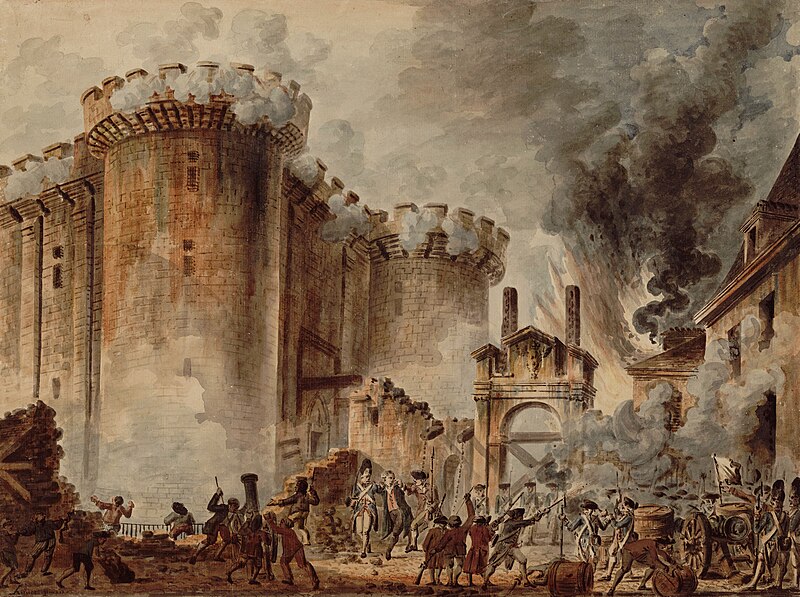
Today is the 233rd anniversary of the storming of the Bastille, a 14th century fort and political prison, by a crowd of 1000 Parisian laborers. The historic event marked the beginning of the French Revolution and the symbolic end of absolute monarchy in France. What followed was eight decades of political and social unrest as France and Europe as a whole struggled with the concept of nationalism. In France, the holiday is known as National Day. In the English-speaking world it is known as Bastille Day.
La Prise De La Bastille Jean-Pierre Houel (1735-1813)
About one hour ago the plane of our planet passed through the center of the sun. That means today is an equinox day: the sun is directly overhead on the equator at midday and the the length of light and darkness are just about equal anywhere on the planet. This year I don't care to get more technical about the facts. What really matters is it's the first day of Spring in the northern hemisphere. Metro Atlanta could not have a more perfect day to mark the arrival. The deep blue skies, no wind, bone-dry air, and a temperature flirting with 68 degrees will soon have me outside and surrounded with signs of a new season.
When it comes to calendars and changing seasons, I'm always reminded of the French Revolutionary Calendar (1793-1805) teasing us with the warmth and color of Spring. The calendar itself wiped away all references to the past, the old French regime, and a return to an Edenic world. For starters the spring equinox marks the first day of the month of Germinal. Every day had a name appropriate for the season. A revolutionary idea, I'd say. So here are the fecund thirty days of Germinal (March 21 - April 19)
1. Primevere - Primrose
2. Plantane - Plane Tree
3. Asperge - Asparagus
4. Tulipe - Tulip
5. Poule - Hen
6. Bette - Chard Plant
7. Bouleau - Birch Tree
8. Jonquille - Daffodil
9. Aulne - Alder
10. Couvoir - Hatchery
11. Pervenche - Periwinkle
12. Charme - Hornbeam
13. Morille - Morel
14. Hetre - European Beech Tree
15. Abielle - Bee
16. Laitue - Lettuce
17. Meleze - Larch
18. Cigue - Hemlock
19. Radis - Radish
20. Ruche - Hive
21. Gainier - Judas Tree
22. Romaine - Lettuce
23 Marronnier - Horse chestnut
24. Roquette - Arugula or Rocket
25. Pigeon - Pigeon
26. Lilas - Lilac
27. Anemone - Anemone
28. Pensee - Pansy
29. Myrtille - Blueberry
30. Greffor - Knife
Wonderful imagery about the season of renewal in those thirty words. The remaining eleven months are equally impressive. Alas, even the best elements of most cultural revolutions are apt to fail. The French Revolutionary Calendar was one of them, disappearing along with the First French Republic in the early days of the Napoleonic Era. Enough with history for now. May your first day of spring be the harbinger of warm weather and wind in your sails. Here is some beautiful imagery in sound to help you on your way.
Sources
Photos and Illustrations: Allegory of Germinal, public domain, wikipedia.fr, French National Library and Bureau of Measures, Paris
For the past four days Atlanta's weather, remarkably clear, warm, and exceptionally dry, sang of the high country. It should persist for another fourteen days, perhaps longer. Such perfection is normally reserved for later in the endless fall that is so characteristic of Georgia and much of the South Atlantic Bight, It reminds me of times in Montana and Colorado and many months spent living in and traveling the sacred high deserts of the Southwest where touching the sky is a reality.
On such days - I call them Colorado days - I work outside in a green woods still brimming with most of the summer birds and insects that have entertained me since May. It's a daily reminder of the full imprint nature has on our lives and one that we too often forget. I think a closer association with our natural world would be both healthy and wise. In this age of simultaneous isolation and mass information I know I'm not alone. I think the sentiment may revive some aspects of the environmental movement.
The origin of a movement to return to nature likely began in the minds of the early anarchists - the Romantics - who saw the evils of the "dark Satanic mills" of England crushing their guilds along with their independence. About the same time zealots in the French Revolution sought to weave nature into their new cultural overlay and remove influences of the feudal monarchy. But even a bloody revolution left us a fascinating remnant of early environmentalism in the form of the French Republican Calendar. It may have been idealistic - it only survived a dozen years - but it was a beautiful reminder that we do live in nature.
According to that calendar we are about to end the month of Vendemiare, the grape harvester.
And here are the thirty days of Vendemiare:
Raisin (Grape)
Safran (Saffron)
Chataignes (Chestnut)
Colchique (Autumn Crocus)
Cheval (Horse)
Balsamine (Yellow Balsam)
Carrotes (Carrots)
Amaranthe (Amaranth)
Panais (Parsnip)
Cuve (Tub)
Pommes de terre (Potatoes)
Immortelle (Strawflower)
Potiron (Giant Pumpkin)
Reseda (Mignonette)
Ane (Donkey)
Belle de nuit (Marvel of Peru)
Citroville (Summer Pumpkin)
Sarrazin (Buckwheat)
Touresol (Sunflower)
Pressoir (Wine-Press)
Chanvre (Hemp)
Peches (Peaches)
Navets (Turnip)
Amarillis (Amaryllis)
Boeuf (Cattle)
Aubegine (Eggplant)
Piment (Chile Pepper)
Tomate (Tomato)
Orge (Barley)
Tonneau (Barrel)
Start with the grape. End with the barrel. I think Vendemiaire provides us a comforting association with a different time and place, a pre-industrial existence where we can easily recognize ourselves as part of nature and not separate from it. And having no interest in returning to the "good old days" - they weren't that good - I would seek compromise with the modern world as we know it. Not easy but that's as it should be.
Today I celebrate the season to be close to the earth and its harvest that sustains us through the cold and dark months to come. It's getting late now. The temperature is already falling through the seventies and darkness will soon overtake my deep ink blue sky. No worries. They'll be a beautiful waning gibbous moon on the horizon an hour before midnight and bedtime. What a stunning day. I am left to sink into a welcomed rest, cradled by the music of Eric Whitacre and lyrics from the pen of Charles Silvestri.
Sleep
The evening hangs beneath the moon
A silver thread on darkened dune With closing eyes and resting head I know that sleep is coming soon
Upon my pillow safe in bed A thousand pictures fill my head I cannot sleep my minds aflight And yet my limbs seem made of lead.
If there are noises in the night A frightening shadow, fleeting light Then I surrender unto sleep.
Where clouds of dreams give second sight What dreams may come both dark and deep Of flying wings and soaring leap
As I surrender unto sleep As I surrender unto sleep
Sources:
Illustration: Wikipedia entry: Vendemiaire, author unknown, National Library and Bureau of Measures, Paris
We call it Bastille Day. To the people of France it is National Day, a commemoration of the storming of the 14th century fort and political prison by a Paris mob. The event was one of many in the early days of the revolution and not particularly significant in that it yielded only a handful of prisoners and a few cannons. Still, it was of great symbolic value in efforts to overthrow the monarchy. Three years later the monarchy was indeed terminated with the execution of Louis XVI and Marie Antionette.
La Prise de la Bastille Jean-Pierre Houel (1735-1813)
What followed the revolution was eight decades of political and social unrest as France and Europe as a whole struggled with the concept of nationalism. Essentially Europe would not experience relative peace and stability until 1870 and the beginning of the Belle Epoch which would last until the advent of the World War I in 1914. For more information about the event, the revolution it spawned, and its significance in national and world politics, visit this brief and well-done post by The Ohio State University.
For an expression of the patriotism July 14 represents to the people of France there is but one song and image, the French national anthem, La Marseillaise:
Tremblez, tyrans et vous, perfides, l'opprobre de tous les partis!
One of the things I most enjoy about living in north Georgia - albeit metro Atlanta - is the seasonal transitions. Granted this is a four season climate even in the southern Appalachian region; however, one is hard pressed to determine exactly what season embraces you if your sole factor is temperature.
Today is the first day of autumn but our high temperature reached 90 degrees and the humidity was more like a measure reserved for the Rockies and the central Continental Divide rather than the rolling Appalachian Piedmont a half hour east of the Atlanta Perimeter. In other words it was a stunningly beautiful summer day unless you looked at the calendar. Our drought may have yellowed the tulip poplars in late August, but those leaves are long gone. Another week of drought will likely mean a weak color season for the region. Looking in our woods today you'd see nothing but a rich green. It doesn't mean change is far away. The clouds are a give away that cooler fronts are closing in on our woods. Autumn waits.
To Autumn
O Autumn, laden with fruit, and stain'd
With the blood of the grape, pass not, but sit
Beneath my shady roof; there thou may'st rest,
And tune thy jolly voice to my fresh pipe,
And all the daughters of the year shall dance!
Sing now the lusty song of fruits and flowers.
'The narrow bud opens her beauties to
The sun, and love runs in her thrilling veins;
Blossoms hang round the brows of Morning, and
Flourish down the bright cheek of modest Eve,
Till clust'ring Summer breaks forth into singing,
And feather'd clouds strew flowers round her head.
'The spirits of the air live in the smells
Of fruit; and Joy, with pinions light, roves round
The gardens, or sits singing in the trees.'
Thus sang the jolly Autumn as he sat,
Then rose, girded himself, and o'er the bleak
Hills fled from our sight; but left his golden load.
William Blake (1757-1827)
To set the mood this evening as Autumn drifts into our lives here is Autumn (1982) composed and performed by George Winston. He has been very generous with his musical talent over many years.
And then there is the great harvest Autumn brings us. Thanks to the revolutionary spirit of the Romantic movement we are left with no better way to express Nature's bounty than in theNapoleonic Calendar. Its ten day weeks, twelve months of thirty days, and assorted extra days to add up to the essential number, 365/6, made it confusing as a time piece. On the other hand, using seasonal events, plant and animal names, and farming implements to label the days and months made the calendar a work of art. And so we have on this day not only the autumnal equinox but also the anniversary of the proclamation of the Republic (1792), the first day of the new Napoleonic Year, and "Grape," the first day of the month of Vendemiaire.
Here in the next 29 days is a vivid picture of the season:
Safran (Saffron)
Chataignes (Chestnut)
Colchique (Autumn Crocus)
Cheval (Horse)
Balsamine (Yellow Balsam)
Carrotes (Carrots)
Amaranthe (Amaranth)
Panais (Parsnip)
Cuve (Tub)
Pommes de terre (Potatoes)
Immortelle (Strawflower)
Potiron (Giant Pumpkin)
Reseda (Mignonette)
Ane (Donkey)
Belle de nuit (Marvel of Peru)
Citroville (Summer Pumpkin)
Sarrazin (Buckwheat)
Touresol (Sunflower)
Pressoir (Wine-Press)
Chanvre (Hemp)
Peches (Peaches)
Navets (Turnip)
Amarillis (Amaryllis)
Boeuf (Cattle)
Aubegine (Eggplant)
Piment (Chile Pepper)
Tomate (Tomato)
Orge (Barley)
Tonneau (Barrel)
I think Vendemiaire provides us a comforting association with a different time and place, a pre-industrial existence where we can easily recognize ourselves as part of nature and not separate from it. That's as it should be. This is the season to be close to the earth and its harvest that sustains us through the cold and dark months to come. Welcome to Fall and the grape harvest. Let us enjoy it whether it be early or late.
Sources:
Illustration:Wikipedia entry: Vendemiaire, author unknown, National Library and Bureau of Measures,
Today is the 230th anniversary of the storming of the Bastille, a 14th century fort and political prison, by a crowd of 1000 Parisian laborers. The historic event marked the beginning of the French Revolution and the symbolic end of absolute monarchy in France. What followed was eight decades of political and social unrest as France and Europe as a whole struggled with the concept of nationalism. In France, the holiday is known as National Day. In the English-speaking world it is known as Bastille Day.
La Prise De La Bastille Jean-Pierre Houel (1735-1813)
For more information about the event, the revolution it spawned, and its significance in national and world politics, visit this site The Ohio State University.
For an expression of the patriotism this day represents, there is but one song and image:
Today is National Day in France - we call it Bastille Day - a holiday marking the 1789 storming of the Bastille by the people of Paris and the symbolic end of absolute monarchy in France. The event ushered in eight decades of political and social unrest as France and Europe as a whole struggled with the concept of nationalism.
One of the things I most enjoy about living in north Georgia - albeit metro Atlanta - is the seasonal transitions. Granted this is a four season climate even in the southern Appalachian region; however, one is hard pressed to determine exactly what season embraces you if your sole factor is temperature. Today is the first day of autumn but our high temperature reached 90 degrees and the humidity was more like a measure reserved for the Rockies and the central Continental Divide rather than the rolling Appalachian Piedmont a half hour east of the Atlanta Perimeter. In other words it was a stunningly beautiful summer day unless you looked at the calendar. Our drought may have yellowed the tulip poplars in late August, but those leaves are long gone. Looking in our woods today you'd see nothing but a rich green. It doesn't mean change is far away. The clouds are a give away that cooler fronts are closing in on our woods. Autumn waits.
To Autumn
O Autumn, laden with fruit, and stain'd
With the blood of the grape, pass not, but sit
Beneath my shady roof; there thou may'st rest,
And tune thy jolly voice to my fresh pipe,
And all the daughters of the year shall dance!
Sing now the lusty song of fruits and flowers.
'The narrow bud opens her beauties to
The sun, and love runs in her thrilling veins;
Blossoms hang round the brows of Morning, and
Flourish down the bright cheek of modest Eve,
Till clust'ring Summer breaks forth into singing,
And feather'd clouds strew flowers round her head.
'The spirits of the air live in the smells
Of fruit; and Joy, with pinions light, roves round
The gardens, or sits singing in the trees.'
Thus sang the jolly Autumn as he sat,
Then rose, girded himself, and o'er the bleak
Hills fled from our sight; but left his golden load.
William Blake (1757-1827)
And sometimes Autumn has nothing to do with temperatures and clouds. Early Autumn was composed in 1949 by Ralph Burns and Woody Herman. Johnny Mercer wrote the lyrics. I think Ella Fitzgerald has owned this song for over sixty years.
And if you're somewhat revolutionary perhaps you'll enjoy the season as Vendemiaire, the Grape Harvester, on Grape, the first day of the Napoleonic Fall.
Leave it to the French to have a sweeping, violent revolution that would attempt to wipe out all traces of monarchy and replace it with enlightenment and the Age of Reason. One of the features of the revolution was the Napoleonic Calendar. Its ten day weeks, twelve months of thirty days, and assorted extra days to add up to the essential number, 365/6, made it confusing as a time piece. On the other hand, using seasonal events, plant and animal names, and farming implements to label the days and months made the calendar a work of art. And so we have on this day, September 22, not only the autumnal equinox but also the anniversary of the proclamation of the Republic (1792) and the first day of the new Napoleonic Year.
Here in the next 29 days is a vivid picture of the season:
Safran (Saffron)
Chataignes (Chestnut)
Colchique (Autumn Crocus)
Cheval (Horse)
Balsamine (Yellow Balsam)
Carrotes (Carrots)
Amaranthe (Amaranth)
Panais (Parsnip)
Cuve (Tub)
Pommes de terre (Potatoes)
Immortelle (Strawflower)
Potiron (Giant Pumpkin)
Reseda (Mignonette)
Ane (Donkey)
Belle de nuit (Marvel of Peru)
Citroville (Summer Pumpkin)
Sarrazin (Buckwheat)
Touresol (Sunflower)
Pressoir (Wine-Press)
Chanvre (Hemp)
Peches (Peaches)
Navets (Turnip)
Amarillis (Amaryllis)
Boeuf (Cattle)
Aubegine (Eggplant)
Piment (Chile Pepper)
Tomate (Tomato)
Orge (Barley)
Tonneau (Barrel)
I think Vendemiaire provides us a comforting association with a different time and place, a pre-industrial existence where we can easily recognize ourselves as part of nature and not separate from it. That's as it should be. This is the season to be close to the earth and its harvest that sustains us through the cold and dark months to come. Welcome to Fall and the grape harvest. Let us enjoy it whether it be early or late or whatever it means.
Sources:
Illustration:Wikipedia entry: Vendemiaire, author unknown, National Library and Bureau of Measures,
On this day in 1789 a crowd of 1000 Parisian laborers stormed the Bastille, a 14th century fort and political prison. The event marked the beginning of the French Revolution and the symbolic end of absolute monarchy in France. What followed was eight decades of political and social unrest as France and Europe as a whole struggled with the concept of nationalism.
July 14 in France is National Day, a holiday know as Bastille Day throughout the English-speaking world. For more information about Bastille Day and the revolution it spawned go here.
Leave it to the French to have a sweeping, violent revolution that would attempt to wipe out all traces of monarchy and replace it with enlightenment and the Age of Reason. One of the features of the revolution was the Napoleonic Calendar. Its ten day weeks, twelve months of thirty days, and assorted extra days to add up to the essential number, 365/6, made it confusing as a time piece. On the other hand, using seasonal events, plant and animal names, and farming implements to label the days and months made the calendar a work of art. And so we have on this day, September 22, not only the autumnal equinox but also the anniversary of the proclamation of the Republic (1792) and the first day of the new Napoleonic Year. Here in the next 29 days is a vivid picture of the season:
Safran (Saffron)
Chataignes (Chestnut)
Colchique (Autumn Crocus)
Cheval (Horse)
Balsamine (Yellow Balsam)
Carrotes (Carrots)
Amaranthe (Amaranth)
Panais (Parsnip)
Cuve (Tub)
Pommes de terre (Potatoes)
Immortelle (Strawflower)
Potiron (Giant Pumpkin)
Reseda (Mignonette)
Ane (Donkey)
Belle de nuit (Marvel of Peru)
Citroville (Summer Pumpkin)
Sarrazin (Buckwheat)
Touresol (Sunflower)
Pressoir (Wine-Press)
Chanvre (Hemp)
Peches (Peaches)
Navets (Turnip)
Amarillis (Amaryllis)
Boeuf (Cattle)
Aubegine (Eggplant)
Piment (Chile Pepper)
Tomate (Tomato)
Orge (Barley)
Tonneau (Barrel)
I think Vendemiaire provides us a comforting association with a different time and place, a pre-industrial existence where we can easily recognize ourselves as part of nature and not separate from it. That's as it should be. This is the season to be close to the earth and its harvest that sustains us through the cold and dark months to come.
Welcome to Fall and the grape harvest. Let us enjoy it.
Sources:
Illustration:
Wikipedia entry: Vendemiaire, author unknown, National Library and Bureau of Measures,
Today is National Day in France - we call it Bastille Day - a holiday marking the 1789 storming of the Bastille by the people of Paris and the symbolic end of absolute monarchy in France. The event ushered in eight decades of political and social unrest as France and Europe as a whole struggled with the concept of nationalism.
Leave it to the French to have a sweeping, violent revolution that would attempt to wipe out all traces of monarchy and replace it with enlightenment and the Age of Reason. One of the features of the revolution was the Napoleonic Calendar. Its ten day weeks, twelve months of thirty days, and assorted extra days to add up to the essential number, 365/6, made it confusing as a time piece. On the other hand, using seasonal events, plant and animal names, and farming implements to label the days and months made the calendar a work of art. And so we have on this day, September 22, not only the autumnal equinox but also the anniversary of the proclamation of the Republic (1792) and the first day of the new Napoleonic Year.
Welcome to Vendemairie (Grape Harvester) and its first day, Raisin (Grape).
Here in the next 29 days is a vivid picture of the season:
Safran (Saffron)
Chataignes (Chestnut)
Colchique (Autumn Crocus)
Cheval (Horse)
Balsamine (Yellow Balsam)
Carrotes (Carrots)
Amaranthe (Amaranth)
Panais (Parsnip)
Cuve (Tub)
Pommes de terre (Potatoes)
Immortelle (Strawflower)
Potiron (Giant Pumpkin)
Reseda (Mignonette)
Ane (Donkey)
Belle de nuit (Marvel of Peru)
Citroville (Summer Pumpkin)
Sarrazin (Buckwheat)
Touresol (Sunflower)
Pressoir (Wine-Press)
Chanvre (Hemp)
Peches (Peaches)
Navets (Turnip)
Amarillis (Amaryllis)
Boeuf (Cattle)
Aubegine (Eggplant)
Piment (Chile Pepper)
Tomate (Tomato)
Orge (Barley)
Tonneau (Barrel)
I think Vendemairie provides us a comforting association with a different time and place, a pre-industrial existence where we can easily recognize ourselves as part of nature and not separate from it. That's as it should be. This is the season to be close to the earth and its harvest that sustains us through the cold and dark months to come.
Welcome to Fall and the grape harvest. Let us enjoy it.
Sources:
Napoleon.org (fascinating site maintained by the Fondation Napoleon).
Wikipedia entry: Vendemaire
Stephane Grappelli in rehearsal Photo: Murdo MacLeod
Today marks the birthday of one of OTR's favorite jazz artists, the violinist, Stephane Grappelli. He was born is Paris, grew up poor and made a marginal living playing the violin in the streets and accompanying silent films on the piano. In 1934 he met a gypsy guitarist named Django Reinhard and, with him,, formed a quintette - Hot Club de France - that would make history in the world of jazz and popular music.
Grappelli made his American debut in 1960, long after the Hot Club dissolved, and enjoyed a second career playing to admiring fans around the world until his death in 1997.
Here is a one-hour interview he made for NPR's Marian McPartland's Piano Jazz in 1990. It's lively and full of warm conversation, humor, and some wonderful, intimate performances. If readers don't have an hour to enjoy this jazz master at work, here is a taste of his contribution to music. OTR hopes that music is a song without end.