Monday, July 31, 2023

The Day Splicing The Main Brace Passed Into History


We all know water is essential to life. At the same time we have to keep in mind that it can also sustain deadly diseases including typhoid, cholera, giardia, dysentery, e. coli, hepatitis, and salmonella. It wasn't until the late 19th century that science really began to understand diseases, their vectors, and methods of control and prevention. It's no wonder that the fermentation of beer was an early cultural practice in human history around the world. Beer was reliably safer than water. It traveled better, lasted longer, and had some medicinal properties as well. The magic molecule was alcohol.

By the 15th century and the burgeoning age of distant empires it was already apparent that ships full of soldiers and sailors needed to carry water. Unfortunately it didn't last more than a few weeks in a barrel or ceramic container under a hot tropical sun. Beer wasn't much better, nor was wine, but rum was almost perfect as a cheap, plentiful, and long-lasting alternative. In 1650, the Royal Navy introduced the tot ration, a daily amount of rum for every sailor. It was a welcome offering for crews whose work was brutal, dangerous, and little more than enslavement for those pressed into service. The practice of the rum (or tot) ration and its benefits and liabilities became an essential part of Royal Navy life. Despite a growing temperance movement in the 1870s and the increasing complexity of tasks, the practice continued until the last piping of "Up Spirits" on July 31, 1970. That day is remembered as Black Tot Day. The practice ended in Canada in 1972 and in New Zealand in 1990. Here is the story of the rum ration and its iterations throughout its more than 300 year history.


Splicing the main brace with the Royal Navy


The end of the rum ration had an enormous impact on producers in the British Empire and its territories, particularly in the Carribean. Many distillers had an association with the ration for centuries. It was a tough decision to put aside such a long tradition but all was not lost. The rum stocks were auctioned and warehoused by the new owner in Gibralter. From there, he supplied select Royal Navy vessels, Royal Air Force and Army messes, and even a few choice bars with the treasured rum. In 1979 Charles Tobias secured the rights to the original Admiralty recipe and founded Pusser's Rum, named after the Ship's Purser who oversaw its daily distribution to sailors. Here's more on the Pusser story.


The American military experience with rum closely resembles that of the Royal Navy. History tells us that both the Contiental Army and Navy had a daily rum ration. The U.S. Navy ration lasted until 1862 when temperance sentiment prevailed in Congress and the practice was abolished. The law took effect on September 1. Here is an air sung in the ward room of an unknown U.S. vessel on August 31.


Farewell To Grog


Come, messmates, pass the bottle ‘round
Our time is short, remember,
For our grog must stop and our spirits drop
On the first day of September.


Jack’s happy days will soon be gone,
To return again oh! Never,
For they’ve raised his pay five cents a day
But stopped his grog forever.


Farewell, old rye, ‘tis a sad, sad word,
But alas! It must be spoken,
The ruby cup must be given up
And the demijohn be broken.


Yet memory oft will backward turn
And dwell with fondness partial,
On the days when gin was not a sin
Nor cocktails brought courts martial.


All hands to splice the main brace call,
But splice it now in sorrow,
For the spirit-room key will be laid away
Forever on to-morrow.


"Splice the main brace" was the common response to the sound of "Up Spirits" on the bosun's pipe.


It would be fitting tonight to pour an ounce or two of rum - obviously Pusser's if you have it - and add twice the amount of water to make a grog, then find your most comfortable chair, sit back, and enjoy your tot while thinking about a great British naval tradition and the day it came to a sad end.


Sources

Photos and Illustrations:
thehistoryproject.co.uk

Text:
Wikipedia
Imbibe!, David Wonderich, Tarcher Perigee, 2015
Naval History and Heritage Command, Navy Department Library
Pusser's Rum


Saturday, July 29, 2023

Tolkien Shapes The First Chapter Of The Rings


For fantasy fiction fans this day in 1954 has great significance. It is the day that J.R.R. Tolkien's The Fellowship of the Ring first appeared on store shelves in the United Kingdom. The book was the first of three volumes in the high fantasy novel we know today as The Lord of the Rings. A used copy of that first edition with its original dust jacket would fetch an owner at least $6500. An autographed copy would easily be in six figures as Tolkien was a bit of an introvert and disliked autographing his books. I doubt that sum would matter much to true fans. To them the words within are priceless.


Who was the man behind this beloved three volume narrative we know as The Lord of the Rings? The 1968 BBC video below contains some footage of an interview and explores Tolkien's real and imaginary worlds. The audio is not the best so viewers may want to use earbuds or headphones.


Below is a probing, fast-paced, and well-known Tolkien interview from BBC Radio in 1964. It was first broadcast in 1971. All of Tolkien's brilliance and eccentricity is on full display in this wide-ranging look at one of the most beloved writers of the last century. 


It would take a generation after his death (1973) before a cinematic version of his great work would, perhaps could, appear. The Lord of the Rings film series produced between 2001 and 2003 not only created a new generation of readers but also energized existing Tolkien fans to reexamine his work. All of this new energy and imagination has had a significant effect on the world of fiction and fiction writing. Tolkien's creative genius and the publication of Fellowship of the Ring - and The Hobbit - started the surge. We can't say with precision where that surge takes us but we can be certain that Tolkien's legacy will be enjoyed and expanded long into the years ahead.


Sources

Photo:
tolkienlibrary.com

Text:
wikipedia.com, J.R.R.Tolkien
tolkienestate.com
"Why Did Tolkien Write The Lord of the Rings," Michael Martinez, middle-earth.xenite.org

Friday, July 28, 2023

J. S. Bach: May His Music Go On Forever


Statue of composer J.S. Bach in Leipzig, Germany


This day in 1750 marks the passing of one of the great three "B's" in classical music, Johann Sebastian Bach, He gave us some of the most sublime music in western culture and it would be an oversight, especially as a Lutheran, not to honor this master of the Baroque and pillar of Lutheranism. Here is a taste of genius whose work was largely forgotten for a century following his death.


Magnificat in D Major, Nikolaus Harnoncourt conducting. 


Goldberg Variations. The performance is by the dazzling and eccentric Canadian pianist, Glenn Gould, who was well-known for quietly "scatting" during his performances. He drove sound and recording engineers batty.


Cello Suite No. 6 in D Major,  Yo Yo Ma


Toccata and Fugue in D Minor A familiar piece but it never gets old especially when played by the amazing young organist, Gert Van Hoef. He made this video a few weeks before his nineteenth birthday.


Bach's music has been a part of me for so long that I couldn't begin to tell you when I first heard it other than to say it had to be in church at a very early age. The preludes. fugues, harmonies, the shear wonder of his work, it's all in my blood, and I can't play a single note of it. Wouldn't have it any other way. I simply listen and let it flow.

I hope you can take time today to listen to the four pieces included in today's post. Normally I try to avoid posting music longer than ten minutes but today will be an exception. 


Music’s ultimate end or final goal…should be for the honor of God and the recreation of the soul. 
                                          J. S. Bach - Leipzig, 1738


Sources

Photo: stlpublicradio.org, flickr/seabamirum

Wednesday, July 26, 2023

Jean Shepherd: American Storyteller


Mention "Ralphie" and "Red Ryder BB gun" in the same breath and I'd say most people could make an immediate connection with the film, A Christmas Story. On the other hand, most people probably know very little about the remarkable personality behind that story. His name is Jean Shepherd.


He was born on this day in 1921 on Chicago's south side and raised in nearby Hammond, Indiana. After serving in World War II, Shepherd began a career in broadcasting that expanded into writing, film, and live performance. He was heard on late night radio for over twenty years - all unscripted - on New York's WOR where he entertained listeners with his humorous stories, interviews, and practical jokes. Shepherd hosted a television show for WOR as well, but he is best remembered in video narrating a number of productions based on his stories of growing up in the Midwest. Many of the scripts were so popular they later appeared in print. Here is the storyteller at his best on his traditional Christmas Eve broadcast on WOR in 1974. A Christmas Story would emerge from these broadcasts in 1983.


Psychology tells us that humorists often do not have the happiest of life stories. Shepherd was no exception. Although he surely had the talent to become a well-known national treasure, radio did not provide him coast-to-coast exposure available with the new medium of television. He was fiercely independent, a maverick, and one not to take life too seriously. I can imagine he was a threat to the ego of more than one radio executive. Furthermore, he was a "night owl" on radio, broadcasting to a dedicated but smaller audience, and in direct competition with televised local news and the likes of Johnny Carson and The Tonight Show. In fact this warm story by a fan notes that Shepherd likely was in line to take over The Tonight Show with Steve Allen's departure in 1957 but Jack Paar had the right of first refusal with the NBC network. Paar unexpectedly accepted thus denying Shepherd his big break on one of television's most popular shows. Finally, from my research, it seems Shepherd maligned his radio work when he moved into writing film for television in the '70s. Indeed, it apparently was a clean break - maybe the execs were happier without him - and he did go on to success with films, including The Phantom of the Open Hearth, The Great American Fourth of July and Other Disasters, and Ollie Hopnoodle's Haven of Bliss. Still, I think the fates denied him the opportunity to become a big television star in the 1950's and much better well-known in his lifetime.


Without question, his best known contribution to American humor is A Christmas Story, a compilation of stories and characters drawn from his earlier work. It was originally produced as a feature film in 1983 and made the transition into a television classic thanks to the persistence of Ted Turner. Almost any man born before 1950 has lived some or all of Ralphie's/Shep's childhood. Each man's path to adulthood is his own, but the markers are identical. Jean Shepherd was a genius at capturing them. And his skills as a narrator made him a natural at weaving life's common threads into humorous and entertaining listening.


". . . the soft glow of electric sex gleaming in the window."


Shepherd died 24 years ago on Sanibel Island, Florida, remembered for one film produced in 1983 when he was 62. There's much more to him than that and I hope more people come to enjoy his work. The settings now and in the future will be different but the collected experiences from childhood and adolescence remain similar and often age into fine wine. Thanks to Shepherd we can laugh at past times and enjoy the harvest.

If you want to explore more of Shepherd's work, the made-for-television film, The Phantom of the Open Hearth, is the place to start. It premiered at Christmas 1976 on public television as a humorous glimpse of Ralphie's teen angst during his high school years in the Midwest. You'll see many of the characters and storylines - yes, the leg lamp is there - that appear in A Christmas Story. These days Phantom is a cult classic among Shepherd fans. If you want to join the cult you can watch the film for free on You Tube.


Monday, July 24, 2023

AirVenture Over Oshkosh 2023


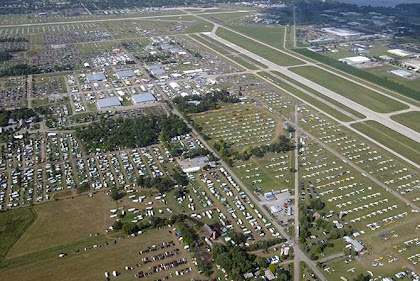
The Experimental Aircraft Association's (EAA) annual week-long AirVenture gathering in Oshkosh, Wisconsin, kicks off today. It's better known as "Oshkosh" to aviation enthusiasts and you can be assured that every one of them has the event on their bucket list. There's good reason. Imagine a fly-in attracting around 7500 airplanes. Imagine 2500 aircraft exhibits, 800 commercial exhibitors, daily world-class airshows, and a total of over 600,000 guests.


AirVenture at Oshkosh is far from your average fly-in


Organizers call the event "the world's greatest aviation celebration" and this year marks its seventieth edition. The map below gives readers an idea of the scope and scale of Oshkosh and indicates why the event turns a rather sleepy Wittman Regional Airport into the busiest airport in the world for one week each year.


AirVenture grounds - for scale, that's an 8000 foot runway at the top 


I had the privilege of attending the event several times in the last decade of my career. Energizing, informative, and significant, the show was a great vehicle for delivering an organizational message to a large, captured, and enthusiastic audience. You may ask why the National Park Service (NPS) would send a dozen or so employees and volunteers to work an air show. First, the agency has almost fifty out of its more than 400 units with a significant link to an aviation theme. In addition, the Service maintains a fleet of fixed and rotary wing aircraft contributing over 20,000 hours of flight time annually in support of park operations, maintenance, and resource and fire management. Add to that interagency cooperation across departments as well as airspace regulation over the parks and the justification become clearer. In recent years the NPS's presence at the event has been reduced significantly and folded into a more cooperative effort with other federal agencies. In summation, it's a grand and demanding opportunity to reach out face-to- face with thousands of guests who enjoy and impact resources and services they provide.


Nothing like fly-in camping with thousands of your best - in this case closest - friends


If you can't attend AirVenture, the EAA maintains a comprehensive up-to-the-second website where you can spend hours reading, watching and listening to events. I've been looking up at the sound of an aircraft engine ever since I could lift my head. If you are blessed with the same response make your plans to attend an Experimental Aircraft Association AirVenture. You will not be disappointed. Until then "wheels up" every chance you get!


Sunday, July 23, 2023

Some Advice On Prepping For The Coming Election Season


We are now fifteen months away from November 2024 and the presidential election. Regardless of the outcome it's promising to be a vicious campaign as the Socialist Democrats struggle to win the House and retain control of the Senate and the future of the Biden presidency. Another significant ingredient will be the collective anger among tens of millions of voters on the right and left who remain upset with an embattled candidate consumed by his 2020 loss and a sitting president tottering through a now rapid descent into late stage dementia. It's not a good choice either way and the chorus for change grows louder week by week. I believe the anger translates easily to motivation and in turn to more confrontational election tactics.

Around 1513 Niccolo Machiavelli wrote The Prince, a guidebook advising those in power on how to keep it. Four and a half centuries later, Saul Alinsky wrote Rules For Radicals advising those out of power on how to take it from those in charge. It's all about keeping and holding power. We have a struggle for that power coming next year. You'll have to read Machiavelli for yourself. It can be a challenge. On the other hand, Alinsky's book is nicely structured, very readable as a playbook, and an aid to the critical thinking you'll need to navigate the campaign battlefield.


In preparation for the desperate and emotional battle that's coming, I thought it would be the perfect time to give readers a booster shot of the political tactics we're likely to encounter from our politicians and their organizations. They won't be new to readers here because they've become the subject of an OTR post in presidential election years. Many of the tactics have been a feature of American elections for well over a century. It took the mind and experience of Saul Alinsky, long recognized as the founding father of community organizing, to best articulated them in his 1971 book. He was after all a Chicago native trained at the University of Chicago and a veteran organizer and political activist in the city's neighborhoods. His experience taught him early that politics was a very dirty game. That's one reason he dedicated the book to Lucifer.


My copy purchased in 1971 during my revolutionary days


Democrats, especially those from the party's "progressive" wing, were well aware of the value of the tactics described herein and used them effectively during their convention in Chicago in 1968. They used them successfully against a naive Republican Party until late in the last century. By then American politics had become a vicious game of win or lose instead of compromise. Eventually GOP campaign strategists recognized political reality required them to fight fire with fire. That said here are the twelve rules or tactics we'll see at work every day until the election and beyond. My condensation of supporting information from the book is in brackets.


1. Power is not only what you have, it's what the enemy thinks you have. [Power is derived from two main sources - money and people.]

2. Never go outside the expertise of your people. [It results in confusion, fear and retreat. Feeling secure adds to the backbone of anyone.]

3. Whenever possible, go outside the expertise of the enemy. [Look for ways to increase insecurity, anxiety and uncertainty.]

4. Make the enemy live up to its own book of rules. [You can kill them with this because nobody can possibly obey all of their own rules.]

5. Ridicule is man's most potent weapon. [There is no defense. It's irrational. It's infuriating.]

6. A good tactic is one your people enjoy.

7. A tactic that drags on too long become a drag. [Don't become old news. Even radical activists get bored.]

8. Keep the pressure on. Never let up. [Attack, attack, attack from all sides, never giving the reeling organization a chance to rest, recover, regroup or re-strategize.]

9. The threat is usually more terrifying than the thing itself. [Imagination and ego can dream up many more consequences than any activist.]

10. If you push a negative hard enough, it will push through and become a positive. [Violence from the other side can become a positive because the public sympathizes with the underdog.]

11. The price of a successful attack is a constructive alternative. [Never let the enemy score points because you're caught without a solution to the problem. If you're not part of the solution, you're part of the problem.]

12. Pick the target, freeze it, personalize it, and polarize it. [Cut off the support network and isolate the target from sympathy. Go after people, not institutions, people hurt faster than institutions.]


Look carefully at these words. Any way you look at them, there is rough play, play for keeps. We've read and heard them daily and watched their consequences unfold on our national stage especially since 2008. Time and experience have taught me well and today I see it as an unsettling and potentially dangerous book now that it has become mainstream. I trust readers will benefit from this information as we face what may well be the most significant national election in our time.

In closing, some readers may be curious how I came to own a first edition of Alinsky's Rules for Radicals: A Pragmatic Primer for Realistic Radicals [1971]. First, the political events of the 1960's were not good to me. After President Kennedy's murder in 1963 , Barry Goldwater's loss to Lyndon Johnson in the presidential election of 1964, and the physical and mental slaughter in Vietnam and the US, I became an anarchist in the classical sense of the word. That's when I encountered Rules for Radicals. It's been read many, many times, it's a bit yellow here and there, and the dust jacket has a few small tears and scuffs; otherwise, it's in excellent condition. 

As a husband and father, and student of the American experience, I moved right of center in politics and economics over the years, but always maintained a fiercely liberal position on many social issues. In essence I'm now a Jeffersonian Democrat and that makes it difficult to place me in context in today's polarized political environment. On the other hand, most folks smile and laugh and many are happy to know I never once liked Richard Nixon. Not even when I was six years old.


Saturday, July 22, 2023

Wiley Post Completes First Solo Flight Around The World in 1933


July is an important month in the history of flight. On July 14, 1914, the US Signal Corps organized an Aviation Section that would eventually grow into the US Air Force. And on July 19, 1969, the Apollo 11 mission first landed humans on the moon. So far in July 2022 NASA released the first images from its spectaculat Webb telescope and both NASA and SpaceX continued their ambitious rocket development and launch programs aimed at the moon and Mars. All of these endeavors were preceded by the work of a number of aviation pioneers whose own achievements often get lost in history. Today we remember another July event and the famous American aviator who achieved it. His name was Wiley Post. After a journey of eight days he returned to his starting point at Floyd Bennett Field in Brooklyn, New York, to complete the first solo flight around the world. Here is a map of the journey:


And here is what This Day In History (history.com) says about the flight:

Two years earlier, Post had won fame when he successfully flew around the northern part of the earth with aviator Harold Gatty. For his solo around-the-world flight in 1933, he flew a slightly greater distance–15,596 miles–in less time. For both flights, he used the Winnie Mae, a Lockheed Vega monoplane that was equipped with a Sperry automatic pilot and a direction radio for Post’s solo journey.


His aircraft, Winnie Mae, was as well known as its pilot. The Smithsonian National Air and Space Museum's summary description of the plane say this:


Flying this specially modified Lockheed 5C Vega, famed aviator Wiley Post set many records and pioneered several aviation technologies. In 1931 Post and navigator Harold Gatty flew it around the world in eight days, and in 1933 Post became the first to fly around the world solo, taking only seven days. In 1935, while wearing the world's first pressure suit, which he helped design, Post flew the Vega into the stratosphere, reaching 547 kilometers (340 miles) per hour while cruising in the jet stream. The Winnie Mae was named for the daughter of F. C. Hall, the original owner and a close friend of Post.

Designed by John K. "Jack" Northrop, the Lockheed Vega first flew in 1927. It was the first aircraft with a NACA [National Advisory Committee for Aeronautics] cowl that decreased drag and increased power plant cooling by streamlining airflow around and through the engine.


Winnie Mae at her place of honor in the Time and Navigation exhibit at the Smithsonian National Air and Space Museum, Washington, DC


Over the next two years Post explored the development of a suit for high altitude flight. During his experimental flights he became the first man to encounter the high speed air currents we know as jet streams. On August 15, 1935, he and the American cowboy humorist, Will Rogers, died in the crash of Post's hybrid Lockheed home-built aircraft while exploring the possibilities of an air mail route across Alaska. Below is a photograph of the pair taken shortly before their fatal accident:


Will Rogers (on wing) and Wiley Post (by prop) as they prepare to depart Point Barrow, AK, August 15, 1935


In many ways Post's interest in science, experimentation and controlled, powered flight mirrors that of Wilbur and Orville Wright. The brothers enabled Post to make his contribution to aviation history as a pilot, inventor, and trailblazer. Today, his name and achievments continue to inspire and enable new air and space pioneers to go higher, faster, and farther than ever. 


Sources

Photos and Illustrations:

Map, fiddlersgreen.net
Winnie Mae, Smithsonian National Air and Space Museum
Post and Rogers, Library of Congress, Prints and Photographs Division

Text:

wikipedia.com
history.com
airandspace.si.edu
gendisasters.com
acepilots.com

ShareThis