Saturday, May 31, 2025

Walt Whitman: On Being In America


The American poet and essayist, Walt Whitman, was born on this day in 1819 in West Hills, Long Island, New York. His formal education ended after six years but his insatiable desire to learn immersed him in libraries, museums, lectures, salons, and landscapes in and around New York. His life as a poet, essayist, journalist and humanitarian would take him to New Orleans, Washington, Boston, and Camden, New Jersey, but his associations in New York would make the greater metropolitan area the hub of his career.


Whitman in 1887


A free spirit easily recognized as the most extraordinary poet of his time, Whitman bridged the American experience from the early Romantic period in literature to the advent of hard realism as the end of the century approached. I'm not sure what presence he has these days in public school systems across the country but baby boomers - born between 1946 and 1964 - had a full dose of his poetry beginning in elementary school. For more information on Whitman, including an extensive biography, visit the outstanding resources at the Walt Whitman Archive.

For an example of his work here is "One's-Self I Sing," the introductory poem to the third and last section of his collection, Leaves of Grass, as published in 1867.


ONE’S-SELF I sing—a simple, separate Person,
Yet utter the word Democratic, the word En-masse.


Of Physiology from top to toe I sing;
Not physiognomy alone, nor brain alone, is worthy for the muse—I say the
Form complete is worthier far;
The Female equally with the male I sing.


Of Life immense in passion, pulse, and power,
Cheerful—for freest action form’d, under the laws divine,
The Modern Man I sing.


Much of Whitman's poetry has been set to music. Sometimes the blend of music and existing poetry as opposed to lyric has limited success and authors often do not think favorably of such adaptations. I believe Whitman would have approved especially with the music coming from a fellow impressionist, in this case Frederick Delius. This composition has been a personal favorite for forty years. The recording features the superb Welsh baritone, Bryn Terfel, and the Bournemouth Symphony Orchestra and Chorus under the baton of Richard Hickox. If you want to follow the text it's available here.


Here is a brief, well-known poem brought to a new generation through it's use in the 1989 film, Dead Poets Society.


Sources

Photos and Illustrations:
public domain photo, George Collins Cox, restored by Adam Cuerden, Library of Congress Prints and Photographs Division

Text:
whitmanarchive.org
Walt Whitman entry, wikipedia.org
One's Self I Sing, wikipedia.org


Friday, May 30, 2025

He Was The King Of Swing From Coast To Coast


In 1935 Benny Goodman and his band had a regular late-night gig on Saturdays on NBC's radio program, Let's Dance. Broadcast from New York, most of the local teens and twenty-somethings who enjoyed his music were fast asleep. On the other hand, it was perfect timing for young audiences on the West Coast. A labor strike brought the program to a sudden and unexpected end and put Goodman and his band out of work. Together they decided on a coast to coast tour. In the interior states, the tour was a disaster because people didn't care for "upbeat" jazz arranged for orchestra. The band was looking forward to the Palomar Ballroom in Los Angeles as the last stop and an end to the pain. When they arrived, thousands of young fans who had heard them on the radio were waiting to hear them in person. What was to be a welcome end to a disastrous tour turned into the beginning of the swing era.


In the shadow of Bebop: Benny Goodman, 1946


Eighteen months later , the now famous Goodman Orchestra was invited to present a jazz review on January 16, 1938 in Carnegie Hall, a venue historically reserved for "high brow" music. Several members of the Duke Ellington and Count Basie orchestras and others joined on stage to perform a concert ranging from traditional to unconventional. No jazz bandleader had ever performed there. The concert was a sensation, reaffirming Goodman as the "King of Swing," and jazz as serious American music. In the eyes of many music critics and historians, this concert remains the single most important event in popular music history in the United States. Superlatives aside, the concert was a study in swing music history and jazz improvisation.

After several curtain calls at the end of the concert, Goodman announced to the screaming fans that an encore would follow. Sing, Sing, Sing was the last song in that set. It already was a popular piece for the band but this performance lifted it to holy status in the swing jazz genre. Featured players: Gene Kruppa on drums, Babe Russin on saxophone, Harry James on trumpet, Goodman on clarinet, and Jess Stacy in a masterpiece of improvisation on piano.


Today we celebrate the birthday of the clarinetist and bandleader, Benny Goodman (1909 - 1986). You can read more about him at his Wikipedia entry here. Mention "Palomar Ballroom" and "Carnegie Hall" in the same breath and any popular music historian will follow with "Benny Goodman." His performances at the two venues took place more than 80 years ago. Today we remember both concerts as course changing landmarks in the history of swing and jazz.


Publicity style photo of Benny Goodman around 1960


Sources

Photos and Illustrations:
1946 photo, Library of Congress, William Gottlieb Collection
1960 photo,public domain, publicity style candid photo of Benny Goodman

Text:
bennygoodman.com
Benny Goodman entry, wikipedia.org

Thursday, May 29, 2025

Igor Stravinsky's THE RITE OF SPRING, A Premiere Wrapped In Praise And Riot


There was an important anniversary in the world of music this weekend. Most of my musical posts usually concern people. This one is about a composition in the forefront of a revolution in sound at the end of the Edwardian era. On May 29, 1913 the 30 year-old composer, Igor Stravinsky, made music history in Paris. The event was the premiere of the ballet, The Rite of Spring. Like his earlier work for Sergei Diaghilev's Ballets Russes, it was experimental and revolutionary. When combined with primitive choreography and a human sacrifice theme some in the audience were dazzled while others were infuriated to the point of riot. 

The violence subsided rather quickly, the anger simmered a bit longer and Stravinsky's imaginative compositions went on to have a huge impact on music and the arts. At the forefront stands The Rite of Spring - Stravinsky produced several arrangement throughout his life - as one of the most widely recorded and performed  works in the world. It remains as fresh in 2025 as it was in 1913. In that century its innovative energy in sound and rhythm has been re-patterned by the likes of Aaron Copeland, Leonard Bernstein, John Williams, Philip Glass and many others.


Photo from 1913 showing original costumes

In the early 1980's the original choreography was meticulously reconstructed after being lost for almost six decades. A few years after its completion it was presented by the Joffre Ballet. Several adaptations based on the original costuming and set design have appeared over rhe last forty years. In my opinion the Jofre production remains the better representation of what that 1913 audience both heard and saw. Here is Part 1 - all three available on YouTube - of their performance.


Some say the most productive experiments often make the biggest messes until they are better understood. The genius and madman in Stravinsky would very much agree. 


Sources

Photos and Illustrations:
public domain photo from First Nights: Five Musical Premieres by Thomas F. Kelly. Yale University Press, New Haven, 2000.

Text:
Igor Stravinsky entry, wikipedia.org


Monday, May 26, 2025

Memorial Day 2025


Many of us grew up knowing this day as Decoration Day but now it is best known as Memorial Day. Though both its date and scope have changed over time its central meaning remains strong. At virtually every crossroad town from sea to sea, there will be old soldiers, flags, a speech or two, and prayers. These events will take place at memorial walls bearing the names of the honored dead. Invariably, the audiences will be small, but firmly dedicated to the idea that the nation will always remember the cost of freedom.


This is a day of mixed emotion as we honor men and women who made the supreme sacrifice in service to their country. They gave their lives that we might live out our own in an experiment of community called the United States. As we enjoy the holiday we will take some moments today to think of these honored men and women and what they have given us and our families.


Here in words and images, the contemplative moments continue...


From the silence of sorrowful hours,
The desolate mourners go,
Lovingly laden with flowers,
Alike for the friend and the foe:
Under the sod and the dew,
Waiting the judgment day.
Under the roses the Blue,
Under the lilies the Gray


A Soldier's Burial
by General George S. Patton (1943)


Not midst the chanting of the Requiem Hymn,
Nor with the solemn ritual of prayer,
Neath misty shadows from the oriel glass,
And dreamy perfume of the incensed air
Was he interred;
But in the subtle stillness after fight,
And the half light between the night and the day,
We dragged his body all besmeared with mud,
And dropped it, clod-like, back into the clay.

Yet who shall say that he was not content,
Or missed the prayers, or drone of chanting choir,
He who had heard all day the Battle Hymn
Sung on all sides by a thousand throats of fire.

What painted glass can lovelier shadows cast,
Than those the evening sky shall ever shed,
While, mingled with their light, Red Battle's Sun
Completes in magic colors o'er our dead,
The flag for which they died.


Friday, May 23, 2025

Artie Shaw: He Searched For The Perfect Sound


The music world has several significant birthdays to remember this week. One of them (May 23, 1910) belongs to  Arthur Arshawsky, the clarinetist, composer, band leader, and author better known as Artie Shaw. To say that Shaw was complex and difficult would be an understatement. He was married eight times, greatly disliked fame, and resented the conflict between creativity and the music industry so much that he virtually abandoned music in the early 1950s. Perhaps his life illustrated a never ending search for perfection by a man who could have approached it in any number of fields. When he died in December 2004 at the age of 94, he was recognized as one of the century's finest jazz clarinetists and a principal force in the development of the fusion of jazz and classical music that would become known as "Third Stream Music." Technically, I think he was at the top. This 1936 recording of him performing his composition, Interlude in B Flat, provides the evidence:


And here is Shaw with strings and woodwinds performing Alberto Dominguez's composition, Frenesi. It charted at #1 in 1940 and would remain one of Shaw's greatest hits.


He completed an autobiography in 1952 and two years later gave up a full-time commitment to the industry and turned to a vast range of interests from advanced mathematics to literature. He went on two write several novels and short stories as well as an unfinished historical fiction trilogy on the jazz era. For a more thorough examination of even more facets in the life of this restless musical genius, visit this link at Swing Music Net for his obituary and this entry for his Wikipedia biography.

Monday, May 19, 2025

NCAA Division 1 Men's Lacrosse Championship Weekend Starts Saturday


With a thrilling quarter final weekend behind us, four teams will go on to semi-final games on Saturday, May 24. Cornell and Penn State play at noon ET and Syracuse and Maryland follow at 2:30. The winners meet on Memorial Day, May 26, at 1:00. The games are broadcast live on the ESPN network and streamed on ESPN+. The Division 1 Women's Semi-Final and Championship games are also available on ESPN on May 23 and 25.

Anyone who reads Old Tybee Ranger this time of year knows he has a thing for college lacrosse. This year is no exception as my Maryland Terps face some serious challenges that guarantee fast and hard hitting action. This is Maryland's centennial year playing varsity lacrosse. They've achieved great success over those years including recognition as one of the top schools in the sport. Much of the credit for Maryland's recent success goes to its head coach, John Tillman, an extraordinary recruiter with nine years of coaching experience at Ithaca, Navy, and Harvard. In his fifteen years at Maryland he brought the team to eleven NCAA Final Four appearances and six title games, including two National Championship. It's been nothing less than a brilliant blend of team management and player skill.

So what is this game called lacrosse? Lacrosse is an ancient American sport, dating from about 1000 C.E. In it's early days, the game had a religious significance. Sides could consist of as many as a few thousand players and the losing side sometimes paid with their lives. In the middle of the 19th century William George Beers, a Canadian dentist and lacrosse enthusiast, wrote rules and parameters to make the game more gentlemanly. His efforts paid dividends quickly as many clubs formed from the Great Lakes to the St. Lawrence River Valley. The Mohawk Lacrosse Club (New York, 1868) was the first club in the United States. Intercollegiate competition followed a decade later focused on universities from New York to Maryland.


An Indian Ball Play                       George Catlin, 1846-50


Fast forward to today and you could say the game still has that religious fervor if you live from Maryland to New England. It's that part of the country where three-year-old boys (and some girls) get little lacrosse sticks for Christmas. These days the teams are a bit smaller - ten players to a side - but there's still a good likelihood of some bloodshed of the non-fatal variety. Little more than a generation ago the game at the college level was a virtually exclusive sport heavily anchored in the Ivy League and the Northeast. Today there are more than sixty Division I teams found on the East and West Coasts and at the flagship universities in the interior. Each year that number grows by two or three teams. Expansion in other college divisions and at the K-12 level is so great that the sport is recognized as the fastest growing team sport in the country. If you're interested in more information go to usalacrosse.com

Today around 900,000 players participate in some form of organized lacrosse. I'd say that's a sign of an outstanding future for the game. And speaking of the future, it looks brilliant for both Maryland and Johns Hopkins as they move from a strong season in 2024 to 2025 when both teams should return to powerhouse status. I am so looking forward to that and as always the annual Maryland-Hopkins clash spurred on by the cheers heard at around 120 games over the last 128 years.


Fear the Turtle!


Thursday, May 15, 2025

Katherine Anne Porter: I Want To Live In A World Capital Or A Howling Wilderness


Katherine Anne Porter, an American writer, journalist and activist, was born on this day in 1890 in the west-central Texas town of Indian Creek. She led an often troubled yet exciting and eccentric life. By the age of forty she was an acclaimed and widely read author but it took another thirty years and the publication of her novel, Ship of Fools (1962), before she found financial security in her craft.


She moved to Washington, D.C., in 1959 to finish the novel and while there developed an association with the University of Maryland in nearby College Park. In 1966 her great success with the novel as well as her receipt of the Pulitzer Prize in Fiction for her Collected Stories published in 1965 moved the university to award Porter an honorary degree of Doctor of Humane Letters. At the same time she announced her desire to donate a lifetime of treasured personal possessions and papers to the school to be housed in the Katherine Anne Porter Room, at that time located in McKeldin Library. Porter eventually moved the few miles from her Washington home to College Park where she could be even closer to her collection and the university's resources.


Readers interested in Porter as a writer will enjoy this 1963 Paris Review interview conducted as part of their Art of Fiction series. 

On a personal note: Back in 1968 I spent about two weeks doing research in special collections on the top floor of McKeldin Library at Maryland. At the elevator and in the hallways I kept meeting this small, friendly, elderly, white-haired woman with a jovial smile that invited conversation. She seemed far too helpful to be a typical university librarian. Years later I read how much Porter loved the academic setting and interacting with students, learning about them, their studies, and their plans for the future. She was, in fact, a near constant visitor to her room on the library's fifth floor. It wasn't long before the realization hit that my "little old librarian" was none other than Katherine Anne Porter. With the knowledge gained over the last fifty years I'd love to have those two weeks back to explore the few degrees of separation she brought me among Mexican Leftists of the 1920's, film making, fractal theory, systems of creative design, and the study of pandemics. This time I'd ask the questions.

Alas, that will never happen but perhaps I could explore this wide-ranging story in a future blog post. Better yet, it is a story best told over pitchers of craft beer enjoyed with some quiet and distant jazz, overstuffed club chairs, and the golden hour blazing from the horizon. Could pure chance give rise to the opportunity for such an exploration among old friends? Porter would be pleased.


Sources

Photos and Illustrations:
grannyweatherall.wordpress.com

Text:
Title, "Katherine Anne Porter, The Art of Fiction," No. 29, Paris Review
Katherine Anne Porter, wikipedia.org

Sunday, May 11, 2025

Happy Mother's Day 2025


Gettysburg National Military Park, 1954


She was taken from our family far too early after a long and difficult illness. And almost fifty years later there's no question that I miss her. I'm especially sorry she did not live to enjoy her daughter-in-law and three grandchildren. Still, I feel her goodness has been with Nancy and me helping to shape our family long after the kids have gone on to establish their own lives. Wouldn't have it any other way. She was a great mother, full of love, compassion, a wonderful sense of humor, and dedication to family and friends.


about 1946


Tuesday, May 6, 2025

Orson Welles: Hollywood's Fiercely Independent Genius


Today marks the 109th anniversary of the birth of Orson Welles. He has been missing from the world stage for over a generation now. The film and stage industries will always owe him immensely for what he brought to them and for the treatment his genius received at the hands of a Hollywood film cartel that resented outsiders.


Welles at 21


There will never be another cinematic alchemist quite like Orson Welles. Interested in experiment and discovery in the performing arts, he was a remarkably talented actor, writer, director, producer, and more. Before he was thirty he had terrified the nation with his realistic Halloween presentation of H.G. Wells's War of the Worlds radio broadcast (1938) and awed film audiences with Citizen Kane (1941). The film still tops most "best film ever made" lists around the world. Welles was already a rather contentious artist when he achieved almost instant fame. His creativity and drive helped label him as a difficult if not reckless personality and he never endeared himself to the Hollywood in-crowd. As a result his film legacy was limited to a number of noteworthy productions and a long list of unfinished projects and pipe dreams.

The achievement of early fame and the fast and loose pursuit of art at almost any cost gave him a unique perspective on creativity and the entertainment industry. Although he appreciated his solitude he was never one to shy from the limelight and delighted in interviews and personal appearances where he could deliver and endless stream of anecdotes in his rich, unforgettable baritone voice.

For a taste of Welles as writer, director, and co-star, here is the famous "mirror scene" from The Lady of Shanghai (1948). Film critic David Kehr has called the film "the weirdest great movie ever made."


And here from his 1958 film, Touch of Evil, is the classic "crane shot" that makes an appearance in every college film class.


In later life Welles became known as a great conversationalist. From 1974, here are the highlights from an interview with the British broadcaster, Sir Michael Parkinson. Welles talks about politics, bullfighting, his friendship with Ernest Hemingway, personal heroes (Winston Churchill, Gen. George S, Marshall), the power of criticism, the film industry, the stars (he thought James Cagney was far and away the best), his attitude toward his films, and future projects. It's a quick and entertaining 37 minutes and in my mind reveals much about the man who foreshadowed the flourishing independent film movement we know today.


A film is never really good unless the camera is an eye in the head of a poet.
                                                                        Orson Welles, 1958


Sources

Photos and Illustrations:
Welles portrait, Library of Congress (Carl Van Vechten, photographer, March 1, 1937)

Text:
Title derived from quote, Welles, from the film, F For Fake (1973)
Kehr quote: chicagoreader.com, review of The Lady of Shanghai
Welles quote: "Ribbon of Dreams" in International Film Annual no. 2, 1958

Monday, May 5, 2025

Cinco De Mayo: When The US Celebrates Mexico


It's Cinco de Mayo across the USA! It's a day when Americans can visit their favorite Mexican restaurant and attend a party devoted to the varied and vivid culture of Mexico. In fact, Americans will be celebrating far more than their neighbors south of the border. Why, you ask? It's simply because Cinco de Mayo isn't what you think it is.

Imagine millions of Mexicans celebrating this historic day from Cabo San Lucas to Cozumel. The dancing . . . the parades . . . the patriotic music . . . the parties and feasts into the night. Doesn't happen. That's right, my friends. Cinco de Mayo in Mexico is a regional celebration of the victory over France at the Battle of Puebla in 1862. Outside the capital city and state of Puebla, today is pretty much just another Monday. For Mexicans, the big national celebration is Independence Day, celebrated on September 16.

Depiction of the Battle of Puebla Francisco Miranda, 1872


Cross the border into the United States today and it's a very different story. What originated in 1862 as a local victory celebration by Mexican gold miners in northern California has spread across the United States as a celebration of Mexican heritage and culture. Like many American holidays, official and otherwise, Cinco de Mayo has grown in popularity in recent decades due to heavy commercial promotion. Greeting card, candy, and florist industries may drive Mother's Day. In the case of Cinco de Mayo a significant force driving the festivities is the alcoholic beverage industry. The distilled beverage of choice will be tequila.


Whatever the reason for such popularity, it's a great time to experience and enjoy the rich heritage and culture of the people of Mexico and their contribution to the American experience. For starters here is some traditional music to set the mood for the day.


The culture of Mexico is a rich mosaic of Mayans, Aztecs, Mestizos (European, American Indian, African, and Asian), and more. May you experience a bit of all of it today as you have a safe and enjoyable Cinco de Mayo.

Sunday, May 4, 2025

Kent State 1970: American Killing Field


John Filo took this photo - a Pulitzer Prize winner - of Mary Ann Vecchio screaming over the body of Kent State University student, Jeffrey Miller, murdered by National Guard troops during an anti-war protest on campus. The event we know as the Kent State University massacre became a landmark in American history. The date was May 4, 1970.


That day four unarmed students were killed and nine others injured by members of the Ohio National Guard. Years of conflict over the nation's role in the Vietnam War already had millions of Americans on edge. In seconds, 67 shots fired into a crowd of defenseless students marked the beginning of both the end of an already very unpopular war and a controversial president already well-known as "Tricky Dick" Nixon.

For three days prior to the massacre Kent State had been hit with violent demonstrations threatening both the campus and downtown commercial district. The Ohio National Guard had been on scene by the evening of May 2. From a city firehouse, Governor James Rhodes fueled the conflict by referring to the protesters as "brown shirts...the communist element... night riders... and the vigilantes." Days earlier President Richard Nixon referred to some campus protesters as "bums."

May 4 began with university officials attempting to ban a campus protest that had been planned days earlier. The result was a loose gathering of around 2000 persons met by guardsmen armed with tear gas and fixed bayonets. For reasons undetermined shots were fired into the unarmed crowd. The average distance of those killed was 345 feet from the guardsmen. The event incited a strike involving millions of students across the nation, forced the closing of hundreds of universities and colleges, and marked a turning point in national opinion among many who had supported American involvement in Vietnam, an ever escalating action that began in 1959.

On May 18, Crosby, Stills, Nash and Young, one of the nation's most popular bands, released the song, Ohio, as an expression of the anger and frustration as well as a call to action among young Americans over both the war and the murders.


A week after Kent State, police killed a student and a passerby at a demonstration at Jackson State College in Mississippi. An unquestionable sense of rebellion began to grip the nation. The Nixon administration was well aware of the situation and took steps to mitigate the danger and political erosion. One of those steps was the creation of the President's Commission on Campus Unrest- the Scranton Commission - in June 1970. The commission was tasked with reviewing the incident. After three months of work the commission concluded:

Even if the guardsmen faced danger, it was not a danger that called for lethal force. The 61 shots by 28 guardsmen certainly cannot be justified. Apparently, no order to fire was given, and there was inadequate fire control discipline on Blanket Hill. The Kent State tragedy must mark the last time that, as a matter of course, loaded rifles are issued to guardsmen confronting student demonstrators.

John Filo took this photo - a Pulitzer Prize winner - of Mary Ann Vecchio screaming over the body of Kent State University student, Jeffrey Miller, murdered by National Guard troops during an anti-war protest on campus. The event we know as the Kent State University massacre became a landmark in American history. The date was May 4, 1970.


That day four unarmed students were killed and nine others injured by members of the Ohio National Guard. Years of conflict over the nation's role in the Vietnam War already had millions of Americans on edge. In seconds, 67 shots fired into a crowd of defenseless students marked the beginning of both the end of an already very unpopular war and a controversial president already well-known as "Tricky Dick" Nixon.

For three days prior to the massacre Kent State had been hit with violent demonstrations threatening both the campus and downtown commercial district. The Ohio National Guard had been on scene by the evening of May 2. From a city firehouse, Governor James Rhodes fueled the conflict by referring to the protesters as "brown shirts...the communist element... night riders... and the vigilantes." Days earlier President Richard Nixon referred to some campus protesters as "bums."

May 4 began with university officials attempting to ban a campus protest that had been planned days earlier. The result was a loose gathering of around 2000 persons met by guardsmen armed with tear gas and fixed bayonets. For reasons undetermined shots were fired into the unarmed crowd. The average distance of those killed was 345 feet from the guardsmen. The event incited a strike involving millions of students across the nation, forced the closing of hundreds of universities and colleges, and marked a turning point in national opinion among many who had supported American involvement in Vietnam, an ever escalating action that began in 1959.

On May 18, Crosby, Stills, Nash and Young, one of the nation's most popular bands, released the song, Ohio, as an expression of the anger and frustration as well as a call to action among young Americans over both the war and the murders.


A week after Kent State, police killed a student and a passerby at a demonstration at Jackson State College in Mississippi. An unquestionable sense of rebellion began to grip the nation. The Nixon administration was well aware of the situation and took steps to mitigate the danger and political erosion. One of those steps was the creation of the President's Commission on Campus Unrest- the Scranton Commission - in June 1970. The commission was tasked with reviewing the incident. After three months of work the commission concluded:

Even if the guardsmen faced danger, it was not a danger that called for lethal force. The 61 shots by 28 guardsmen certainly cannot be justified. Apparently, no order to fire was given, and there was inadequate fire control discipline on Blanket Hill. The Kent State tragedy must mark the last time that, as a matter of course, loaded rifles are issued to guardsmen confronting student demonstrators.

Location map, Scranton Commission report


Over time the event has been remembered in several way including the designation of the seventeen acre site as a National Historic Landmark in 2016. Kent State University also commemorates the event through its May 4 Visitor Center.


Saturday, May 3, 2025

Crosby And Seeger: Two Very Different Voices In American Music History


Two iconic American entertainers share May 3 as a birthday. 


Bing Crosby 1930s.jpg
Crosby publicity photo from the 1930's

Born in 1903, Bing Crosby used his baritone voice and recording technology to develop a personal singing style that made him the nation's top entertainer for a generation beginning in the mid-1930s. Young people probably know little if anything about Crosby. He died in 1977 but I think he sits at the pinnacle of the American entertainment industry in that era - along with Bob Hope - and is well worth exploring if you enjoy popular culture. The Crosby family has authorized a comprehensive site about The Crooner if readers want more information. For a small taste of his talent, here is Crosby singing to Grace Kelly in the 1956 film, High Society:


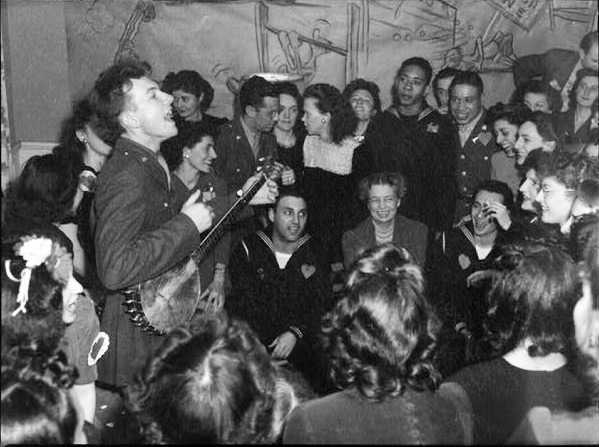
Our second birthday celebrant is Pete Seeger, an entertainer who has been described as the most successful communist in the United States. I'll let readers discover the politics for themselves and focus instead on Seeger as singer and songwriter. 

File:PeteSeeger2.jpg
Entertaining at labor canteen opening, Washington, DC, February 1944

Seeger was born in 1919 into a musical family, took up the family's leftist politics, and made a name for himself as a "protest singer" in the 1940s. In 1950, he was a member of the folk group, The Weavers, and in the bow wave of a folk music revival in the U.S. It was short-lived, however, as the group was blacklisted in 1953 for suspected political reasons. A decade later Seeger found himself at the forefront of the 1960's folk revival embedded in antiwar activities and the Youth Revolution.  He continued singing and pursuing his social, political, and environmental activism around the world almost to the day he died at 94 in 2014. For more information and a host of links, here is his Wikipedia entry.

For a taste of Pete Seeger the performer, here he is singing lead and playing his banjo on the first recording (1949) of If I Had A Hammer, co-written with Lee Hays, also with The Weavers:


Although this video highlights Seeger, it does not do justice to the beautiful harmony The Weavers produced. Readers may want to explore the Internet for more of their recordings. Their 1981 reunion concert at Carnegie Hall is a particularly moving statement on the American music experience.


Sources

Photos and Illustrations:
commons.wikimedia.org/wiki/File:Bing_Crosby_1930s.jpg
loc.gov/pictures/resource/fsa.8d41983/

Thursday, May 1, 2025

May Day 2025: On The Coming Of Summer


To be fair we could be talking about workers of the world, the joys of collectivist thought, and even the "fruits" of Communism on this day. I would rather speak of a more ancient and far happier theme, the arrival of the season of warmth and growth.


May 1, 2023, in Glastonbury, United Kingdom


The Gaelic festival day, Beltane ("be-EL-ten-a" in Irish, "BEL-tayn" in English)) occurs on May 1 and is a cross-quarter day marking the beginning of summer in their ancient calendar. It is one of two "turning" days of the year and exactly six months apart from the other, Samhain (saa-wn), marking the beginning of the dead season of winter. In the United Kingdom and other places with Gaelic heritage Beltane celebrations began last night with the lighting of bonfires, dancing and feasting long into the night.


The fun continues with the welcoming of the sun, the selection of the May Queen or earth goddess representing fertility, and the May King or Green Man - the latter first appeared in the 12th century -  representing vegetation and growth. The partying includes a Maypole dance - once an ancient fertility rite - and the decoration of houses, farms, and livestock; and more feasting.


Here in the United States there isn't much associated with the day unless there's an opportunity to sell something under the May Day Sale label. Even schools show little interest in May Day but it was a day-long festival at my elementary school in the 1950's. Actually the day was a big event for the whole community. It was so important that I recall the teachers having us outside days in advance to practice the May Pole dance until the lattice pattern on the pole was perfect. I wonder how enthusiastic they would have been had they known we were practicing a fertility rite. Aside from a few New Agers all religious associations with the activities have been left to an ancient past. These days it's simply good fun. Or at least a happy memory.


Maypole Dance, Bascom Hill, Wisconsin, May 1, around 1917


May you have a most festive celebration of the arrival of a time of warmth and new life


Sources

Photos and Illustrations:
Photograph: University of Wisconsin Digital Collections

ShareThis