Tuesday, July 29, 2025

A Giant Leap In Epic High Fantasy


For fantasy fiction fans this day in 1954 has great significance. It is the day that J.R.R. Tolkien's The Fellowship of the Ring first appeared on store shelves in the United Kingdom. The book was the first of three volumes in the high fantasy novel we know today as The Lord of the Rings. A used copy of that first edition with its original dust jacket would fetch an owner at least $6500. An autographed copy would easily be in six figures as Tolkien was a bit of an introvert and disliked autographing his books. I doubt that sum would matter much to true fans. To them the words within are priceless.


Who was the man behind this beloved three volume narrative we know as The Lord of the Rings? The 1968 BBC video below contains some footage of an interview and explores Tolkien's real and imaginary worlds. The audio is not the best so viewers may want to use earbuds or headphones.


Below is a probing, fast-paced, and well-known Tolkien interview from BBC Radio in 1964. It was first broadcast in 1971. All of Tolkien's brilliance and eccentricity is on full display in this wide-ranging look at one of the most beloved writers of the last century. 


It would take a generation after his death (1973) before a cinematic version of his great work would, perhaps could, appear. The Lord of the Rings film series produced between 2001 and 2003 not only created a new generation of readers but also energized existing Tolkien fans to reexamine his work. All of this new energy and imagination has had a significant effect on the world of fiction and fiction writing. Tolkien's creative genius and the publication of Fellowship of the Ring - and The Hobbit - started the surge. We can't say with precision where that surge takes us but we can be certain that Tolkien's legacy will be enjoyed and expanded long into the years ahead.


Sources

Photo:
tolkienlibrary.com

Text:
wikipedia.com, J.R.R.Tolkien
tolkienestate.com
"Why Did Tolkien Write The Lord of the Rings," Michael Martinez, middle-earth.xenite.org

Sunday, July 27, 2025

A Time When Dogs Seek Shade


Orion the Hunter


Back in the '70's and '80's I had the good fortune to live on the beach of a small barrier island at the mouth of the Savannah River. My house was a raised Caribbean-style cottage built in the 1920s. The porch overlooking the Atlantic faced southeast and was ideal for capturing the summer trade winds. At this time of year when I looked toward the horizon I saw a beautiful event unfold many times in the hour before dawn. Those hours and the imaginary music of the spheres evoke memories so vivid they seem to have occurred only yesterday.


First, Bellatrix, a blue giant star rose out of the Atlantic haze to be followed soon by the red giant, Betelgeuse. Soon the blue giants, Mintaka, and Rigel followed. At this point viewers saw a signature belt of three stars and a faint sword. Experienced sky watchers knew that Orion the Hunter was ascending. In minutes the belt stars pointed to shimmering Sirius, a binary star also known as the Dog Star. It was by far the brightest star in the sky but soon it and all the others would dissolve in the blinding light and heat of another summer sunrise.


Sirius the Dog Star


In the Nile and other valleys of the ancient Middle East, all eyes turned to the summer dawn anticipating the appearance of Orion and Sirius. They signaled the coming of the floods, of water for life and eventually for civilization. To the ancient Greeks the rising of these stars with the sun signaled the peak of summer heat when even dogs chose not to leave shade. 
They came to call this time of year hemerai kynades, a phrase that translates directly to "dog days." We have come a long way in time since scribes first recorded Sirius rising from the damp mud along the banks of the Nile. But we still experience the Hunter and the Dog, now both lost in daylight, one awaiting his turn to rule the autumn sky, the other to remind us that his days, the sultry dog days, are still with us.


While some people dread them I look forward to the coming of the "dog days." The heat makes me thrive and my arthritis becomes a memory. Atlanta's climate data tells us that on average the warmest days of 2023 will be behind us in a few weeks. The sun is already casting ever longer shadows as it arcs lower across the southern sky. Leaves hang limp on trees catching more and more of that light giving the woods a golden hue even at midday. The aging summer has also brought this year's acorn crop closer to maturity. I can tell because the squirrel community in our woods is starting to work overtime on an early and ripening harvest.

Calm days and high temperatures also lead to popcorn thundershowers that meander across the region waiting to die out as fast as they arise. So far they've brought powerful lightning, the positive strikes that start fires, several inches of rainfall, high winds, and pea sized hail. With that said it's time to envision sitting comfortably on the screened porch where a big ceiling fan quietly generates a steady breeze and your sweating sweet iced tea feels good even to the touch. The forest surrounding me is a still landscape interrupted by an occasional bird or squirrel. If you stay there long you witness the yellowing light of day giving way to the twilights, the lightning bugs, the cicadas, then the katydids and a chorus of north Georgia tree frogs.

I love all of those twilight sounds but I love the katydids most. They remind me of long summer vacations and drifting to sleep in my bed next to a cottage window that opened wide to both their chatter and a comforting breeze moving down the West Virginia mountainsides of my childhood. It was there I first developed a passion for forests, for flowing water, for a clear sky I felt I could almost touch. Over sixty year later that passion leads me to waken before the sun to witness a pattern of stars rise out of an unseen ocean and bring me summer. Bring it on!


Saturday, July 26, 2025

Jean Shepherd: The Man Behind Ralphie And His Unforgettable Christmas


Mention "Ralphie" and "Red Ryder BB gun" in the same breath and I'd say most people could make an immediate connection with the film, A Christmas Story. On the other hand, most people probably know very little about the remarkable personality behind that story. His name is Jean Shepherd.


He was born on July 26, 1921, on Chicago's south side and raised in nearby Hammond, Indiana. After serving in World War II, Shepherd began a career in broadcasting that expanded into writing, film, and live performance. He was heard on late night radio for over twenty years - all unscripted - on New York's WOR where he entertained listeners with his humorous stories, interviews, and practical jokes. Shepherd hosted a television show for WOR as well, but he is best remembered in video narrating a number of productions based on his stories of growing up in the Midwest. Many of the scripts were so popular they later appeared in print. Here is the storyteller at his best on his traditional Christmas Eve broadcast on WOR in 1974. A Christmas Story would emerge from these broadcasts in 1983.


Psychology tells us that humorists often do not have the happiest of life stories. Shepherd was no exception. Although he surely had the talent to become a well-known national treasure, radio did not provide him coast-to-coast exposure available with the new medium of television. He was fiercely independent, a maverick, and one not to take life too seriously. I can imagine he was a threat to the ego of more than one radio executive. Furthermore, he was a "night owl" on radio, broadcasting to a dedicated but smaller audience, and in direct competition with televised local news and the likes of Johnny Carson and The Tonight Show. In fact this warm story by a fan notes that Shepherd likely was in line to take over The Tonight Show with Steve Allen's departure in 1957 but Jack Paar had the right of first refusal with the NBC network. Paar unexpectedly accepted thus denying Shepherd his big break on one of television's most popular shows. Finally, from my research, it seems Shepherd maligned his radio work when he moved into writing film for television in the '70s. Indeed, it apparently was a clean break - maybe the execs were happier without him - and he did go on to success with films, including The Phantom of the Open HearthThe Great American Fourth of July and Other Disasters, and Ollie Hopnoodle's Haven of Bliss. Still, I think the fates denied him the opportunity to become a big television star in the 1950's and much better well-known in his lifetime.


Without question, his best known contribution to American humor is A Christmas Story, a compilation of stories and characters drawn from his earlier work. It was originally produced as a feature film in 1983 and made the transition into a television classic thanks to the persistence of Ted Turner. Almost any man born before 1950 has lived some or all of Ralphie's/Shep's childhood. Each man's path to adulthood is his own, but the markers are identical. Jean Shepherd was a genius at capturing them. And his skills as a narrator made him a natural at weaving life's common threads into humorous and entertaining listening.


". . . the soft glow of electric sex gleaming in the window."

Shepherd died 26 years ago on Sanibel Island, Florida, remembered for one film produced in 1983 when he was 62. There's much more to him than that and I hope more people come to enjoy his work. The settings now and in the future will be different but the collected experiences from childhood and adolescence remain similar and often age into fine wine. Thanks to Shepherd we can laugh at past times and enjoy the harvest.

If you want to explore more of Shepherd's work, the made-for-television film, The Phantom of the Open Hearth, is the place to start. It premiered at Christmas 1976 on public television as a humorous glimpse of Ralphie's teen angst during his high school years in the Midwest. You'll see many of the characters and storylines - yes, the leg lamp is there - that appear in A Christmas Story. These days Phantom is a cult classic among Shepherd fans. If you want to join the cult you can watch the film for free on You Tube.


Tuesday, July 22, 2025

It's "Wheels Up" At AirVenture Oshkosh 2025


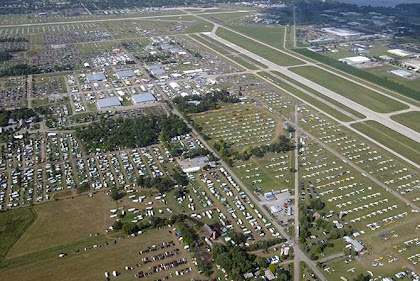
The Experimental Aircraft Association's (EAA) annual week-long AirVenture gathering in Oshkosh, Wisconsin, is underway. It's better known as "Oshkosh" to aviation enthusiasts and you can be assured that every one of them has the event on their bucket list. There's good reason. Imagine a fly-in attracting around 7500 airplanes. Imagine 2500 aircraft exhibits, 800 commercial exhibitors, daily world-class airshows, and a total of around 700,000 guests.


AirVenture at Oshkosh is far from your average fly-in


Organizers call the event "the world's greatest aviation celebration" and this year marks its seventy-second edition. The map below gives readers an idea of the scope and scale of Oshkosh and indicates why the event turns a rather sleepy Wittman Regional Airport into the busiest airport in the world for one week each year.


AirVenture grounds - for scale, that's an 8000 foot runway at the top 

AirVenture grounds looking east to Lake Winnebago


I had the privilege of attending the event several times in the last decade of my career. Energizing, informative, and significant, the show was a great vehicle for delivering an organizational message to a large, captured, and enthusiastic audience. You may ask why the National Park Service (NPS) would send a dozen or so employees and volunteers to work an air show. First, the agency has almost fifty out of its more than 400 units with a significant link to an aviation theme. In addition, the Service maintains a fleet of fixed and rotary wing aircraft contributing over 20,000 hours of flight time annually in support of park operations, maintenance, and resource and fire management. Add to that interagency cooperation across departments as well as airspace regulation over the parks and the justification become clearer. In recent years the NPS's presence at the event has been reduced significantly and folded into a more cooperative effort with other federal agencies. In summation, it's a grand and demanding opportunity to reach out face-to- face with thousands of guests who enjoy and impact resources and services in and ver the parks.


Nothing like fly-in camping with thousands of your best - in this case closest - friends


If you can't attend AirVenture, the EAA maintains a comprehensive up-to-the-second website where you can spend hours reading, watching and listening to events. I've been looking up at the sound of an aircraft engine ever since I could lift my head. If you are blessed with the same response make your plans to attend an Experimental Aircraft Association AirVenture. You will not be disappointed. Until then "wheels up" every chance you get!


Sunday, July 20, 2025

Footsteps On The Moon


Lunar Module Eagle in landing configuration, July 20, 1969


July 20, 1969, fifty-six years ago today, the Apollo Lunar Module Eagle landed on the moon. Millions watched at 10:56 PM, EDT, as Neil Armstrong, the commander of the Apollo 11 mission, descended the Eagle's ladder and made what he called a "giant leap for mankind" with his final step onto the powdery lunar surface. Learn more about the Apollo 11 mission here on Wikipedia where you can find scores of links to more National Aeronautics and Space Administration (NASA) reports and multimedia.


Armstrong and Buzz Aldrin, the lunar module pilot, spent almost 22 hours on the moon including their 150 minute walk where they erected an American flag, collected soil and rock samples, and deployed experiments. On their return to Earth much of the material they collected was eventually archived and displayed at the Smithsonian Institution. Some rocks entered our culture in some fascinating ways, including this one at the Washington National Cathedral, where one was embedded at the center of a red planet in what has become known as the Space Window.


Time is catching up with those first attempts at exploring our nearest celestial neighbor. Neil Armstrong passed away in 2012 at the age of 82. Buzz Aldrin turned 94 earlier this year. Michael Collins, the command module pilot, passed away in 2021 at the ago of 90. With the creation of the Artemis program in 2017, the US and its partners hope to return to the lunar surface with a crewed polar landing scheduled for 2025. That's an ambitious target date , but no more so than the private sector timetable for similar missions to Mars. Regardless of what the future holds, those early years including the mission we commemorate today were an exciting and almost magical time for science, exploration, and discovery of the frontier "out there."


Sources

Photos and Illustrations:
atlasobscura.com, Space Window detail
nasa.gov, Space Window, full photo

Text:
Wikipedia.com

Sunday, July 13, 2025

Andrew Wyeth: Master Of Fine Illustration


My career often involved planning and producing a broad variety of visual media including publications, audiovisuals, and museum exhibits. The work made me aware of any number of artists, illustrators and styles both historic and contemporary. It's led me to appreciate the work of two artists in particular. One is Walter Inglis Anderson. There'll be a post about him in September. On this day we note the birth of another favorite, Andrew Wyeth. He was born in Chadds Ford, Pennsylvania, in 1917 and died there in 2009 after a lifetime of painting individuals and landscapes near his home and at his summer residence in Maine. He represented the second of three generations of famous painters in the Wyeth family. His father, N. C. Wyeth, was a renowned illustrator and painter. His son, Jamie, who turned 75 last week, continues painting in his father's footsteps in Pennsylvania and Maine.


I can best characterize his work as compelling, thought-provoking dreamscapes on canvas, not quite real, not quite abstract. Here are three painting by Wyeth offering a comfortable contrast to the season of his birth. Readers can see the full range of his subjects at his authorized website.


Ice Pond 1969

My aim is to escape from the medium with which I work; to leave no residue of technical mannerisms to stand between my expression and the observer. To seek freedom through significant form and design rather than through the diversion of so-called free and accidental brush handling.

Branch in the Snow 1980

My aim is not to exhibit craft, but rather to submerge it, and make it rightfully the handmaiden of beauty, power and emotional content.

Shredded Wheat 1982

What you have to do is break all the rules.


Thanks to the BBC and Michael Palin we have a fine documentary of Andrew Wyeth, his craft and emotion, and especially his sense of place. Hope you take the time to enjoy it.


Sources

Text:
quotations, art-quotes.com

Wednesday, July 9, 2025

He Penned A Masterpiece At 21


Bob Dylan turned 84 earlier this year. That means he's been writing songs for over 60 years. He was only 21 on July 9, 1962 when he walked into the Columbia Recording Studios in New York to record a song to be included on his second album. The song, Blowin' in the Wind, brought him fame and recognition as one of the nation's leading folk poets of the twentieth century. The lyrics and Dylan's comments on the song were published in June 1962 in the folk journal, Sing Out. He said this:


Too many of these hip people are telling me where the answer is but oh I won’t believe that. I still say it’s in the wind and just like a restless piece of paper it’s got to come down some . . . But the only trouble is that no one picks up the answer when it comes down so not too many people get to see and know . . . and then it flies away.


Dylan and Joan Baez, March on Washington, August 8. 1963


The music critic, Andy Gill, said this about the song in his book, Classic Bob Dylan, 1962-1969: My Back Pages:

Blowin' in the Wind marked a huge jump in Dylan's songwriting. Prior to this, efforts like The Ballad of Donald White and The Death of Emmett Till had been fairly simplistic bouts of reportage songwriting. Blowin' in the Wind was different: for the first time, Dylan discovered the effectiveness of moving from the particular to the general. Whereas The Ballad of Donald White would become completely redundant as soon as the eponymous criminal was executed, a song as vague as Blowin' in the Wind could be applied to just about any freedom issue. It remains the song with which Dylan's name is most inextricably linked, and safeguarded his reputation as a civil libertarian through any number of changes in style and attitude.


Blowin' In the Wind is a poem for our time, perhaps all time.


Sources

Photos and Illustrations:
U.S. Archives and Records Service, Rowland Scherman Collection

Text:
wikipedia.com, Bob Dylan entry
history.com

Thursday, July 3, 2025

The Battle Of Gettysburg, July 1-3, 1863: Of Endings and Beginnings


Today marks the conclusion of the Battle of Gettysburg, fought July 1-3, 1863, and the beginning of the end for the Confederate States of America. A year later, in August 1864, the Union unconditionally controlled the Mississippi River and relentlessly pressed Confederate forces in Virginia. In the Deep South, General Sherman's army devastated Atlanta. Six months later, he would be in Savannah and poised to destroy the remains of the Confederacy as he moved north through the Carolinas.


The American Civil War is a perennial topic in our history. Indeed, it did preserve the Union as President Abraham Lincoln intended and left us with any number of consequences in our national experience, both good and bad. Regarding those consequences, we should not expect otherwise as that is the way events unfold in the great wheel of history. And so it is with our great wheels of personal experience. Now in  my seventh decade immersed in all of this I'm a bit surprised and certainly privileged to experience Gettysburg at 100 and 150 years after the pivotal battle. The place is a personal holy ground because three people cared.

The Old Ranger and his dad at Gettysburg in 1954

First of all. my parents always loved being in nature and its historical overlay. Living in the Potomac River watershed afforded our family many opportunities to enjoy any number of places of national significance. As is often the case, first impressions become lasting ones. I was seven years old when we spent a long weekend exploring almost every foot of Gettysburg National Military Park. It was a fascinating experience and I still have the souvenirs to prove it. About six years later I met George Landis, the third person in this story. Landis taught middle school history and social studies on the eve of the Civil War Centennial. A Pennsylvanian with a love of history and basketball, he devoted an entire school year to the study of the Civil War. He was a superb teacher, highly animated and far ahead of his time. He focused on learning that took his students beyond lectures into the world of role-playing, performance, critical thinking and more. I recall fondly seeing every chalkboard in his classroom filled with detailed maps of battles, each carefully drawn and labelled with colored chalk. A little more than a decade after my year with Landis, I began a long and rewarding career immersed in experiential learning in the sacred places and histories in our national parks.

The Old Ranger and his mom at Gettysburg in 1954

There will be tens of thousands of people visiting Gettysburg this holiday week as well as many thousands of volunteers recreating and commemorating the events that took place there. Lasting impressions will be made this week about the sacrifice, the consequences, and the wheels of history both national and personal. And somewhere in that crowd will be a seven year-old with a new enthusiasm for a defining moment in our national experience. The commemorative landscape at Gettysburg will wait with pride and serenity like an old veteran to welcome him on his return visit in 2063.

ShareThis